Botany and Morphology of Hazel (Corylus avellana)
Content generated by artificial intelligence — verify before application
This article was automatically compiled from a collection of hazelnut literature using artificial intelligence and may contain errors or outdated data. It serves as a starting point for further research, not as professional advice. Dosages, products, and timing are informative and depend on the cultivar, location, and applicable regulations — always consult with an advisory service and official sources before application.
Understanding the botanical structure of hazelnut (Corylus avellana L.) is the foundation of successful hazelnut production. The way the plant develops its roots, shoots, leaves, buds, and male and female inflorescences directly influences decisions in the orchard — from selecting planting distances and training systems (bush or tree), through pruning and fertilization, to choosing pollinizers and interpreting phenological phases. This article systematically presents the systematics of the genus Corylus, the morphology of vegetative organs (roots, shoots, leaves, buds) and generative organs (catkins and female flowers), and links this structure to practical implications for cultivation.
Systematics of the Genus Corylus
Hazel belongs to the family Betulaceae within the order Fagales. The genus Corylus was once distinguished as a separate family, Corylaceae, but based on genetic and molecular data, it is now treated as part of the Betulaceae family, along with the genera Betula (birches), Alnus (alders), Carpinus (hornbeams), and Ostrya (hop-hornbeams).
The most important botanical and taxonomic descriptors of the species:
| Level | Name |
|---|---|
| Order | Fagales |
| Family | Betulaceae (birch family) |
| Genus | Corylus L. |
| Species | Corylus avellana L. (common hazel) |
| Croatian names | lijeska, ljeska; fruit: lješnjak |
| English names | common hazel, European hazel, cobnut, filbert |
The genus Corylus encompasses several hazel species distributed in the temperate zones of Europe, Asia, and North America. For cultivation and selection in our conditions, the most important are:
- Common hazel (C. avellana) — the most significant species for hazelnut production; typically shrubby habit; the mother of most cultivated cultivars.
- Lombardy / large-fruited hazel (C. maxima) — a large-fruited species whose genes have entered many noble cultivars; the nut is deeply embedded in a long husk.
- Asiatic hazel / Turkey oak hazel (C. colurna) — grows as a true, single-trunk tree, does not produce suckers from the root collar, and is used as a rootstock for tree-form hazelnut cultivation.
- Pontic hazel (C. pontica) and other Euro-Asian species — significant in breeding.
A large part of today's cultivar assortment resulted from crossing and selection within and between these species, which is why morphological characteristics (leaf size, internode length, nut shape, flowering time) vary significantly among cultivars. The genetic basis (cultivar) decisively affects phenology and structure, which is important to keep in mind when generalizing in the following text.
Practical consequence of systematics
The difference between the shrubby C. avellana and the single-trunk C. colurna is not just botanical: when hazel is grafted onto Asiatic hazel, a tree form is obtained that does not produce suckers from the stump, eliminating the most labor-intensive task in the orchard — constant removal of shoots (suckers). This is a pure consequence of the root collar morphology.
Habit: Bush or Tree
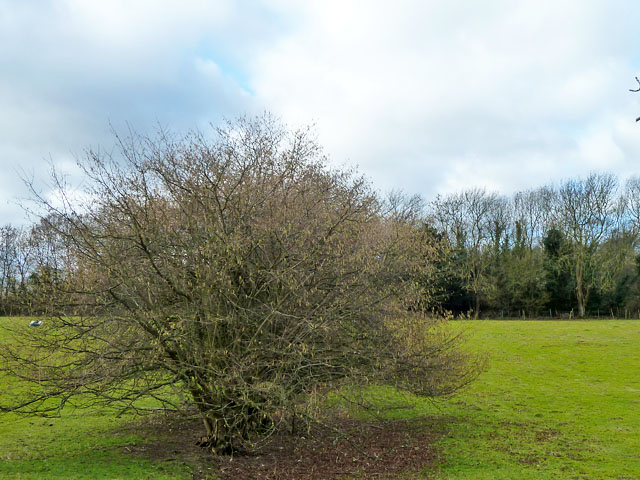
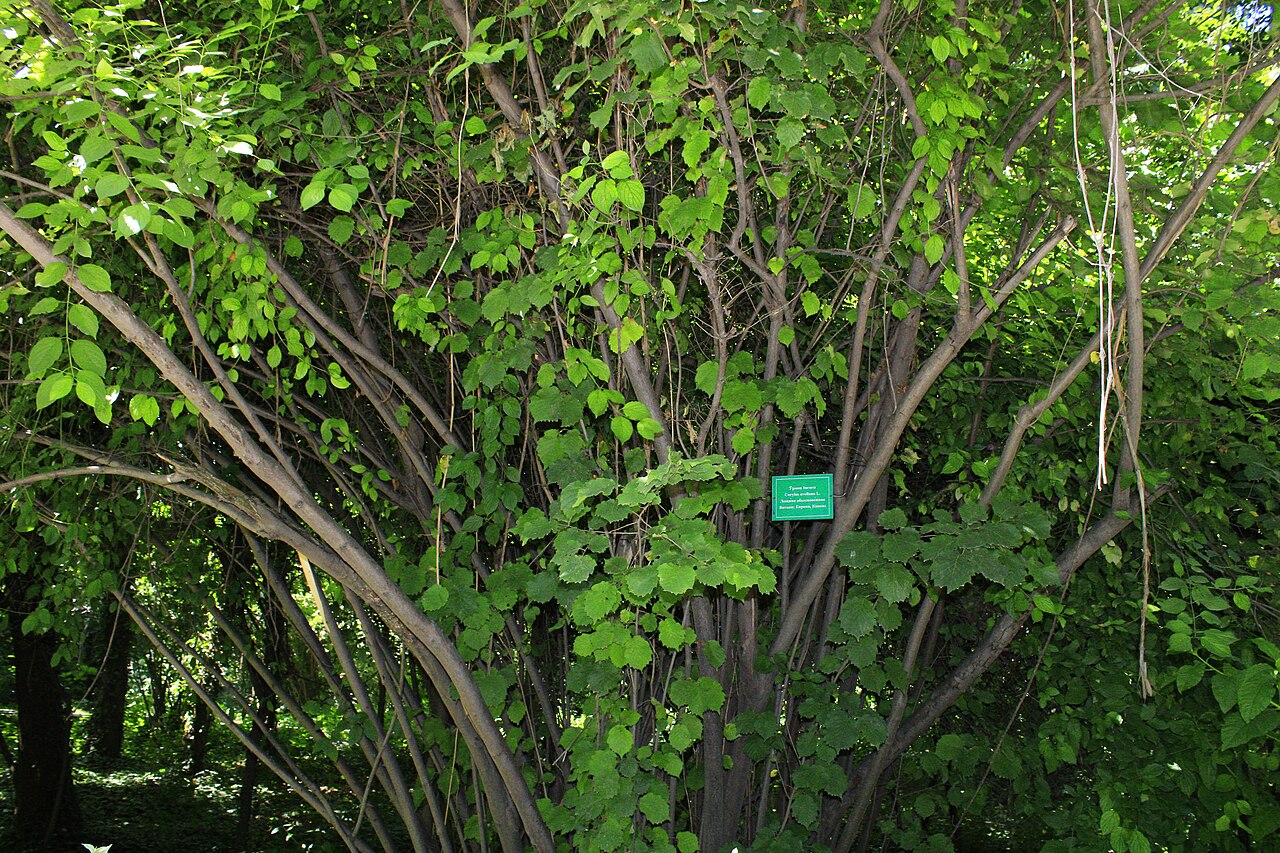
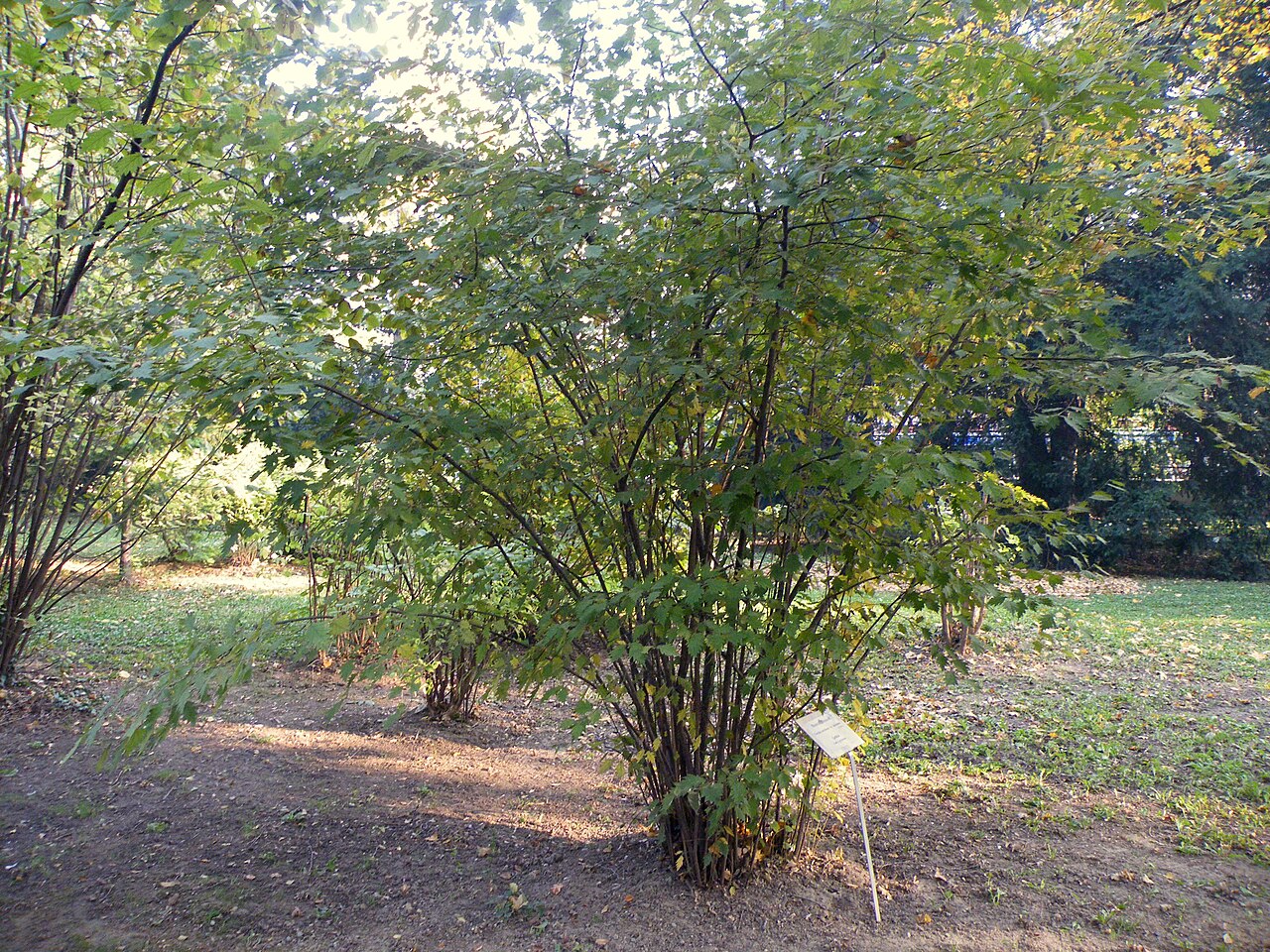
Common hazel is naturally a deciduous, multi-stemmed shrub that typically grows 3–4 (up to 6) m in height, and as a low tree in favorable conditions up to 10–15 m. The trunk (in tree training) reaches a diameter of up to ~20 cm. A characteristic of the species is the ability to abundantly produce suckers from the root collar, with which the plant naturally forms a dense clump (thicket).
In production, two basic training systems are applied, which directly arise from this habit:
| Training System | Description | Main Consequence |
|---|---|---|
| Bush (clump) | 3–6 bearing shoots from the root collar | Faster entry into bearing, easier renewal of old shoots, but permanent removal of suckers |
| Tree (training form with trunk) | One trunk with a canopy; often on C. colurna rootstock | Better aeration and mechanization, no suckers, slower entry into bearing |
The choice of system determines planting distance, pruning method, and the possibility of mechanized harvest, so understanding the habit is the starting point for orchard design.
Root Morphology
The hazelnut root system is shallow, widely and densely branched, without a prominent central (tap) root. The majority of the root mass is located superficially:
- About 75% of the root mass develops in the layer up to ~40 cm deep.
- The roots usually spread wider than the canopy projection, allowing the plant to efficiently utilize surface moisture and nutrients.
This root structure has several practical consequences:
- Sensitivity to compaction and waterlogging (anaerobic conditions). Shallow roots do not tolerate heavy, compacted, and poorly drained soils well; the root needs an aerated and well-drained profile. Therefore, soil preparation and drainage before planting are crucial.
- Shallow cultivation. Deep soil tillage or aggressive harrowing in the row damages the surface roots; shallow, careful cultivation or grassing of the inter-row space is recommended.
- Sensitivity to drought in the surface layer. Since the root utilizes the shallow layer, hazelnut reacts to the drying of upper horizons, so mulching and irrigation help maintain moisture in the root zone.
- Root collar and suckers. From the root collar and underground parts, hazelnut produces numerous suckers (shoots), which is the morphological basis for bush training, but also a constant work task (removal of suckers) in tree training.
The root, besides anchoring and absorbing water and nutrients, is a site of intensive metabolic activity and synthesis of substances important for the growth of the above-ground part; the structure and anatomical structure of the root, absorption and transport of water and nutrients are detailed in professional literature (e.g., Miljković, Lijeska).
Shoots, Branches, and Bark
The above-ground woody structure consists of perennial branches, one-year-old shoots (young shoots), and the current year's summer growth. Characteristics:
- Young shoots are knee-bent in a zigzag line, yellowish-brown to grayish-brown in color, initially covered with hairs, with characteristic light spots — lenticels (gas exchange openings) — which later become bare.
- Bark is smooth and thin in youth, reddish-gray to brown, and ages by shallow cracking in plates.
- Nodes and internodes. The young shoot is composed of nodes (knees), places where leaves and buds are attached, and internodes between them. Internode length varies among cultivars and affects the compactness of growth and bud density on the shoot.
A very important production fact: the nut is formed on one-year-old shoots, meaning floral and mixed buds as well as male catkins are arranged precisely on shoots from the previous vegetation. Therefore, the goal of pruning is to constantly promote healthy, moderate growth of new shoots that will bear fruit the following year — without sufficient new growth, fruiting is absent.
Leaf
The leaf is the main vegetative and physiological organ of the plant. It plays an essential role in photosynthesis, transpiration, respiration, hormone synthesis, and occasional accumulation of nutrients.
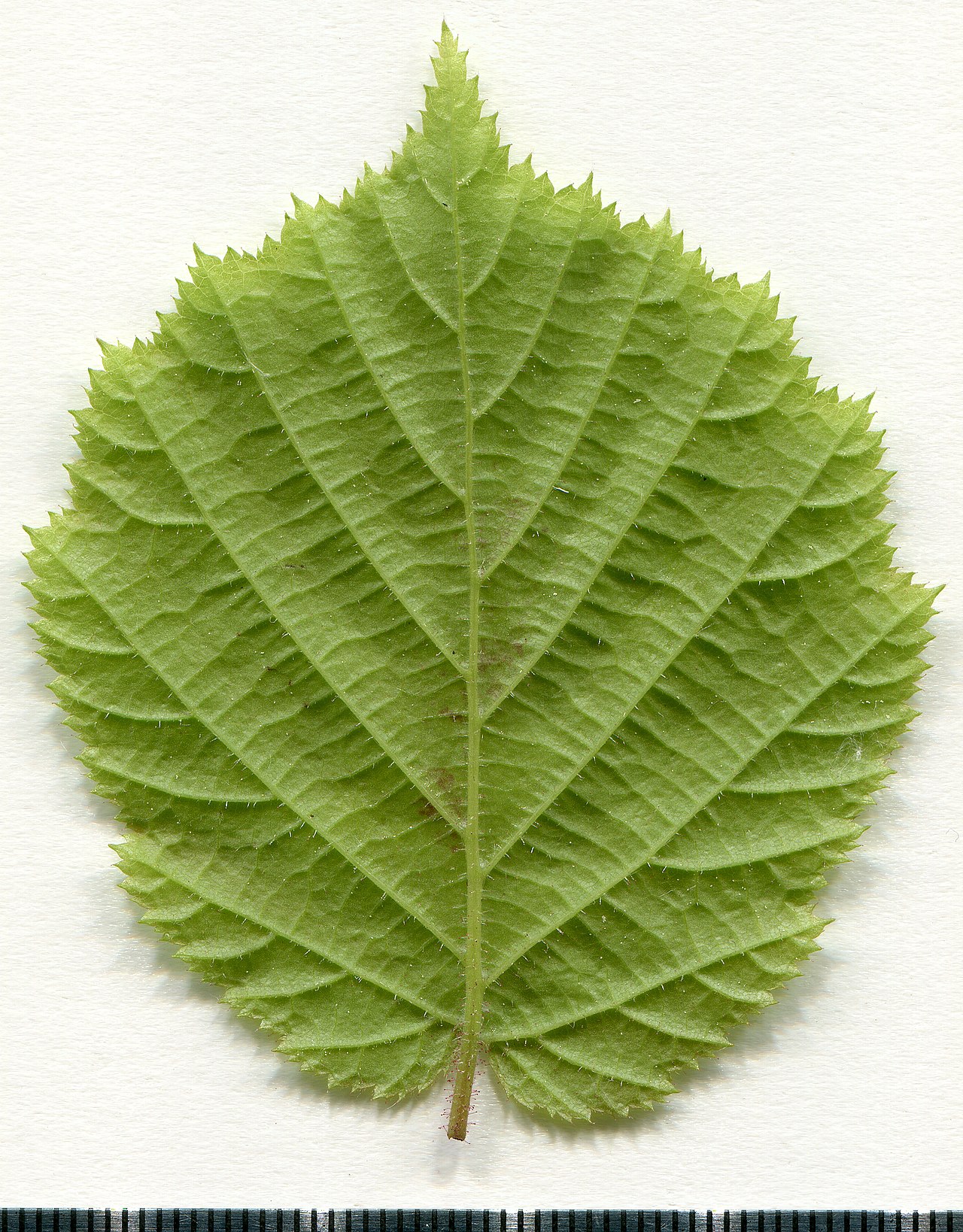
Leaf structure consists of three parts:
| Leaf Part | Latin Name | Note |
|---|---|---|
| Stipule (with stipules) | stipula | Usually weakly developed; holds the leaf on the node (knee) of the young shoot |
| Petiole | petiolus | Connects the stipule and blade; length varies by cultivar |
| Blade | lamina | Assimilatory surface of the leaf |
Blade morphology:
- Leaves are alternate, obovate to almost round, cordate at the base, pointed at the tip.
- Dimensions: length approximately 5–13 cm, width 5–9 cm (in literature also 6–12 cm).
- The margin is doubly (irregularly) serrated.
- Both sides of the blade are softly hairy; the upper side is darker green, the lower side lighter green.
Petiole length and spacing between nodes (internodes) vary among cultivars, which are also auxiliary characteristics for pomological (cultivar) differentiation. The anatomical structure of the leaf — blade thickness, number and size of stomata in the epidermis, hairs — also varies among cultivars and is linked to resistance to some pests (e.g., aphids) and physiological properties such as transpiration intensity.
Buds
A bud is a young, undeveloped shoot tip from which a specific organ develops. Buds are alternate, green to grayish, large and blunt (up to ~3 mm), with ciliate (fringed) margins on the scales; on the sun-exposed side often reddish-brown, on the shaded side green. They consist of a bud scale and scales; if the bud scale fails, its role can be taken over by the scale.
According to function, buds are divided into vegetative and generative (reproductive):
| Group | Bud Type | Develops into |
|---|---|---|
| Vegetative | woody bud | new vegetative shoot (young shoot) |
| Vegetative | leaf (transitional) bud | leaf / vegetative growth |
| Vegetative | dormant (adventitious) bud | reserve shoot after injury/pruning |
| Generative | floral (female) bud | female inflorescence, and after fertilization, the nut |
In addition to these buds, male inflorescences (catkins) differentiate on the shoot, which enter fully formed in winter. Dormant (adventitious) buds have great practical value: they are the reserve from which the plant renews its canopy after severe pruning, frost damage, or mechanical injury.
Catkins (male flowers) and female flowers
Hazelnut is a monoecious plant — male and female flowers are found on the same plant, even on the same branch — but the flowers are unisexual and spatially separated. It is an anemophilous (wind-pollinated) plant and predominantly cross-pollinating due to the temporal separation of male and female flowering phases (dichogamy/protandry or protogyny) and the pollen incompatibility system (SS-alleles). Therefore, pollinizers — compatible cultivars with synchronized phenology — must be planted in the orchard.
Male flowers — catkins
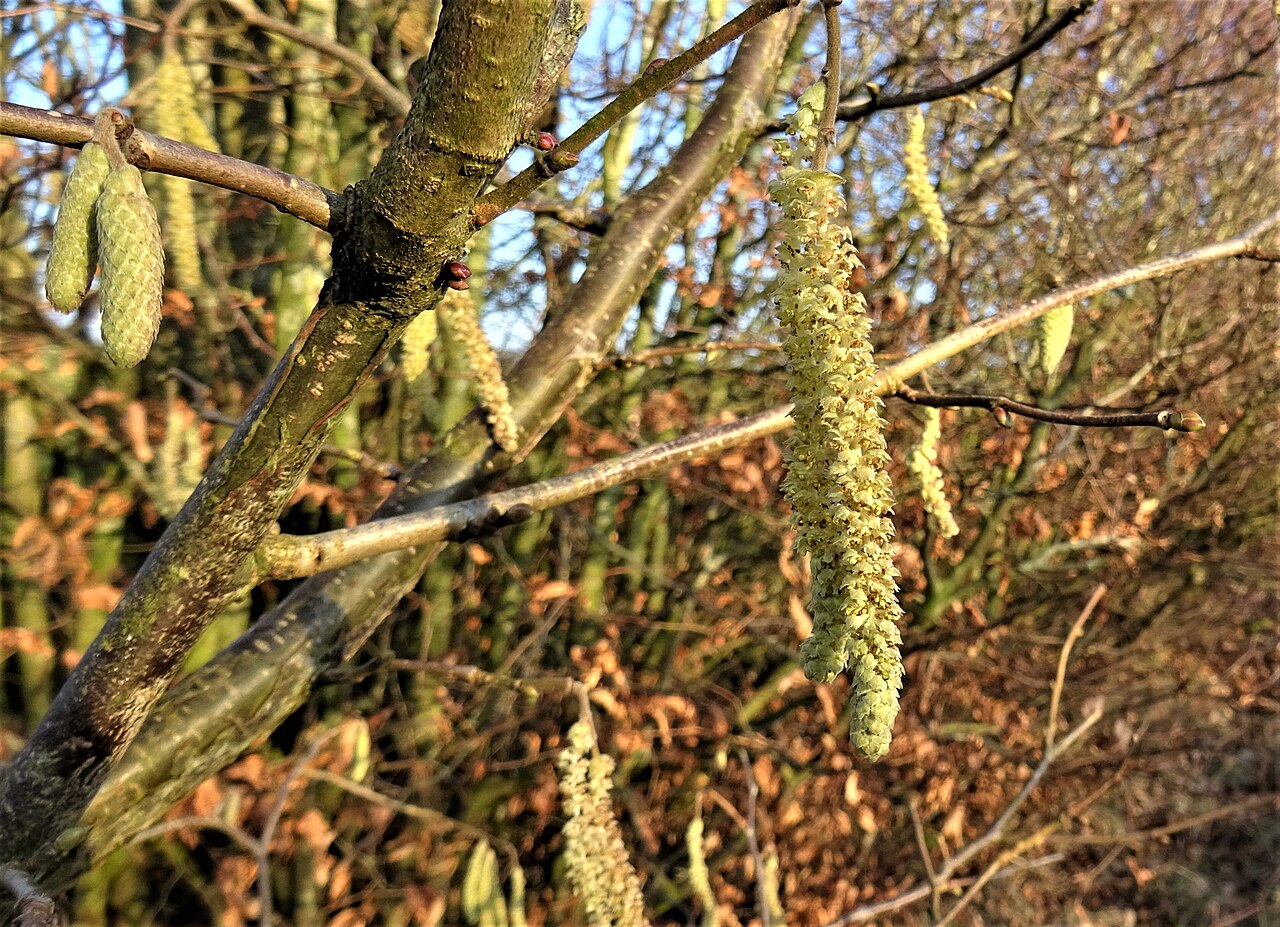
- Male flowers are grouped into catkins, which are hanging inflorescences arranged on a rachis, located on branches from the previous vegetation cycle.
- Catkins are arranged in clusters of 2–3 (in some species 8–10) units.
- Catkin formation begins in late June and early July; they enter winter fully formed.
- During full bloom, catkins elongate — from the usual ~5–7 cm to up to ~20 cm in length.
- Each male flower contains several stamens (approximately 4–8).
Key figures (from corpus, for informational purposes):
| Indicator | Value | Range / Note |
|---|---|---|
| Number of flowers per catkin | 130–260 | depends on catkin length |
| Catkin production per mature tree | ~1 kg | per tree |
| Catkin clusters | 2–3 (up to 8–10) | depends on species |
| Daily catkin growth during bloom | ~30 mm/day | faster in dry air |
| Pollen shedding duration | 4–12 days | depends on weather |
Female flowers
- Female flowers are located in buds that resemble vegetative buds, in the lower parts of branches or in the upper two-thirds of the branch.
- They are grouped into a short spike-like inflorescence (approximately 5–6 bracts), and only the red stigmas (pistils) are visible externally — wart-like, sticky outgrowths adapted for catching pollen, only ~1–3 mm long. The female inflorescence is distinguished from other buds by these red filaments.
- Female flowers remain open (receptive) for approximately 14 days.
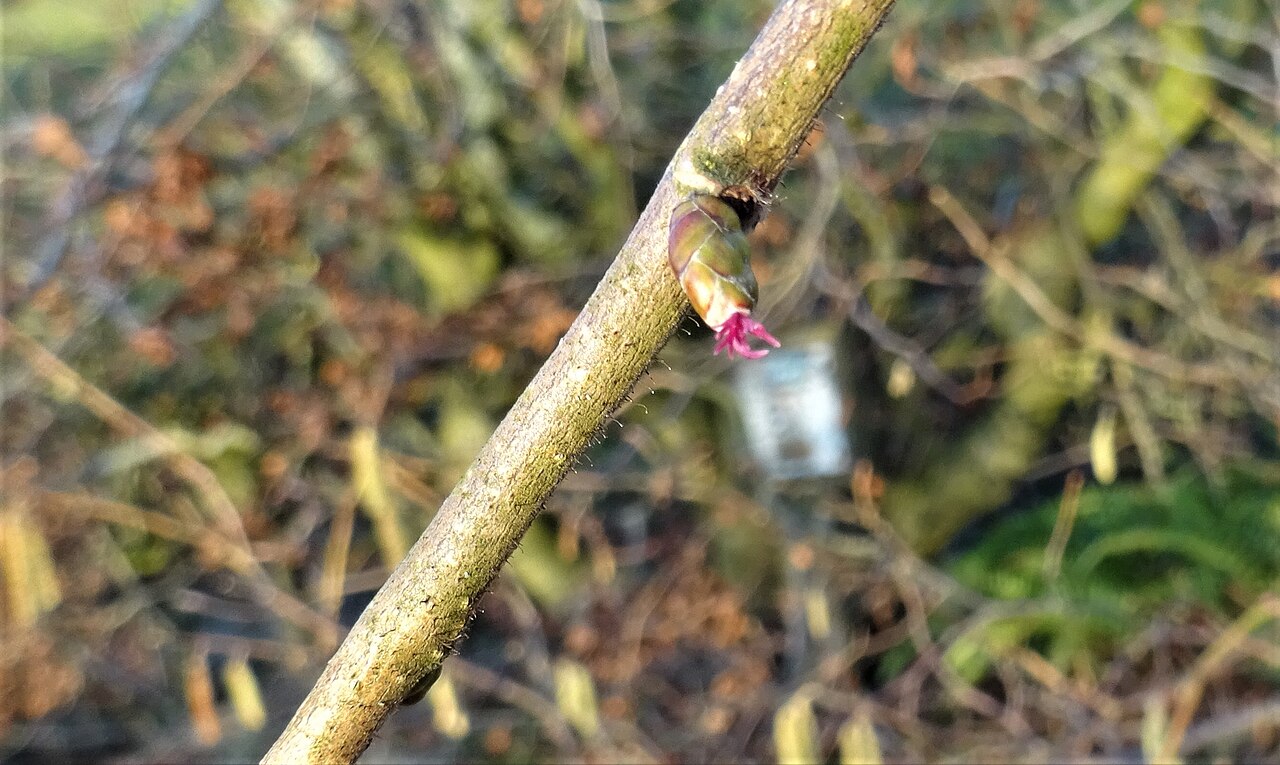
- The female inflorescence consists of several individual flowers; the ovary differentiates only during flowering, and fertilization (fusion of the egg cell and pollen) occurs a month or more after pollination — this is known as delayed fertilization, characteristic of hazelnut.
Flowering phenology (informational)
| Phase | Typical Period | Note |
|---|---|---|
| Formation of catkins and female flowers | June–July | enter winter formed |
| Start of flowering | (December) February–March | earliest of all fruit trees |
| Active catkin growth | at ~12 °C air temperature | start of pollen shedding |
| Full bloom / pollination | February–March | average daily temp. ~12–14 °C |
| Fertilization | March–May | a month or more after pollination |
Practical consequence of flower structure
Since hazelnut blooms very early and the male phase often does not coincide with the female phase, a single cultivar in monoculture regularly produces poor yields. The orchard must ensure 2–3 compatible pollinizers with synchronized flowering, arranged so that wind can distribute pollen across the entire area. Literature recommendations suggest that at least 3 specimens (cultivars) of hazelnut should be present at the site.
Sensitivity of generative organs to low temperatures
Since hazelnut blooms in the middle of winter/early spring, frost is the main risk to yield. Resistance depends on the phenophase and cultivar, so the values are only indicative:
| Organ / Phase | Critical Temperature (indicative) |
|---|---|
| Vegetative buds in deep dormancy | down to ~ −25 to −30 °C (short-term, some cultivars) |
| Flowers (general) | down to ~ −14 °C, some cultivars −18 °C |
| Female inflorescences | frost damage around −9 °C (on poorly nourished trees and at −2 to −4 °C) |
| Male inflorescences in full bloom | very sensitive; −5 to −6 °C significantly reduces yield |
These figures show that the male phase (catkins) in full bloom is the most vulnerable — late frosts can destroy pollen before female flowers develop, leading to poor fertilization or crop failure. Good tree nutrition increases the frost resistance of female inflorescences.
Practical recommendations and common mistakes
- Do not plant only one cultivar. Due to unisexual flowers, temporal separation of flowering, and pollen incompatibility, a monoculture of a single cultivar results in poor yields. Always plan for compatible pollinizers.
- Respect the shallow root system. Avoid compacted and poorly drained soils, deep cultivation in the row, and drying of the surface layer. Mulching and irrigation maintain moisture in the zone where 75% of the roots are located.
- Promote new growth through pruning. The fruit is borne on one-year-old shoots; old, shaded, and unproductive wood must be renewed to continuously create new fruiting shoots.
- Monitor phenology, not the calendar. Catkin growth start is linked to temperature (~12 °C), not a fixed date; monitoring phenophases is key for assessing frost risk and timing protection measures.
- Distinguish buds. Swollen, deformed buds may indicate hazelnut erineum mite (gall mite) — bud structure here becomes a diagnostic sign; do not confuse them with normal floral buds.
- When growing in tree form, consider the C. colurna rootstock to avoid constant removal of suckers from the crown.
Gallery
Sources
This text is an AI summary generated from an internal literature collection on hazelnut (RAG corpus) and publicly available sources. Data, figures, and timelines are informational and depend on cultivar, location, and current regulations — consult advisory services and original literature before application.
Main sources used:
- Miljković, I.: Hazelnut (monograph) — root, shoot, leaf, and bud structure, as well as differentiation and structure of male and female inflorescences (RAG corpus; book overview).
- Economics and Establishment of Hazelnut Orchards on Family Farms (2021) — leaf structure (hand, petiole, blade), nodes/internodes, arrangement of buds and catkins on one-year-old shoots (RAG corpus).
- State and Trends in Hazelnut Production and Consumption (2017) — bud classification, structure of male and female flowers, number of flowers per catkin, and catkin production per tree (RAG corpus). doi.org/10.31727/gzb.42.3.9
- Guidelines for Phenological Observations (2013) — flowering phenology, behavior of male and female inflorescences (RAG corpus).
- Impact of Low Temperatures on Hazelnut Frost Damage (2021) — critical temperatures by phenophase and organ (RAG corpus).
- Hazelnut Cultivation (2009) — development of female and male flowers, ovary differentiation, and delayed fertilization (RAG corpus).
- Plantea — Hazelnut (Corylus avellana): plantea.com.hr/lijeska
- Wikipedia — Hazelnut / Common Hazel: hr.wikipedia.org/wiki/Lješnjak
- Wikipedia — Corylus avellana: en.wikipedia.org/wiki/Corylus_avellana
- Hicks et al. (2022): Biological Flora of Britain and Ireland: Corylus avellana, Journal of Ecology: doi.org/10.1111/1365-2745.14008