Machinery for Protection, Fertilization, and Orchard Maintenance
Content generated by artificial intelligence — verify before application
This article was automatically compiled from a collection of hazelnut literature using artificial intelligence and may contain errors or outdated information. It serves as a starting point for further research, not as professional advice. Dosages, products, and timing are informative and depend on the cultivar, location, and current regulations — always consult with advisory services and official sources before application.
Hazelnut is often classified among fruit species with low maintenance requirements, but this does not mean the orchard does not need mechanization. On the contrary — a successful and profitable hazelnut orchard relies on a series of mechanical operations that repeat throughout the year: protection against diseases and pests with a sprayer, fertilization with a spreader, mowing and mulching of the inter-row space, and mechanical assistance during pruning and control of root suckers (water sprouts). This article provides a practical overview of these machines, their selection and adjustment, with a focus on the conditions under which hazelnuts are grown in Croatia. The figures and dosages we provide serve as a guide — actual values always depend on the cultivar, planting distance, orchard condition, soil analysis, and current product registration (FIS).
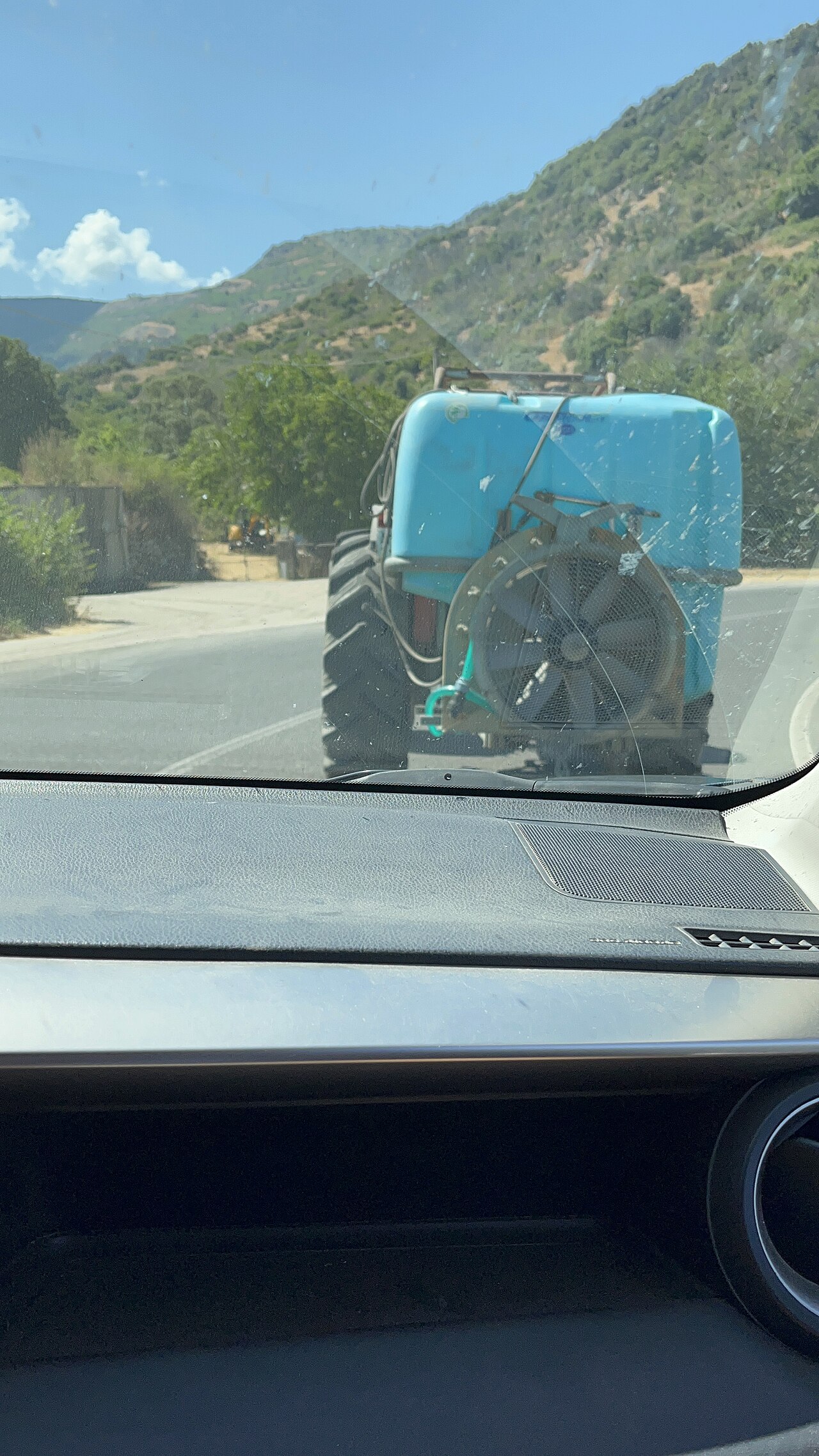
Mechanization as the Foundation of Orchard Maintenance
For a multi-hectare hazelnut orchard managed professionally, the typical set of agrotechnical interventions performed mechanically looks roughly like this (according to plans for establishing permanent hazelnut orchards):
- manual pruning (still predominantly manual today), with mechanical piling of pruned biomass;
- fertilization with mineral or organo-mineral fertilizers using a spreader;
- mowing / mulching of the inter-row space with a mower/mulcher;
- protection with a sprayer (copper and ecological preparations, insecticides);
- mechanical harvest (covered in a separate article).
From this, it follows that the basic mechanization of a hazelnut orchard, in addition to a tractor of appropriate power and dimensions, consists of a sprayer, fertilizer spreader, and mulcher/mower. This is simultaneously the most significant capital investment in equipment after the tractor and the establishment of the orchard itself.
Tractor and Row Dimensions
The row spacing in hazelnuts (often 4.5–6 m) and the height of bush-type or low-trunk trees determine the width and height of attachments. Before purchasing a machine, measure the narrowest passage, canopy height, and terrain slope — narrow inter-row spacings require narrower mulchers and low-profile sprayers. A horticultural/viticultural ("narrow") tractor is often more suitable than a standard arable farming tractor.
Sprayers for Orchard Protection
Protection of hazelnuts against pests (hazelnut weevil Curculio nucum, aphids, stink bugs, caterpillars of leafrollers) and diseases (bacterioses, fungal leaf spots, powdery mildew) is carried out by applying liquid preparations, which is the job of a sprayer (atomizer). Unlike arable farming boom sprayers with horizontal booms, the sprayer directs the product towards the canopy using an air stream generated by an axial fan, thereby achieving penetration of droplets into the interior of the canopy.
Types of Sprayers
| Type | Description | Suitability for Hazelnut |
|---|---|---|
| Classic axial (radial) | Fan blows air in all directions around nozzles; most common and cheapest | Good for bush-type and lower orchards; simple |
| Directed / with deflectors | Nozzles and channels direct the air stream into the row | Less drift, better coverage of high canopies |
| Tangential / with vertical nozzle column | Air exits from a vertical channel parallel to the row | Even distribution along canopy height |
| Mounted vs. Trailing | Mounted (smaller tank, 200–600 l) or trailing (600–2000+ l) | Larger plots → trailing; smaller → mounted |
Adjustment and Practical Notes
- Spray volume and driving speed are adjusted according to canopy density and phenological phase; the goal is even coverage without dripping. Check nozzle flow and pressure before each season.
- Fan direction should be adjusted to canopy height — upper nozzles for the top, lower for the ground level. Close nozzles that "shoot" above or beside the canopy to reduce drift.
- Anti-drift nozzles and operation in calm, windless conditions (early morning) reduce losses and are mandatory near water bodies and neighboring crops.
- Summer pruning that thins the canopy directly improves spray quality — better ventilation means better penetration of the sprayer's air stream.
Product Registration and Operator
Plant protection products may only be applied by persons who have passed the exam on safe handling and correct application of pesticides. Check the list of currently registered products for hazelnut in the Phytosanitary Information System (FIS): https://fis.mps.hr/fis/javna-trazilica-szb. The application device (sprayer) must have a valid certificate of correctness.
Products Applied with a Sprayer (Informative)
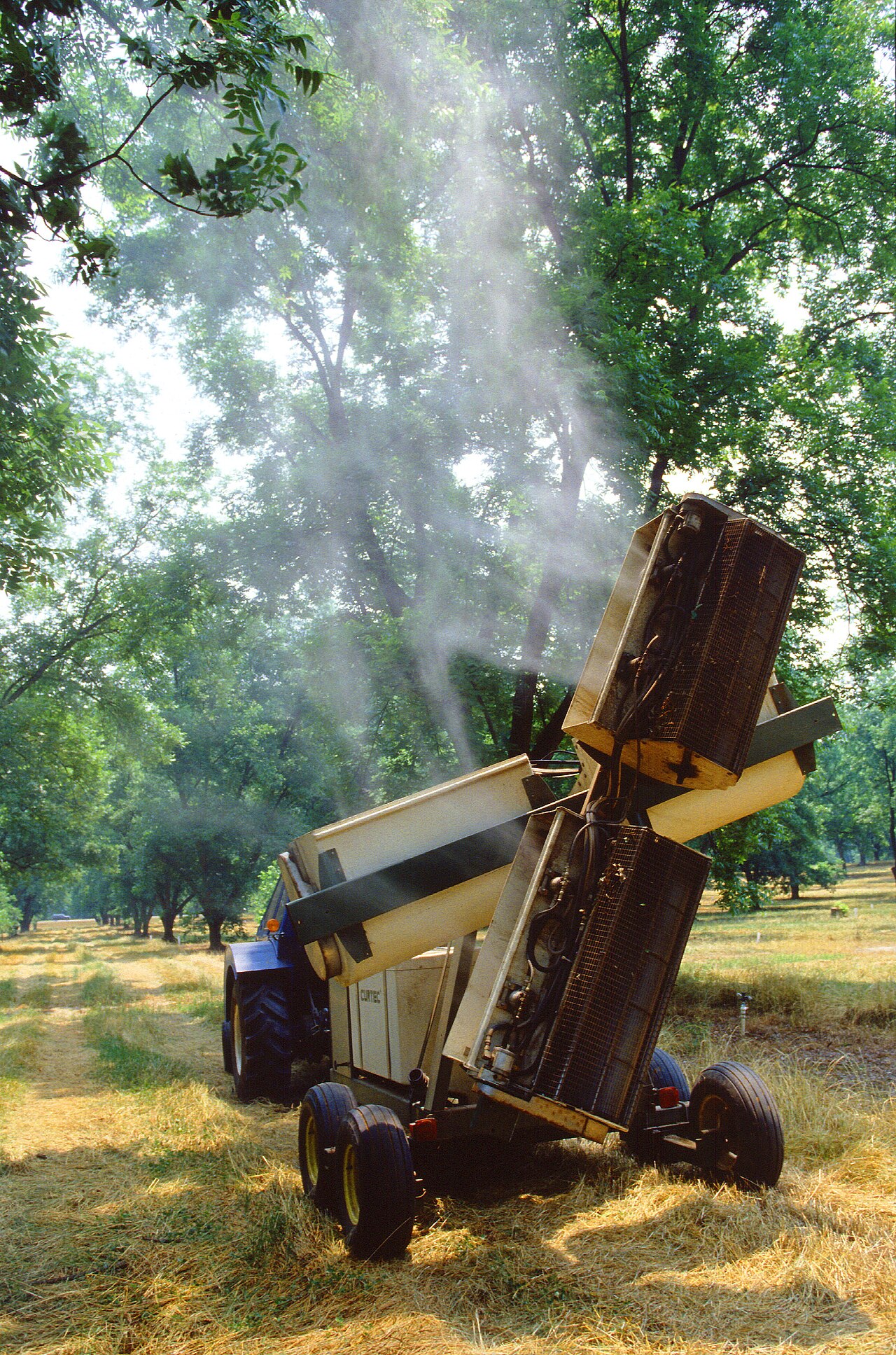
From literature and advisory service notices, the following products and uses are mentioned for hazelnut (subject to valid registration). All dosages and preparations are informative — check current registration in FIS before application.
| Purpose | Examples of preparations from literature | Note |
|---|---|---|
| Bacterial / Fungal diseases | Bordeaux mixture, Champion WG 50, Cuprablau Z, Neoram WG (copper compounds) | Part of organic production |
| Powdery mildew, mites | Sulfur preparations (Cosavet DF, Microthiol) | — |
| Gray/gray leaf spot | Signum (pyraclostrobin + boscalid) | — |
| Hazelnut weevil | Calypso SC 480 (thiacloprid) — historical; today often without registered product | Monitored by shaking; critical 3–4 pipes/tree |
| Aphids, leafrollers | Decis 100 EC, Scatto, Kaiso, Movento, etc. | According to label |
| Stink bugs | NeemAzal-T/S, Asset (pyrethrins) | Allowed in organic production |
For the hazelnut weevil, the most important pest, product registration changes; when there is no registered insecticide, advisory services mention immunostimulators/oil preparations (e.g., Boundary SW) that act physically. Always start from the pest threshold and monitoring, not from a calendar.
Fertilizer Spreaders
Hazelnut fertilization is primarily carried out in autumn and supplemented in spring. Mechanical spreading of mineral and organo-mineral fertilizers in the orchard is done with a fertilizer spreader.
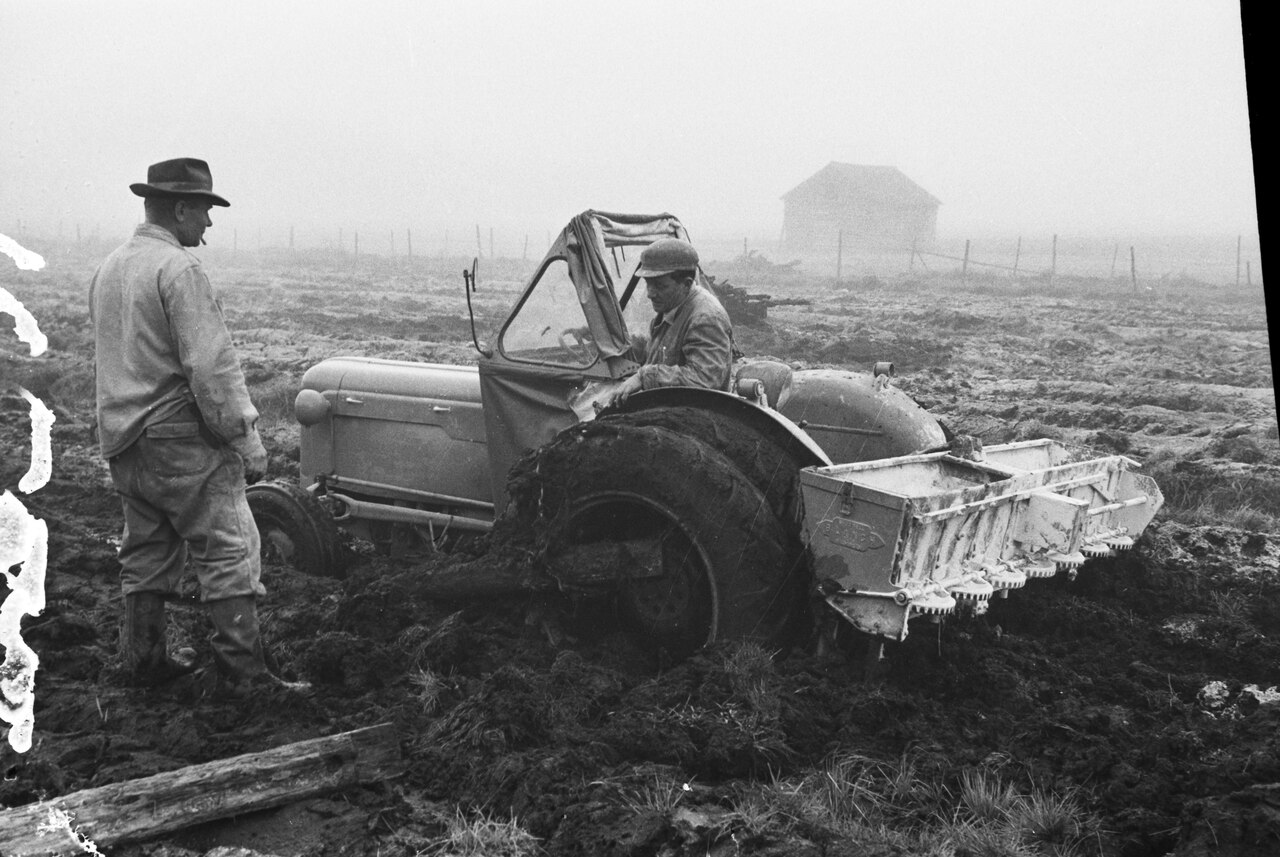
Types of Spreaders
| Type | Principle | Application in Hazelnut Orchard |
|---|---|---|
| Centrifugal (with one or two discs) | Rotating disc(s) eject granules in a wide arc | Fast, for spreading over the entire surface of older orchards |
| Pneumatic | Air conveys fertilizer through pipes to outlets | Precise distribution, less drift |
| Single-sided / Double-sided (orchard) | Disc or side outlet directs fertilizer into a strip along the row | Ideal when trees are young and fertilization is along the row, not the entire surface |
| Organic (manure/compost/pellet spreader) | Ejects solid organic matter | For organo-mineral pelletized fertilizers and manure |
In a young orchard, fertilizer is applied around the bush, in a width slightly wider than the canopy edge (in a strip), so single-sided/orchard spreaders are suitable that direct fertilizer into the row. In an older orchard (from about 4th–8th year), complex NPK fertilizer is spread over the entire surface, where the centrifugal spreader comes into its own.
Indicative Dosages (Informative)
From Croatian literature on hazelnut fertilization (values are approximate and depend on soil analysis):
| Phase / Year | Fertilizer and Quantity | Note |
|---|---|---|
| 1st year | ~0.5 kg nitrogen fertilizer / bush | at the canopy edge |
| 2nd year | ~0.6 kg nitrogen fertilizer / bush | — |
| 3rd year | ~0.8 kg nitrogen fertilizer / bush | — |
| 4th year | ~1 kg CAN (27% N) / bush | in early spring |
| 4th–8th year (autumn) | NPK + ~20 kg/ha P, ~150 kg/ha K | over the entire surface |
| 4th–8th year (spring) | ~100 kg/ha N (≈350 kg/ha CAN) | over the entire surface |
| After 8th year | as from 4th year, quantities +~35% | — |
| Organic cultivation | e.g., organo-mineral pellets (GRANOSANO EVO 6:16:0, PROECA 5:10:10) | spread at the canopy edge, lightly incorporated by cultivation |
Calibration of the spreader is mandatory
The same settings give completely different dosages for different fertilizers (density and granule size, moisture). Before the season, calibrate the spreader (test with bucket/ground, check working width and evenness). The centrifugal spreader requires overlapping working passes to ensure even distribution across the width. For variable rate application, spreaders with ISOBUS and prescription map capability are becoming more common.
Mulchers and Mowers
The inter-row space of a hazelnut orchard is most often grassed (usually 2–3 years after orchard establishment), and the grass cover is then maintained by mowing and mulching. This brings a number of benefits: increases organic matter content, improves physical, chemical, and biological soil properties, allows better rainwater infiltration on slopes, moderates soil temperature fluctuations, and reduces damage and soiling of fruits that fall to the ground before and during harvest.
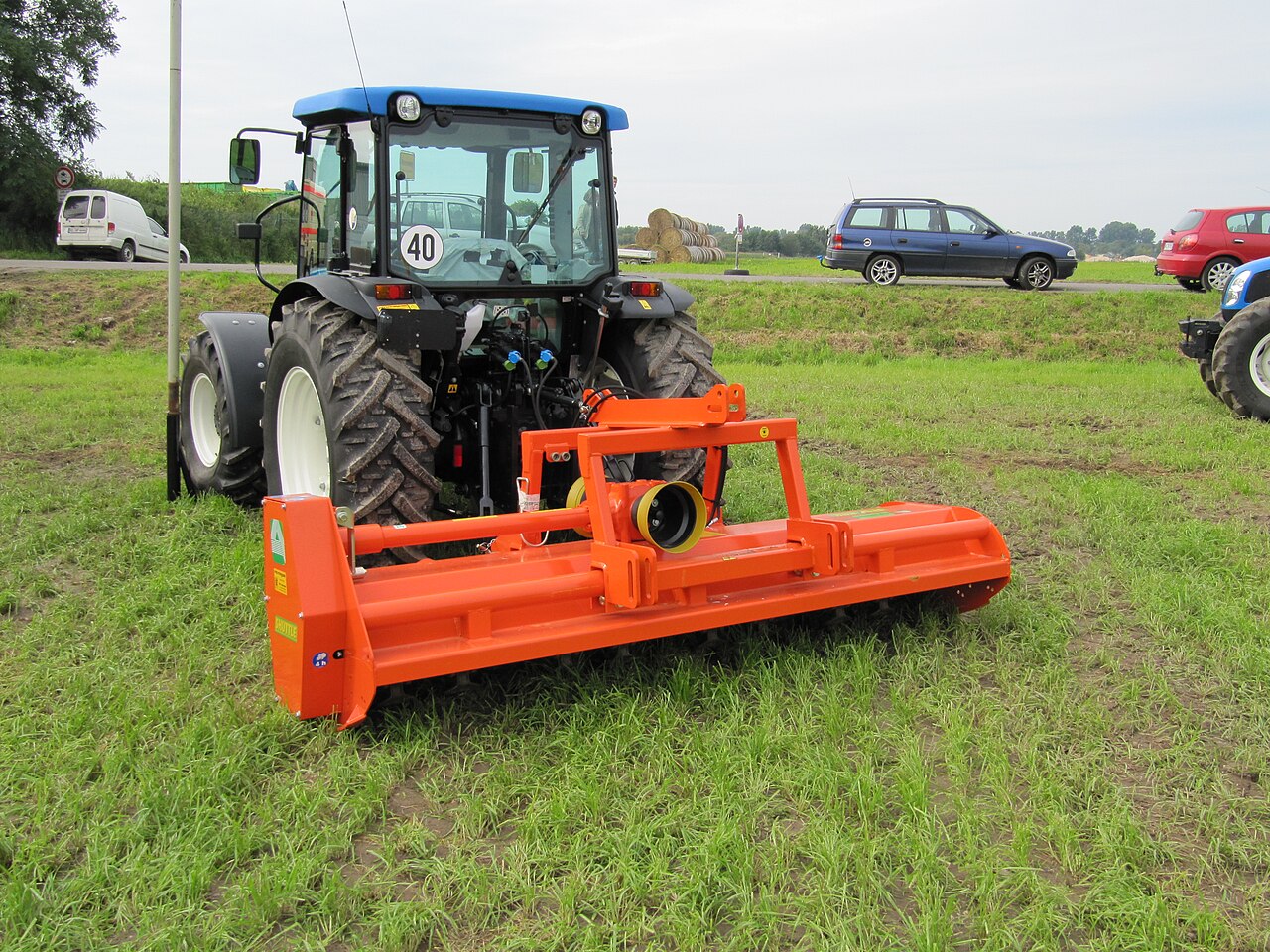
Mulcher vs. Mower
- Mower (rotary/drum) cuts the grass; it is fast and simple, but leaves longer cut residues.
- Mulcher with knives or hammers (flails) shreds plant mass into small pieces that remain on the soil and decompose quickly into humus with the help of microorganisms. Because of this, the mulcher is particularly valuable in hazelnuts — while maintaining the sward, it simultaneously shreds pruning residues (branches) and fallen leaves.
In literature (organic farms), a horticultural mulcher with lateral (mechanical) shift over two guides is also mentioned, with which the working width can be moved closer to the row and the space next to the bush can be worked.
Types of Mulchers for Hazelnut Orchards
| Type | Characteristic | Suitability |
|---|---|---|
| Flail (with hammers) | Robust hammers shred both grass and woody pruning residues | Best choice where mulching includes pruned biomass |
| Knife (Y / straight knives) | Lighter, lower power consumption, finer grass shredding | For predominantly grassy cover |
| With lateral shift (offset) | Shifts to the side, works space along the row | Reduces the need for a herbicide strip |
| With ejecting/shifting segment (with tree sensor) | Avoids trunks and works space within the row | More expensive, but reduces manual work along the row |
Power, Width, and Safety
Match the working width of the mulcher with the row spacing and the required power (PTO) with the tractor power — flail mulchers require more power than knife mowers. Check protective chains/rubber curtains that prevent stone ejection, and the sharpness and balance of knives/hammers (imbalance destroys bearings and causes vibration). Work at lower driving speeds with dense or woody material.
Mechanization for Pruning and Sucker Control
Pruning
Hazelnut pruning remains predominantly manual, as the objective is selective: to obtain the highest possible number of long one-year-old shoots (20–40 cm) that produce the best yield, thin out the interior of the canopy, remove low, damaged, crossing, and degenerate branches, as well as suckers. Such fine pruning is difficult to fully automate. Mechanization assists here through:
- Pneumatic and cordless (battery-powered) shears and saws — drastically reduce fatigue and speed up manual pruning; pneumatic tools operate via a tractor compressor, while battery-powered ones offer greater mobility;
- Telescopic pruning poles / pole saws for higher parts of the canopy;
- Mechanical collection of pruned biomass — after pruning, branches are collected and most often mulched on-site (returning organic matter to the soil) or transported away;
- Mechanized "topping"/hedging using rotary or chain cutters mounted on a carrier — used in intensive, densely planted orchards to maintain hedge dimensions, but applied less frequently and with caution in classic Croatian bush-type hazelnut orchards.
Pruning is not required every year
Once the training form is established, hazelnut does not need to be pruned annually; heavy pruning (thinning) is often planned every 2nd–3rd year when yield begins to decline. When planning investments in pruning machinery, consider this periodicity and the high cost of manual labor.
Control of Root Suckers (Vodopija)
Hazelnut grown on its own rootstock vigorously produces root suckers that consume nutrients, overcrowd the bush, complicate maintenance and harvest, and reduce yield. Controlling them is an ongoing task throughout the growing season.
Machine and semi-manual options:
- Mechanical removal — most commonly with motorized/battery-powered shears or a trimmer along the row. Suckers are better snapped off or pulled out at the base rather than cut, as cutting stimulates new growth.
- Mulcher with side-shift or a movable segment around the trunk — can work the space within the row, thereby preventing/removing low suckers and weeds.
- Mechanical treatment of the row zone (inter-row cultivators, rotary hoes, "finger weeders") — in organic production, these replace the herbicide strip and simultaneously suppress young suckers and weeds along the row.
- Herbicide strip (where permitted and registered) — directed, protected spraying along the row; ensure the product does not contact green parts or bark of young trees.
Prevention is easier than cure
Planting grafted scions or growing in tree form reduces the sucker problem compared to bushes on own roots. Regular, frequent interventions in the row zone (both mechanical and, where permitted, chemical) are much cheaper than later removal of an overgrown bush base.
Practical Recommendations and Common Mistakes
- Measure before buying. The narrowest inter-row passage, canopy height, and terrain slope determine the width, height, and type of every implement. An oversized machine damages branches and soil; an undersized one extends working hours.
- Calibrate the spreader and sprayer every season. An uncalibrated spreader easily deviates ±20–30 % from the target dose; an uncalibrated sprayer means either poor protection or excessive consumption and drift.
- Do not spray "by calendar." Start with monitoring (shaking branches for weevils, inspecting for aphids/caterpillars) and action thresholds; check registration in the FIS database.
- Mulcher = double benefit. Choose a mulcher that chops both grass and pruned biomass — you return organic matter and save one pass.
- Address suckers early and frequently. Short, regular interventions along the row are much easier than one large cleanup once a year.
- Safety and certifications. PTO guards, correct mulcher curtains, sprayer certification, and passing the PPE application exam are not bureaucracy but conditions for safe and legal operation.
- Used machinery can be rational for smaller family farms (in orchard establishment cost estimates, tractors and working machines are often planned as used), but check the condition of vital components (sprayer fan and pump, mulcher bearings, disc and metering device of the spreader).
Gallery
Sources
This article is an AI-generated summary compiled from a collection of hazelnut literature (internal RAG corpus) and public sources. Data on doses, products, and agrotechnical practices were gathered from multiple documents; verify them in current official sources (FIS, advisory service) before application. Main sources used:
- HAZELNUT GROWING GUIDE — Ministry of Agriculture / advisory service (savjetodavna.mps.hr) — pruning, training form, fertilization.
- Environmental Impact Assessment — Establishment of permanent hazelnut and plum orchard, Grubišno Polje — list of mechanical agrotechnical operations (mulching, mechanical biomass collection, protection) — https://bbz.hr/doc/uprava/elaborat_zastite_okolisa_visegodisnji_nasadi_lijeske_i_sljive.pdf
- Technology and Economics of Organic Hazelnut Production (OPG Hobolić Alen), Visoko Higher Education College — orchard mulcher with side-shift, inter-row maintenance.
- Notices to Hazelnut Producers and Advisory Bulletins (Ministry of Agriculture / FIS) — protection products, weevil monitoring, action thresholds — https://fis.mps.hr/fis/javna-trazilica-szb
- Vrtlarica.hr and other Croatian literature on hazelnut fertilization and care — indicative N, P, K doses — https://www.vrtlarica.com/ljesnjak/
- Hazelnut Pruning — AgroPortal.hr and agronomija.info — pruning periodicity and cost-effectiveness, sucker control.
- Galenika-Pharmacopia / other plant protection and nutrition programs — example doses and formulations (indicative, not specific to HR registration).
- Public web sources on equipment (indicative, for machine types): KUHN (fertilizer spreaders) — https://www.kuhn-usa.com/crop/fertilizer-spreaders; Loftness Orchard Spreader — https://www.loftness.com/product/orchard-spreader/; Whatcom Manufacturing Orchard Mulcher — https://whatcommfg.com/orchard-mulcher/; Gospodarski list — mulchers — https://gospodarski.hr/rubrike/mehanizacija/malceri-za-uredivanje-zapustenih-povrsina-za-poljoprivrednu-proizvodnju/; AgroPower — mulching mowers — https://agropower.hr/sto-je-kosilica-za-malciranje/.
Recommended equipment
🔎 nut harvester machine — Amazon →Affiliate links — we may earn a small commission at no extra cost to you.
Hazelnut Harvesting Equipment
Compare manual, semi-mechanized, and larger solutions.
| Use Case | Option Type | What to Check Before Purchase |
|---|---|---|
| Small gardens | Manual rakes and nets | Handle length and net durability |
| Medium orchards | Semi-mechanized sweepers | Engine power and collection capacity |
| Large plantations | Over-the-row harvesters | Professional machinery specifications |