Barcelona, Ennis and Hall's Giant
Content generated by artificial intelligence — verify before application
This article was automatically compiled from a collection of hazelnut literature using artificial intelligence and may contain errors or outdated information. It serves as a starting point for further research, not as professional advice. Dosages, products, and timing are informative and depend on the cultivar, location, and current regulations — always verify with advisory services and official sources before application.
Barcelona, Ennis, and Hall's Giant (Ger. Hallesche Riesennuss; in Croatia known as Haleška lijeska or Halški div) are three large-kernel hazelnut (Corylus avellana L.) cultivars of European-American origin that have long served as the benchmark for table (in-shell, sold in the shell) and combined-use purposes. All three belong to the group of cultivars whose key advantage is nut size and attractive shell appearance, making them interesting for the fresh and roasted hazelnut market, rather than primarily for the confectionery industry, which seeks small, round nuts with high kernel percentage (such as Tonda Gentile). This profile summarizes their morphological and economic traits, yield, and susceptibility to diseases, based on a collection of hazelnut literature (RAG corpus) and public sources.
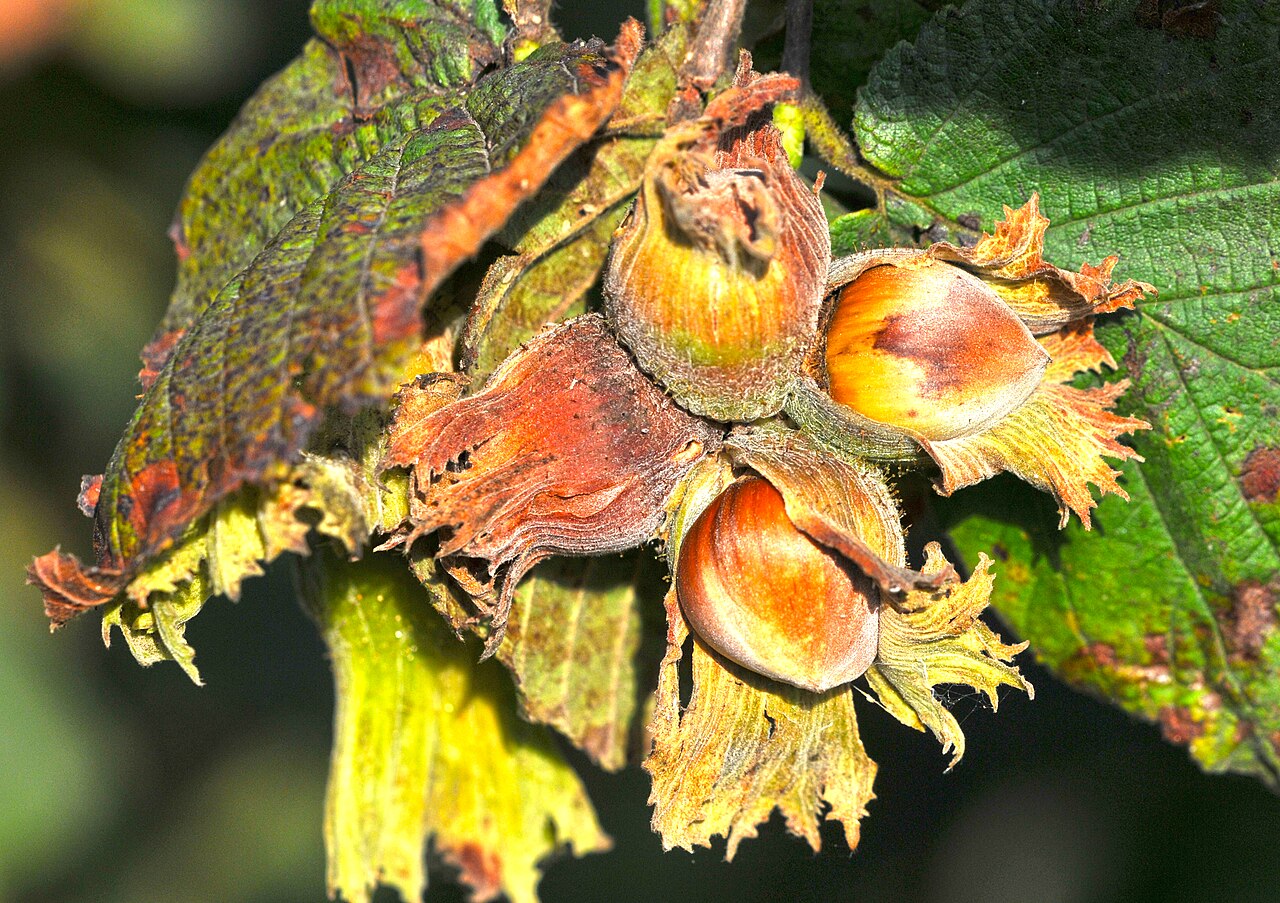
Barcelona = Fertile de Coutard — this is the primary profile
The Barcelona cultivar and the French Fertile de Coutard are the same cultivar (synonyms; primarily known as "Barcelona" in English, "Fertile de Coutard" in French, and in Croatia also as "Rodni kutard"). The complete profile for this cultivar — including agronomy, pollinizers, and S-alleles — is maintained here. The article Spanish and other European cultivars: Negret, Pauetet, Fertile de Coutard, Segorbe treats the cultivar only in the context of Mediterranean orchards and refers to this profile to avoid conflicting figures. The figures in both articles are aligned according to the same sources (OSU Extension, West Coast Nut, Croatian cultivation guides).
Why these large-kernel table cultivars?
Hazelnut cultivars are typically divided into three groups in the literature based on nut quality and purpose:
- table cultivars — for consumption fresh or roasted, in the shell; here, size, uniformity, and appearance of the nut are decisive;
- combined-trait cultivars — suitable for both industry and table use;
- confectionery industry cultivars (chocolate) — small, round nuts, high kernel percentage, and easy blanching (skin removal).
Barcelona, Ennis, and Hall's Giant belong to the first or combined groups. Their main advantage — large, decorative nuts — is simultaneously their economic limitation: large nuts usually have a lower kernel percentage (ratio of kernel mass to total nut mass) and thicker shells than confectionery cultivars, making them less profitable when selling kernels alone.
Term: Kernel percentage. Kernel percentage (engl. kernel percentage) is the mass proportion of the kernel in the whole nut with shell. Confectionery cultivars reach 49–54 %, while for these large-kernel cultivars, the percentage generally ranges between 36–48 %. A lower percentage means more shell per kilogram, but for table sales in the shell, this is not a disadvantage — on the contrary, large nuts achieve a better price.
Cultivar comparison table
| Trait | Barcelona | Ennis | Hall's Giant (Haleška) |
|---|---|---|---|
| Synonyms | Fertile de Coutard, Rodni kutard | — | Merveille de Bollwiller, Hallesche Riesennuss, Wunder aus Bollwiller, Haleška, Halški div |
| Origin | SW France (assumed); leading in Oregon (USA) | Washington → Oregon (USA) | Germany/France (Bollwiller); name Halle |
| Habit / Growth | Very vigorous, semi-erect, wide symmetrical canopy, up to ~6 m | Moderately vigorous, transitional to semi-erect habit | Vigorous, distinctly erect, elliptical canopy |
| S-alleles (incompatibility) | S1 S2 | S1 S11 | S5 S15 |
| Flowering time | Very long period, medium to late | Late flowering and late vegetative onset | Late pollen (short shedding period), late female flowers |
| Ripening | Early–mid October | Medium-late | Continental area, medium |
| Nut shape | Round to semi-round, laterally flattened | Slightly oval / elongated, uniform | Large, round-ovoid |
| Average nut mass | 3.0–4.2 g (approx. 3.8 g) | 3.8–4.2 g | 3.5–4.2 g |
| Average kernel mass | 1.4–1.7 g | 1.5–2.0 g | ~1.4 g |
| Kernel percentage | 43–45 % (range 36–46 %) | 42–48 % | 36–44.9 % (NZ: 36–41 %) |
| Shell thickness | ~1.5 mm, medium hardness | 1.3–1.4 mm | ~1.5 mm, thick, shiny brown |
| Husk dehiscence | Husk opens easily | Mature nuts drop easily (easier harvest) | Drop automatically from the husk |
| Bearing | High, but prone to alternate bearing | Good and regular | Low to medium, but early bearing |
| Main purpose | Table / benchmark for in-shell market | Table (main table cultivar in USA) | Table + excellent pollinizer |
| Susceptibility to EFB | Medium (intermediate) | Very susceptible | Medium (intermediate) |
Note: Figures from literature vary by location, year (dry/wet seasons), clone, and measurement method — take them as a guide, not absolute values. S-alleles are from OSU cultivar descriptions and are listed in the same format for compatibility calculation.
Barcelona (Fertile de Coutard) — industrial standard in the shell
Barcelona (synonym Fertile de Coutard, in Croatia Rodni kutard) is historically the benchmark against which all other cultivars are compared. It is assumed to originate from southwestern France and dominated the hazelnut landscape in the USA for decades, especially in Oregon (Willamette Valley), where it was long the most widespread cultivar. Its share is declining today because infected trees are being removed due to Eastern Filbert Blight (EFB).
Habit and nut. The cultivar has very vigorous, semi-erect growth with symmetrical, wide canopies; bushes/trees reach up to 6 m in height. The nut is round to semi-round, slightly flattened laterally, with a thick, dark chestnut-brown shell of medium hardness and gray hairs on the tip. It produces some of the largest nuts, making it the reference cultivar for the in-shell market. Harvest begins in early to mid-October.
Figures (aligned with OSU Extension and West Coast Nut).
- Average nut mass: 3.77–3.85 g (range in literature 3.0–4.2 g); varies significantly with precipitation — nuts are smaller in dry years.
- Average kernel mass: 1.66–1.70 g.
- Kernel percentage: 43.1–45.2 % (range in broader citations 36–46 %).
Phenology and pollination. Barcelona has an exceptionally long period of female flower receptivity, which facilitates pollination — the classic pollinizer Daviana almost always sheds pollen at the moment when a large number of Barcelona female flowers are still receptive. Barcelona's S-alleles are S1 S2, so a pollinizer whose pollen carries neither S1 nor S2 is required for fertilization (see table of compatible pollinizers below). Literature lists Daviana (Davijana), Negret, Dugi španjolski, Cosford, Segorbe, Mortarella, Butler, Merveille de Bollwiller (Hall's Giant), Imperiale di Trebisonda, and Corabel as pollinizers; pollen compatibility studies have shown that Davijana is a very compatible pollen source, while Negret did not always yield satisfactory results.
Note on a newer cultivar. From seeds of Fertile de Coutard in Bordeaux, a newer table cultivar emerged (since 1992, the main table cultivar in France): very vigorous, early-bearing, nut ~3.6–4.5 g, Havana-colored shell 1.2–1.3 mm thick, kernel percentage 43–48 %; late ripening and susceptibility to bacterial diseases/antracnose are its drawbacks. Do not confuse it with the parent cultivar Barcelona/Fertile de Coutard.
Weaknesses. Barcelona is prone to alternate (biennial) bearing and the appearance of empty nuts (engl. blank nuts), and is also susceptible to bacterial diseases and has intermediate (medium) susceptibility to EFB (Anisogramma anomala) — in the same group as Butler, Hall's Giant, and Willamette. Literature also notes susceptibility to moniliosis and susceptibility to attack by hazelnut weevil/mite in related large-kernel cultivars.
Ennis — largest table nut
Ennis originates from Washington state, from where it was introduced to Oregon. In the USA, it was long the main table cultivar, and cultivation is expanding outside the USA, especially in France. In popularity among classic cultivars, it ranks second to Barcelona and is one of the few that can compete with Barcelona, and even surpass it in nut size.
Habit and nut. It develops bushes/trees of moderate vigor, with a transitional to semi-erect habit; it flowers and vegetates late (advantageous for areas with late spring frosts). The nut is slightly oval to elongated, uniform in size and attractive in appearance. The husk is as long as the nut, so mature nuts drop easily from the husk, facilitating harvest.
Figures.
- Average nut mass: 3.8–4.2 g (some sources cite ~4.2 g).
- Kernel mass: 1.5–2.0 g.
- Kernel percentage: 42–46 % (some sources up to ~48 %); the nut drops from the husk in 80–90 % of cases.
- Shell: 1.3–1.4 mm, shiny, light brown.
- Kernel: irregular shape, very good quality and pleasant aroma; the skin separates easily during roasting.
- S-alleles: S1 S11.
Weaknesses. Ennis is very (highly) susceptible to EFB — along with Daviana and Du Chilly, it is classified as a highly susceptible cultivar, unlike Barcelona and Hall's Giant, which have medium (intermediate) susceptibility. Inoculation experiments show that Ennis becomes infected even at low concentrations of A. anomala ascospores, while resistant cultivars (with the Gasaway gene) are infected only at very high concentrations (on the order of 10⁶–10⁷ ascospores/ml) and with repeated exposure. Due to the devastating impact of EFB, areas planted with Ennis in the USA have significantly decreased. In addition to EFB, literature notes susceptibility to bacterial diseases, powdery mildew, and especially anthracnose. For a detailed description of the disease, fungal biology, and control measures, see Eastern Filbert Blight (EFB / Anisogramma anomala).
Hall's Giant — Large Nut and Key Pollinizer
Hall's Giant is an old large-nut cultivar known by a number of names: Merveille de Bollwiller, Hallesche Riesennuss, Hallesche Zellernuss, Wunder aus Bollwiller*, Haleška lijeska, Halški div, Géant de Halle. In Australia and the USA, it is regularly referred to as Hall's Giant, while in Europe (United Kingdom, Germany, France, New Zealand) it is better known as Merveille de Bollwiller — it is the same cultivar. It has been expanded in several European countries (most notably in Germany, the Czech Republic, and Russia), and in Croatia, it is particularly interesting as a pollinizer for the autochthonous Istarski duguljasti and for Rimski.
Habit and Nut. It develops vigorous shrubs/trees with very upright (to spreading) growth, an elliptical canopy, and dark green leaves; buds are recognizably dark red to purple, and catkins have a purple tint. Late leafing. The nut is large, roundish-spherical, with a scar in the basal part; the shell is light chestnut to dark brown, shiny, and about 1.5 mm thick. Mature nuts drop out of the husk spontaneously, which is only slightly longer than the nut. The kernel is roundish-oval, firm, fiberless, and blanches well.
Numbers.
- Average nut weight: 3.5–4.2 g.
- Kernel weight: ~1.4 g; milling ratio 36–44.9 % (New Zealand sources cite a narrower range of 36–41 %) — relatively low.
- Chemical composition of the kernel (approximate, 2020 season): fat around 59–66 %, proteins ~10–13 %.
- S-alleles: S5 S15.
Weaknesses and Strengths in Protection. The cultivar yields lower than Ennis (smaller and thicker nuts), but produces attractive nuts and is a reliable pollinizer. It is susceptible to mites and filbert weevil, but is resistant to bacterial blight (Xanthomonas) and to big bud mite and resistant to powdery mildew. On EFB it shows intermediate (medium) susceptibility — in the same group as Barcelona, Butler, and Willamette; under repeated exposure to high concentrations of ascospores, it does become infected, so "resistant" is not an accurate description.
Hall's Giant as a Pollinizer — and Its Own Pollinizers
Hall's Giant forms a large number of catkins with abundant pollen, but the pollen sheds late and often through a short period, so its value as a pollinizer lies in covering the late part of flowering. This makes it a logical pollinizer for late-flowering main cultivars (e.g., Istarski duguljasti, Rimski).
Caution with Phenology in Croatian Conditions
Foreign literature (Oregon, New Zealand) describes Hall's Giant as a late pollinizer because it sheds pollen approximately at the same time as MdB and late American cultivars. The Croatian cultivation guide (savjetodavna.mps.hr), however, notes that Haleška starts vegetation and flowers earlier in relation to Istarski duguljasti and Rimski and has long-lasting, elongated catkins that shed pollen abundantly. In other words, it is "late" in an absolute sense, but earlier than the domestic Istrian cultivars — precisely this overlap (its late, but early for our cultivars, pollen + their late receptive female flowers) makes it a good pollinizer here. Always verify phenology at the specific location, as it depends on winter and altitude.
American literature (OSU) warns that for Hall's Giant itself as a bearing cultivar, compatible pollinizers are not reliably established and recommends a higher proportion of pollinizers (¼ to ⅓ of trees) because it flowers late. New Zealand sources for Merveille de Bollwiller list Alexandra and Keen's Late (late-flowering cultivars) as suitable pollinizers. In the European/Croatian context, natural partners are late-flowering domestic and Mediterranean cultivars; specific combinations should be confirmed according to S-alleles (see table below).
Table of Compatible Pollinizers for Hall's Giant (S5 S15)
Compatibility is calculated based on sporophytic self-incompatibility: a pollinizer is effective only if its pollen does not express any of the S-alleles of the female (main) cultivar. Hall's Giant carries alleles S5 and S15, so any cultivar whose pollen carries S5 or S15 is incompatible with it. (In some cultivars, one allele is dominant in pollen, which can change the outcome — therefore, the table is orientational.)
| Potential Pollinizer | S-alleles | Compatibility with Hall's Giant (S5 S15) | Phenological Note |
|---|---|---|---|
| Barcelona (Fertile de Coutard) | S1 S2 | ✅ Compatible | Long flowering; see above |
| Ennis | S1 S11 | ✅ Compatible | Late flowering — good overlap |
| Butler | S2 S3 | ✅ Compatible | Medium–late |
| Tonda Gentile delle Langhe (TgdL) | S2 S7 | ✅ Compatible | Early–medium |
| Tonda di Giffoni | S2 S23 | ✅ Compatible | Medium |
| Negret | S10 S23 | ✅ Compatible | Protogynous, medium |
| Segorbe | S9 S23 | ✅ Compatible | Medium–late |
| Daviana (Davijana) | S2 S10 | ✅ Compatible | Long shedding period |
| Alexandra | (late-flowering) | ✅ (NZ recommendation) | Late — recommended for MdB |
| Keen's Late | (late-flowering) | ✅ (NZ recommendation) | Late — recommended for MdB |
| Delta | S1 S15 | ❌ Incompatible (shares S15) | — |
| Cultivars expressing S5 or S15 in pollen | contain S5/S15 | ❌ Incompatible | Check each one |
Source of S-alleles: OSU Extension cultivar descriptions (pollenizer map). Take the table as a starting point — for a new combination, confirm the S-alleles of the specific clone and flowering overlap at the location. For safe pollination, plant at least two to three compatible pollinizers with different flowering times.
Yield, Quality, and Market Use
Although all three cultivars are classified as large-nut, their economic value differs:
| Criterion | Best of the Three | Comment |
|---|---|---|
| Nut size (table) | Ennis ≈ Barcelona | Ennis often largest and most uniform |
| Kernel milling ratio | Ennis (up to ~46–48 %) | Barcelona ~43–45 %; Hall's Giant lowest (36–44.9 %) |
| Ease of harvest | Ennis / Hall's Giant | Nuts easily/spontaneously drop from husk |
| EFB Resistance | Hall's Giant ≈ Barcelona > Ennis | Both medium (intermediate); Ennis very susceptible |
| Value as Pollinizer | Hall's Giant | Abundant, late pollen |
| Resistance to Bacterial Blight / Powdery Mildew / Mite | Hall's Giant | Resistant to bacterial blight, powdery mildew, and big bud mite |
| Tendency to Alternate Bearing | (Barcelona's drawback) | Barcelona pronounced, Ennis more regular |
For sale in-shell (table use), size, uniformity, and clean, attractive nut appearance are decisive — Ennis and Barcelona lead in this regard. For kernel/industry, these cultivars are not the first choice due to lower milling ratios and thicker shells; confectionery cultivars (Tonda Gentile, Tonda di Giffoni) perform better there.
Pollination and Cultivar Harmony in the Orchard
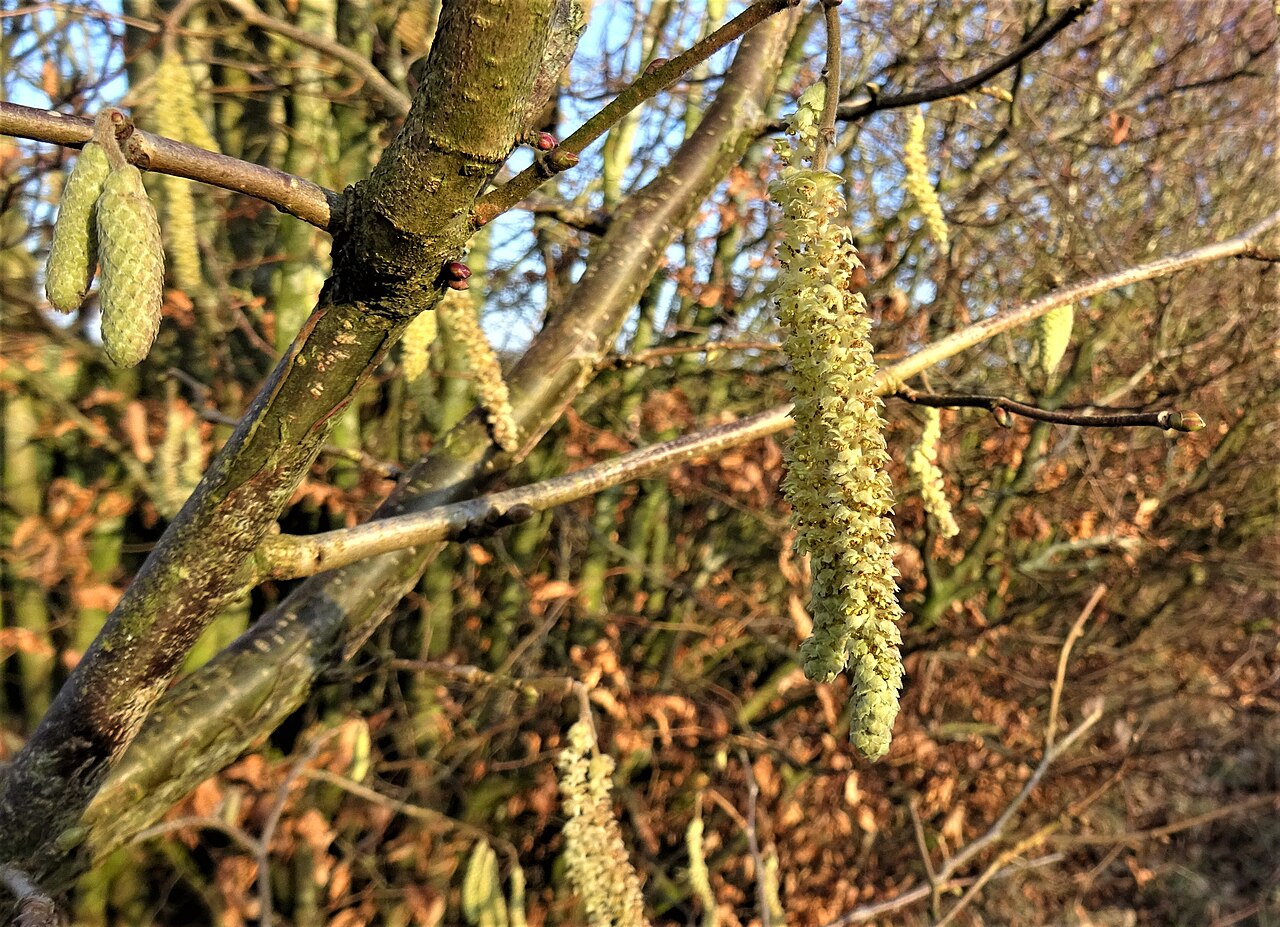
Hazelnut is monoecious but cross-pollinating and largely self-incompatible (autosterile) — for bearing, it is necessary to plant multiple pollinizer cultivars with synchronized flowering. In literature and Croatian practice, it is recommended to have at least two to three different pollinizer cultivars in the orchard and careful matching of male catkin shedding time with the receptivity of the female flowers of the main cultivar. According to Spanish experience, pollinizers should not occupy more than ~25 % of the area, and are placed at a distance of up to ~30 m from the main trees (although wind carries pollen for kilometers, closer spacing yields more reliable bearing).
- Hall's Giant, due to abundant and late pollen, is a classic pollinizer for Istarski duguljasti, Rimski, and is also cited alongside Ludolf and Daviana. It requires a compatible pollinizer itself (see table above) because it is self-incompatible and flowers late.
- Ennis (S1 S11) and Barcelona (S1 S2) are late/medium cultivars; when planning, inter-(in)compatibility must be checked — e.g., Ennis and Barcelona share allele S1, so they are not an ideal pair for each other and require a third, compatible cultivar (e.g., Hall's Giant or Daviana).
Practical. Do not rely on a single pollinizer. Distribute 2–3 pollinizers throughout the orchard (e.g., every 8th–9th row and within rows) so that pollen reaches all main trees in all years, as flowering varies depending on winter and spring. Always plant an even number of rows per cultivar for easier harvest organization.
Eastern Filbert Blight (EFB) — Key Risk
The most important disease for these cultivars is Eastern Filbert Blight (EFB), caused by the fungus Anisogramma anomala.
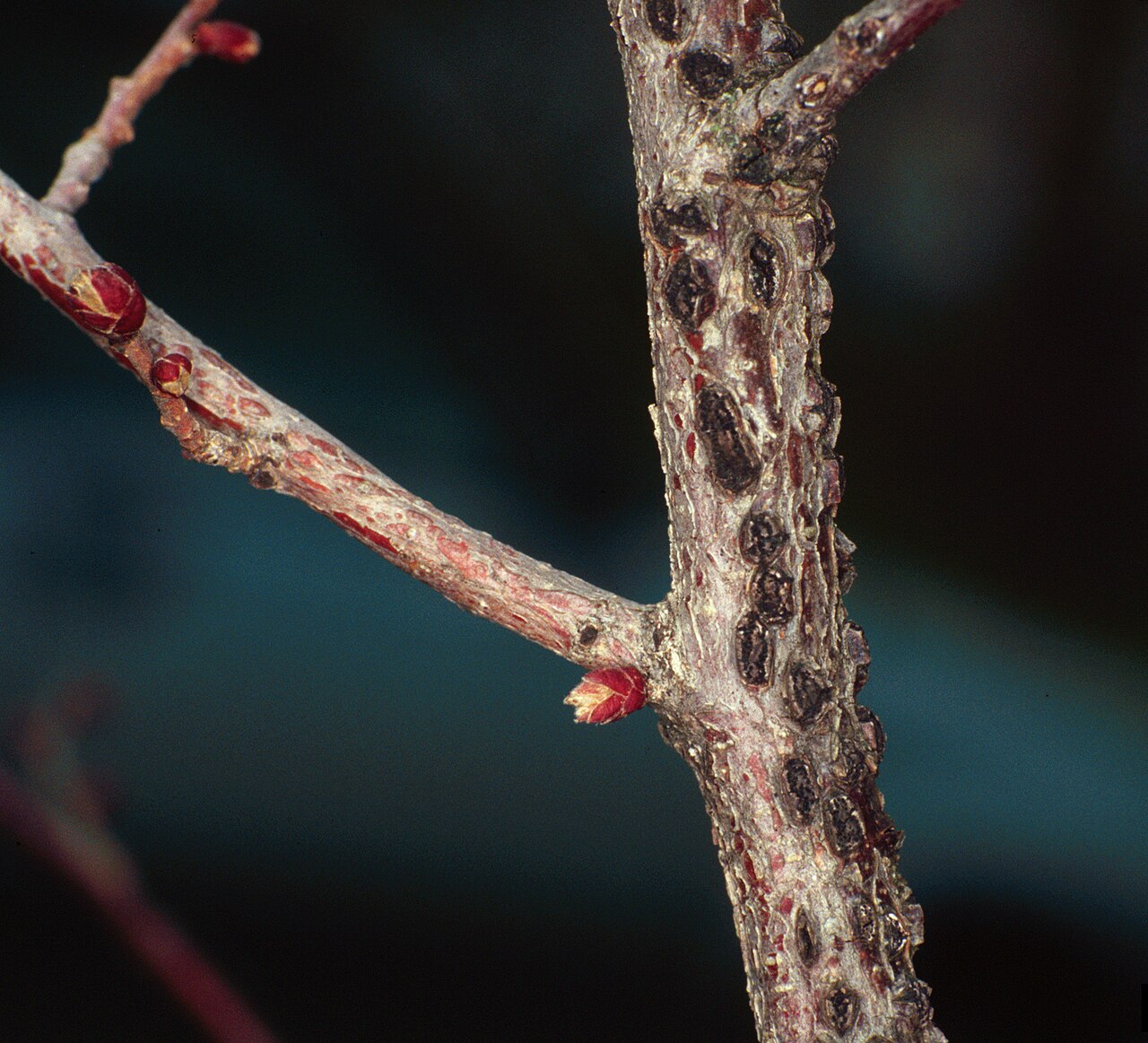
All three cultivars originate before the discovery of resistance genes (e.g., Gasaway), so none are genetically resistant; they differ only in the degree of susceptibility:
| Cultivar | EFB Susceptibility |
|---|---|
| Barcelona | Medium (intermediate) — susceptible |
| Hall's Giant | Medium (intermediate), resistant to bacterial blight, but not to EFB |
| Ennis | Very (highly) susceptible |
In susceptible cultivars, protection in practice comes down to removal and burning of infected shoots (pruning of cankers), application of fungicides during the period of ascospore release (in spring, during rainy periods), and, if possible, combining with resistant cultivars and pollinizers. For European producers, EFB is primarily a quarantine threat (the fungus is not yet widespread in Europe), so prevention of entry and certified planting material are key.
Specific agents, doses, and timing depend on registration for hazelnut in Croatia/EU, the cultivar, and location — always check the current list of permitted agents (FIS database / advisory service) before application. A complete description of the fungus's biology, symptoms, infection cycle, and control measures is covered in a separate article: Eastern Filbert Blight (EFB / Anisogramma anomala). See also Status and Quarantine Framework of EFB in Croatia and EU and EFB Resistance and Breeding.
Practical Recommendations and Common Mistakes
- Choose the cultivar according to the market. For in-shell sales (table use), Barcelona and Ennis offer size; for kernel/industry, consider cultivars with higher milling ratios.
- EFB is the main long-term risk. In areas with blight present, avoid monoculture of Ennis; plan for more resistant cultivars and regular monitoring of cankers.
- Watch S-alleles when combining main cultivars. Barcelona (S1 S2) and Ennis (S1 S11) share allele S1 — they are not a good mutual pair; add a compatible third cultivar. Hall's Giant (S5 S15) is compatible with both.
- Do not forget pollinizers — not even for Hall's Giant. The most common mistake is too few pollinizers or mismatched flowering — the result is poor bearing despite healthy trees. Hall's Giant is a proven late pollinizer, but it itself requires a compatible, late-flowering partner.
- Account for Barcelona's alternate bearing. Plan pruning and nutrition to mitigate natural fluctuations from year to year.
- Numbers from literature are orientational. Nut weight and milling ratio vary greatly with precipitation, clone, and year; do not compare cultivars based on a single season.
- Check planting material. Due to the multitude of synonyms (especially for Hall's Giant / Merveille de Bollwiller) and clonal differences, purchase certified seedlings of known origin.
Sources
This article is an AI-generated summary compiled from an internal hazelnut literature collection (RAG corpus) and publicly available sources; data may vary among sources and seasons. Main sources used:
- Chemical Composition of Hazelnuts from the 2020 Season — undergraduate thesis, Faculty of Food Technology and Biotechnology, University of Zagreb (PBF repository, 2022.) — cultivar descriptions for Barcelona, Ennis, and Hall's Giant (Haleška) including nut weight, kernel ratio, and susceptibility.
- Chemical Composition of Hazelnuts — cultivar review (Pavlović, 2010; Miljković, 2018), describing cultivars Ennis, Butler, Fertile de Coutard, Gunslebert, and Negret.
- GUIDE TO Hazelnut Cultivation — Ministry of Agriculture / Advisory Service (savjetodavna.mps.hr, 2024.) — Hall's Giant as a pollinizer for Istrian Long and Roman cultivars, phenology (blooms earlier than domestic cultivars).
- Vujević, P.: Cultivars and Training Systems for Hazelnuts — Agroklub. https://cdn.agroklub.com/upload/documents/sorte-i-uzgojni-oblici-lijeske.pdf
- Current State and Trends in Hazelnut Production and Consumption — Plant Protection Gazette. https://doi.org/10.31727/gzb.42.3.9
- Good Hazelnut Yields Depend on Good Pollination (pollinizers for Istrian Long / Roman).
- New Hazelnut Cultivars — Gospodarski list; Hazelnut Cultivars from America — A Short Guide (EFB, popularity of Barcelona and Ennis).
- Guidelines for Growing Hazelnuts in New Zealand — description of Merveille de Bollwiller (= Hall's Giant): late pollen shed, resistance to bacterial blight and bud mite, pollinizers Alexandra and Keen's Late, kernel ratio 36–41%.
- Oregon State University Extension — cultivar descriptions and pollinizer map (S-alleles: Barcelona S1S2, Ennis S1S11, Hall's Giant/Merveille de Bollwiller S5S15, Delta S1S15). https://catalog.extension.oregonstate.edu/em9073
- Pinkerton et al. (2001): Spatial and temporal increase of eastern filbert blight in European hazelnut orchards in the Pacific Northwest. https://doi.org/10.1094/phyto.2001.91.12.1214
- Response of Resistant Hazelnut Cultivars to Eastern Filbert Blight (2022) — infection under repeated exposure to high concentrations of ascospores.
- West Coast Nut: Oregon Hazelnut Varieties in a Nutshell. https://www.wcngg.com/2021/05/14/oregon-hazelnut-varieties-in-a-nutshell/ (Barcelona ~3.85 g, kernel ratio 43.1%; Barcelona/Butler/Hall's Giant/Willamette intermediate susceptibility to EFB; Ennis highly susceptible).
- Oregon State University — Plant Resistant Cultivars (EFB). https://bpp.oregonstate.edu/efb/management/plant-resistant-cultivars
- Pacific Northwest Pest Management Handbooks — Hazelnut – Eastern Filbert Blight. https://pnwhandbooks.org/plantdisease/host-disease/hazelnut-corylus-avellana-eastern-filbert-blight
- Hazelnut Hub — Understanding the Unique Traits of the Barcelona Hazelnut. https://hazelnuthub.com/understanding-the-unique-traits-of-the-barcelona-hazelnut/