Calculating and Converting Fertilizers: From Pure Nutrients to Kilograms of Product
Content generated by artificial intelligence — verify before application
This article was automatically compiled from a collection of hazelnut literature using artificial intelligence and may contain errors or outdated data. It serves as a starting point for further research, not as professional advice. Dosages, products, and timing are informative and depend on the cultivar, location, and current regulations — always consult with an advisory service and official sources before application.
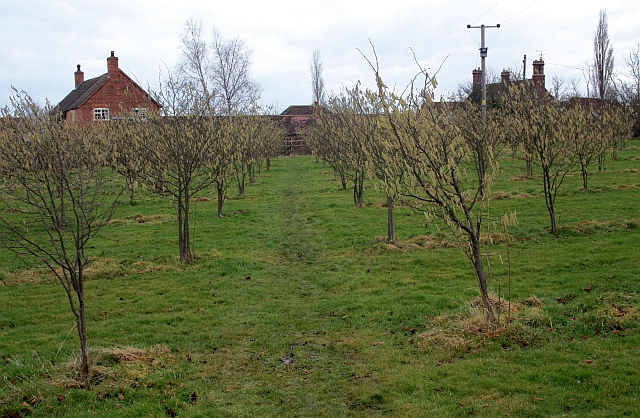
The most common concrete obstacle faced by a beginner in hazelnut cultivation is not a lack of recommendations, but the step between the recommendation and the fertilizer bag. The advice might say "add 100 kg of nitrogen per hectare" or "in autumn, incorporate 20 kg of phosphorus and 150 kg of potassium per hectare," but in the store, bags are labeled with KAN 27%, UREA 46%, NPK 7-20-30, MAP 12-52, potassium sulfate 0-0-50. The question is simple but crucial: how many kilograms of the product from the bag need to be spread to actually add the requested amount of pure nutrient to the soil? This article shows exactly that conversion — in both directions — using a table of common Croatian fertilizers, formulas, and practical examples with numbers from hazelnut literature.
What the Numbers on the Bag Actually Mean
The three numbers on a fertilizer bag (e.g., 7-20-30) indicate the mass fraction of three main nutrients, in order:
- N — Nitrogen, expressed as the pure element (elemental N),
- P — Phosphorus, expressed as phosphorus pentoxide (P₂O₅), not as pure phosphorus,
- K — Potassium, expressed as potassium oxide (K₂O), not as pure potassium.
The numbers are percentages by mass: in 100 kg of NPK 7-20-30 fertilizer, there are 7 kg of N, 20 kg of P₂O₅, and 30 kg of K₂O. The remainder (43 kg) consists of inert and auxiliary substances (sulfur, calcium, fillers, water in liquid forms).
The oxide form is the source of most errors
P and K on the label are in the oxide form (P₂O₅, K₂O), as prescribed in the EU. If a soil analysis recommendation refers to the pure element (P, K), the numbers do not match and must be converted. The factors are:
- P → P₂O₅: multiply by 2.29; P₂O₅ → P: multiply by 0.436
- K → K₂O: multiply by 1.205; K₂O → K: multiply by 0.830
Most Croatian agronomic recommendations for fruit trees, including citations about hazelnuts in literature, already refer to the oxide form (kg P₂O₅/ha, kg K₂O/ha), so the factor often does not need to be applied. Always first check in which units the recommendation and the soil test result are stated.
Two Basic Formulas
The entire conversion boils down to two versions of the same equation. The nutrient percentage is always entered as a fraction (decimal number): 27% = 0.27.
1) From kilograms of product to pure nutrient
kg of pure nutrient = kg of product × (nutrient percentage / 100)
Use this when you know how much fertilizer you spread and want to know how much nutrient you actually added.
2) From pure nutrient to kilograms of product (most important for planning)
kg of product = kg of pure nutrient / (nutrient percentage / 100)
Use this when you have a recommendation ("need 100 kg N/ha") and are looking for how many bags to buy and spread.
When starting from a soil analysis, there is one more step before these formulas — subtracting what the soil already offers:
required nutrient = target amount (for yield) − available in soil
And only that difference is divided by the proportion in the fertilizer. This is the standard approach in global fertilization practice and the foundation of all agricultural advisory service calculators.
Table of Most Common Fertilizers in Croatia
Values are typical/declared; always read the actual composition from the specific label as formulations differ among manufacturers and batches.
| Fertilizer | N (%) | P₂O₅ (%) | K₂O (%) | Note |
|---|---|---|---|---|
| UREA (carbamide) | 46 | 0 | 0 | Most concentrated solid nitrogen; volatilizes quickly if not incorporated into soil |
| KAN | 27 | 0 | 0 | Lime-ammonium nitrate; standard for spring top-dressing of hazelnuts |
| AN (ammonium nitrate) | 33–34 | 0 | 0 | Stronger nitrogen than KAN, without lime |
| UAN (liquid) | 28–32 | 0 | 0 | Liquid solution for fertigation |
| MAP | 12 | 52 | 0 | Monoammonium phosphate; starter P + some N |
| DAP | 18 | 46 | 0 | Diammonium phosphate |
| NPK 15-15-15 | 15 | 15 | 15 | Balanced complex fertilizer |
| NPK 7-20-30 | 7 | 20 | 30 | Often used for autumn fertilization of fruit trees/hazelnuts |
| NPK 8-26-26 | 8 | 26 | 26 | Strong P+K base fertilization |
| NPK 5-15-30 | 5 | 15 | 30 | Emphasis on K, little N |
| NPK 7-14-21 (+SO₃) | 7 | 14 | 21 | With added sulfur |
| Potassium sulfate (SOP) | 0 | 0 | 50 | K₂O + ~18% S; chloride-free, suitable for fruit trees |
| Potassium nitrate (KNO₃) | 13 | 0 | 46 | Soluble; N in nitrate form + K, for fertigation and foliar application |
| KCl (potassium chloride, MOP) | 0 | 0 | 60 | Cheapest K, but contains chloride |
Practical Examples
Example A — Spring nitrogen via KAN
Hazelnut literature states that "in spring, about 100 kg of nitrogen, or 350 kg/ha of KAN, is spread over the entire area." Let's check that number with formula 2.
- Required: 100 kg N/ha
- KAN contains 27% N → fraction = 0.27
$$\text{kg KAN} = \frac{100}{0.27} = 370 \text{ kg/ha}$$
The calculation yields ~370 kg/ha; the literature rounds to 350 kg/ha. Both numbers are in the same order of magnitude — the difference comes from rounding the target N and from some authors calculating with ~95 kg N. Lesson: 350 kg/ha of KAN provides ~95 kg N/ha, and for exactly 100 kg N, you need ~370 kg/ha.
Example B — Same nitrogen, but with urea
What if you have urea (46% N) instead of KAN?
$$\text{kg UREA} = \frac{100}{0.46} = 217 \text{ kg/ha}$$
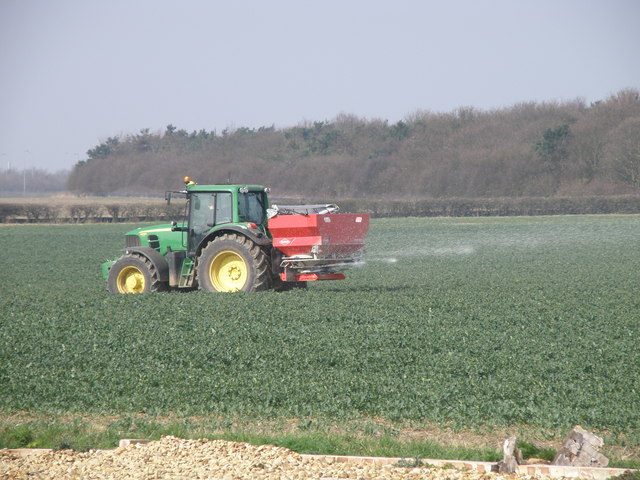
For the same 100 kg N, you need only ~217 kg of urea instead of ~370 kg of KAN. Urea is more concentrated, so per unit of nitrogen it is usually cheaper for transport and spreading — but it must be incorporated into the soil or applied before rain, otherwise a significant portion of the nitrogen will volatilize.
Example C — Autumn P and K fertilization with complex NPK
Recommendations from multiple sources for hazelnuts: in autumn, add ~20 kg P₂O₅/ha and ~150 kg K₂O/ha. Assume we use NPK 7-20-30.
How much product is needed to cover potassium (usually the most demanding nutrient)?
$$\text{kg NPK} = \frac{150}{0.30} = 500 \text{ kg/ha}$$
Let's check what those 500 kg/ha of NPK 7-20-30 simultaneously deliver (formula 1):
| Nutrient | Calculation | Added |
|---|---|---|
| N | 500 × 0.07 | 35 kg/ha |
| P₂O₅ | 500 × 0.20 | 100 kg/ha |
| K₂O | 500 × 0.30 | 150 kg/ha |
Potassium is hit exactly (150 kg), but we added 100 kg of phosphorus instead of the target 20 kg — five times more. This is a typical "conflict" of complex fertilizers: one fertilizer rarely hits all three numbers at once.
Example D — Separating nutrients for precise targeting
If we want exactly 20 kg P₂O₅ and 150 kg K₂O without excess phosphorus, we combine two simpler fertilizers:
- Phosphorus via MAP (12-52-0): $\dfrac{20}{0.52} = 38.5$ kg/ha of MAP → provides 20 kg P₂O₅ and incidentally 38.5 × 0.12 = 4.6 kg N.
- Potassium via potassium sulfate (0-0-50): $\dfrac{150}{0.50} = 300$ kg/ha → provides exactly 150 kg K₂O (+ ~54 kg SO₃ sulfur).
Thus, we hit both target numbers, added only ~4.6 kg of "excess" nitrogen, and received sulfur as a bonus. Nitrogen for spring is then supplemented with KAN or urea (Examples A/B). Separation is more expensive per bag, but prevents phosphorus accumulation in the soil and better matches the analysis.
Example E — From soil analysis to product (full procedure)
Assume the results and goals for a mature orchard are:
- Target intake for expected yield: 120 kg K₂O/ha
- Soil already provides an equivalent of 40 kg K₂O/ha that the plant will utilize
Step 1 — Need: 120 − 40 = 80 kg K₂O/ha Step 2 — Product (potassium sulfate 50%): $\dfrac{80}{0.50} = 160$ kg/ha of potassium sulfate.
The same procedure is repeated for N and P. This is the methodology used by official calculators of advisory services (e.g., UGA, Clemson): target minus reserve, divided by the proportion in the fertilizer.
Quick Conversion "Key" for the Field
To avoid calculating every time, it is useful to remember how many kg of product provide 1 kg of pure nutrient:
| For 1 kg of this nutrient | from this fertilizer | product needed |
|---|---|---|
| 1 kg N | UREA 46% | 2.17 kg |
| 1 kg N | KAN 27% | 3.70 kg |
| 1 kg N | AN 34% | 2.94 kg |
| 1 kg P₂O₅ | MAP 52% | 1.92 kg |
| 1 kg P₂O₅ | DAP 46% | 2.17 kg |
| 1 kg K₂O | potassium sulfate 50% | 2.00 kg |
| 1 kg K₂O | KCl 60% | 1.67 kg |
| 1 kg K₂O | potassium nitrate 46% | 2.17 kg |
Example usage: for 100 kg N from KAN → 100 × 3.70 = 370 kg KAN. Same result as the formula, but without dividing on the field.
Specifics of Foliar (Leaf) Top-Dressing
In hazelnuts, foliar top-dressing is often used in addition to base fertilization. Here, the dosage is usually stated per hectare of solution (e.g., TRAFOS K 3.0 l/ha, boron 1.0 l/ha, zinc 1.0 kg/ha) or as a concentration in the spray (e.g., 0.2–0.4%). Technological guides for foliar fertilization of hazelnuts warn that for effectiveness, the following are key:
- water volume per hectare — early in the growing season ~300–350 l/ha, later with larger leaf mass ~500 l/ha;
- solution pH — optimal around 6.5; water in Croatia is often pH 7.0–7.2, so it is acidified for better effect.
A concentration of e.g., 0.3% means 0.3 kg of fertilizer per 100 l of water, or 3 kg per 1000 l. Foliar top-dressing is a supplement, not a replacement for soil fertilization.
Common Mistakes and Practical Recommendations
- Confusing pure nutrient with product. "100 kg of nitrogen" is not "100 kg of KAN" — that is almost a fourfold difference. Always ask whether the number refers to the nutrient or the bag.
- Forgetting the oxide form. If the soil test gives P and K as elements, but the label as P₂O₅/K₂O, apply the factors (×2.29 for P, ×1.205 for K) before dividing.
- Hitting all three numbers with one NPK. It is almost impossible; plan around the most demanding nutrient (usually K), then supplement the rest with separate fertilizers.
- Ignoring nitrogen losses. Urea and ammonium forms volatilize; spread before rain or incorporate shallowly into the soil. Nitrate N (in KAN, KNO₃) acts faster but is also more easily leached.
- Fertilizing "blindly" without soil analysis. Soil analysis every few years (with special attention to pH, P, K, and organic matter) is the only way to make the conversion meaningful — otherwise, you are precisely calculating the wrong target.
- Young orchard ≠ mature orchard. Hazelnut literature notes that for the first four years, if ameliorative fertilization has been performed, only nitrogen is applied around the bush: ~0.5 kg of fertilizer in year 1, 0.6 kg in year 2, 0.8 kg in year 3, and 1 kg in year 4. Only from ~4th–8th year do we switch to NPK + KAN over the entire area, and from the 8th year, quantities are increased by ~35%. Conversion per plant (kg/bush) and per area (kg/ha) must not be mixed.
- Check permissions and regulations. In organic production, only certain (organic/mineral) fertilizers with declared N-P₂O₅-K₂O content are permitted; the same conversion applies, but the choice of products is limited.
Mini-reference (everything in one place)
- Convert percentage to fraction: 27 % → 0.27.
- If necessary, adjust forms (element ↔ oxide).
- From the analysis: requirement = target − soil reserve.
- kg of product = requirement / fraction.
- Check for "side effects": by multiplying the product by other contents, you see how much N/P/K you added incidentally.
- Plan around the most demanding nutrient; supplement the rest with separate fertilizers.
Sources
This article is an AI summary generated from an internal hazelnut literature collection (RAG corpus) and publicly available agronomic sources. Hazelnut dosage figures originate from Croatian professional and scientific sources listed below; the conversion methodology is aligned with public calculators of agricultural advisory services. All values are informative — check the product label and consult your advisory service before application.
Main sources used:
- GUIDE for hazelnut cultivation — Ministry of Agriculture / advisory service (ameliorative fertilization 1200–3000 kg/ha NPK, liming 4–12 t/ha CaCO₃). — https://www.savjetodavna.hr
- Proceedings of the 13th Scientific-Professional Conference of Croatian Fruit Growers, 2018 (fertilization trial Sv. Marija: NPK 7-20-30, 7-14-21, 5-15-30, UREA, KAN, MAP per ha).
- Technology and cost-effectiveness of organic hazelnut production at OPG Hobolić Alen, 2021 (KAN 27 % per year; ~20 kg P and 150 kg K/ha).
- Investment study for hazelnut-based products production (Corylus avellana L.), 2019 (N and NPK fertilization dynamics by year).
- Environmental Protection Assessment — hazelnut orchard, Municipality of Vojnić / Donji Hrastovac, 2021 (calcium carbonate, raw phosphate, potassium salt, NPK 7-20-30 dosages).
- Guide for foliar fertilization of hazelnut, 2021. — https://gnojidba.info/wp-content/uploads/2022/06/Vodic-za-folijarnu-gnojidbu-lijeske-2021.pdf
- Catalogs of variable cost coverage models for agricultural production (2019, 2021, 2022) — N-P₂O₅-K₂O contents in fertilizers (KAN, NPK, water-soluble and organic fertilizers).
- Hazelnut — Vrtlarica.com. — https://www.vrtlarica.com/ljesnjak/
- N-P-K Fertilizer Calculation Formula, Haifa Group. — https://www.haifa-group.com/haifa-blog/how-calculate-npk-formulae
- How to Calculate a Fertilizer Ratio, Penn State Extension. — https://extension.psu.edu/how-to-calculate-a-fertilizer-ratio
- NPK Fertilizer Calculator, University of Georgia (AESL). — https://aesl.ces.uga.edu/soil/fertcalc/
- NPK Recommendation Calculator, Clemson Extension. — https://precisionag.sites.clemson.edu/Calculators/Fertility/npkRec/
- Interpreting soil tests for fruit and vegetable crops, UMN Extension. — https://extension.umn.edu/nutrient-management-specialty-crops/interpreting-soil-tests-fruit-and-vegetable-crops
Recommended equipment
🔎 fruit tree fertilizer — Amazon →Affiliate links — we may earn a small commission at no extra cost to you.