Classic hazelnut pollinizers: Daviana, Cosford, Ludolf, Gunsleben, Apolda
Content generated by artificial intelligence — verify before application
This article was automatically compiled from a collection of hazelnut literature using artificial intelligence and may contain errors or outdated data. It serves as a starting point for further research, not as professional advice. Dosages, products, and timing are informative and depend on the cultivar, location, and current regulations — always verify with an advisory service and official sources before application.
Hazelnut (Corylus avellana L.) is monoecious but predominantly self-incompatible (autosterile) and sexually incompatible, meaning almost no commercial cultivar can self-pollinate — regardless of how many bushes of the same cultivar are in the orchard. Therefore, selecting a pollinizer (pollen cultivar) is just as important as selecting the main, bearing cultivar. While catalogs usually describe main, fruiting cultivars such as Istarski duguljasti, Rimski, and Halški div in detail, cultivars primarily planted as a source of pollen are often given only a single sentence. This article fills that gap and provides a profile of five classic, frequently cited pollinating cultivars — Daviana (Daviana), Cosford, Ludolf, Gunsleben (Gunslebert), and Apolda — with an emphasis on catkin shedding time and compatibility with leading Croatian cultivars.
Why the pollinizer is a separate issue
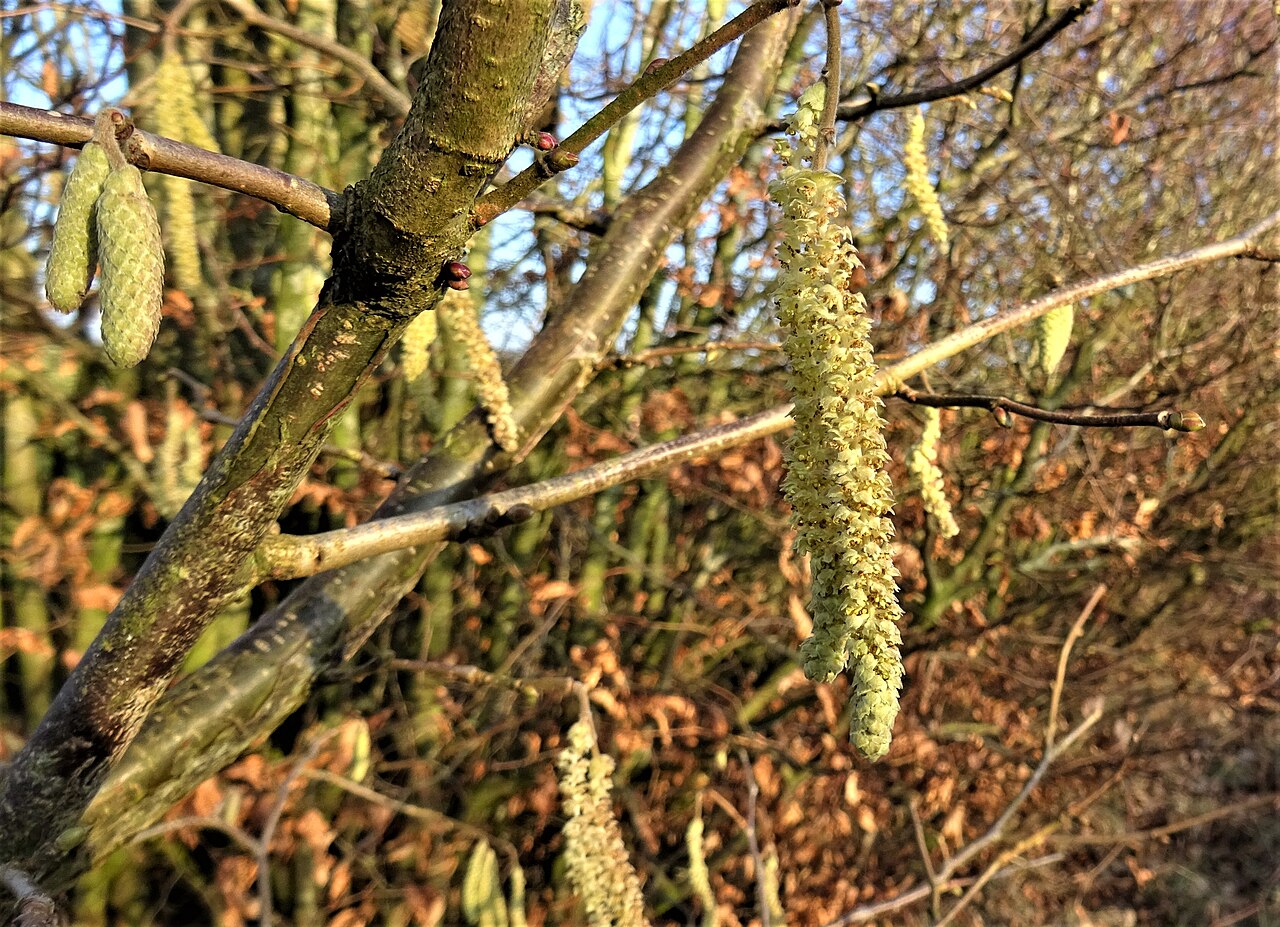
Hazelnut blooms in winter (approximately from January to March), is wind-pollinated (anemophily), and the flowering period is very long — male flowers (catkins) and female flowers often do not open simultaneously (dichogamy). For fertilization to succeed, the pollen from the pollinizer must be shed precisely when the stigmas (female flowers) of the main cultivar are receptive.
It is also important that the choice of pollinizer is not just a "yes or no" matter — research shows that the source of pollen (xenia and metaxenia) affects the quality of the fruit itself: the percentage of empty (blind) nuts, fertilization rate, nut and kernel mass, and kernel percentage. This is exactly where Daviana stands out.
Daviana (Daviana)
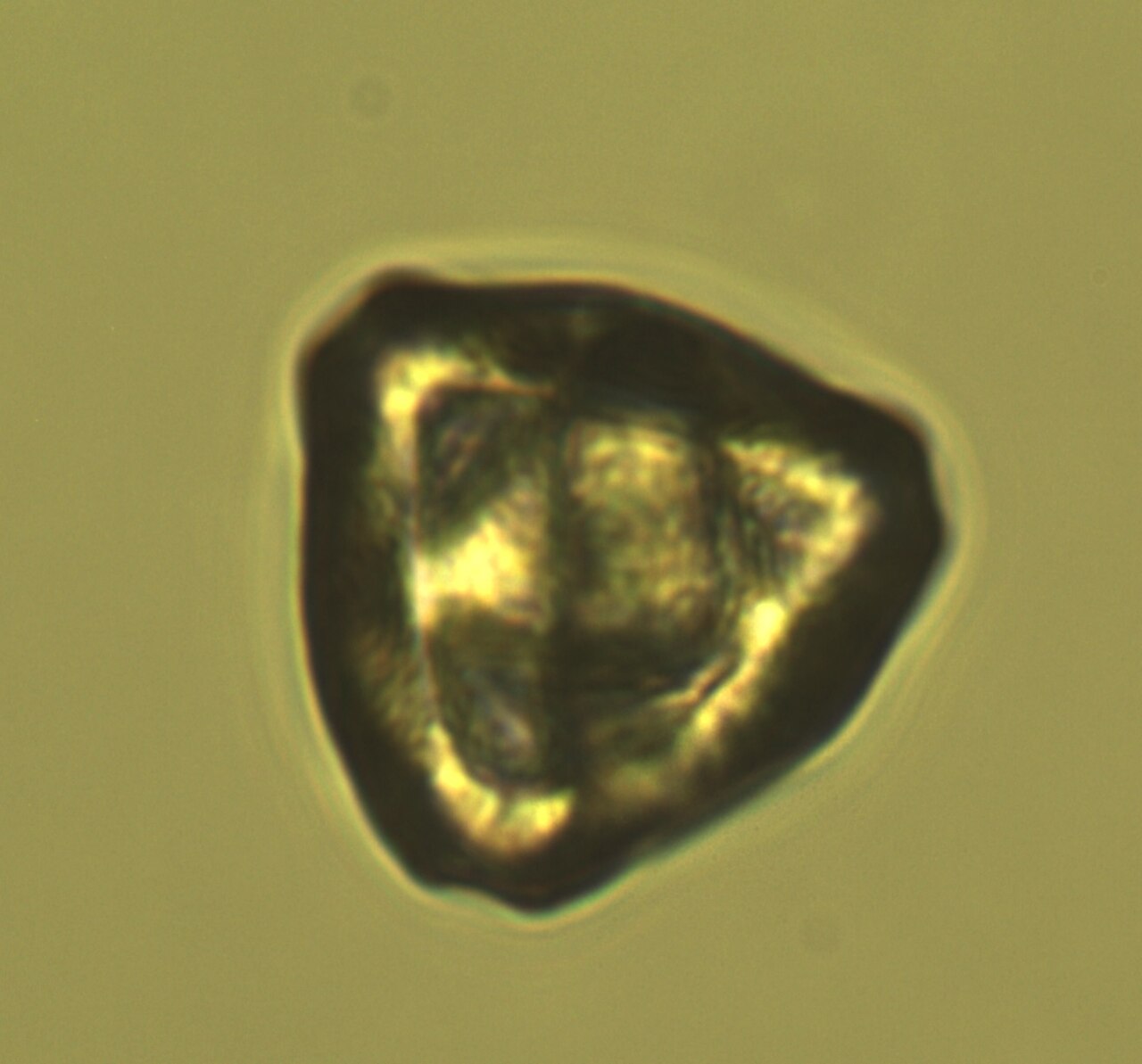
Daviana is probably the most frequently recommended "pure" hazelnut pollinating cultivar in European and world literature. It is an old English cultivar that is rarely planted for its own fruit, but almost regularly used as a pollen source.
Key properties as a pollinizer:
- Abundant catkin shedding. It is estimated that one good catkin of Daviana produces about 4 million pollen grains — making it an exceptionally abundant source of pollen.
- Very high pollen viability. In comparative studies, Daviana had the highest percentage of pollen viability among the tested pollinizers.
- Positive effect on fruit (metaxenia). Daviana pollen reduces the proportion of empty (blind) nuts and increases fertilization, kernel percentage, and nut and kernel mass. In other words, it does not just serve to "produce something," but to produce better.
- Later flowering. Both male and female flowering of Daviana occur later than most commercial cultivars — this is important because Daviana covers cultivars that enter receptivity later well, but for early-flowering cultivars, overlap should be checked.
Daviana as a pollinizer for Istarski duguljasti and Barcelona
For Croatian producers, the most important data is that Daviana is cited in literature as a highly compatible pollen source for Istarski duguljasti and Barcelona. From the corpus:
- For Istarski duguljasti (autosterile, or weakly autofertile cultivar), good pollinizers are cited as: Halški div, Rimski, Lambert, Gunsleben, Cosford, Apolda, Barcelona, and others; in some sources, explicitly Daviana alongside Ludolf and Rimski. Note: Istarski duguljasti is intersterile with cultivars Cosford and Sodlinger, so this combination is not recommended as the sole pollinizer.
- For Barcelona, Daviana is in world practice (especially North American experience) one of the most classic partners for pollination.
This means Daviana can serve as a common pollinizer in an orchard where Istarski duguljasti and/or Barcelona are grown simultaneously — provided that local flowering overlap is verified, as Daviana blooms relatively late.
Cosford
Cosford (synonyms: Coxford, Cosforder, Zellernuss, Prolifique à Coque Tendre) is an old English cultivar (selected around 1816) that has a dual role: it is valued both as a table cultivar and as an excellent pollinizer.
Fruit and habitus properties:
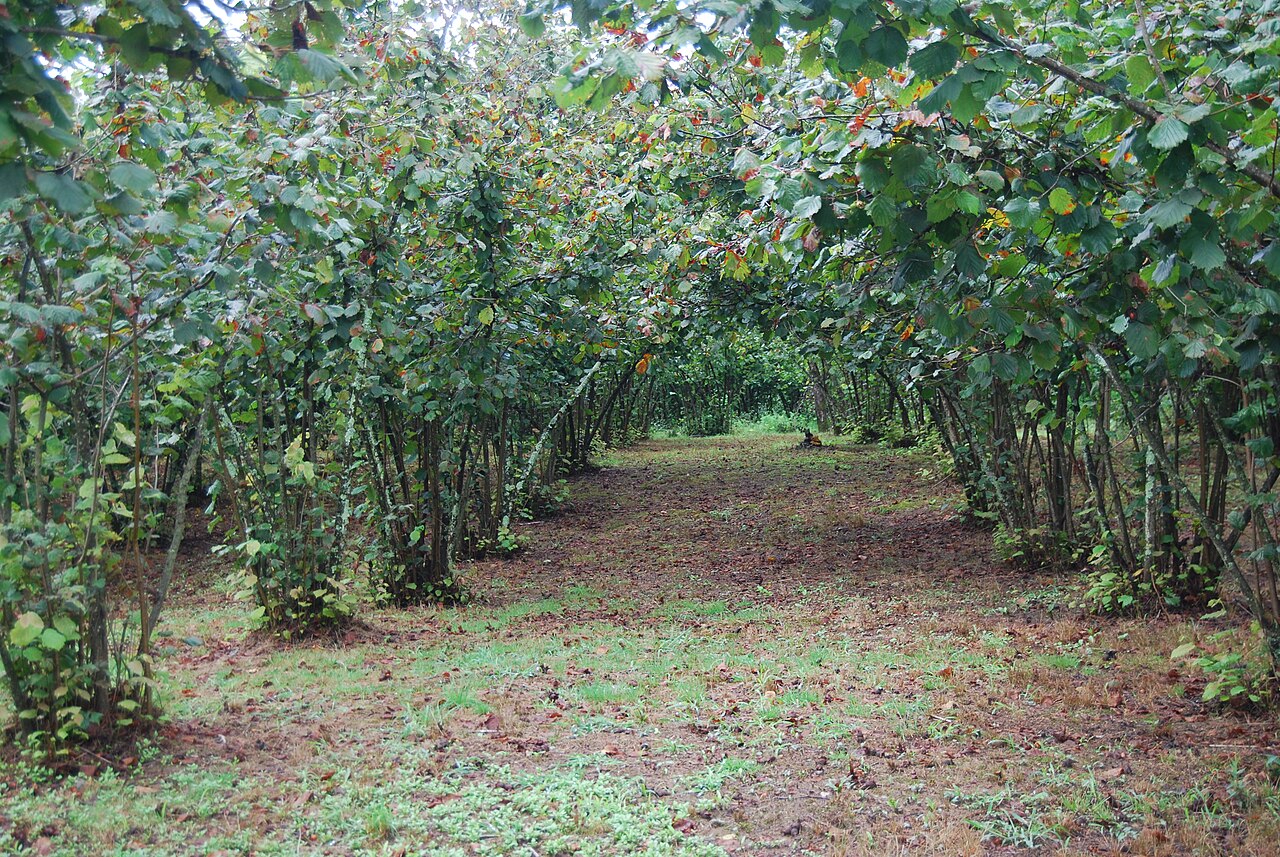
- Vigorous to moderately vigorous, semi-erect to transitional canopy growth; forms a dense canopy (bush up to ~3.5 m).
- Medium to large fruit, oblong-cylindrical, husk longer than the nut and pointed at the tip.
- Average nut mass ~2.5 g, kernel ~1.3 g; shell thin, light chestnut brown.
- High kernel percentage: 52–53 %, according to some sources up to 63 %.
- Large, firm, crisp, sweet kernel, good for storage; skin separates poorly when roasted (hence primarily for table use).
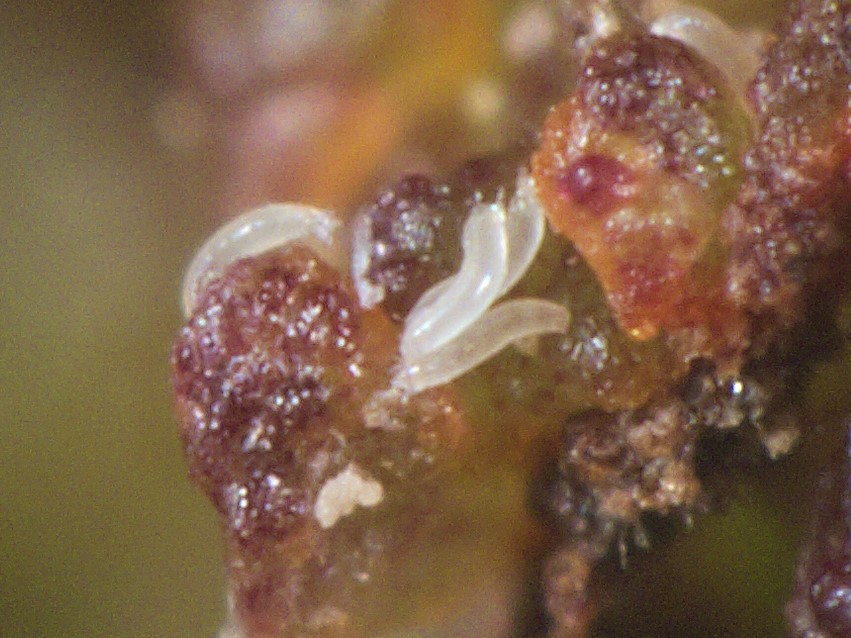
- Sensitive to mites (hazelnut mite) — which should be considered in the health program.
Cosford as a pollinizer and its pollinizers:
- Cosford is self-autosterile, so it also needs a pollinizer; good pollinizers for it are Gunslebert, Long Spanish (Lambert), and Halški div, and from the corpus, Rimski.
- Cosford is simultaneously an excellent pollinizer for other cultivars — it is noted to pollinate Istarski dugi and others well, and is a common partner in English orchards.
- Caution with Istarski duguljasti: Since Istarski duguljasti is intersterile with Cosford, Cosford should NOT be set as the sole pollinizer for Istarski duguljasti. It can be part of the cultivar mix, but alongside other compatible pollinizers (e.g., Apolda, Rimski, Ludolf, Daviana).
Ludolf
Ludolf is a cultivar that is almost exclusively mentioned in the context of pollination in Croatian literature, as a reliable pollen partner for continental orchards.
- In the corpus, Ludolf is listed among cultivars that pollinate Istarski duguljasti very well (alongside Northampton and Rimski lješnjak), as well as explicitly in the list of "good pollinizers: Rimski, Halški džin, Ludolf, Daviana".
- Thus, Ludolf, along with Daviana and Rimski, is one of the recommended pollinizers for Istarski duguljasti that is not affected by the problem of intersterility (unlike Cosford).
- The catkin shedding time of Ludolf places it in a group that overlaps well with mid-early flowering cultivars such as Istarski duguljasti and Rimski; specific phenophases should be confirmed by local observation, as dates strongly depend on location and year.
Gunsleben (Gunslebert)
Gunsleben, more commonly written as Gunslebert, is a German cultivar of medium vigor, very abundant and reliable bearing type, but in practice extremely valued also as a pollinizer.
Properties:
- Medium-large, slightly round fruit with strong, good taste; clusters of six or more nuts — it ranks among the most productive hazelnuts.
- Extremely abundant winter display of catkins, making it an abundant source of pollen.
- Flowering (as with most hazelnuts) lasts 4–6 weeks in the January–March period.
Compatibility:
- Gunslebert is an excellent pollinizer for other cultivars; it is well pollinated by Cosford and Butler.
- In the corpus, Gunsleben is listed among good pollinizers for Istarski duguljasti (alongside Halški div, Rimski, Lambert, Cosford, Apolda, Barcelona).
- Practical combination: Gunslebert + Cosford pollinate each other well and together can cover the main cultivar, with attention to the intersterility of Cosford with Istarski duguljasti.
Apolda
Apolda is another German cultivar classically present on lists of pollinizers for Croatian conditions.
- In the corpus, Istarski duguljasti is described as a cultivar that is "excellently pollinated by cultivars Apolda and Bandnuss", very well by Northampton, Rimski, and Ludolf.
- Apolda is also listed in the broader list of good pollinizers for Istarski duguljasti (alongside Halški div, Rimski, Lambert, Gunsleben, Cosford, Barcelona).
- Due to the rating "excellently pollinated" specifically with Apolda, this cultivar is one of the first choices for pollinating Istarski duguljasti where they overlap temporally — which should be confirmed on site.
Summary overview of pollinizers
The table summarizes the role of the five treated cultivars. Catkin shedding time is given descriptively (early/mid/late) because absolute dates depend on location, altitude, and year — always rely on your own phenological observations.
| Cultivar | Main Role | Catkin Shedding (Approximate) | Special Feature as Pollen Source | Attention / Intersterility |
|---|---|---|---|---|
| Daviana (Daviana) | Pure pollinizer | Late | Very abundant catkins (~4 mil. grains/catkin), highest pollen viability, improves fruit (metaxenia) | Late flowering — check overlap with early-flowering cultivars |
| Cosford | Table cultivar + pollinizer | Mid | Good, versatile pollen source | Intersterile with Istarski duguljasti and Sodlinger; sensitive to mites |
| Ludolf | Pollinizer | Mid | Reliable partner for Istarski duguljasti and Rimski | — |
| Gunsleben (Gunslebert) | Bearing cultivar + pollinizer | Mid | Very abundant catkins, productive and reliable | Self-pollinated by Cosford/Butler |
| Apolda | Pollinizer | Mid–Early | "Excellently" pollinates Istarski duguljasti | — |
Compatibility with leading Croatian cultivars
| Main Cultivar | Recommended Pollinizers (from corpus) | Avoid (Intersterile) |
|---|---|---|
| Istarski duguljasti | Apolda and Bandnuss (excellent); Northampton, Rimski, Ludolf (very good); Halški div, Lambert, Gunsleben, Daviana, Barcelona | Cosford, Sodlinger (intersterile) |
| Barcelona | Daviana (classic partner), Gunsleben, Rimski, Halški div | — |
| Cosford | Gunslebert, Lambert (Long Spanish), Halški div, Rimski | — |
| Rimski | Overlaps well with Istarski duguljasti, Haleški, Barcelona | — |
Key for Croatian orchards: Daviana is a highly compatible and high-quality pollen source for both Istarski duguljasti and Barcelona, so it can be a practical "common" pollinizer in a mixed orchard — provided that its later flowering manages to cover the receptivity of the main cultivar at the specific location.
Practical recommendations and common mistakes
- Do not rely on a single pollinizer. Plant at least 2–3 pollinizer cultivars with different flowering times to cover the entire receptive period of female flowers.
- Check intersterility before planting. The most common mistake in Croatian conditions is planting Cosford as a pollinizer for Istarski duguljasti — these cultivars are intersterile. Use Cosford only with other compatible cultivars (Apolda, Rimski, Ludolf, Davijana).
- Focus on quality, not just fertilization. Davijana not only pollinates but has been proven to reduce the proportion of blind nuts and increase kernel mass — choose your pollen source based on its impact on the nut.
- Orchard layout. Keep pollinizers within ~30 m of bearing trees, distributed evenly, and ensure the total proportion of pollinizers does not exceed ~25% of the area.
- Monitor local phenology. Catkin shedding dates vary significantly by location and year; labels such as early/mid/late in the literature serve only as a rough guide, not as a substitute for your own observations.
- Health status. Cosford is susceptible to hazel erineum mite; align it with your protection program when planning the cultivar mix. All planting material must be free from seven regulated non-quarantine pests (threshold 0%).
Gallery
Sources
This article is an AI-generated summary compiled from an internal literature collection on hazelnuts (RAG corpus) and public internet sources. Main sources used:
From the hazelnut RAG corpus:
- „Good hazelnut yield depends on good pollination" — list of pollinizers (Istarski dugi: Rimski, Halški džin, Ludolf, Davijana; Cosford autosterility).
- „PDF UZGOJ LIJESKE" (pdfcoffee, 2009.) — pollinizers for Istarski duguljasti (Halški div, Rimski, Lambert, Gunsleben, Cosford, Apolda, Barcelona) and intersterility with Cosford/Sodlinger.
- „UNIVERSITY OF ZAGREB" / core (2016.) — Istarski duguljasti: pollinates excellently with Apolda and Bandnuss, very well with Northampton, Rimski, and Ludolf.
- „CHEMICAL COMPOSITION OF HAZELNUTS FROM THE 2020 SEASON" (diploma thesis, PBF, 2022.) — description of the Cosford cultivar (properties, nutting-out percentage, synonyms).
- „Best hazelnut cultivars for Eastern Europe" — Cosford: nut/kernel weight, nutting-out percentage, autosterility, pollinizers (Gunslebert, Dugi španjolski, Halški div).
- „GUIDE TO HAZELNUT CULTIVATION" (savjetodavna.mps.hr, 2024.) and „untitled" (2024.) — leading Croatian cultivars and nutting-out percentage of Istarski duguljasti.
- „HAZELNUT CULTIVATION, book" (2017.) — pollinizer proportion up to 25%, spacing up to 30 m.
- „State and trends in production…" (2017.) and „Phenology of hazelnut flowering…" (Jurkin, 2023.) — rules on the number of pollinizers and flowering overlap.
Public sources (web):
- Hazelnut Growers' Association of New Zealand — Pollenizer management — https://hazelnut-growers.org.nz/2003/07/24/pollenizer-management-in-a-hazelnut-orchard/
- OSU Extension — Growing Hazelnuts in the Pacific Northwest: Pollination and Nut Development — https://extension.oregonstate.edu/catalog/pub/em-9074-growing-hazelnuts-pacific-northwest-pollination-nut-development
- West Coast Nut — Choosing, Planting and Pruning Hazelnut Pollinizers — https://www.wcngg.com/2020/02/03/choosing-planting-and-pruning-hazelnut-pollinizers/
- Effect/Influence of pollen source on nut and kernel characteristics of hazelnut (ResearchGate) — https://www.researchgate.net/publication/291228583_Effect_of_pollen_source_on_nut_and_kernel_characteristics_of_hazelnut
- Frank P Matthews — Gunslebert — https://www.frankpmatthews.com/catalogue/hazel/10033
- Chew Valley Trees — Corylus Gunslebert — https://www.chewvalleytrees.co.uk/products/detail/corylus-gunslebert
- Orange Pippin Trees / Ashridge — Cosford cobnut pollination — https://www.orangepippintrees.co.uk/articles/fruit-tree-advice/hazelnut-pollination
- RHS — Cobnuts and Filberts: Growing Guide — https://www.rhs.org.uk/advice/profile?PID=602