Packaging, Packaging Materials, and Shelf Life of Hazelnuts and Hazelnut Products
Content generated by artificial intelligence — verify before application
This article was automatically compiled from a collection of hazelnut literature using artificial intelligence and may contain errors or outdated data. It serves as a starting point for further research, not as professional advice. Dosages, products, and timeframes are informative and depend on the cultivar, location, and applicable regulations — always consult with advisory services and official sources before application.
Packaging is the final, yet often underestimated, link in the hazelnut quality chain. Everything a producer invests in careful harvesting, drying, and storage can be lost within a few weeks if the nut or processed product is packed in unsuitable packaging. Hazelnut is an oil-rich product — the kernel contains about 60% fat, primarily unsaturated fatty acids — making it highly susceptible to rancidity (oxidative rancidity) promoted by oxygen, light, heat, and moisture. This article consolidates knowledge scattered across multiple sources and provides a comprehensive overview of packaging for in-shell nuts, kernels, oil, and paste, followed by shelf-life estimates by packaging type, basics of shelf-life testing (peroxide value and free fatty acids), and mandatory labeling elements for the Croatian and EU markets.
Why Packaging Choice is Critical
The choice of packaging directly determines the internal conditions around the product — gas composition (primarily oxygen level), humidity, and light exposure — and the stability of the oil in the kernel depends precisely on these conditions. There are three main enemies:
- Oxygen (O₂). Triggers auto-oxidation of fats and the development of rancidity. At low oxygen concentrations (below 1–2%), oxidation is significantly slowed or almost stopped. Many changes depend on redox potential and available oxygen within the package, so controlling the oxygen level is key to long shelf life.
- Light. Promotes photo-oxidation. Dark packaging (e.g., dark cellophane) effectively protects the product from light-induced rancidity; thin parchment paper also protects kernel oil well because light then has no influence on oil changes.
- Moisture. High humidity accelerates mold development (and the risk of aflatoxins) and softens texture. In-shell nuts should be packaged at a moisture content of around 7%, and kernels at around 4%.
Therefore, for kernels, oil, and paste, there is an increasing demand for barrier materials and modified atmospheres, while for in-shell nuts, which have the additional natural protection of the shell, simpler "breathing" packaging is acceptable.
Packaging for In-Shell Nuts
In-shell nuts are the most resilient form for storage because the shell protects against mechanical damage, light, and part of the atmospheric oxygen. Here, the emphasis is on ventilation (preventing condensation and mold), not hermetic sealing.
| Packaging | Application | Note |
|---|---|---|
| Jute / woven sacks (permeable) | Bulk storage, in-shell nuts | Allow air circulation; sacks can be stacked on pallets (e.g., approx. 25 sacks per pallet) or hung in drafty areas |
| Big-bags (500–1000 kg sacks) | Large quantities, transport | Practical for forklift handling; keep in dry, ventilated areas |
| Cardboard boxes (e.g., 10 kg) | Shipping units | Stack in cold rooms or dry warehouses |
| Smaller consumer packages | Retail sale of in-shell nuts | Optionally with perforation for ventilation |
It is important that the nuts are previously dried to the target moisture content, as insufficiently dried hazelnuts in a closed sack will "sweat" and mold. The storage facility must have good ventilation and airflow; sacks on pallets in a ventilated room allow for "natural drying" through air flow.
Packaging for Kernels
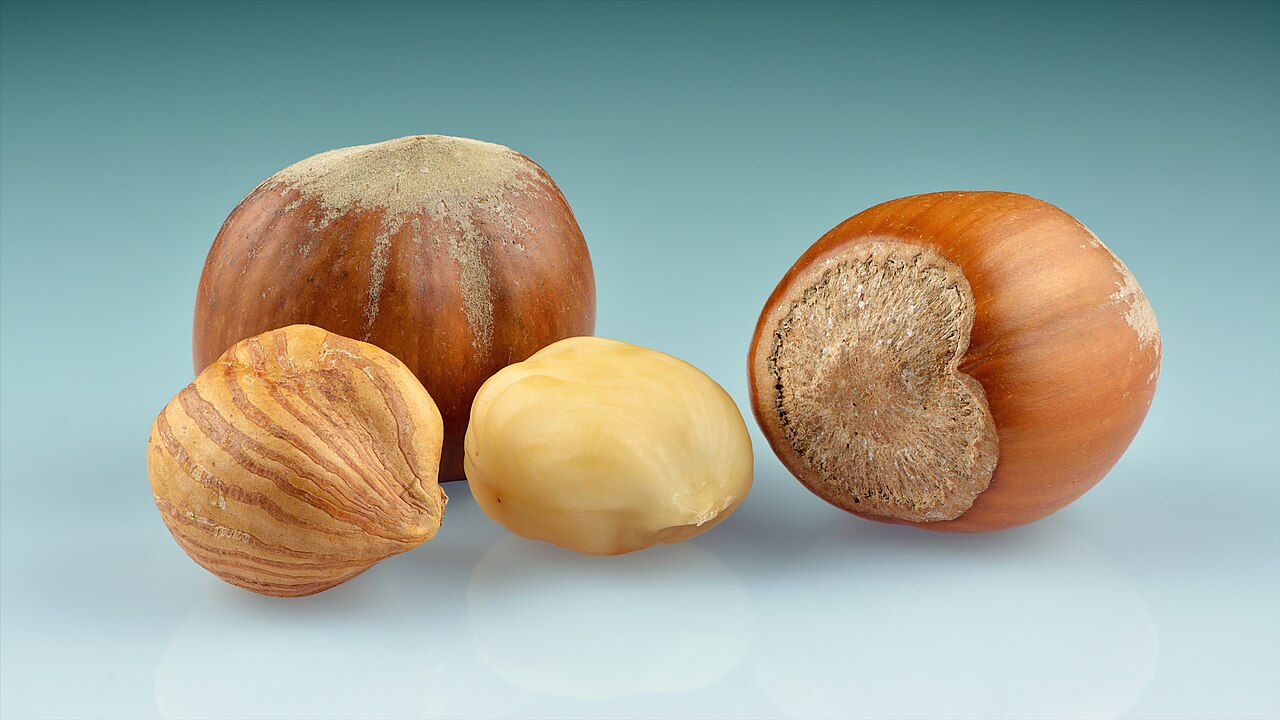
Kernels lack the shell's protection, making them most sensitive to rancidity and absorption of foreign odors (nutty fruits strongly absorb odors, so they must not be stored alongside foods with intense smells). For kernels, the following are applied, in order of increasing protection:
- Standard sacks / cotton bags (e.g., 1 kg, with zip closure). Typically manual packaging on small family farms. Cheap and practical for short-term sales, but poor barrier against oxygen — shortest shelf life.
- Dark or parchment packaging. Reduces photo-oxidation; good for kernels intended for quicker consumption.
- Vacuum packaging. By removing air, available oxygen is drastically reduced and rancidity is slowed; one of the most effective and accessible ways to extend kernel shelf life. Requires low oxygen permeability film to maintain the vacuum.
- Modified Atmosphere Packaging (MAP). Air is replaced with an inert gas; for kernels, 100% nitrogen (N₂) is most commonly used, sometimes with CO₂. Research shows that MAP with 100% N₂ delays lipid oxidation and surpasses edible coatings in maintaining quality.
- Multi-layer barrier laminates (e.g., PET/ALU/PE). Combine mechanical strength, high barrier against oxygen and moisture, and complete light impermeability (aluminum layer). Suitable for snack and premium products as they provide superior protection of aroma and appearance.
- Sacks with oxygen absorbers. Sacks that bind residual oxygen provide additional protection for kernels; useful with barrier film when MAP is not applied.
MAP / Modified and Controlled Atmosphere — How It Works
Modified Atmosphere Packaging (MAP) involves removing air from the package and introducing a specific mixture of gases adapted to the product; this atmosphere then changes dynamically depending on biochemical changes and gas diffusion to the outside. Differences include:
- Passive MAP — the atmosphere establishes itself through product respiration and film permeability.
- Active MAP — the atmosphere is actively set by filling with inert gas (and/or absorbers).
Related is Controlled Atmosphere (CA) storage in large chambers, where the CO₂ and O₂ ratio is continuously regulated around the product, reducing metabolic activity and oxidation. Typical gas mixtures in nut research studies range around 70% N₂ + 30% CO₂, or a high N₂ content with very low O₂.
Practical
For kernels, the goal is O₂ below 1–2%. Vacuum is the simplest path to low oxygen for smaller producers; MAP with nitrogen is the standard for larger batches and premium lines. In both cases, the film must be barrier — otherwise, the difference disappears quickly.
Packaging for Hazelnut Oil
Hazelnut oil is pure fat and most sensitive to light, oxygen, and heat. Rules:
- Dark glass (amber/green bottles) — standard for cold-pressed nut oils; glass is inert, and dark color blocks light.
- Minimal "headspace" (air space above the oil) and good cap sealing — less residual oxygen means slower oxidation. Filling under inert gas (N₂) further extends shelf life.
- Tins / metal packaging with internal protection — complete barrier against light, an alternative to glass for larger packages.
- Store in a cool, dark place; avoid transparent plastic and exposure to daylight on shelves.
Packaging for Paste (Spread / Hazelnut Butter)
Paste contains finely ground kernels with a large exposed oil surface, so oxidation is rapid once opened:
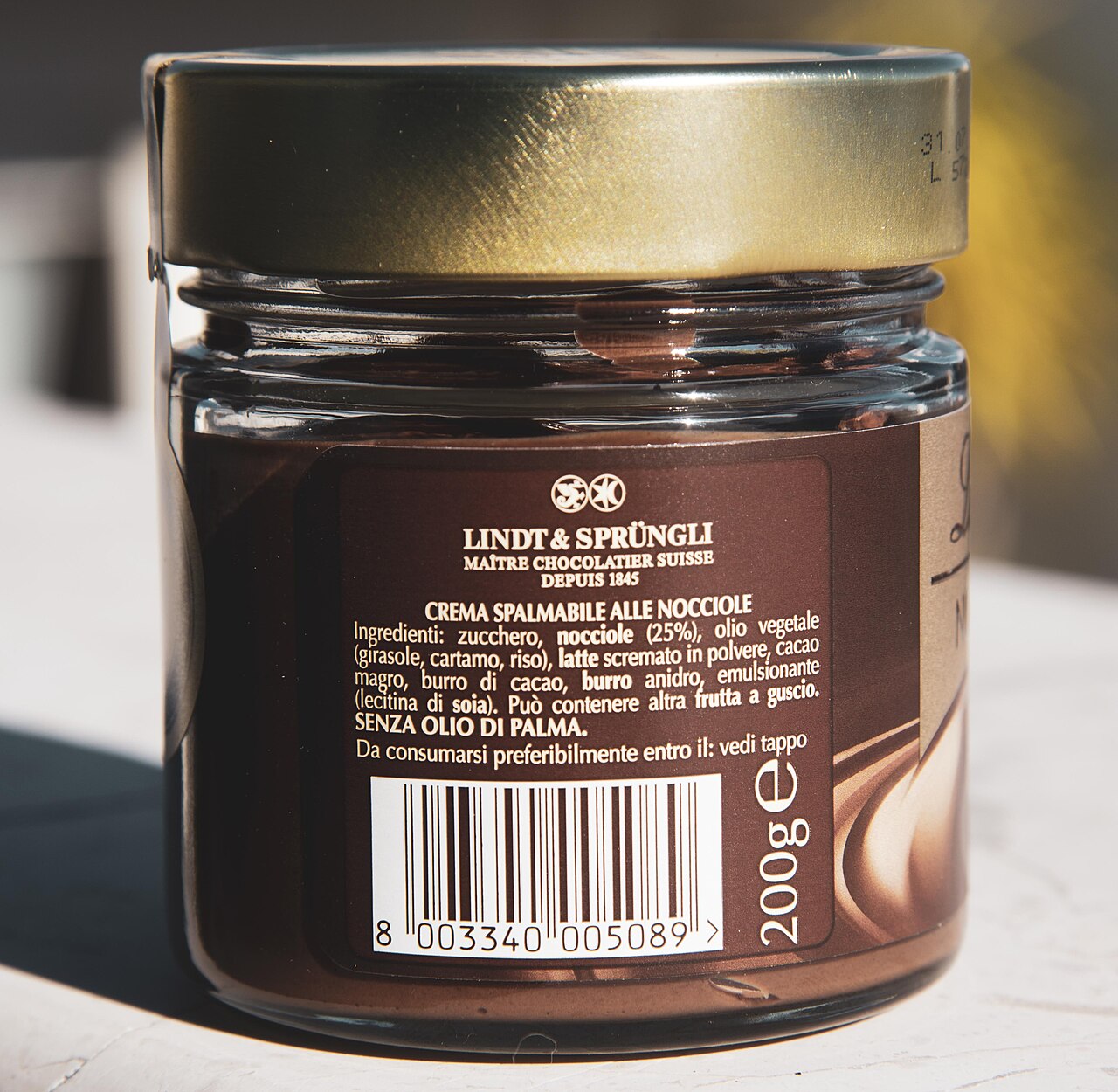
- Glass jars (preferably dark) with hermetic lids for premium and short batches.
- Barrier plastic containers or laminate doypack bags for larger quantities and practicality.
- For industrial spreads, filling is done with minimal headspace and, where possible, nitrogen inertization.
- After opening, the product is stored in the refrigerator and consumed quickly; oil separation on top is a physical phenomenon, but increased air exposure accelerates rancidity.
Shelf Life by Form and Packaging
The following approximate shelf lives are summarized from literature. They are informative and depend heavily on initial quality and moisture, cultivar, storage temperature, and packaging quality (especially barrier properties and oxygen level).
| Form / Packaging | Conditions | Approximate Shelf Life |
|---|---|---|
| In-shell nuts, ventilated sack, dry storage | well-dried, cold (< 10 °C) | up to 24 months |
| In-shell nuts, room conditions | dry, ventilated | approx. 12 months (2–3 years under ideal conditions) |
| Kernels, refrigerated | 4–5 °C, RH 55–60% | up to ~12 months |
| Kernels, room conditions, standard packaging | permeable sack | a few months (can go rancid within weeks if hot and bright) |
| Kernels, vacuum / MAP (N₂) | low O₂, cold | significantly extended compared to standard sack |
| Roasted hazelnuts | 0, 5, or 10 °C | up to ~6 months until rancidity appears |
| Roasted/peeled kernels, room conditions | — | approx. 3 months |
Additional guidelines from literature:
- Temperature is critical. At temperatures below 10 °C, in-shell nuts can be stored with minimal quality loss for up to 24 months. During two years of storage, the peroxide value was highest at 10 °C, lower at 5 °C, and lowest at 0 °C.
- Bitterness increases with time. Nuts stored for a year and a half have about 4% bitter kernels, and after 3 years up to 22% — which is a practical limit for long-term storage regardless of packaging.
- Refrigeration vs. cost. Low temperatures are most effective for extending shelf life, but hazelnuts are often stored at room temperature due to high energy costs for refrigeration. A combination of barrier packaging + low oxygen partially compensates for the lack of refrigeration.
Shelf-Life Testing: PV and FFA
Shelf life is not assessed "by eye." There are two fundamental laboratory indicators of fat oxidative deterioration:
- Peroxide Value (PV). Measures primary oxidation products (hydroperoxides). The increase in PV during storage is a direct signal of advancing rancidity and is the main parameter monitored in shelf-life tests. Lower PV = fresher fat.
- Free Fatty Acids (FFA) / Acid Value. Measure hydrolytic rancidity (splitting of fats into free fatty acids). An increase in FFA indicates hydrolysis, often associated with moisture and poor conditions.
Alongside these, sensory attributes, moisture, mass (weight loss), hardness, and color are monitored, and sometimes TBARS (secondary oxidation products). Typical procedure: store samples in different packaging/conditions, periodically remove and measure PV and FFA until an acceptability limit is reached — thus experimentally determining the actual shelf life of a specific product and package.
Practical
Limit values for PV and FFA depend on the product type and market/standard; check applicable standards (Codex Alimentarius for nuts and oils, and customer specifications). Always interpret numbers in conjunction with the production date and storage conditions.
Mandatory Labeling Elements (HR/EU)
For the sale of packaged hazelnut products on the Croatian and EU markets, the label must contain the prescribed data according to EU Regulation (EU) No 1169/2011 on the provision of food information to consumers. Key mandatory elements include:
- Name of the food (e.g., "Hazelnuts in shell," "Hazelnut kernels," "Roasted hazelnuts," "Hazelnut oil," "Hazelnut spread").
- Net quantity (mass in g/kg or volume for oils).
- Shelf life — "Best before" (date of minimum durability) for such products, accompanied by the batch/lot number.
- Storage conditions (e.g., "Store in a dry, cool, and dark place"; for paste after opening, "Store in a refrigerator").
- Name and address of the food business operator (producer/packer/distributor within the EU).
- List of ingredients (for processed products; for raw kernels/nuts, a single ingredient).
- Allergens — Hazelnuts are tree nuts and must be highlighted as an allergen (emphasized in the ingredients list); any potential traces must be declared if applicable.
- Nutrition declaration (energy value, fats and saturates, carbohydrates and sugars, proteins, salt) — mandatory for packaged food products (subject to prescribed exemptions).
- Country of origin where applicable, and organic production label/certification if claimed.
For hazelnut planting material and reproductive material, separate regulations apply (packaging, sealing, and labeling of planting material according to the relevant ordinance), which differ from food product labeling. Packaging waste must be disposed of properly in accordance with packaging waste management regulations.
Practical
Align nutritional values and exact allergen text with laboratory analysis of your product and current requirements; verify the label text with the competent authority or a food labeling expert before printing.
Practical Recommendations and Common Mistakes
- Do not package insufficiently dried product. Moisture trapped in hermetic packaging leads to mold and aflatoxins. Aim for ~7 % moisture in the shell and ~4 % in the kernel.
- Choose the barrier based on the form. Whole nuts in shell → breathable; kernels/oil/paste → barrier + low oxygen + dark.
- Hermetic does not automatically mean better. Hermetic packaging of moist nuts worsens the condition; hermeticity makes sense only with dry product and oxygen control.
- Do not neglect light. Transparent plastic on a lit shelf rapidly accelerates rancidity in kernels and oil — use dark/barrier packaging.
- Store away from odors. Tree nuts absorb foreign odors; do not store alongside aromatic foods or chemicals.
- Monitor PV and FFA. Without measurement, shelf life is only guessed; simple periodic tests provide a realistic picture.
- Vacuum/MAP requires the correct film. Without a barrier film, vacuum is lost and inert gas diffuses out — the effect disappears.
- Cold extends shelf life but costs money. Where cooling is not cost-effective, combine low oxygen (vacuum/MAP) with dark barrier packaging and a dry, ventilated storage facility.
Sources
This article is an AI summary compiled from an internal hazelnut literature collection (RAG corpus) and publicly available sources. Main sources used:
- Vrtodušić et al. (2022): Technology of Harvesting, Drying, and Storing Hazelnuts: A Literature Review, Journal of Central European Agriculture — https://jcea.agr.hr/articles/772314_Tehnologija_berbe_su_enja_i_skladi_tenja_lje_njaka_Pregled_literature_hr.pdf
- Cultivation of Hazelnuts (book, 2017) — kernel grading and storage periods (RAG corpus)
- Hazelnut Cultivation (manual, 2009) — bitter kernels and storage (RAG corpus)
- Cascaded Use of Hazelnut By-products (2025) — selection of PET/ALU/PE packaging for snack products (RAG corpus)
- Hazelnut Processing at Pantera Company (2025) and Family Farm Hobolić Alen (2021) — practices for kernel and processed product packaging (RAG corpus)
- Unraveling Mechanisms of Enzymatic Browning in Nuts (Molecules, 2025) — MAP vs. controlled atmosphere (RAG corpus)
- Food preservation by cold plasma / MAP (2022) — gas mixture composition in MAP (RAG corpus)
- Masterpack: The benefits of storing hazelnuts under Modified Atmosphere packaging — https://blog.masterpackgroup.com/the-benefits-of-storing-hazelnuts-under-modified-atmosphere-packaging
- Making.com: How to protect your hazelnuts from going rancid along the supply chain — https://making.com/stories/how-to-protect-your-hazelnuts-from-going-rancid-along-the-supply-chain-2
- Investigation of antioxidant edible coating and modified atmosphere packaging for hazelnut kernels, ScienceDirect — https://www.sciencedirect.com/science/article/pii/S2666154324002837
- Influence of Arabic Gum/Gelatin/Ascorbyl Palmitate Coating on Quality Parameters of Hazelnut Kernels (Molecules, 2025) — https://www.ncbi.nlm.nih.gov/pmc/articles/PMC12565976/
- Regulation (EU) No 1169/2011 on the provision of food information to consumers (mandatory labeling elements) — official EU law source
Recommended equipment
🔎 food dehydrator — Amazon →Affiliate links — we may earn a small commission at no extra cost to you.
Food Dehydrator
For controlled drying of small batches.
| Use Case | Option Type | What to Check Before Purchase |
|---|---|---|
| Small batch drying | Stackable tray model | Tray material and airflow design |
| Uniform drying | Fan-powered unit | Temperature control accuracy |
| Commercial volume | Industrial dehydrator | Professional capacity and energy use |