Investment decision on mechanization: buy, rent, or hire a service
Content generated by artificial intelligence — verify before application
This article was automatically compiled from a collection of hazelnut literature with the help of artificial intelligence and may contain errors or outdated data. It serves as a starting point for further research, not as professional advice. Dosages, products, and timelines are informative and depend on the cultivar, location, and applicable regulations — always verify with an advisory service and official sources before application.
Mechanization in a hazelnut orchard is one of the largest, yet most easily misjudged, investment items. Tractors, atomizers, mowers, fruit harvesters, and processing and drying equipment can easily exceed the value of the land and planting material itself — in one Croatian business plan, mechanization accounts for nearly 24% of the total investment in the project. Therefore, the question of "buy your own machine, rent it, order a service, or collaborate with other producers?" is not primarily technical but economic. The answer is almost never the same for everyone: it depends on the size of the orchard, the annual utilization rate of the machine, the availability of services in the area, and how important it is for you to have access to the machine at the critical moment of harvest or protection. This article provides a framework for this decision — from cost structure to calculating the break-even point, to realistic scenarios for small, medium, and large orchards.
Why the decision is harder than it seems
Mechanization has two characteristics that make the "instinctive" decision often wrong:
- A large portion of the cost is fixed and incurred regardless of use. Depreciation, interest on invested capital, insurance, registration, and machine storage costs are incurred even when the machine sits in the garage. The less you use the machine, the larger share of these fixed costs each working hour or each hectare "carries."
- The most expensive machines are often the least utilized. In arable farming, the combine harvester is a classic example: it is one of the most expensive machines, yet its annual utilization is only about 7%. The same applies to hazelnuts for fruit harvesters and processing/drying equipment — they operate for only a few weeks a year, yet sit idle at high cost.
The consequence is simple: a machine you rarely use is almost always cheaper to rent or pay for as a service than to buy. Owning a machine is only worthwhile when you use it sufficiently (enough hours or enough hectares per year) to spread its fixed costs over a reasonable price per unit of work.
Anatomy of machine cost
To even compare buying with renting or hiring a service, we divide the costs of owning a machine into two groups.
| Group | Items | Dependent on use? |
|---|---|---|
| Fixed (ownership) costs | Depreciation, capital interest, insurance, registration, storage/garage | No — incurred even when the machine is idle |
| Variable (operating) costs | Fuel and lubricants, repairs and spare parts, operator labor, wear parts | Yes — increase with the number of hours/hectares |
The key rule states: the fixed cost per unit of work decreases as annual utilization increases. The same machine costing, for example, 350,000 in value and operating 200 hours a year has twice the fixed cost per hour compared to one operating 400 hours. Therefore, "dead capital" in an underutilized machine quietly erodes the profitability of the entire orchard.
Approximate depreciation rates
Croatian business plans for hazelnuts typically apply these rates (informative, dependent on tax regulations and actual lifespan):
| Asset | Typical annual depreciation rate |
|---|---|
| Buildings (dryer, warehouse, cold storage) | ~5 % |
| Mechanization (tractor, attachments, harvester) | ~25 % |
| Founding investments | ~10 % |
In one concrete plan, mechanization valued at 87,000 yields an annual depreciation of about 21,750 — which is just one, fixed, component of the annual cost, before fuel, repairs, and labor.
Note: Figures from the literature were originally expressed in Croatian Kuna (plans from 2015–2019). They are retained for source fidelity; for today's decisions, convert them to Euros (1 EUR ≈ 7.53 HRK) and update to current market prices for machines and services.
Four models for securing mechanization
1. Purchase (own machine)
Advantages: complete availability at the critical moment (harvest, protection), independence from others' schedules, ability to provide services to others and thus increase utilization. A large portion of expensive equipment (dryers, harvesters, combines) in Croatia and Turkey is purchased with support (IPARD), thereby reducing the effective acquisition cost.
Disadvantages: highest initial outlay, capital tie-up, full burden of fixed costs, and risk of low utilization on small areas.
When it makes sense: large and/or specialized orchards, machines you use frequently (tractor, atomizer, mower), and cases where you can utilize the machine further by providing services to other producers.
2. Rental / Leasing
Advantages: you pay approximately what you use, without a large initial outlay and without long-term capital tie-up. Ideal for occasional need for expensive, specialized machinery. EU programs (e.g., Italian measures) explicitly recognize leasing or renting machinery and equipment for preserving and improving product quality as an acceptable model.
Disadvantages: per unit of use, it can be more expensive than owning your own machine if you actually use it a lot; dependence on rental availability during peak season. Caution: some national support programs do not recognize rental costs, interest, and borrowing as eligible (case of the Turkish program for machinery and equipment) — check conditions before relying on rental in a co-financed project.
3. Service (custom hire)
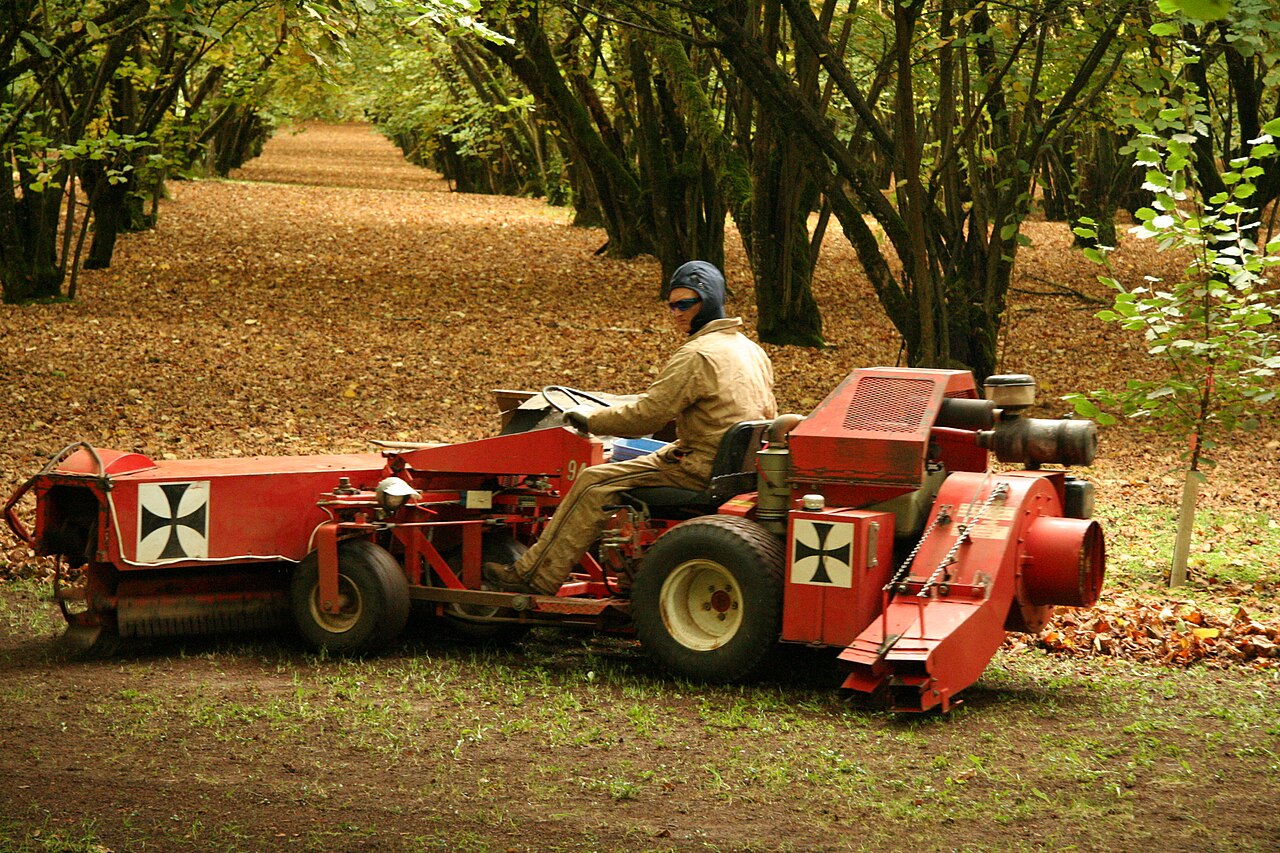
Advantages: you do not own or maintain the machine — you pay for a finished operation per hectare or per ton. The service provider uses their machine very intensively, spreading the fixed cost over many more hectares, and can often offer you the operation cheaper than your own labor would cost. In hazelnut production, this is already common for processing, drying, and shell cleaning — owners of large equipment (e.g., companies with their own orchard of 7+ ha) routinely provide these services to smaller producers.
Disadvantages: dependence on others' schedules at the most critical moment. Delays in harvest or protection can cause greater losses than all the savings from not owning the machine. Therefore, for many producers, the service must be significantly cheaper than the break-even point to relinquish control over the timing.
4. Cooperation / Joint ownership (machine ring)
Advantages: multiple producers share the cost and utilization of one machine, thereby increasing the annual utilization of "their share" for each and lowering the fixed cost per hectare. Models range from informal agreements and joint companies (LLC) to formal cooperatives or machine rings. Cooperative agreements in hazelnut production (e.g., the model with a buyer) also offer guaranteed purchase prices as well as advisory and machine support.
Disadvantages: requires trust, clear rules on schedules, maintenance, and cost sharing; conflict over priorities during peak season is a common reason for breakdown. Research shows that farmers often prefer informal sharing or LLCs over formal cooperatives.
Break-even point: when buying starts to pay off
The key idea: owning a machine is only worthwhile when you use it above a certain utilization threshold. There are two simple, complementary ways to estimate it.
The 60% Rule (quick check)
A practical rule from agricultural literature: if you use the machine more than ~60% of the time it could work (approximately 12–14 working days per month during the season), buying is usually more cost-effective than renting. Below that, renting or hiring a service almost always wins. For seasonal machines in hazelnut production (harvester, sprayer in narrow protection windows), this rule quickly shows that utilization on a small orchard is often too low to justify buying.
Threshold Formula (more accurate calculation)
We calculate the true limit by comparing the annual fixed costs of owning your own machine with what you pay for the service:
Minimum Area (ha/year) = Annual fixed costs of own machine ÷ [Service price (€/ha) − Operating costs of own work (€/ha)]
In other words: we divide the annual fixed cost of owning the machine by the savings per hectare achieved by working yourself instead of paying for a service. The result is the number of hectares above which buying is worthwhile. If your orchard has fewer hectares than the calculated threshold — take the service or rent.
Hypothetical Example (illustration of method, not a price recommendation)
| Size | Value |
|---|---|
| Annual fixed cost of harvester (depreciation + interest + insurance) | 4,000 €/year |
| Service harvest price | 250 €/ha |
| Operating cost of own harvest (fuel, labor, repairs) | 90 €/ha |
| Savings per hectare with own work | 250 − 90 = 160 €/ha |
| Break-even point | 4,000 ÷ 160 = 25 ha |
In this (fictional) example, an own harvester is only worthwhile above ~25 ha; below that, service harvest is cheaper. The figures are illustrative only — insert your actual prices for the machine, service, and operation. The principle is universal: higher fixed cost raises the threshold, while a larger difference between service price and own operating cost lowers it.
Utilization as a measure of mechanization level
Professional literature on hazelnut mechanization uses indicators that help assess whether an orchard is "over-mechanized" or "under-mechanized":
- tractor power per hectare (kW/ha) — in Turkish orchards, organic production showed ~1.3 kW/ha, while traditional showed over 6 kW/ha;
- number of tractors per 1,000 ha and area cultivated per one tractor (ha/tractor).
High power per hectare on a small area is a sign of underutilization — capital is "sleeping." A low value may mean you rely too much on manual labor or services. The goal is to hit the level where machines are sufficiently loaded.
Typical machines and recommended model by phase
| Machine / Operation | Work Frequency | Typically Most Cost-Effective Model |
|---|---|---|
| Tractor (75–95 HP; smaller "vineyard" type up to year 4) | Entire season, many operations | Purchase — high utilization |
| Atomizer/Sprayer (reach 7–8 m) | Multiple times per season, narrow windows | Purchase for medium/large; service/cooperation for small |
| Mower / Inter-row mower | Regularly during vegetation | Purchase (often with tractor) |
| Fruit Harvester / Combine for Harvest | A few weeks per year | Service or cooperation below threshold; purchase above threshold (~from 3 ha upwards depending on prices) |
| Dryer / Processing and shell cleaning equipment | Short, seasonal, very expensive | Service (processing/drying with larger producers) or purchase with IPARD support and by providing services to others |
Power figures (75–95 HP for all tasks; harvesters require from ~30 HP to several hundred HP depending on design) are informative and depend on terrain, cultivar, planting distance, and machine design.
Practical Recommendations
- Calculate utilization first, then choose. Estimate how many hours/hectares the machine realistically operates annually; only then compare purchasing with service using the break-even formula.
- Separate machines by frequency of use. Equipment used throughout the season (tractor, atomizer, mower) is often worth owning; equipment used for only a few weeks (harvester, dryer) is often cheaper as a service or through cooperation.
- Prepare the orchard for machinery. Mechanical harvesting requires leveled, rolled, and weed-free soil under the trees; without this, the harvester loses efficiency and the savings disappear.
- Leverage subsidies — but check the rules. Expensive processing/drying is often funded through IPARD; however, some programs do not recognize rental, interest, or used machines as eligible costs.
- Turn your own machine into a revenue source. If you purchase expensive equipment, providing processing/drying services to others increases utilization and shortens the payback period.
- Value the risk of timing. With services and cooperation, secure the schedule in the peak period via contract; delays in harvesting or protection can cost more than any savings.
Common Mistakes
- Buying "just in case" for a machine used for only a few weeks — fixed costs quietly eat into the orchard's profit.
- Ignoring fixed costs in comparisons: looking only at the machine price, not amortization + interest + insurance + registration + storage on an annual basis.
- Overestimating own utilization — "I'll work for others too" remains on paper, and the machine sits idle.
- Relying on service without a scheduled slot, resulting in crop loss due to delays.
- Entering cooperation without written rules regarding schedules, maintenance, and cost sharing.
Decision Algorithm Summary
- List machines and estimate the annual utilization of each (hours or ha).
- For each expensive/seasonal machine, calculate the break-even threshold (fixed costs ÷ savings per ha).
- If your area is above the threshold and you have capital/subsidies → consider purchasing (ideally while providing services to others).
- If you are below the threshold → service (if available and the slot is secured) or cooperation/machinery ring with other producers.
- For occasional, short-term needs for expensive machinery → rental/leasing, after verifying eligibility under your subsidy program.
Gallery
Sources
This article is an AI summary from an internal hazelnut literature collection (RAG corpus) and publicly available sources on agricultural mechanization economics. Main sources used:
From RAG Corpus (hazelnut literature):
- Business Plan for Hazelnut Seedling Production (2019.) — investment structure, amortization rates (mechanization ~25 %), investment of 80,000 kn in mechanization on 5 ha.
- Mechanization in Hazelnut Production and Processing at Minas-zrno 1 (2021.) — harvester for harvesting ~3 ha, atomizer (range 7–8 m), IPARD for expensive processing/drying, providing services to others (orchard 7.34 ha).
- Establishing a Permanent Hazelnut Orchard / Environmental Protection Elaborate (2020.) — 75–95 HP tractor for all tasks; fuel consumption ~5,000 l/year at ~500 h of tractor operation.
- Tractor Attachment for Hazelnut Harvesting, Gojak (2020.) — harvesters as tractor attachments or standalone machines, power from 30 HP to several hundred HP.
- Hazelnut Cultivation — Agricultural Forum (2007.) — cooperative model (Corylus), "viticultural" tractor up to year 4, buy-back service without the need for own drying facility.
- A Guide to Sharing Farm Equipment (2018.) — models of shared machinery ownership (informal, LLC, cooperative).
- State and Trends in Production and Consumption (2017), DOI 10.31727/gzb.42.3.9 — annual operating costs of an orchard (~60,000 kn for a 10 t orchard).
- The agricultural mechanization situation… in Türkiye, Kahraman et al. (2023.) — mechanization level indicators (kW/ha, tractor/1,000 ha, ha/tractor).
Public Sources (mechanization economics):
- Farm Machinery Costs: Own, Lease or Custom Hire — SDSU Extension — https://openprairie.sdstate.edu/cgi/viewcontent.cgi?article=1481&context=extension_circ
- Estimating Farm Machinery Costs — University of Arkansas (UAEX) — https://www.uaex.uada.edu/publications/PDF/fsa-21.pdf
- Guide to machinery costs and contract rates — NSW DPI — https://www.dpi.nsw.gov.au/__data/assets/pdf_file/0011/302699/Guide-to-machinery-costs-and-contract-rates.pdf
- Managing Farm Equipment Ownership Costs — MU Extension (G435) — https://extension.missouri.edu/publications/g435
- Machinery Cost Estimates for 2025 — farmdoc daily — https://farmdocdaily.illinois.edu/2025/09/machinery-cost-estimates-for-2025.html
- Custom Rates and Machinery Costs — Ohio State Farm Office — https://farmoffice.osu.edu/farm-management/custom-rates-and-machinery-costs
All dosages, power ratings, prices, and break-even thresholds are indicative and depend on cultivar, location, terrain, machine/service prices, and current regulations — consult advisory services and official sources before making decisions.
Recommended equipment
🔎 nut harvester machine — Amazon →Affiliate links — we may earn a small commission at no extra cost to you.
Hazelnut Harvesting Equipment
Compare manual, semi-mechanized, and larger solutions.
| Use Case | Option Type | What to Check Before Purchase |
|---|---|---|
| Small gardens | Manual rakes and nets | Handle length and net durability |
| Medium orchards | Semi-mechanized sweepers | Engine power and collection capacity |
| Large plantations | Over-the-row harvesters | Professional machinery specifications |