Irrigation of young hazelnut orchards: The first three years
Content generated by artificial intelligence — verify before application
This article was automatically compiled from a collection of hazelnut literature with the aid of artificial intelligence and may contain errors or outdated data. It serves as a starting point for further research, not as professional advice. Dosages, products, and timing are informative and depend on the cultivar, location, and current regulations — always consult with an advisory service and official sources before application.
The first three years of a hazelnut orchard’s life are critical for everything that follows. During this period, a young sapling invests almost all its energy into root development; only when the root system is sufficiently developed and the plant is well-anchored does the above-ground part experience rapid growth and enter the reproductive phase. Therefore, irrigation during the orchard establishment phase is not merely "watering to prevent wilting," but a strategic tool used to shape root depth and distribution, reduce sapling stress, and increase survival rates and growth speed. This article explains the goals of irrigation in years 1–3, the principle of deeper and less frequent watering, the annual decrease in frequency, and the transition from "establishment irrigation" to "production irrigation" as the orchard enters production.
Why the first three years are special
Young hazelnut has a shallow and poorly developed root system. Literature repeatedly emphasizes that "irrigation is essential, especially in the first years because of the shallow root, so it is important that the plant has access to water." In hazelnut, the majority of roots are concentrated in the top 40–50 cm of soil, while a smaller portion of deeper roots (more than 1 m) ensures stability and water supply on the hottest days. During the establishment phase, this deeper part still needs to be built, making the plant extremely sensitive to drought.
Foreign sources (e.g., hybrid hazelnut manuals) estimate that in the first one to two years, almost all the sapling’s energy goes into root production; only when the plant is well-rooted and anchored does rapid growth follow (from a typical 10–15 cm growth in the first year to 45–60 cm and more once the plant is established), followed by the development of flowers and first nuts after about 4–5 years.
Conclusion for practice: The goal of irrigation in years 1–3 is not maximum yield (as there are almost no nuts), but maximum survival and the development of a deep, healthy root system.
| Phase | Main Plant Goal | Main Irrigation Goal |
|---|---|---|
| Year 1 | Survival, initial root | Prevent drought stress, encourage rooting |
| Year 2 | Root expansion and deepening | Direct roots downward (deeper, less frequent) |
| Year 3 | Establishment completion, initial vigor | "Harden" the plant, reduce dependence on irrigation |
| Year 4+ (Production) | Nut, kernel, yield | Scheduled irrigation during critical phenological phases |
Main goal: Development of deep roots
Water moves downward in the soil, and roots grow toward water. If you water lightly and frequently, you only moisten the top few centimeters of soil, encouraging the formation of shallow roots that "get used" to surface moisture. Such a plant becomes permanently dependent on frequent watering and is highly vulnerable to drought, heat, and irrigation system failures.
The principle that runs through almost all professional literature is: thorough soaking at less frequent intervals is better for root development and sapling health than frequent, shallow watering. American planting manuals (NARD) recommend that during each irrigation, the soil be moistened throughout the entire root zone profile — for new saplings, this is a depth of approximately 40–60 cm (16–24 inches), while for mature trees, it is 90–150 cm. Afterward, allow the top layer of soil to partially dry out before the next irrigation, which facilitates gas exchange (oxygen) in the root zone and encourages roots to grow deeper.
This same principle is confirmed by general fruit tree guides: deep, less frequent watering drives roots downward for stability and drought resistance; roots need to reach at least 30 cm in depth, so water must penetrate at least that deep. Conversely, frequent and shallow watering with sprinklers creates a shallow root system.
Deep watering rule in one sentence
Water so that each time the water penetrates to the bottom of the root zone, then wait for the top layer of soil to dry out — better less often and abundantly than frequently and superficially.
How much water? Approximate quantities and frequency
Hazelnut requires a moist habitat throughout the year. Croatian sources cite optimal 800–1200 mm of annual precipitation, of which at least 350–400 mm should fall during the vegetation period (months 4–9), and about 280 mm from April to July (approximately 70 mm per month). Where precipitation and its distribution do not cover this — and in increasingly dry summers in July and August, this is the rule, not the exception — the difference must be compensated by irrigation. Estimates for Croatian locations (e.g., the Sisak/Glina area) suggest about 100 mm of supplemental irrigation during vegetation for a productive orchard, while for a young orchard, the estimated average annual need is significantly lower (on the order of one-fifth of the need of a fully productive orchard per hectare), because young plants have less leaf mass and lower transpiration.
For individual saplings and watering frequency, sources provide the following frameworks (all are informative and highly dependent on soil, climate, and timing):
| Source / Context | Quantity per plant | Frequency | Note |
|---|---|---|---|
| NARD (USA), saplings first 3 years | ~25 mm (1 inch) of water | every 7–10 days during vegetation | soak entire profile to 40–60 cm |
| Hazelnut hedge guide (OSU/EM8721) | "deeply" | 1st year: weekly, 2nd year: every 2 weeks, 3rd year: monthly | depends on location and type |
| Croatian/regional gardening sources | 30–50 (up to 60–80) l per bush | 5–7 times during vegetation, avg. ~1×/month | more often in drought; skip after rain |
| Bucket (manual watering) | ~20 l (5 gal) slowly around plant | as needed | do not pour directly on the plant |
Manual dosing "by bucket" (6–8 buckets, i.e., ten liters per sapling at planting and upwards) is useful for small orchards, but the quantity must always be adjusted so that water truly soaks to root depth, rather than just moistening the surface. At planting, it is recommended to water generously immediately, and in continental conditions, saplings begin regular watering approximately one week after planting.
Measure, don't guess
The most reliable way to determine water needs is checking soil moisture with a probe or stick at root depth. Irrigate only when the top ~30 cm has dried out (for newly planted saplings), not according to a fixed calendar. After heavier rain, skip irrigation — hazelnut does not tolerate water stagnation; roots in constantly wet soil rot easily.
Annual decrease in watering frequency
The key idea of the establishment strategy is that irrigation frequency decreases from year to year as roots penetrate deeper and the plant becomes more independent. A clear, practical pattern is given by the hazelnut hedge planting guide: water once a week during summer heat in the first year, every two weeks in the second year, and once a month in the third year; with the note that most saplings will not survive without supplemental irrigation in the first few years, but needs depend on location.
| Year | Approximate Frequency (Peak Summer) | Logic |
|---|---|---|
| 1st year | ~1× weekly | shallow root, plant most vulnerable |
| 2nd year | ~1× every 2 weeks | root expands and deepens |
| 3rd year | ~1× monthly | root established, plant more resilient |
| 4th year (Production) | transition to scheduled irrigation by phenological phases | goal becomes yield and kernel quality |
With each irrigation, the quantity per watering remains abundant (soaking the entire profile) — the number of waterings decreases, not the depth of soaking. This gradually "teaches" the plant to seek water deeper and tolerate longer dry intervals, which is precisely the goal of hardening before entering production.
This pattern is orientative: on sandy, fast-draining soils and in extremely dry, windy locations, intervals will be shorter; on heavier, moisture-retentive soils and in wetter years, longer. It must always be adjusted according to actual soil moisture and weather forecasts.
How to irrigate: Systems and technique
The choice of system during the establishment phase affects how easily the principle of deeper and less frequent watering can be implemented.
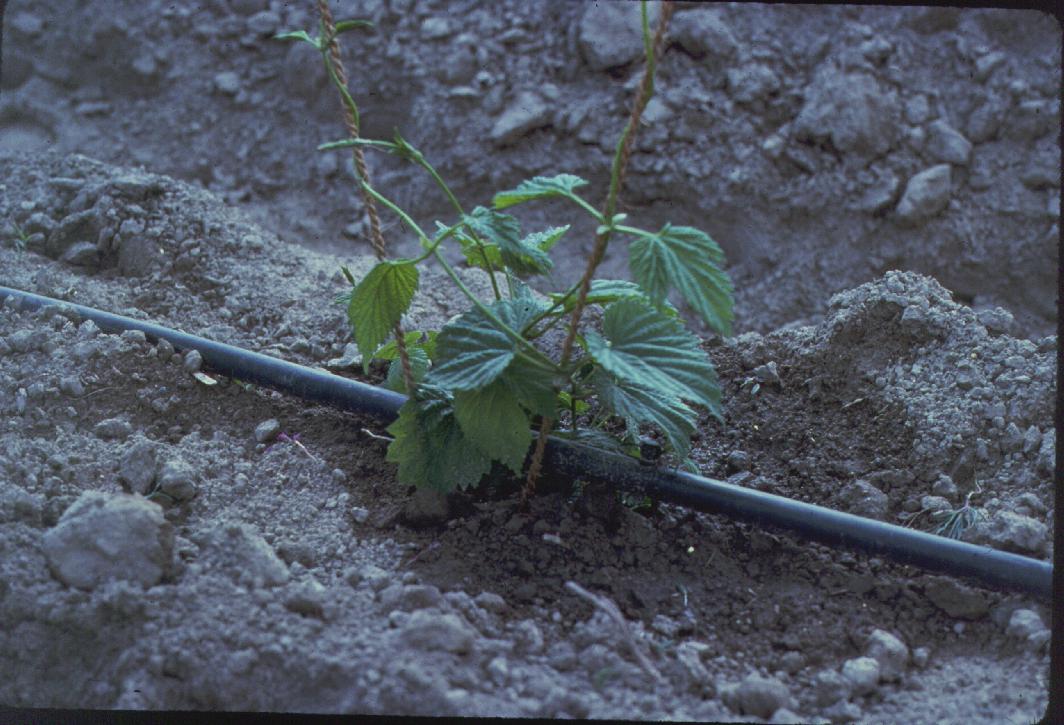
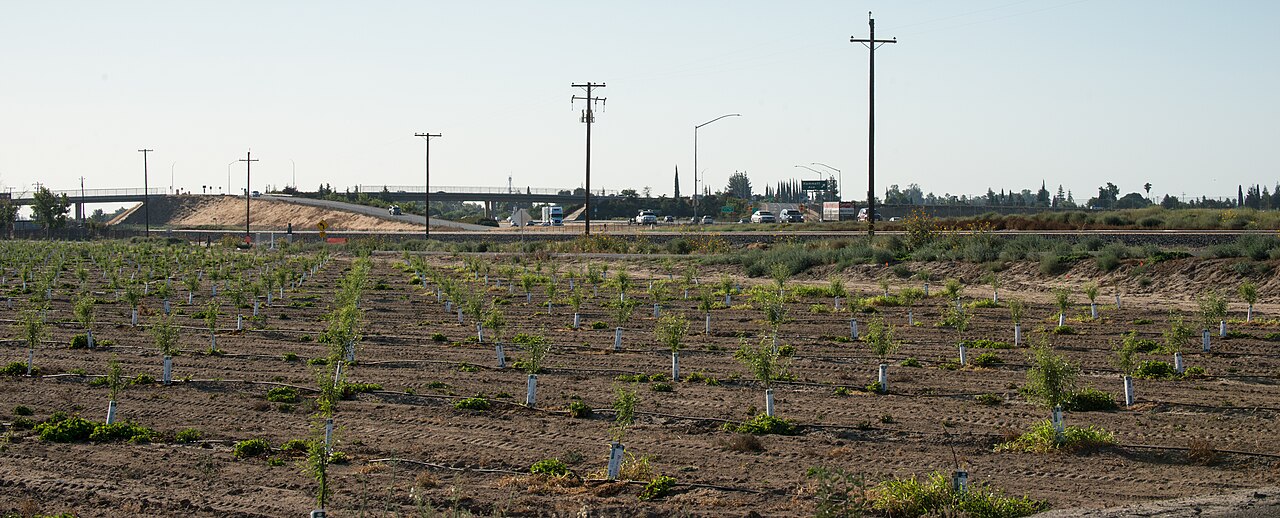
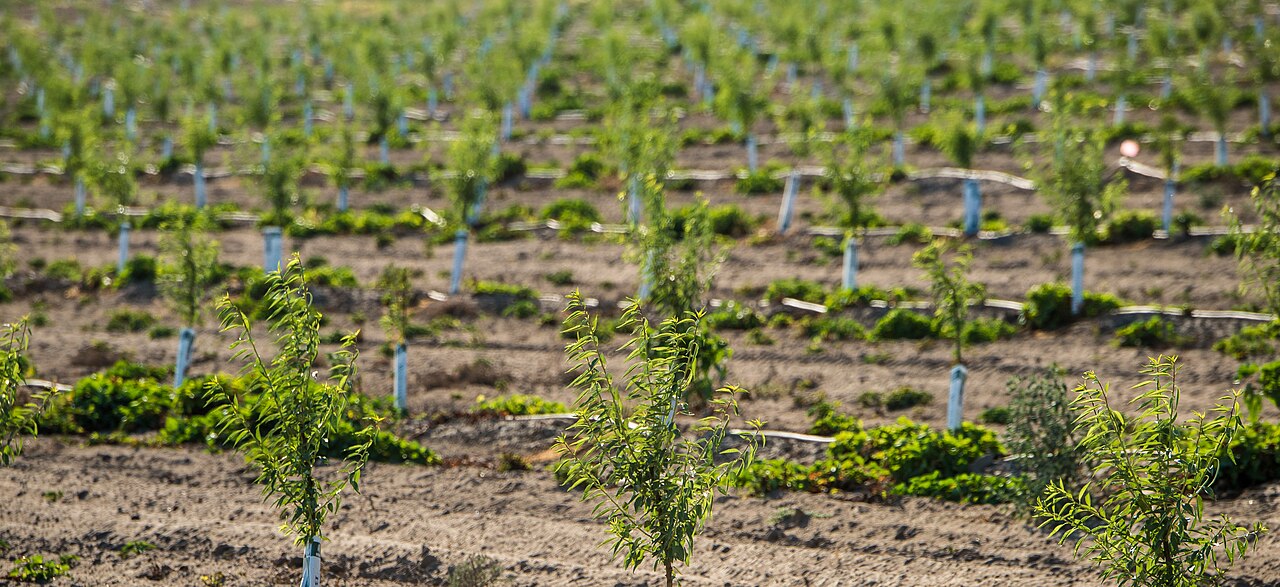
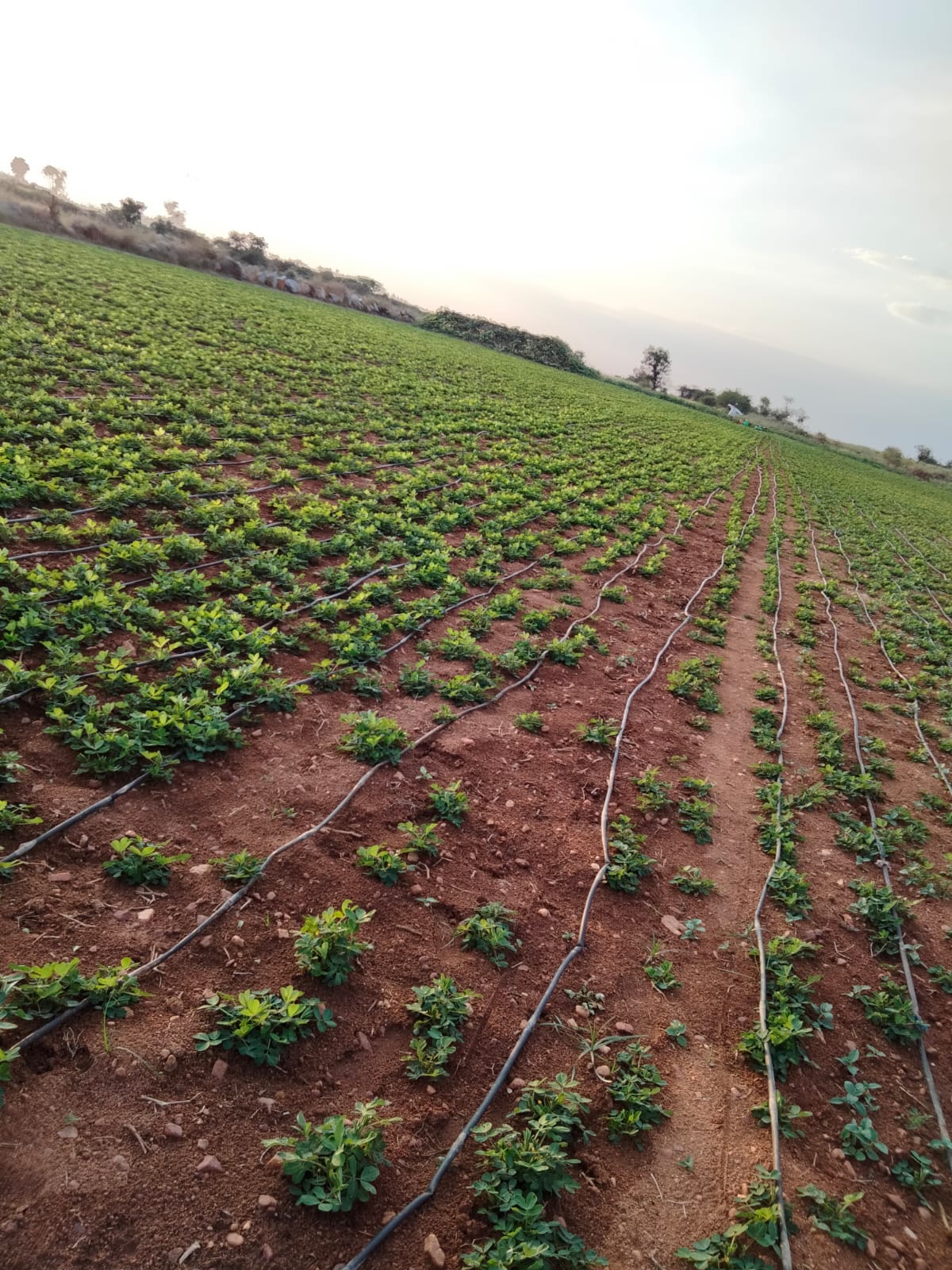
- Drip irrigation. Very effective in both the cultivation and production phases; when establishing a new orchard, it ensures uniform rooting and even plant growth and rapid entry into production. It adequately supplies the shallow roots of young plants and allows for fertigation (adding nutrients through water). Later, pipes can be buried (sub-irrigation at 30–35 cm and 2.5–3 m from the trunk) so as not to interfere with mechanical harvesting.
- Mist sprinklers / Sprinklers. In some experiences (Oregon), young hazelnut reacts better to sprinklers because water moistens the entire soil surface better; drip irrigation, however, targets the shallower roots of the young orchard. Both options are valid — the important thing is to achieve deep soaking.
- Mobile irrigation (tank/barrel on tractor, manual). Typical solution in the first years when investments in a fixed system are not cost-effective; practitioners describe how they watered first-year saplings "mobilely using a tractor and barrels," and only later installed a permanent system.
Regardless of the system, water should be delivered in rings around the plant so that it absorbs, rather than sitting in a puddle for hours. Do not pour directly onto the root collar and sapling.
Practical measures that reduce water needs
- Mulching and moisture retention. A layer of mulch (e.g., sawdust or compost, 8–10 cm) around young plants conserves moisture and suppresses weeds. In Croatian elaborates, the soil around saplings is maintained by cultivation/chiseling for the first three years, and only after the third year does it transition to sodding or mulching with low-growing grasses of low evapotranspiration potential.
- Weed control. Weeds and grass consume water intended for hazelnut; in dry years, the strip next to plants should be maintained more frequently. It is recommended to keep the area around the plant (approximately 1 m in diameter) free of weeds.
- Wind protection. Due to large leaves, young hazelnut suffers greater water stress in windy locations; windbreaks reduce drying and increase survival and growth in the first year.
- Proper planting depth. The sapling should be planted at the same depth it was in the nursery; planting too deep encourages surface root development and die-off of the primary root, while planting too shallow exposes roots to drying.
Transition to scheduled irrigation upon entering the bearing stage
When the orchard enters the bearing stage (approximately from the fourth year, depending on the cultivar and conditions), the goal of irrigation changes. It is no longer just about survival and root establishment, but about water scheduling according to phenophases to optimize yield and kernel quality. Water demand increases with the size and age of the plant (in nut crops generally, water consumption per tree increases significantly with age).
Based on Croatian and regional practice, several critical periods are known:
| Period | Effect of Irrigation |
|---|---|
| June (fruit development) | increases fruit growth and size |
| July–August (kernel formation and filling) | positively affects kernel weight/fullness |
| Generally April–September | covers 350–400 mm of seasonal water requirement |
Hazelnut has its highest water needs from April to September. Since evapotranspiration rises in July and August, and rainfall is often scarce, supplemental irrigation during this period protects yield. Practically, the transition means:
- shifting from "decreasing frequency during establishment" to a planned seasonal schedule linked to phenophases of flowering, fruit development, and kernel filling;
- typically larger total seasonal water volumes because a mature, bearing plant transpires much more than a seedling;
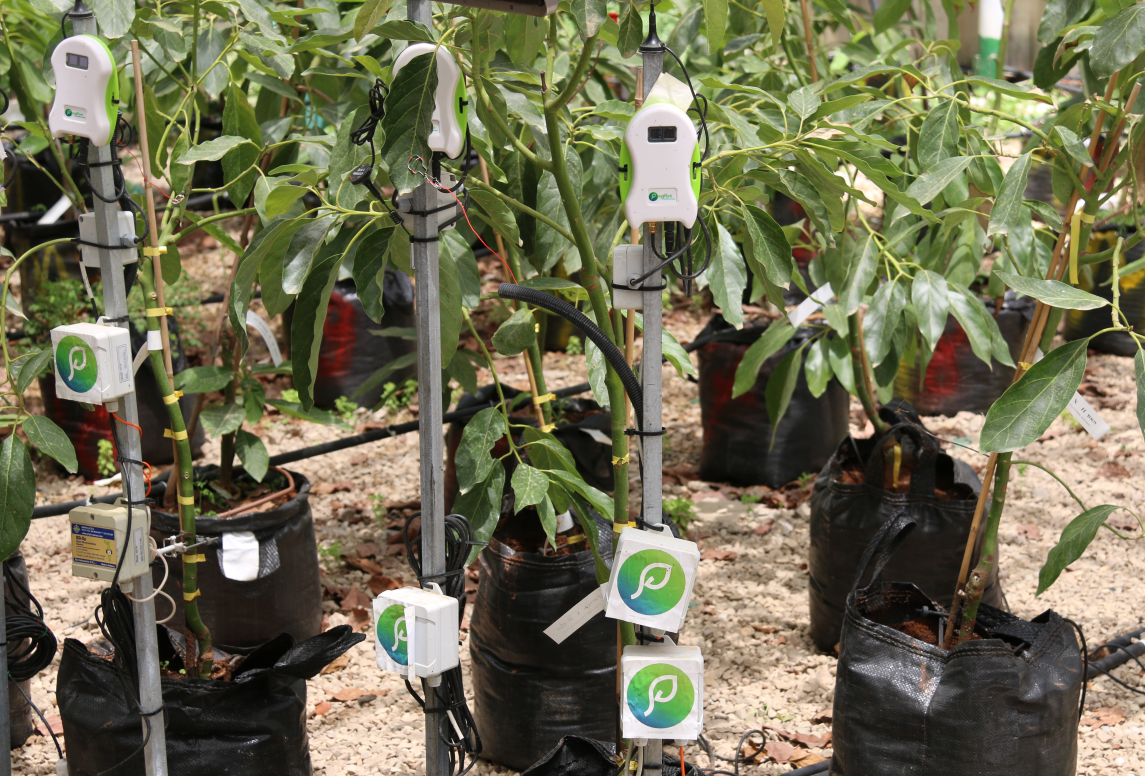
- introducing soil moisture monitoring and/or water stress indicators, and, where available, fertigation through drip systems to supply both water and nutrients simultaneously;
- maintaining the principle of deep wetting of the root zone — this remains beneficial during the bearing stage, only the timing and total volume change.
In other words, a well-executed establishment phase (deep roots, drought resistance) directly facilitates later scheduled irrigation: a plant with deep roots utilizes soil water more efficiently and tolerates intervals between watering more stably.
Common Mistakes
- Frequent and shallow watering. The most common mistake; it creates a shallow root system dependent on constant moisture and vulnerable to drought. It is better to water less frequently but thoroughly.
- Fixed calendar without soil checks. Irrigating "every week regardless of weather" leads to overwatering during rainy periods (risk of root rot) and underwatering during heatwaves. Check soil moisture.
- Not reducing frequency over the years. If you water with the same frequency in the third year as in the first, the plant does not "harden off" and remains dependent on irrigation.
- Neglecting weeds and mulch. Weeds "steal" water, and a bare, unprotected circle around the plant loses moisture quickly through evaporation.
- Water directly on the root collar and stagnation. Hazelnut does not tolerate standing water; roots in constantly wet soil rot. Drainage and spreading water in a circle around the plant are important.
- Planting too deep or too shallow. This affects where the root develops and how drought-resistant the plant will be.
Summary Checklist for Years 1–3
- [ ] Plant at the correct depth and water thoroughly immediately.
- [ ] Begin regular watering ~one week after planting.
- [ ] Saturate the entire root zone profile each time (for seedlings ~40–60 cm depth).
- [ ] Frequency: Year 1 ~weekly → Year 2 ~every 2 weeks → Year 3 ~monthly (in summer, adjusted according to soil and weather).
- [ ] Allow the top layer of soil to dry out between waterings.
- [ ] Mulch and keep the circle around the plant weed-free.
- [ ] Check soil moisture; skip watering after heavy rain.
- [ ] Prepare for the transition to scheduled, phenophase-based irrigation before entering the bearing stage.
Gallery
Sources
This article is an AI summary generated from an internal hazelnut literature collection (RAG corpus) and supplemented with publicly available sources. The data regarding volumes, frequency, and timelines are informative and depend on the cultivar, soil, location, and applicable regulations — consult advisory services and official sources before implementation.
Main sources used:
- Hazelnut Literature Collection (RAG corpus): Croatian horticultural and professional texts on hazelnut irrigation and care (Vrtlarica); final theses and studies on ecological hazelnut production (e.g., Huzjak, "Technology and Economics of Ecological Hazelnut Production at OPG Hobolić Alen", 2021); environmental impact assessments for establishing permanent hazelnut orchards (Vojnić/AGRO Utinja 2021; Grubišno Polje 2020; Glina 2022; Dragodinac); business plan for hazelnut seedling production (2019); brochure "Our Land and Italian Hazelnut" (EcoBegic); and newspaper/practical articles on hazelnut cultivation.
- NARD — "Good site preparation is the key to a successful tree planting project" (booklet, 2023): supplemental irrigation for seedlings in the first three years, ~25 mm (1 inch) every 7–10 days, deep profile wetting, drip irrigation.
- Oregon State University Extension — "Growing Hazelnuts in the Pacific Northwest" and articles on irrigating young hazelnut orchards — https://extension.oregonstate.edu/catalog/em-9077-growing-hazelnuts-pacific-northwest-orchard-design
- "A Guide to Hedgerows" (EM8721, OSU, 2020): template for reducing watering frequency (weekly → every 2 weeks → monthly) and deep watering to encourage deep roots.
- Irrigating Young Hazelnut Trees / Drip Irrigation for Hazelnut Orchards (West Coast Nut) — https://www.wcngg.com/2019/03/25/irrigating-young-hazelnut-trees/
- General guides on fruit tree irrigation (UC IPM, WSU Tree Fruit) on deep, less frequent watering and root development — https://ipm.ucanr.edu/PMG/GARDEN/FRUIT/CULTURAL/fruitwatering.html
Recommended equipment
🔎 drip irrigation kit — Amazon →Affiliate links — we may earn a small commission at no extra cost to you.
Drip Irrigation Kit
Suitable for small to medium orchards or gardens.
| Use Case | Option Type | What to Check Before Purchase |
|---|---|---|
| Small plots | Basic drip lines | Emitter spacing and flow rate |
| Medium orchards | Complete kit with filters | Pressure regulation and filtration quality |
| Large scale systems | Professional installation | Hydraulic calculation and zoning |