Hazelnut Oil Production and Extraction
Content generated by artificial intelligence — verify before application
This article was automatically compiled from a collection of hazelnut literature using artificial intelligence and may contain errors or outdated data. It serves as a starting point for further research, not as professional advice. Dosages, products, and timelines are informative and depend on the cultivar, location, and applicable regulations — always consult with an advisory service and official sources before application.
Hazelnut oil is one of the most valuable processed products of the hazelnut: it has a golden-yellow color, a distinctive aroma and flavor, and high nutritional value. Due to its high content of monounsaturated oleic acid, its composition is very similar to olive oil. For hazelnut producers, oil represents a typical path to "moving beyond raw material" — the value obtained from a kilogram of kernel is several times higher than selling the nut in shell, and the by-product, press cake, remains rich in protein. This article explains how oil is produced (via cold and hot pressing, as well as solvent and CO₂ extraction), what yields and quality to expect, the fatty acid composition and oxidative stability, and how gourmet oils are positioned in the market.

Why Oil: Economics and Raw Material
Hazelnut oil is valued in the market primarily for its return on investment: literature indicates that approximately 10 kg of hazelnuts are required for one liter of oil, automatically placing the oil in the group of products with a high unit price. Traditionally, it was used in the perfumery and pharmaceutical industries, but today its greatest value lies as a gourmet edible oil for cold cuisine and seasoning.
The starting raw material is cleaned kernel. Before pressing, the kernel is separated from the shell using a cracking and shelling machine, during which the shell is often used as fuel for the boiler (thermal energy for operation). The quality and composition of the oil depend directly on the quality of the kernel: storage conditions, moisture content, and any thermal treatment before pressing determine how stable and aromatic the oil will be.

| Initial Data | Typical Value | Note |
|---|---|---|
| Fat content in kernel | ~60–76 % | Depends on cultivar and year (informative) |
| Hazelnuts per 1 L of oil | ~10 kg | Rough field estimate |
| Cold press yield | ~45–55 % of kernel mass | Lower than solvent extraction |
| Solvent extraction yield | Closer to total oil content (up to ~70%+) | Highest yield, but "native" quality is lost |
Values are informative and depend on cultivar, raw material moisture, equipment, and process parameters.
Cold Pressing
Cold pressing is a physical (mechanical) process for obtaining edible oil from seeds, without the use of heat or organic solvents. Mechanical force squeezes the oil out of the kernel, and the resulting crude oil then undergoes sedimentation (settling) and filtration to achieve a clear final product. Due to the absence of heat, cold-pressed oil retains nutritionally important components — essential fatty acids, phenols, flavonoids, and tocopherols (vitamin E) — and is sensorially "more appealing," with a more intense aroma and flavor.
Equipment
In practice, two basic versions are used:
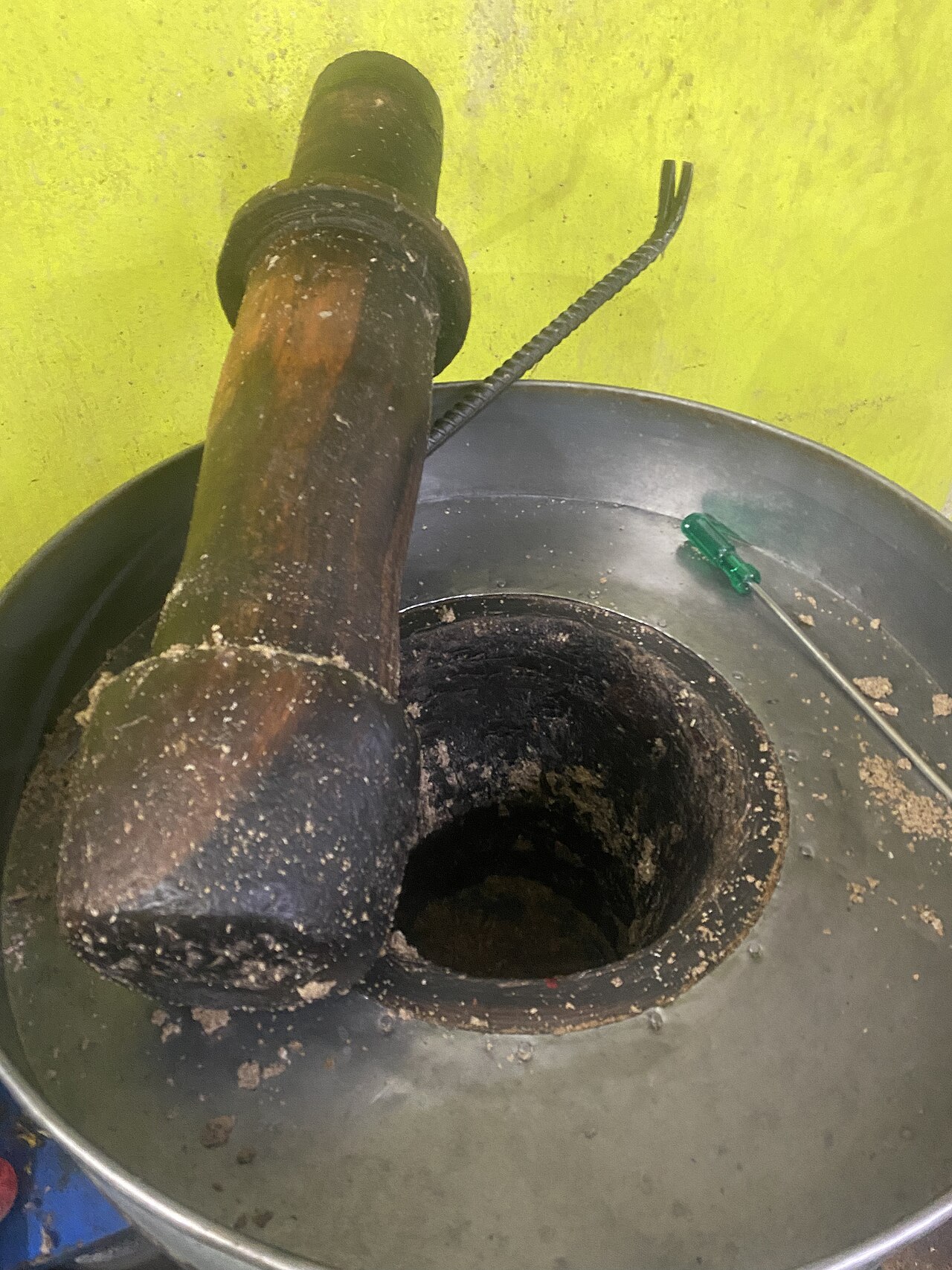
- Continuous screw (auger) press — most common for small and medium-sized facilities. From literature: type SPU 20, capacity 20–25 kg/h, power 1.5 kW. Pilot machines of similar size describe a capacity of ~12 kg of seeds/h, an oil outlet temperature of ~40 °C, and screw speed of ~20 rpm.
- Hydraulic (batch) press — operates in batches; in the description of one facility, kernels are batch-fed into a press with a capacity of ~5 kg of kernels/h, the oil is collected in a settling tank where it remains for ~36 hours, and then into stainless steel barrels for packaging.

Process Parameters and Their Impact on Yield
The oil yield (extraction rate) in a screw press depends on several adjustable parameters that are systematically varied in research:
| Parameter | Tested Range | Effect |
|---|---|---|
| Nozzle (die) opening size | 8 / 11 / 12 / 16 mm | Smaller opening → higher pressure → higher yield, but stronger friction/heating |
| Motor frequency (screw speed) | 20 / 22 / 27 / 32 / 40 Hz | Lower frequency → longer retention → better pressing |
| Press head heater temperature | 70 / 90 / 100 / 105 / 110 °C | Helps oil flow, but during "cold" pressing, the outlet oil temperature must remain low |
| Moisture content and material type | — | Crucially affect capacity and yield |
Important distinction: the "press head heater" heats the outlet channel to facilitate oil flow and prevent clogging, but this is not the same as hot pressing — in cold pressing, the temperature of the oil itself at the outlet is decisive. Field practice holds that in true cold pressing, the outlet oil temperature should not exceed ~50 °C; such oil is healthier and richer in flavor, but the yield is lower. Studies suggest that the best utilization is usually achieved by combining the smallest opening (e.g., 8 mm) and lower frequency (~20 Hz).
Refining Crude Oil
After pressing, the crude oil contains suspended particles and some water and needs to be clarified:
- Sedimentation / Settling — crude oil rests (in described experiments up to ~2 weeks, in production ~36 hours) to allow sediment to separate.
- Filtration — most commonly vacuum filtration (e.g., via a Büchner funnel in the laboratory, or filter plates in production); sometimes centrifugation immediately after pressing to remove particles and moisture.
- Filling and Protection — clear oil is filled into dark glass; for maximum shelf life, protection with inert gas (e.g., nitrogen blanketing) and cold storage are used.
Hot Pressing and Thermal Treatment of Kernels
With hot processes — preheating the kernel or pressing at higher temperatures — the yield increases because heat reduces oil viscosity and facilitates its flow out of cells. The cost is the loss of some thermolabile components and, often, poorer oxidative stability and an altered sensory profile.
Particularly instructive is roasting (toasting) the kernel before pressing, which develops the "roasted" aroma prized in some gourmet oils. Research on thermal treatment of kernels at 180 °C for 24 min before cold pressing showed:
- increase in acid value of the oil (indicator of hydrolytic changes in triacylglycerols),
- decrease in refractive index (changes in triacylglycerols and fatty acids),
- no effect on water and volatile matter content,
- no detectable peroxides immediately after production, regardless of treatment.
Practical lesson: roasting yields the desired aroma, but more aggressive thermal treatment degrades chemical parameters and can shorten shelf life, so a balance must be sought (moderate roasting + rapid cooling + good refining).
Solvent and Supercritical CO₂ Extraction
In addition to pressing, there are extraction processes in which the oil is dissolved in a suitable solvent:
- Soxhlet extraction (with solvent) — reference laboratory method for determining total oil content in the kernel and in the press cake (residual oil after pressing). It is performed with petroleum ether (or similar solvent), with prior sample drying (e.g., ~2–3.5 g, drying at 100–105 °C) and extraction lasting 12–16 hours. Industrial solvent extraction gives the highest yield (approaching the total oil content in the kernel), but requires solvent removal and does not fall into the category of "native" cold-pressed oils.
- Supercritical CO₂ extraction — a modern alternative without solvent residue, with a mild temperature regime and good preservation of bioactive compounds; technologically more demanding and capital-intensive, so it is reserved for high-value, niche products.
The speed and efficiency of any extraction depend on the solubility of the oil in the solvent, temperature, exposed surface area (kernel fineness), flow rate, and solvent viscosity; higher temperature accelerates the process, but too high a temperature can damage nutritional properties or extract undesirable substances.
| Process | Yield | Nutrient Preservation | Typical Application |
|---|---|---|---|
| Cold Pressing | Lower (~45–55%) | Best | Gourmet native oil |
| Hot Pressing | Medium–High | Poorer | Higher yield, "roasted" aroma |
| Solvent Extraction | Highest | Poor (refining necessary) | Industrial/refined oil, analytics |
| Supercritical CO₂ | High | Very Good | High-value/niche products |
Fatty Acid Composition and Nutritional Value
Hazelnut oil belongs to the oleic type of oils. It is dominated by monounsaturated oleic acid (C18:1) — about 75%, with linoleic (C18:2) as the second main acid; together, oleic and linoleic acids make up to ~90% of total fatty acids. Saturated fatty acids (e.g., palmitic, stearic) are present in the smallest proportion. In addition to fatty acids, the oil contains tocopherols (α-tocopherol, vitamin E) as well as phenols and flavonoids, which contribute to both nutritional value and stability.
| Component | Typical Proportion | Role |
|---|---|---|
| Oleic (C18:1, MUFA) | ~75% | Stability + favorable health profile |
| Linoleic (C18:2, PUFA) | Significant (second highest) | Essential, but more sensitive to oxidation |
| Saturated (SFA) | Lowest proportion | — |
| Tocopherols (Vit. E) | Present | Natural antioxidant |
Proportions are informative and depend on cultivar, climate, maturity, and processing.
Oxidative Stability
The high content of oleic (monounsaturated) acid is the primary reason for the good oxidative stability of hazelnut oil — oleic acid is less reactive than polyunsaturated acids (e.g., linoleic), so the oil rancidifies more slowly. Additionally, natural α-tocopherol acts as an antioxidant. For comparison, linseed oil with 56–71% linolenic (C18:3) acid is extremely unstable; this is precisely why hazelnut oil is used for natural stabilization of mixtures (e.g., 50:50 with linseed oil).
Oxidative stability is measured using accelerated tests (e.g., Rancimat stability test at 98–98 °C), and quality is monitored using standard indicators:
| Quality Parameter | Example Measured Value | Meaning |
|---|---|---|
| Peroxide Value (PV) | initial ~0; after 38 h ~8.70 mmol O₂/kg | Degree of primary oxidation |
| Free Fatty Acids (FFA) | ~0.34 % | Hydrolytic spoilage |
| Water Content | ~0.069 % | Risk to stability |
| Insoluble Impurities | (occasionally slightly elevated) | Filtration efficiency |
Measured parameters in the literature are generally within the limits of the Regulation on Edible Oils and Fats (NN 11/2019), confirming that properly managed cold pressing yields oil of satisfactory quality.
Stabilization with Antioxidants
Stability can be further extended using natural or synthetic antioxidants and synergists. Research has utilized:
- Natural: rosemary extract (e.g., Oxy'Less CS type), sage extract, pomegranate extract, green tea, tocopherol mixture (~0.2 %), essential oils (~0.05 %).
- Synthetic: propyl gallate (PG) ~0.01 %.
- Synergist: citric acid ~0.01 %.
The proportions are informative; the permissibility and maximum permitted levels of additives depend on current regulations and product labeling — always verify before application.
Storage and Packaging
Because unsaturated fatty acids are susceptible to oxidation, the oil must be protected from three main "enemies": oxygen, light, and heat.
- Dark glass (or other light-proof packaging), tightly closed.
- Cool, dark storage; preferably refrigerated for opened packages.
- Protection with inert gas (nitrogen) above the oil for long-term storage.
- Minimal headspace in the bottle (less oxygen).
Practical Recommendations and Common Mistakes
- Quality starts with the kernel. Wet, poorly stored, or rancid kernels cannot produce good oil — drying and proper storage are prerequisites.
- Do not confuse heating the press head with warm pressing. Monitor the outlet oil temperature (target < ~50 °C for native cold-pressed oil).
- Optimize yield, but not at the expense of quality. A smaller nozzle opening and lower screw speed increase yield; excessive "forcing" raises temperature and spoils the oil.
- Do not skip sedimentation and filtration. Residual particles and water accelerate spoilage and raise insoluble impurities above permitted limits.
- Roasting: moderate and with rapid cooling. Aggressive heat (e.g., 180 °C/24 min) increases the acid value and shortens shelf life.
- Utilize the cake. Residual oil and proteins in the cake are raw materials for flour and spreads — added value from the same process.
- Monitor quality parameters. Peroxide value, FFA, water, and impurities should be within the limits of the Regulation (NN 11/2019).
Gourmet Oil Market
Hazelnut oil is a typical gourmet (premium) product: it is sold in small packages (often 100–500 ml) directly from the farm ("at the doorstep"), through specialized health food stores and delicatessens, and via webshops. Croatian producers (e.g., family farms and enterprises specializing in hazelnuts) already offer cold-pressed hazelnut oil as a recognizable brand alongside kernels, flour, and spreads.
Key success factors in this market:
- Story and origin — cultivar, location, manual/"native" processing, small batches.
- Sensory attributes — aroma and flavor (moderately roasted variants) are the main selling points.
- Packaging — dark glass, clear labeling (pressing date, expiry), aesthetic design.
- Positioning — high price justified by low yield (~10 kg kernel/L) and manual production.
For small producers, oil is an ideal way to convert fruits that are not first-grade for shell sales into a product with the highest margin — provided that hygienic and regulatory requirements for placing edible oil on the market are met.
Gallery

Sources
This article is an AI summary from an internal collection of hazelnut literature (RAG corpus of scientific and professional papers, theses, and field documents) and public internet sources. Main sources used:
- Influence of antioxidants and synergists on the oxidative stability of produced cold-pressed hazelnut oil (2015) — RAG corpus (core_acc8134c016bf07c).
- Testing the quality of oils from various nuts/hazelnuts (2025) — https://doi.org/10.15255/kui.2024.054
- Cold pressing — process and storage (2018) — https://doi.org/10.46584/lm.v36i2.1141
- Effect of antioxidants on stabilization (mixture of hazelnut and linseed oil) (2023) — https://doi.org/10.31727/gzb.46.5.5
- Chemical composition of hazelnuts (2017) — RAG corpus (enhanced_harvest__197886475).
- Influence of antioxidants on the stabilization of a mixture of hazelnut oil and linseed oil (2019) — RAG corpus (198153525).
- Production and stabilization of hazelnut oil with natural and synthetic antioxidants (Petrić, 2019.) — https://urn.nsk.hr/urn:nbn:hr:109:932963
- Production and stabilization of cold-pressed hazelnut oil of the Trabizon cultivar (Tuba, 2023.) — RAG corpus.
- Environmental Protection Elaborate (processing plant, 2019.) — RAG corpus (Agro-Tok d.o.o.).
- Mechanization in hazelnut production and processing (Minas-Zrno 1) (2021) — RAG corpus.
- Preparation and Characterization of Cold-Pressed Hazelnut Oil (2023) — RAG corpus (tr).
- The Quality Characteristic and Fatty Acid Profile of Cold-Pressed Hazelnut Oils during Nine Months of Storage — https://www.mdpi.com/2073-4395/11/10/2045
- Hazelnut oil production using pressing and supercritical CO₂ extraction — https://www.researchgate.net/publication/282235286
- Balentić Hazelnuts — cold-pressed hazelnut oil — https://ljesnjaci-balentic.hr/proizvod/hladno-presano-ljesnjakovo-ulje/
- OPG Domjanić — cold-pressed oils — https://opgdomjanic.hr/
- Regulation on Edible Oils and Fats (NN 11/2019).
Note: Some DOI/URL citations originate from the corpus and may refer to summary records; verify original sources before citing.
Recommended equipment
🔎 nut roaster — Amazon →Affiliate links — we may earn a small commission at no extra cost to you.
Handheld Nut Cracker
For processing small batches of nut kernels.
| Use Case | Option Type | What to Check Before Purchase |
|---|---|---|
| Small quantity processing | Manual lever cracker | Crushing mechanism and shell separation |
| Kernel preservation | Adjustable pressure tool | Ease of cleaning and durability |
| High volume needs | Electric cracking machine | Professional equipment for speed |