Machinery and Equipment for Irrigation Orchards (Pumps, Filtration, Automation, Fertigation)
Content generated by artificial intelligence — verify before application
This article was automatically compiled from a collection of hazelnut literature with the aid of artificial intelligence and may contain errors or outdated data. It serves as a starting point for further research, not as professional advice. Dosages, products, and timing are informative and depend on the cultivar, location, and current regulations — always consult with an advisory service and official sources before application.
Irrigation in hazelnut cultivation is too often viewed merely as an agronomic measure — how much water to add and when. However, behind every drop falling near the trunk lies a series of machines and technical equipment that constitute a serious capital investment: pumps, filtration stations, control and metering devices, automation, and a fertigation unit. This is the "system head" (It. testata, Eng. system head) — the heart of the orchard from which water and nutrients leave under controlled pressure and in controlled quantities. This article treats irrigation specifically as mechanization and technological investment: how to dimension and select hardware, what it costs, how to maintain it, and why the system head is most often underestimated, the "missing link" between the borehole and the dripper.
System Architecture: What Makes Up the Irrigation "Head"
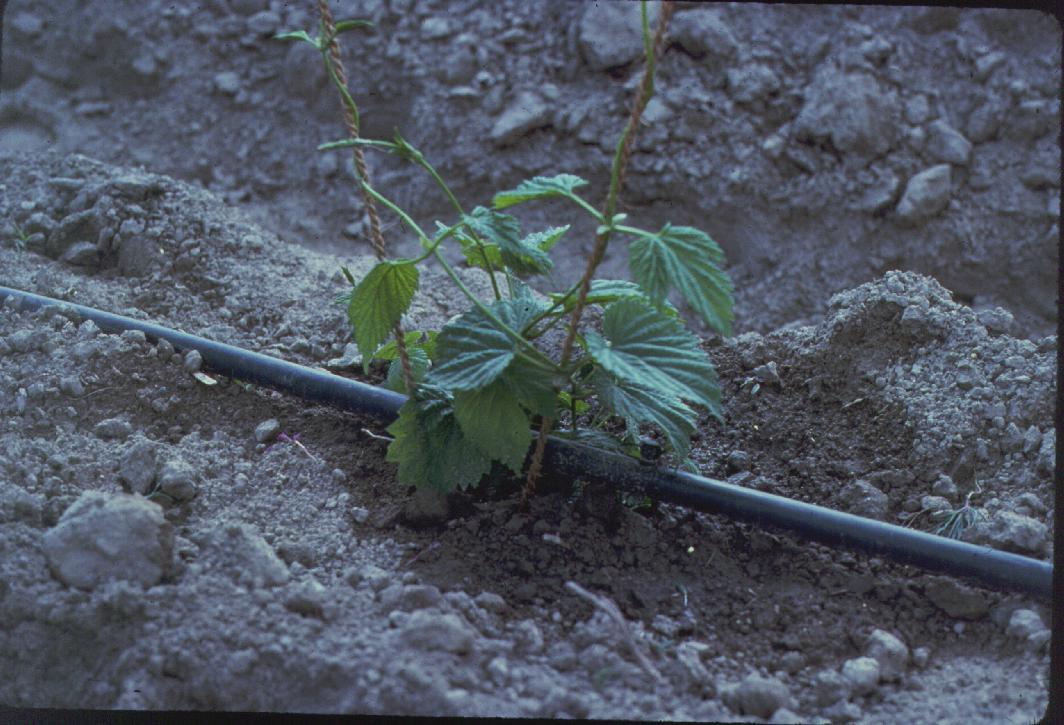
Localized drip irrigation ("drip by drip") is the standard in hazelnut cultivation because it saves water and energy, doses precisely, and operates reliably with the possibility of electronic regulation. A typical system is divided into two functional units:
- Water preparation and drive unit (system head) — water source (well, reservoir, watercourse), main pump, filtration, backflow (anti-siphon) valve, manometers, safety and control valves, fertigation unit, and controller.
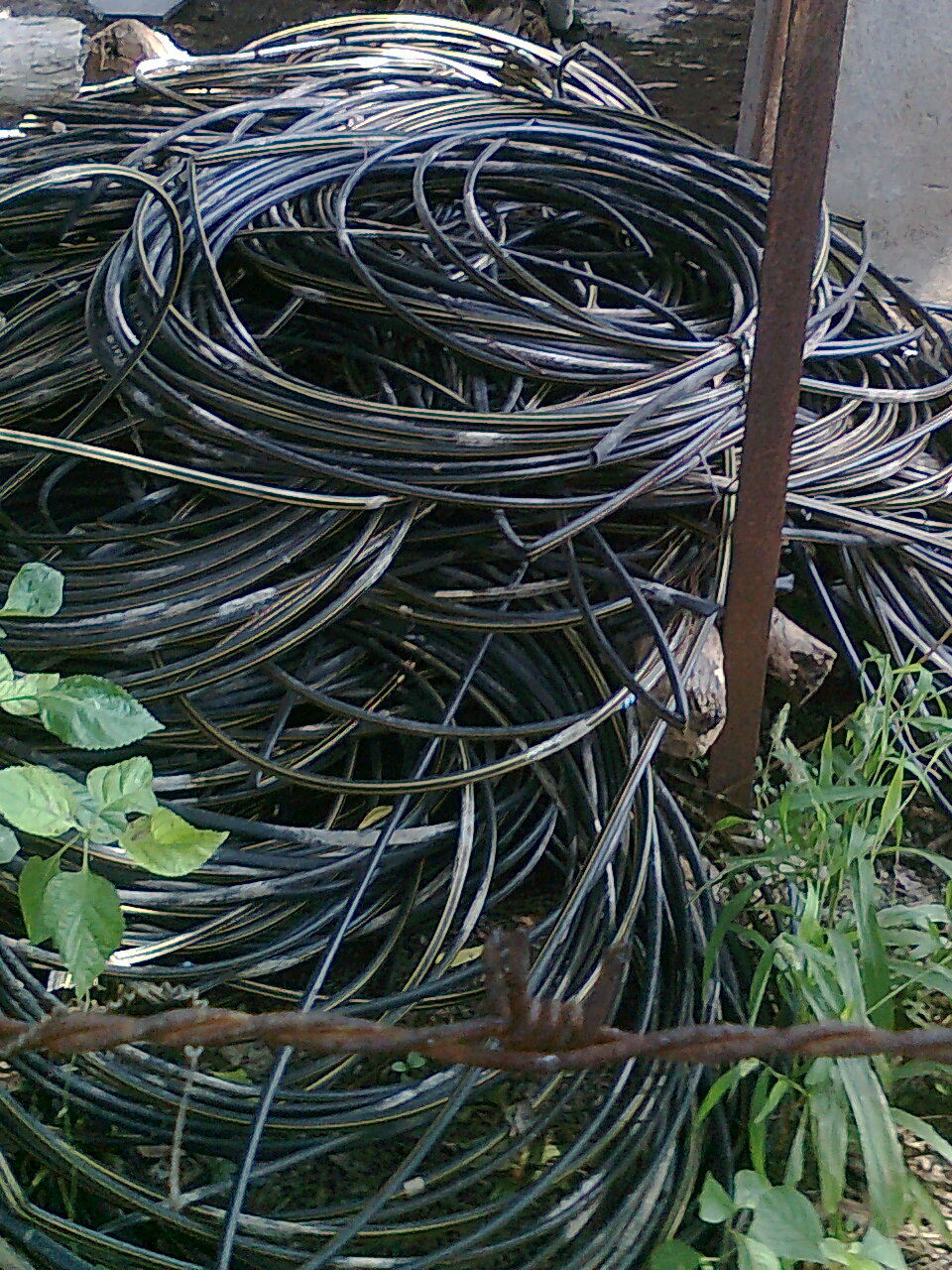
- Distribution network — main pipeline, branch pipes to sections, sectional (zonal) valves, and laterals with drippers near the plants.
According to Italian and Croatian project documentation, the order of components in the system head from the source to the field is typically: pump station → primary filters → fertigation unit → secondary (safety) filters → metering and control devices → distribution to sections. The exact order (especially the position of injectors relative to the filter) depends on the type of fertilizer and equipment manufacturer recommendations.
| Component | Function | Typical Location |
|---|---|---|
| Pump | Lifting water and ensuring operating pressure | Near source / reservoir |
| Anti-siphon / Check valve | Prevents backflow of water and fertilizer into the source | Between pump and injector |
| Primary filters | Coarse separation of sand/silt | Immediately after the pump |
| Fertigation unit | Injection of water-soluble fertilizers | After the primary filter |
| Secondary (disk/mesh) filters | Protection of drippers from fertilizer precipitates and fine particles | After the injector, before sections |
| Manometers | Monitoring pressure drop on filters | Before and after filtration |
| Pressure regulator | Constant operating pressure to sections | After the filter bank |
| Flowmeter (water meter) | Measuring delivered quantity | At the exit of the system head |
| Controller / Central Unit | Managing sections, timing, fertigation | In the "command" room |
Pumps: Dimensioning and Power
The pump is the component that dictates whether the entire system will work at all. An incorrectly dimensioned pump means either insufficient pressure (drippers at the end of the lateral are "starving") or energy waste and overload.
Two Input Data: Flow Rate (Q) and Head (H)
Dimensioning starts from two values:
- Flow rate Q (m³/h or l/s) — how much water the system must deliver to the most demanding section operating simultaneously.
- Required head / pressure H (m or bar) — sum of the geodetic height (height difference between the source and the orchard), losses in pipes, and the required operating pressure of the drippers.
From Croatian project reports, it is evident that the system is designed by sections (rotations) so that the pump can be smaller and cheaper. An example from an orchard near Glina:
| Section | Area | Number of Laterals | Flow Q | Pressure (P) |
|---|---|---|---|---|
| Rotation 1 | 0.9 ha | 20 | 7.3 m³/h | 25 m |
| Rotation 2 | 0.8 ha | 21 | 6.8 m³/h | 21 m |
| Rotation 3 | 0.6 ha | 21 | 5.3 m³/h | 19 m |
Key point: The system never irrigates the entire orchard at once. By dividing into rotations, the pump only needs to cover the largest individual flow rate (here ~7.3 m³/h), not the sum of all sections. This directly reduces the required power and pump cost.
Estimating Required Flow from Dripper Consumption
Consumption of a single dripper in hazelnut typically amounts to 1.6–2 l/h (self-compensating drippers operate stably over a wide pressure range). Section flow = number of drippers × dripper flow. For an orchard with a 5 × 4 m spacing, this is 500 trees/ha; with 2–4 drippers per tree and 2 l/h, a rough order of magnitude is several tens of m³/h per hectare to irrigate all at once — which is exactly why we divide into rotations.
Source Capacity as an Upper Limit
A pump cannot deliver more than the source provides. In reports, well capacity is determined by test pumping; examples cite a well with a capacity of 2.77 l/s (≈ 10 m³/h) with an annual consumption of around 5,000 m³/year for an orchard. When the source is weaker or distant (e.g., well 2,600 m from the orchard, 120 m height difference), the system is solved in three stages: well → reservoir → pressurized irrigation system, where one pump fills the reservoir, and another (or the same one) pressurizes towards the orchard. Reservoirs in reports vary from a 25 m³ tank to earthen basins of 3,200–30,000 m³.
Orientative Power and Pump Type
- Submersible pumps — for wells; selected based on depth and borehole capacity.
- Surface / centrifugal pumps — for reservoirs and surface water.
- Variable Frequency Drive (VFD) — recommended for systems with multiple sections of different flow rates as it maintains constant pressure and saves energy.
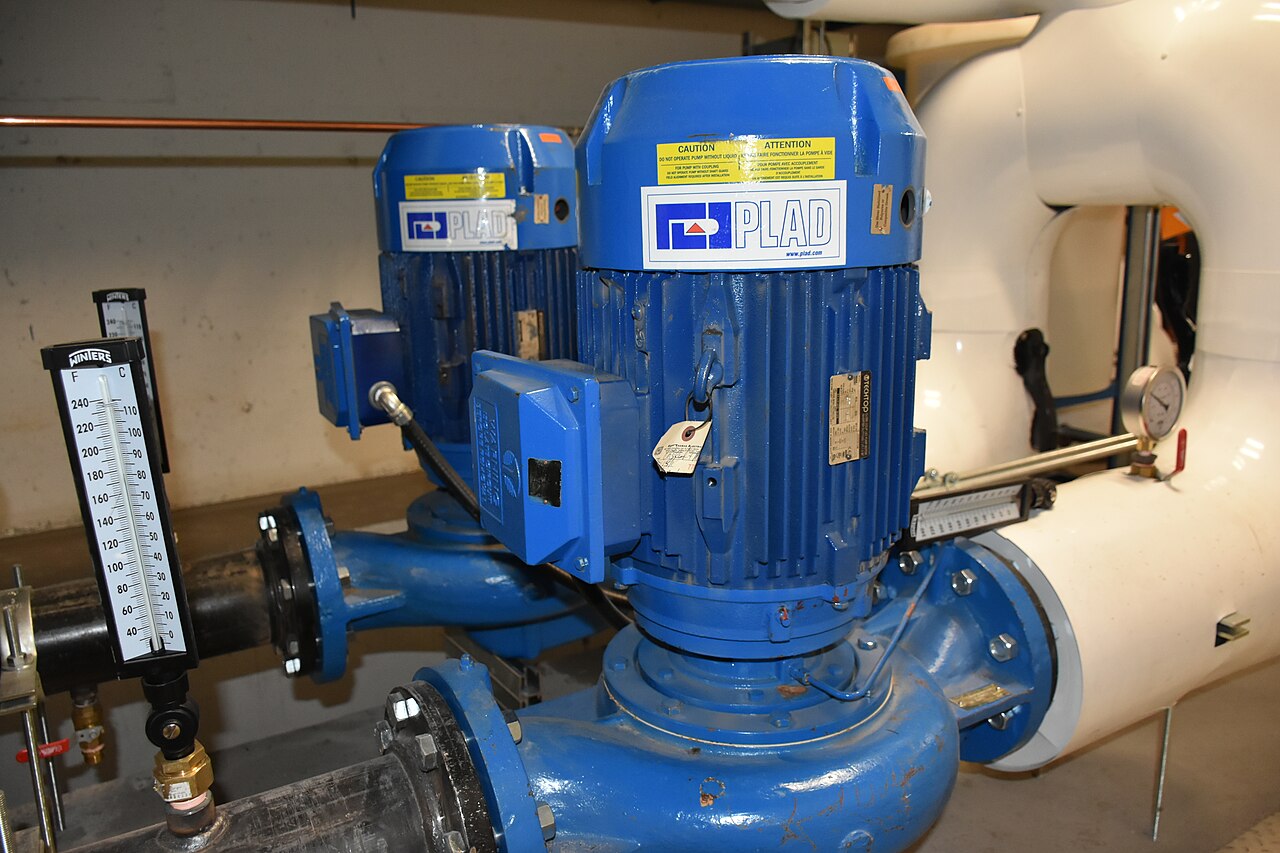
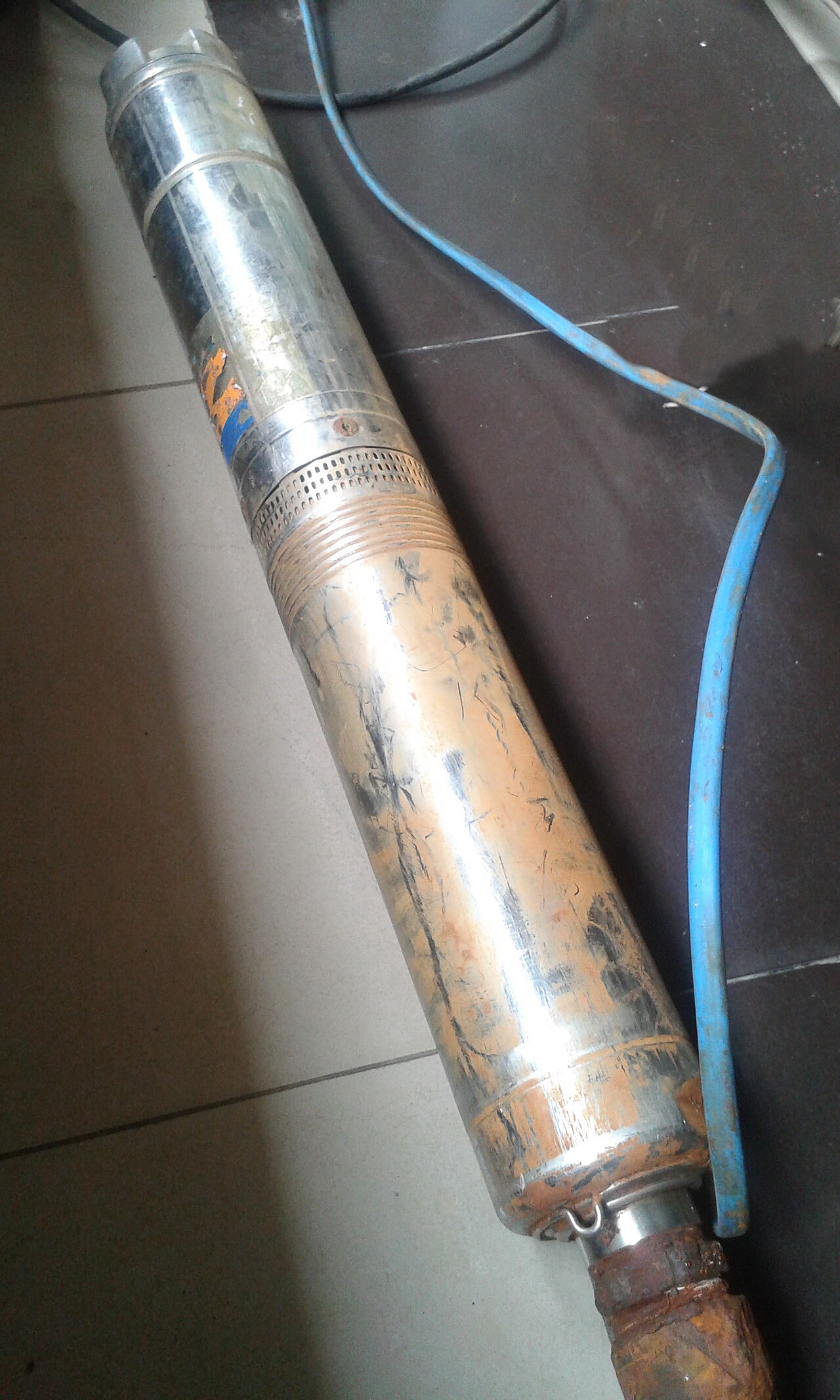
Rough orientative power: for a flow rate of the order of 7–13 m³/h with a head of 20–40 m, a pump with a power of approximately 1.5–4 kW is required; larger reservoirs or height differences increase the requirement. The exact operating point (Q-H) is always read from the curve of the specific pump according to the project.
Filtration Units
Filters are mandatory for drip irrigation, not optional. The small openings of drippers easily clog with sand, silt, algae, or fertilizer precipitates, causing the section to gradually "die." Properly installed filtration is the cheapest insurance for an expensive network of laterals.
Selecting a Filter Based on Water Source
The type of filter depends primarily on the source and the physicochemical analysis of the water:
| Water Source | Main Problem | Recommended Filter |
|---|---|---|
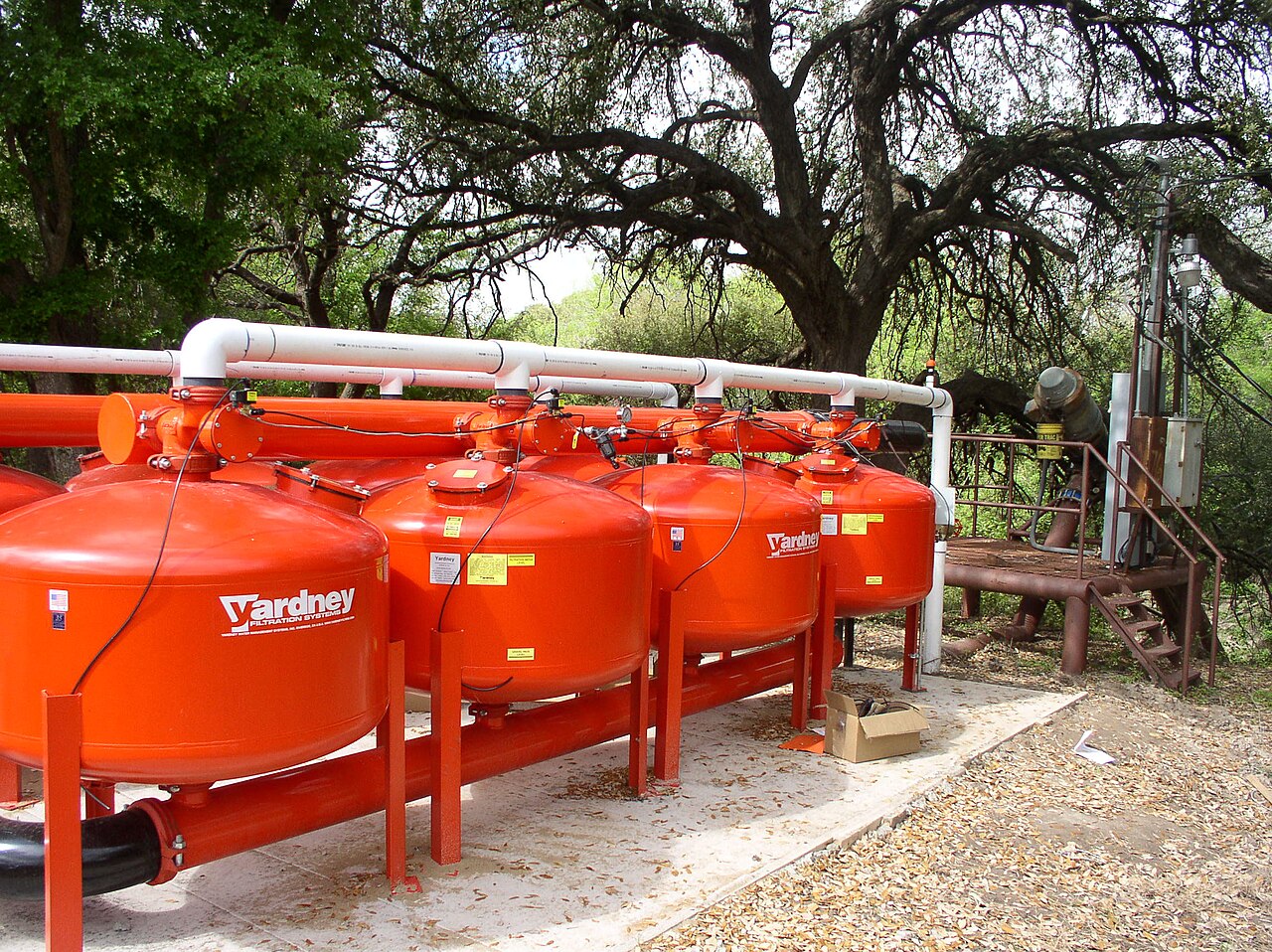
| Reservoir, lake, watercourse | Organic particles, algae, silt | Sand (media) filters with automatic backwashing + safety mesh/disk filter |
| Well with lots of sand | Sand | Hydrocyclone + safety mesh/disk filter |
| Relatively clean well water | Fine particles | Disk or mesh filter |
From Croatian reports: at the entrance of the system head, primary filtration (removal of sand) is located, and often a battery of self-cleaning disk filters is installed. An example of dimensioning: a filter with a minimum flow rate of 12.8 m³/h and a filtration degree of 130 microns, with at least two manometers (before and after the filter) for monitoring pressure drop.
Stages of Filtration and Control
- Primary filters — hydrocyclone or sand, depending on the source.
- Secondary (safety) filters — disk or mesh, as the last line of defense immediately before sections; especially important after fertilizer injectors as they catch precipitates formed by mixing fertilizers.
- Manometers before and after: an increase in pressure difference is a sign that the filter is dirty and needs to be flushed/cleaned.
Rule of thumb: when the pressure difference before and after the filter rises by approximately 0.3–0.5 bar compared to the clean state, it is time to flush.
Automation and Controllers
Automation turns a pile of valves into a system. In small orchards, manual control may suffice, but with multiple sections and fertigation, automation quickly becomes cost-effective.
According to Croatian projects, the main system control consists of: filter equipment, regulation equipment, feeding (fertigation) equipment, system operation controller, and metering and control equipment. Operating pressure regulation is carried out by a hydraulic valve behind the filter bank, and a safety valve at the inlet protects the system from overpressure.
What an advanced controller/central unit enables (according to Italian guidelines, e.g., Netafim):
- Control of hydraulic valves with voltage 12 V DC or 24 V AC.
- Input reception from flowmeters and pH and EC probes.
- Irrigation management by volume or by evapotranspiration (ETP), not just by weekly schedule.
- Control of individual valves with two-wire cable, mono-cable with decoder, or wirelessly (radio).
- Acceptance of soil moisture probes for closed-loop control.
- Remote monitoring and control via GSM/mobile connection from a remote computer or phone.
Hydraulic valves are more suitable for automated systems than manual butterfly/ball valves, so this should be considered during design. Control valves at the very water inlet (at the pump station) are often omitted to save costs, but they allow isolation of part of the system for repair without draining the entire network.
Fertigation Units (Injectors, Tank A/B)
Fertigation — simultaneous irrigation and fertilization — represents the peak efficiency of the system, as nutrients are delivered directly to the root zone in controlled doses. A fertigation unit consists of tank(s) for the fertilizer solution, an injector, and the associated plumbing/valving.
Types of Injectors
| Injector Type | Operating Principle | Advantages | Disadvantages |
|---|---|---|---|
| Venturi | Vacuum in a pipe constriction draws in the solution | Inexpensive, no external energy required | Causes pressure drop, less precise |
| Metering Pump (piston/diaphragm) | Actively injects the solution | Highly precise, independent of pressure | More expensive, requires power |
| Pressure Tank (by-pass) | A portion of the flow passes through the fertilizer tank | Simple | Decreasing concentration during operation |
| T-junction on pump suction | Solution is drawn in at the pump inlet | Cheapest | Least control, risk to the pump |
According to literature, the metering pump (injector) is the most precise form of fertigation, but it requires additional filters at the inlet of each zone. Venturi injectors are common in practice due to their low cost. Commercial injection systems (e.g., Irritec) achieve an injection range of 150 to 1,700 l/h depending on the model.
Tanks and A/B System (Tank A / Tank B)
In more advanced fertigation, two separate solution tanks, "Tank A" and "Tank B", are used, plus an acid tank if needed:
- Tank A — typically contains nitrogen and potassium (e.g., calcium nitrate) and other fertilizers that are compatible in a concentrated solution.
- Tank B — contains fertilizers that must not be mixed with those from Tank A in the concentrate because they would precipitate (typically phosphates and sulfates, e.g., monoammonium potassium phosphate / magnesium sulfate together with calcium).
- Acid Tank — used for water pH correction and preventing precipitation (limescale) in the system.
The reason for separation: calcium compounds with phosphates and sulfates form insoluble precipitates that clog emitters. When diluted in the main water flow simultaneously, they are harmless, but in the concentrate, they must be kept separate. Advanced controllers dose from A and B channels and acid independently, managing EC (total salt concentration) and pH to set values using online probes.
Injector Position and Protection
- The injector is placed so that a safety (disk/screen) filter remains downstream to catch any potential precipitates.
- An anti-siphon / check valve between the pump and injector is mandatory: if the pump stops during injection, it prevents the return of fertilizer or chemicals to the water source (protection of the well/water body).
- After fertigation, the system should be "flushed" with clean water so that fertilizer does not remain in the laterals and promote algae/precipitate growth.
Indicative Prices (Informational)
Prices vary significantly depending on orchard size, water source, elevation difference, and level of automation. The following figures are only order-of-magnitude estimates from public sources (2025/2026) and should be verified with supplier quotes for a specific project.
| Item | Indicative Price |
|---|---|
| Complete drip system | ~ €850–1,200/ha (up to €2,000+ /ha with all equipment) |
| Pump (small zone, 15 m³/h) | ~ €1,200–1,500 |
| Pump (5 ha at once, ~60 m³/h) | ~ €4,000–5,000 |
| Solar / generator pump drive | + €1,500–15,000 (depending on capacity) |
| Filter (by type) | ~ €150–1,200 per unit |
| Pressure regulator | ~ €30–200 |
| Sectional (solenoid) valve | ~ €50–300 per unit |
| Basic controller | ~ €100–500 |
| Smart / remote controller | ~ €300–1,200 |
| Lateral (drip line) | ~ €0.30–2.60/m (≈ 1,666 m/ha) |
Note: In BiH/regional calls for proposals, irrigation equipment (pumps, hoses, sprinklers/emitters, filtration systems, fertilization systems, hose reels) is explicitly an eligible cost under the "Equipment and Machinery" category — it is worth checking current calls (e.g., IPARD, rural development measures) as they may co-finance the head of the system.
Maintenance
The system head requires regular, but simple, care:
- Filters: flushing/cleaning according to pressure drop (manometers); check self-cleaning cycle for automatic banks.
- Pump: monitoring operating pressure and power consumption (signs of clogging or failure), checking seals and bearings, protecting against dry running.
- Emitters and Laterals: periodic flushing of lateral ends; preventive acidification of water in case of limescale precipitation.
- Fertigation: flushing the system with clean water after each feeding; cleaning Tank A/B; calibrating/cleaning pH and EC probes.
- Valves and Automation: checking hydraulic valves, controller batteries/power supply, and cables/wireless connections before the season.
- Winter Preparation: draining exposed parts to protect against freezing; protecting controllers from moisture.
Burying laterals (after 2–3 years, when roots descend to ~0.5 m depth) removes interference with harvest, mowing, and pruning — provided self-compensating emitters with anti-siphon and root intrusion protection are used.
Practical Recommendations and Common Mistakes
- Do not size the pump for the entire orchard at once. Dividing into sections/shifts drastically reduces the required pump size and cost.
- Always perform a physical-chemical water analysis before choosing a filter. Without it, even the most expensive filter is not correctly selected.
- Install two manometers (before and after the filter). Without them, you don't know when the filter needs cleaning — and a clogged filter means starving emitters.
- The anti-siphon valve is not optional. It protects the water source from fertilizer backflow when the pump stops.
- Do not mix calcium fertilizers with phosphates/sulfates in the same tank. Hence the Tank A / Tank B system.
- Flush the system after every fertigation. Otherwise, fertilizer in the laterals promotes algae and precipitates that clog emitters.
- Do not skimp on sectional valves and automation if you plan fertigation — manually managed fertigation across multiple sections is prone to errors and uneven feeding.
- Plan for a variable frequency drive (VFD) in systems with multiple sections of different flow rates for stable pressure and energy savings.
Proper irrigation can increase hazelnut yield by up to 30% thanks to better differentiation of flower buds, reduced flower drop, and larger leaf area — but only if the hardware behind the emitter works reliably. The system head is an investment that preserves the value of the entire orchard.
Gallery
Sources
This article is an AI summary generated from an internal literature collection on hazelnut (RAG corpus) and publicly available sources. Dosages, flow rates, pressures, and prices are indicative and depend on cultivar, location, water source, and applicable regulations and permits. Main sources used:
- Environmental impact assessments for groundwater abstraction and irrigation of hazelnut orchards in Croatia (Donji Hrastovac/Sunja, Glina, Dragodinac, Nova Kapela, Zmajevac, Donja Pištana/Orahovica, Vojnić) — project data on pumps, sections, filtration, and reservoirs.
- Linee guida per la realizzazione di un impianto a goccia su corileto (Netafim) — automation, hydraulic valves, fertigation. PDF
- Nutrizione / Irrigazione del nocciolo — Manuale tecnico (Ferrero) — fertigation station scheme, Venturi injector, pressure regulation. tecnichenuove.it
- Irritec — Drip Irrigation for Hazelnut Trees (filter selection based on water source, injector capacity). irritec.com
- Best Management Practices — Irrigation Management (injector types, filter/injector position).
- Guidelines for applicants (calls for proposals) — eligible equipment for irrigation and fertilization.
- New Mexico State University — Planning and Operating Orchards With Drip and Microspray Irrigation Systems. pubs.nmsu.edu
- TNAU Agritech — Drip Irrigation and Fertigation (system head components). agritech.tnau.ac.in
- Drip Depot — Fertigation in irrigation systems (anti-siphon, injector position). help.dripdepot.com
- Farmonaut / Irrigation Tech / Bhumi Calculator — indicative system, pump, controller, and filter prices (2025/2026). irrigationtech.com, bhumicalculator.com
Recommended equipment
🔎 nut harvester machine — Amazon →Affiliate links — we may earn a small commission at no extra cost to you.
Hazelnut Harvesting Equipment
Compare manual, semi-mechanized, and larger solutions.
| Use Case | Option Type | What to Check Before Purchase |
|---|---|---|
| Small gardens | Manual rakes and nets | Handle length and net durability |
| Medium orchards | Semi-mechanized sweepers | Engine power and collection capacity |
| Large plantations | Over-the-row harvesters | Professional machinery specifications |