Deficit irrigation and drought stress management
Content generated by artificial intelligence — verify before application
This article was automatically compiled from a collection of hazelnut literature using artificial intelligence and may contain errors or outdated data. It serves as a starting point for further research, not as professional advice. Dosages, products, and timing are informative and depend on the cultivar, location, and current regulations — always consult with an advisory service and official sources before application.
Water is increasingly becoming a limiting factor for yield and quality in hazelnut (Corylus avellana) production. Hazelnuts develop a shallow root system, making them sensitive to summer drought and high temperatures, which in combination can significantly reduce yields. At the same time, water is becoming an increasingly expensive and strictly regulated resource, forcing producers to extract the maximum value from every cubic meter. Deficit irrigation — the deliberate and controlled application of less water than the plant's full requirement — is a strategy that, if applied during the correct period and with measurement, can save water with little or no yield loss. This article explains how hazelnuts respond to drought stress, which periods are sensitive, how to plan controlled water deficits, and how to recognize and mitigate the consequences of drought on kernel filling, crop, and quality.
Why is hazelnut sensitive to drought?
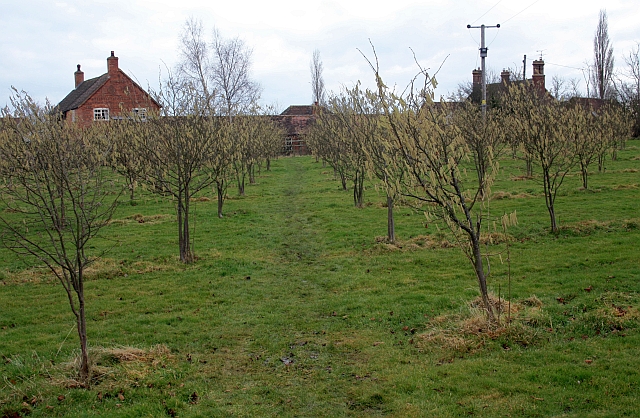
The main stress factor in our growing conditions is the occurrence of high summer temperatures combined with a lack of precipitation. As hazelnut develops a shallow root system, water deficit and high temperatures can significantly reduce fruit yields in orchards (Proceedings of the Croatian Fruit Growers, 2018.). A shallow root system means the plant quickly depletes moisture from the topsoil layer and cannot effectively reach deeper reserves — therefore, hazelnuts on dry, hot, and compacted soils produce small and irregular crops.
Water is a key factor for a stable crop. Under dry conditions, irrigation is a regular measure from May to the end of August, and literature cites an approximate seasonal requirement on the order of 950–1000 mm evenly distributed over these months (PDF "For Tito's Hazelnuts", 2012.). It should be emphasized: this figure includes precipitation — irrigation only compensates for the deficit between the actual need and rainfall.
Shallow root = small reservoir
Since hazelnut primarily uses the topsoil layer, frequent small irrigations are generally better than rare, heavy ones. This is also the foundation for why deficit irrigation in hazelnuts should be managed carefully and with measurement — errors quickly affect the plant.
What is deficit and controlled (regulated) irrigation?
Deficit irrigation (DI) means deliberately applying water below the full evapotranspiration requirement of the orchard. Regulated deficit irrigation (RDI) is a more refined version: the deficit is applied only during phenophases when the plant is relatively resistant to water stress, while full or nearly full supply is maintained during sensitive periods (e.g., kernel filling).
The goal of RDI is not to maximize yield at all costs, but to stabilize the crop with significantly higher water use efficiency (WUE). In various fruit and nut crops, RDI allows savings of the order of 20–30% water without (or with minimal) yield loss, provided that the deficit is timed outside critical phases (review papers on RDI, Springer 2015; PMC 2023.).
In practice, RDI is implemented in three ways:
| Approach | How it works | Note |
|---|---|---|
| Deficit by phenophase | Reduction of dosage only in less sensitive periods | Most common approach for fruit trees; requires phenology monitoring |
| Partial rootzone drying (PRD) | Only part of the rootzone is moistened alternately | Promotes water savings via physiological signal of stomatal closure |
| Subsurface drip irrigation | Water is delivered below the soil surface | Reduces evaporation and weeds |

RDI is not the same as 'watering less'
Controlled deficit only makes sense if you know when and how much water is being withheld and if the plant's condition is monitored. Random under-watering, especially during kernel filling, leads directly to yield and quality loss.
Phenophases and sensitivity to water stress
The key to RDI is distinguishing between periods when the plant "forgives" a deficit and those where it "punishes" it. Although precise thresholds for hazelnut are still a subject of research, general rules from nut and stone fruit crops and experience with hazelnut provide the following orientation:
| Phenophase (approx.) | Period (continental HR) | Sensitivity to drought | Strategy |
|---|---|---|---|
| Bud swell, leafing, flowering/pollination | March–April | Moderate | Maintain moisture; poor pollination reduces fruit set |
| Husk growth and fruit set | May–June | High | Avoid deficit; early damage leads to fruit abortion |
| Kernel filling | July–August | Highest | Full supply — this determines kernel mass and quality |
| Ripening, pre-harvest | Late August–September | Lower | Controlled deficit possible; aids husk drying and harvest |
| Post-harvest, reserve accumulation | September–October | Moderate | Moderate irrigation for reserves and bud differentiation |
This leads to the rule: if a deficit is applied, it is safest to place it in late ripening/pre-harvest, not during the kernel filling period. Dry and clean soil before harvest also has a practical advantage — lower fruit moisture and higher efficiency of machine harvesting (Elaborate PPO Hazelnut, 2015.).
Drought stress and kernel filling, crop, and quality
The period of kernel filling — in our conditions mostly July and August — is the most sensitive to water stress because this is when the mass and fullness of the kernel are formed, i.e., what the buyer pays for.
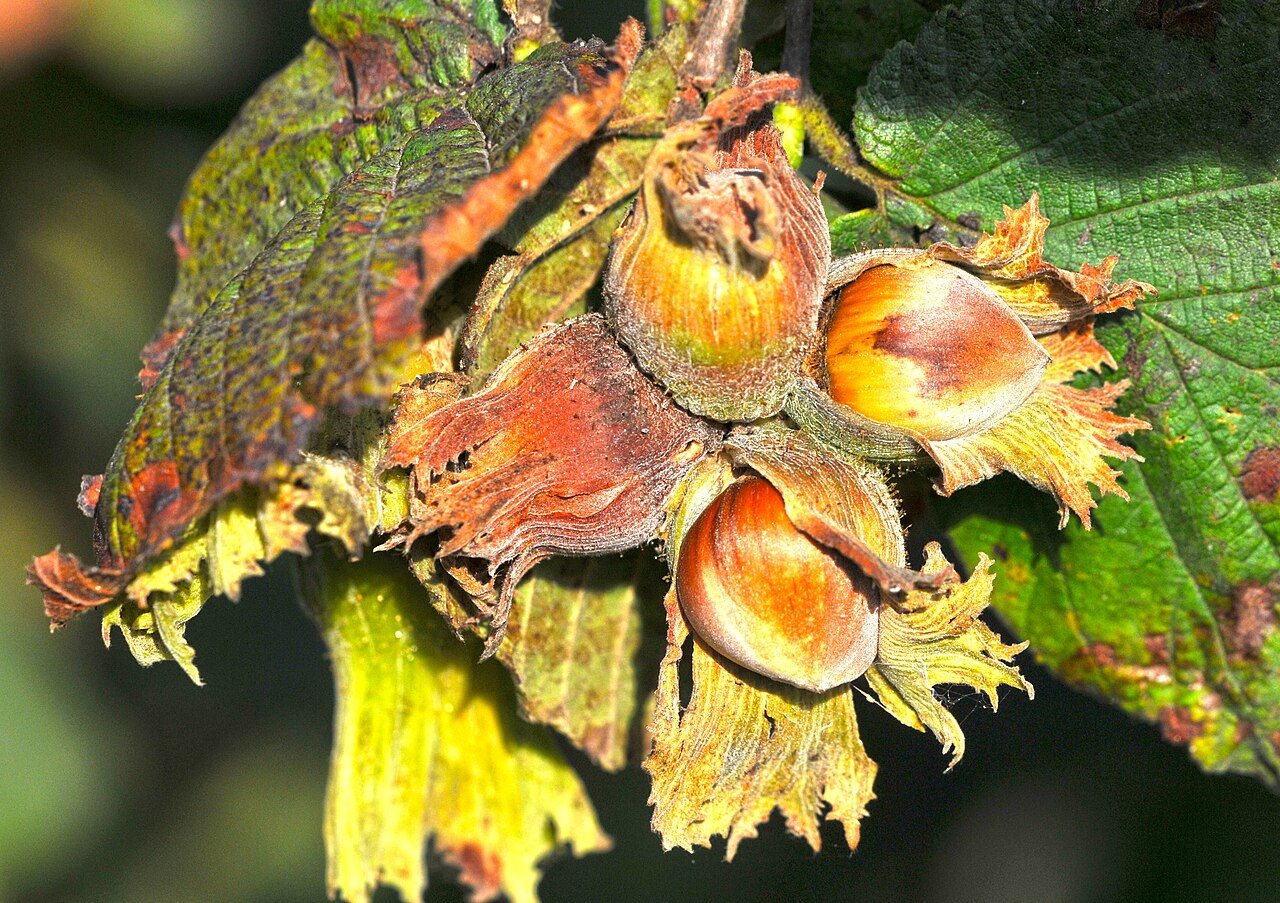
Water deficit in this window typically leads to:
- reduced kernel mass and poorer kernel ratio (proportion of kernel to fruit),
- higher proportion of empty and shriveled fruits (poorly filled),
- smaller fruit size and poorer appearance,
- in combination with heat — increased fruit drop (abortion).
It is important to distinguish the causes of "empty shells." Besides drought, poor pollination and attack by fungi causing rot (e.g., Nematospora coryli with the assistance of bugs) lead to the deterioration and non-development of the kernel, where the kernel turns black and dries up — so-called traumatic abortion from early stings in May/June (Hazelnut Diseases and Pests, 2020.; Annual Treatment Plan, Gospodarski list). Therefore, the diagnosis of "empty fruits" should be made carefully: a cross-section of the fruit and the presence of brown droplets/sour-smelling kernel indicate bugs and fungi, while uniformly small, dry, and poorly filled fruits without signs of stings point more towards abiotic (water/heat) stress.
Practical rule for the kernel
In July and August, aim for full water supply. Move any potential savings to spring (with sufficient rainfall) and late ripening. Deficit during kernel filling is an "expensive" saving because it directly reduces kernel ratio and size.
How much water does hazelnut need — indicative figures
The following data are informative and serve for rough planning; actual needs depend on the year's climate, soil, planting density, orchard age, and cultivar.
| Indicator | Indicative Value | Source / Note |
|---|---|---|
| Crop coefficient (Kc) for hazelnut | ~0.8 during the season (April–October) | Lysimeter measurements (ISHS) |
| Kc by month | 0.4–0.5 in spring → 0.65–0.8 in summer | 9-year-old orchard (lysimeter) |
| Daily drip requirement (summer) | ~35 L/tree/day (June–September, no rain) | 9-year orchard, 670 trees/ha |
| Seasonal requirement (precipitation + irrigation) | ~950–1000 mm | PDF "For Tito's Hazelnuts" |
| Minimum daily dose | ~3 mm/day | Glina Elaborate (well dimensioning) |
| Annual water consumption (examples from elaborates) | ~3,880 m³/year (≈40 ha); ~5,000 m³/year | EZO Vojnić; EZO Sunja |
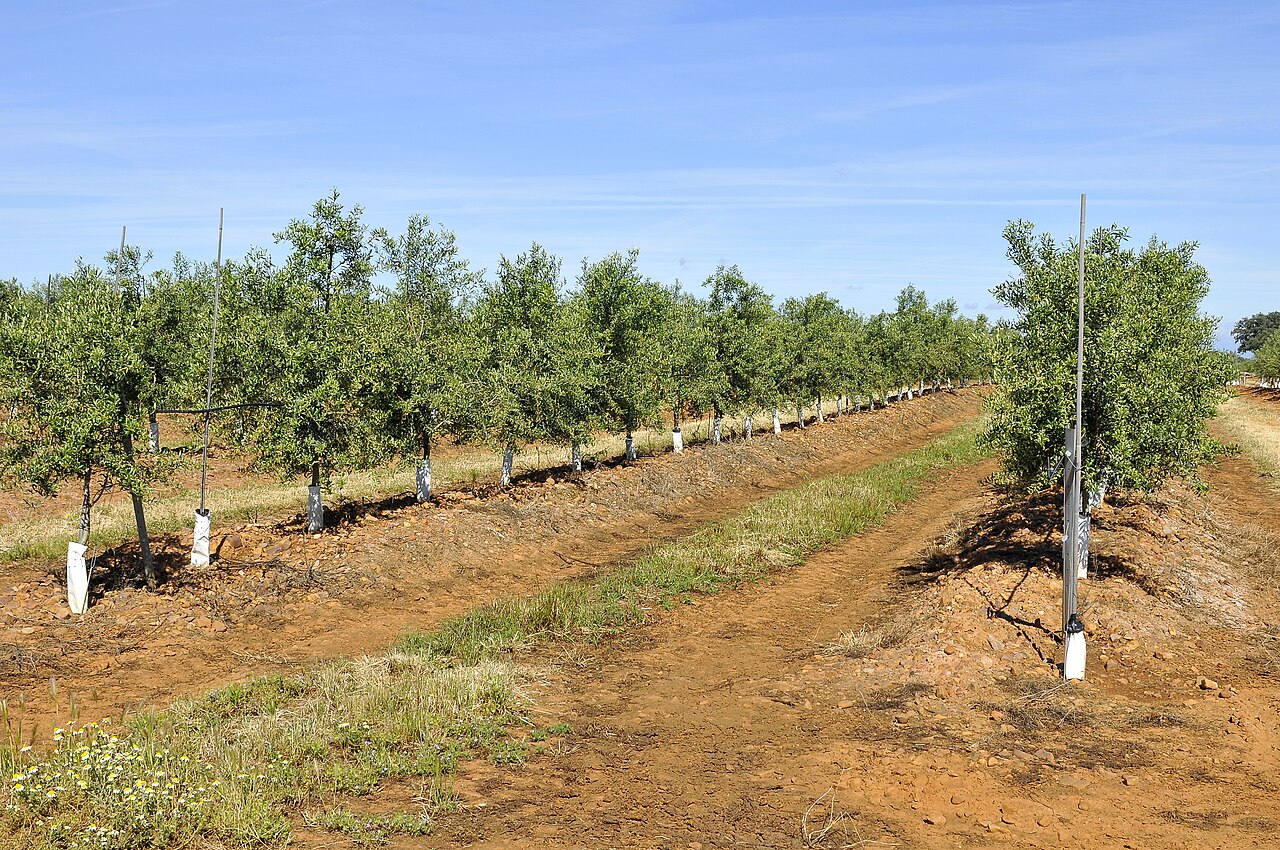
From the need of ~3 mm/day and the assumed capacity, the dimensioning of the source follows: for 3 mm/day, a well flow rate of ~12.8 m³/h is cited (Glina Elaborate, 2022.). In practice, drip irrigation (drip system) is almost exclusively used, often automated, because it allows precise dosing, less evaporation loss, and compatibility with deficit regimes; furrow irrigation is avoided due to easier fruit collection from the soil.
How to monitor stress and decide on irrigation
The essence of RDI is measurement, not guessing. Without monitoring, deficit easily crosses from "controlled" to "harmful." Useful approaches:
- Stem water potential (SWP) with a pressure chamber — the reference method for water status in the plant; requires a trained person and does not provide continuous measurement. Newer probes (microtensiometers) allow continuous monitoring (S03 Proceedings, 2024.).
- Crop Water Stress Index (CWSI) from leaf temperature using inexpensive infrared thermometers — for hazelnut, it is noted that at SWP above −6 bars, CWSI remains below 0.2, which corresponds to low stress (PMC, 2024.).
- Irrigation thresholds proposed by researchers for hazelnut: leaf conductance around 0.2 mol m⁻² s⁻¹ or water potential around −6 bars. Non-irrigated trees were under stress from mid-July to the end of the season, while irrigated trees remained stress-free.
- Soil moisture sensors (tensiometers, FDR/TDR probes) at 2–3 depths — simple and inexpensive for routine schedule management, especially with the shallow root system of hazelnut.
- Monitoring phenology and weather forecasts — so that the deficit does not "drift" into the kernel filling period.
Combine methods
Soil sensors tell what is available to the root; measurements on the plant (SWP, CWSI) tell how the plant is actually feeling. The best decisions are made by combining both.
Mitigating Drought and Heat Stress
Beyond irrigation alone, there is a range of measures that reduce plant load during dry/hot periods:
- Row mulching with organic mulch or cover crops conserves moisture and cools the soil; desiccation/mowing of the grass cover before harvest reduces competition for water and facilitates harvesting.
- Maintaining proper pH and nutrition — low pH values limit nitrogen and potassium uptake, and potassium is crucial for water regulation and stress resistance; shallow roots further reduce nutrient uptake (Foliar fertilization of hazelnut; PDF Hazelnut Cultivation).
- Mycorrhiza — symbiosis helps hazelnut uptake of more water and minerals, and results in more vigorous and productive trees with less fruit drop (PDF Hazelnut Cultivation, 2009).
- Biostimulants and preparations with amino acids / seaweed extracts — modern fertilization technology recommends them for stress mitigation and faster recovery after frost, drought, or hail.
Reference doses for preparations for recovery after stress (frost/drought/hail), informative only — always check the label and registration in Croatia:
| Preparation (type) | Reference Dose | Note |
|---|---|---|
| FitoAlgen F (amino acids from algae) | 2.0 l/ha | recovery after stress |
| Fitofert LMW (organic with amino acids) | 2.5–3.5 l/ha | recovery after stress |
| Kaishi (concentrated amino acids) | 1.5–2.0 l/ha | recovery after stress |
| Shigeki | 1.5 l/ha | recovery after stress |
| Amive (organic with amino acids) | 1.5–2.0 l/ha | recovery after stress |
Doses and registrations are subject to change
Some preparations from the protection/nutrition program are not registered for hazelnut in Croatia or registrations change. Before application, always check the current label, registration, and pre-harvest interval with the advisory service.
Practical Recommendations (Summary)
- Save water outside critical phases. The safest window for controlled deficit is late ripening/pre-harvest; spring is usually covered by precipitation.
- Keep kernel filling (July–August) fully supplied. This is where yield, size, and quality are decided — savings here are expensive.
- Measure. Combine soil moisture sensors with plant status measurements (SWP ~−6 bar or leaf conductance ~0.2 mol m⁻² s⁻¹ as reference thresholds).
- Irrigate more frequently, with smaller doses due to shallow roots; use drip irrigation.
- Reduce evaporation and competition through mulching and grass cover management.
- Support the plant with proper pH, potassium, mycorrhiza, and, if necessary, biostimulants.
- Differentiate causes of "empty nuts" — drought vs. bugs/fungi — before drawing conclusions about water.
Common Mistakes
- Deficit during kernel filling — the most costly mistake; directly reduces kernel mass and yield percentage.
- Infrequent heavy irrigations with shallow roots — water runs off or is lost, roots remain dry.
- Managing "by feel" without measurement — the line between beneficial and harmful deficit is narrow.
- Neglecting pH and potassium — stressed plants uptake nutrients poorly, exacerbating drought effects.
- Attributing all empty nuts to drought — often the culprits are bugs and fungi (kernel rot), which require entirely different measures.
Sources
This article is an AI summary compiled from an internal literature collection on hazelnut (RAG corpus) and supplemented with publicly available sources. Main sources used:
From the hazelnut RAG corpus:
- PDF "For Tito's Hazelnuts" (pdfcoffee), 2012. — seasonal water needs and significance of irrigation.
- Environmental Protection Elaborate, hazelnut orchard ~40 ha, Vojnić Municipality (EZO, EcoMission), 2021.
- Environmental Protection Elaborate, hazelnut orchard and irrigation, Sunja Municipality, 2021.
- Elaborate — water abstraction for hazelnut orchard, City of Glina (Eko-monitoring), 2022.
- Proceedings of the 13th Scientific-Professional Conference of Croatian Fruit Growers, 2018. — drought and high temperature stress, biostimulants.
- "Water stress measurements in fruit trees under different regulated deficit irrigation regimes", IRTA Lleida, 1996.
- "Fruit production systems for sustainable and resilient development" (S03 Proceedings), 2024. — RDI and water potential measurement.
- PDF "Hazelnut Cultivation" (pdfcoffee), 2009. — mycorrhiza, water, and minerals.
- "Achieving higher yields in hazelnuts through foliar fertilization" — pH, nitrogen, potassium, and shallow roots.
- Hazelnut diseases and pests (Repository), 2020.; "Annual Hazelnut Treatment Plan" (Gospodarski list) — kernel rot, bugs.
- Reference protection and fertilization programs (Lijeska, fito-eko); Fitoeko Catalog 2025. — amino acid preparations for stress recovery.
- Elaborate PPO Lješnja, 2015. — grass desiccation and bare soil before harvest.
Public sources (web):
- "A Crop Water Stress Index for Hazelnuts Using Low-Cost Infrared Thermometers", PMC — https://pmc.ncbi.nlm.nih.gov/articles/PMC11644836/
- "Establishing hazelnut stem water potential baseline to improve water management", Frontiers in Plant Science — https://www.frontiersin.org/journals/plant-science/articles/10.3389/fpls.2026.1771736/full
- "Water use of hazelnut trees as measured with lysimeters", ISHS — https://ishs.org/ishs-article/351_34/
- "Regulated deficit irrigation for crop production under drought stress. A review", Agronomy for Sustainable Development (Springer), 2015. — https://link.springer.com/article/10.1007/s13593-015-0338-6
- "Regulated deficit irrigation: an effective way to solve the shortage of agricultural water for horticulture", PMC, 2023. — https://pmc.ncbi.nlm.nih.gov/articles/PMC10441918/
- "Regulated deficit irrigation during the kernel-filling period and optimal irrigation rates in almond", ScienceDirect — https://www.sciencedirect.com/science/article/abs/pii/S0378377405000053
Recommended equipment
🔎 drip irrigation kit — Amazon →Affiliate links — we may earn a small commission at no extra cost to you.
Drip Irrigation Kit
Suitable for small to medium orchards or gardens.
| Use Case | Option Type | What to Check Before Purchase |
|---|---|---|
| Small plots | Basic drip lines | Emitter spacing and flow rate |
| Medium orchards | Complete kit with filters | Pressure regulation and filtration quality |
| Large scale systems | Professional installation | Hydraulic calculation and zoning |