Sorting, Calibrating, and Grading Hazelnuts
Content generated by artificial intelligence — verify before application
This article was automatically compiled from a collection of hazelnut literature using artificial intelligence and may contain errors or outdated information. It serves as a starting point for further research, not as professional advice. Dosages, products, and timing are informative and depend on the cultivar, location, and applicable regulations — always consult an advisory service and official sources before application.
After harvest, drying, and before storage, harvested hazelnuts must undergo a series of post-harvest treatments to transform the orchard mass into a market-defined product of uniform size and known quality. The three steps often confused — sorting (removal of impurities, empty, and damaged nuts), calibrating (sorting by size), and grading (assigning to quality classes) — together determine how much a producer will receive for their crop and whether it can be sold to a buyer requiring a specific caliber. This article explains the sequence of these operations, target figures (calibers in mm, kernel percentage, breakage rate), quality classes according to current standards, and equipment — from simple roller calibrators to optical sorters with AI recognition.
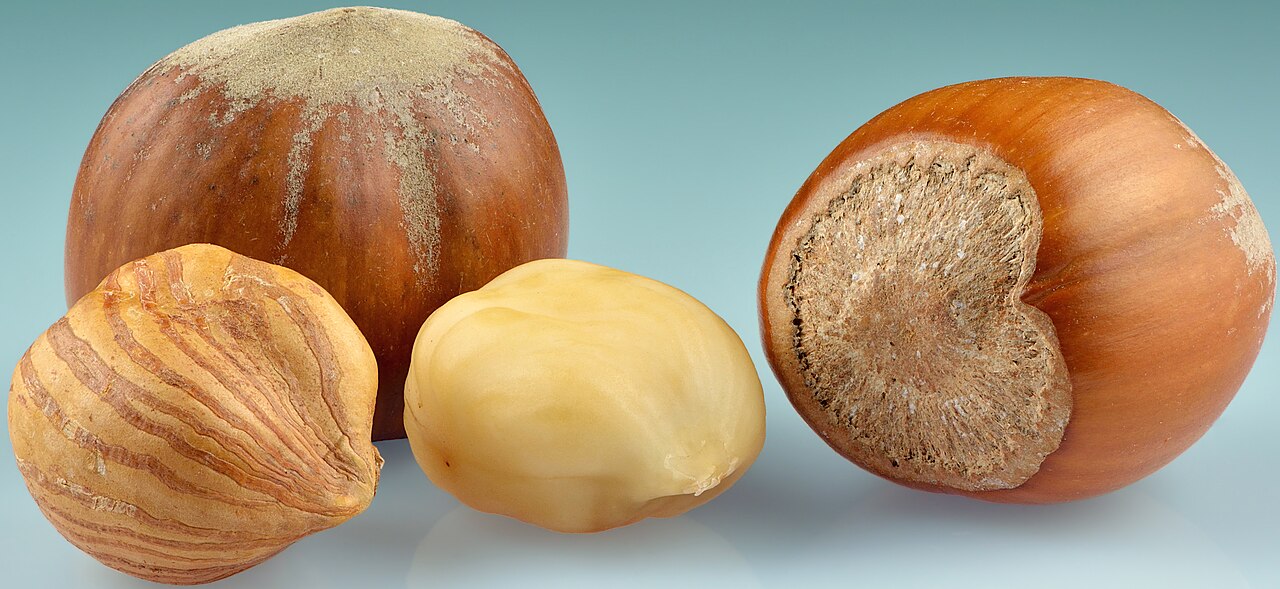
Terms: Sorting, Calibrating, Grading
In practice, these three terms constantly overlap, but it is useful to distinguish them because they serve different purposes and require different equipment.
| Operation | What it does | Criterion | Typical Equipment |
|---|---|---|---|
| Cleaning / Sorting | separates impurities, leaves, empty and damaged nuts, stones | mass, density, shape, color | aspirators, gravity tables, optical sorters |
| Calibrating (Calibration) | sorts nuts into groups by size (diameter) | nut diameter in mm | roller calibrators, sieves, drums |
| Grading | assigns the batch to quality classes according to the standard | overall quality, kernel percentage, defects | combination of all above + visual/laboratory control |
The sequence is important. In a well-set up processing line, cleaning and drying come first, followed by calibrating by size, and only then cracking (shelling) and, for kernels, fine sorting (optical) and finally grading of the finished product. Calibrating nuts in the shell before cracking is not a cosmetic operation — it directly reduces kernel breakage because the cracking machine works with nuts of uniform size.
Calibrating by Size
Calibrating is the sorting of hazelnuts into groups by coarseness, from the smallest to the largest. It is performed as many times and into as many groups as necessary to achieve the uniformity required for the next step.
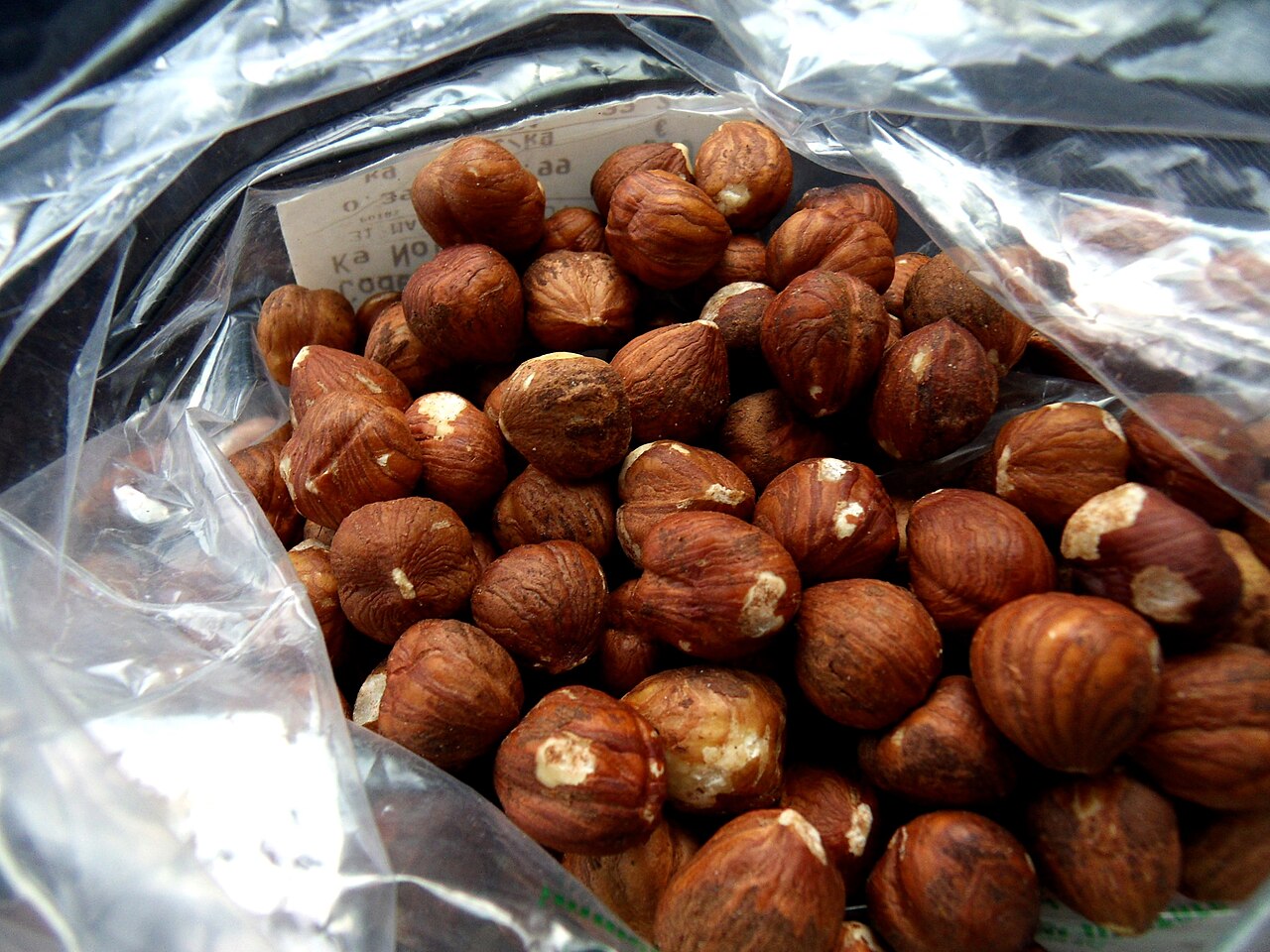
Why calibrate before cracking
The main reason is reducing kernel breakage during cracking. When the cracking machine processes nuts of uniform size, the gap between working elements can be precisely adjusted so that the shell cracks with minimal broken kernel content. From the literature: for calibrated nuts, the cracking machine crushes them with about 2% breakage, while uncalibrated mass yields significantly more broken kernels and small fragments.
The second reason is market-related — buyers (especially the confectionery industry) order goods by precisely defined caliber, so uniformity is a prerequisite for sales and for premium pricing.
Practical note from practice: before calibrating, the nut must be completely free of burrs (husk) and well dried. Remnants of the husk cause machine jams, and wet nuts do not sort accurately.
Caliber in mm and Market Groups
Caliber (English caliber) refers to the diameter of the nut or kernel, expressed in millimeters. The market — led by the Turkish industry recognized by chocolate manufacturers and processors worldwide — uses standardized ranges. The following table roughly shows the ranges and their intended use (informative, depends on buyer and cultivar):
| Kernel Caliber | Typical Use |
|---|---|
| 9–11 mm | chocolate fillings, pralines, grinding (internal use) |
| 11–13 mm | most common caliber — fillings and standard chocolate bars |
| 13–15 mm | premium bars where the whole nut is visible |
| > 15 mm | table use, premium retail |
For nuts in the shell, calibers are larger. An example from Croatian practice (Minas-Zrno company, inox-Daruvar calibrator): the machine achieves calibration 12–18 mm for nuts in the shell, sorting them through four pairs of rotating rollers spaced at 12 mm at the start and 18 mm at the end.
How the shape of the opening determines size
An important technical detail from the literature: the shape of the opening on the sorting device determines by which dimension the nut is sorted. The nut is not a sphere — it has the smallest (S3), middle (S2), and largest (S1) dimensions.
- Elongated openings (slots, "slot") — sort by the smallest dimension (S3). Usually used before cracking.
- Round openings — sort by the middle dimension (S2).
Since kernel mass is approximately proportional to the cube of the geometric mean diameter, even a small measurable difference in size means a large difference in kernel mass. Therefore, the choice of opening shape is not secondary — it affects how uniform the mass of nuts in each group will be, not just their "piece count".
Practical Calibrator Figures
| Parameter | Value (example) | Source / Note |
|---|---|---|
| Roller spacing (start → end) | 12 mm → 18 mm | inox-Daruvar |
| Achieved calibration (in shell) | 12–18 mm | inox-Daruvar |
| Number of calibration groups | 4 (e.g., OPG Hobolić) to 7 | depends on machine |
| Calibrator capacity | 150–250 kg/h | depends on model |
| Breakage after cracking with calibration | ~2 % | with properly adjusted gaps |
Figures are informative and depend on cultivar, machine model, nut moisture, and settings.
Separating Empty and Damaged Nuts
Empty and damaged nuts reduce kernel percentage, spoil the batch flavor, and carry risks (mold, aflatoxin, stink bug damage). Separation begins in the orchard and continues through the entire processing line.
Separation already in the field (before harvest)
A useful trait of hazelnuts: nuts with empty shells regularly fall before correct nuts. Literature recommends that after these early, empty nuts have fallen (usually towards the end of August, before healthy nuts drop), the following should be done:
- final field leveling (smoothing) — filling small depressions so the vacuum cleaner works cleanly, and/or
- one "pre-gathering" — to eliminate empty nuts before the main harvest.
In this way, a good portion of low-quality goods is removed before they even enter processing.

Air separation (aspiration)
Vacuum harvesters already work as the first separator: a strong air stream separates heavier (full) nuts, which fall into the collection chamber, from lighter material (leaves, debris, empty shells) which is removed. The diameter of suction pipes is typically 10–12 cm.
In processing, the same principle is used on gravity cleaners and aspirators: an air stream and/or a tilted vibrating table separate material by density — full kernels/nuts fall to one side, empty and light ones to the other. A calibration line from the literature consists of: a hopper, conveyor belt, impurity vacuum, centrifugal blower, settling chamber, calibration roller, and control panel.
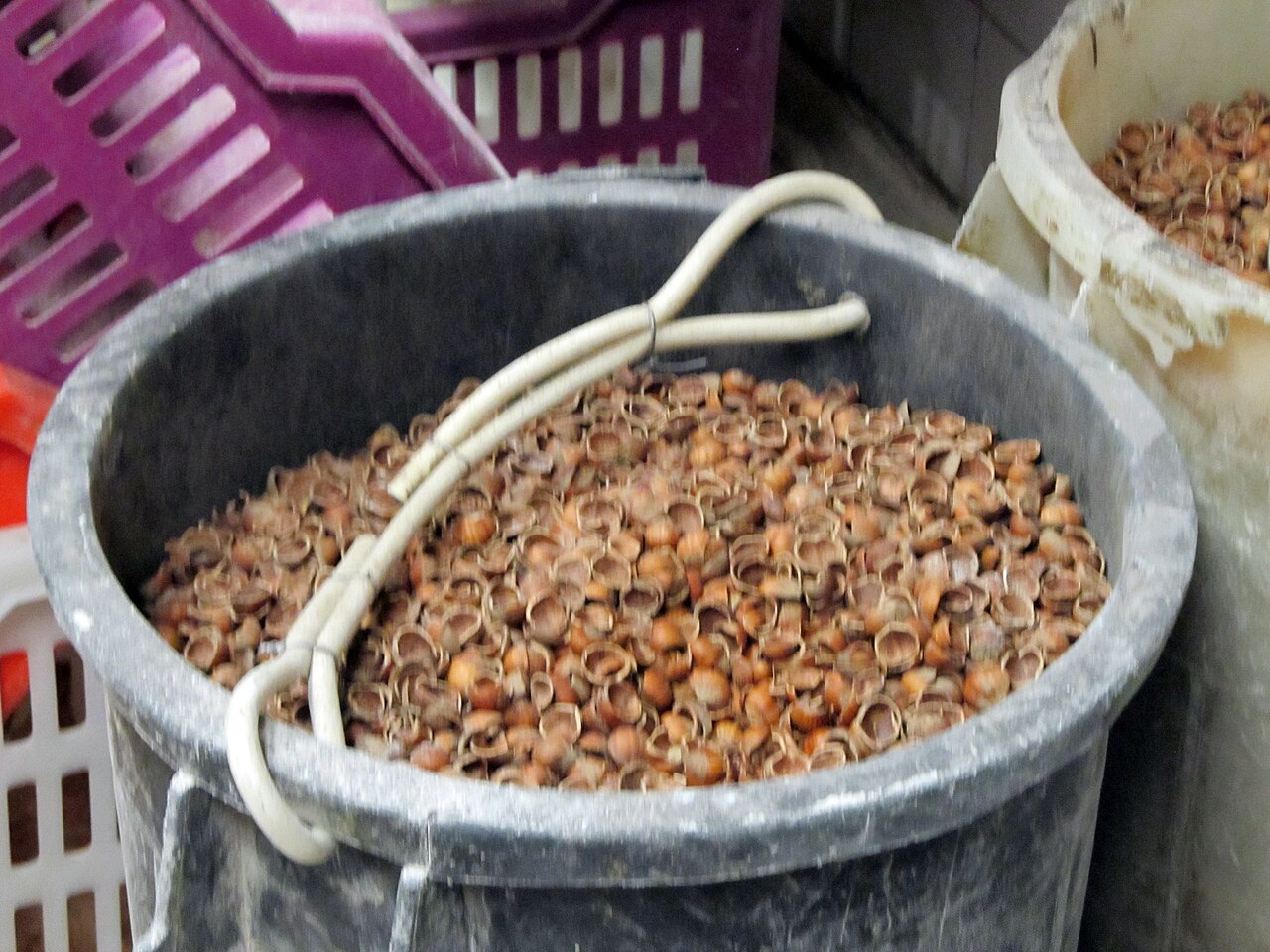
Fine separation — optical
After cracking, when the kernel is separated from the shell, the finest separation follows: an optical sorter recognizes and ejects rotten nuts, nuts damaged by stink bug piercing, and remaining impurities (shell fragments, foreign bodies). More on this equipment in the equipment chapter.
Moisture before cracking
A detail that saves kernel percentage: before shelling, it is recommended that kernel moisture be raised from ~6% to about 10% so that the kernel becomes more elastic and the proportion of broken and damaged kernels during cracking is reduced. (This refers to controlled, short-term humidification immediately before shelling, not a permanent increase in storage moisture — storage is dry.)
Kernel Percentage
Kernel percentage (yield) is the ratio of kernel mass to the mass of the whole nut, expressed in percent:
$$\text{Kernel Percentage (\%)} = \frac{m_{\text{kernel}}}{m_{\text{whole nut}}} \times 100$$
Kernel percentage is one of the main determinants of quality and price of hazelnuts. The higher the kernel percentage, the more usable kernel per kilogram of nuts in the shell, thus greater economic profitability.
Kernel Percentage Ranking
Classic ranking of kernel percentage (Modic et al., 1975; cited in Vrtodušić et al.), where 5 is most desirable and 1 is poorest:
| Rank | Kernel Percentage | Rating |
|---|---|---|
| 5 | > 49 % | most desirable |
| 4 | 46–49 % | very good |
| 3 | 43–46 % | good |
| 2 | 40–43 % | poorer |
| 1 | < 40 % | poorest |
In the USA, hazelnuts with a kernel percentage above 50% achieve a premium price (Mehlenbacher and Olsen, 1997). Top cultivars exceed this — e.g., Tonda Gentile delle Langhe has a kernel percentage of 49–54% and is considered one of the highest quality cultivars in the world.
What affects kernel percentage and processing suitability
Besides usability itself, value is also affected by:
- Sphericity of the nut — round (spherical) nuts are preferred because they are easier to process (e.g., skin removal/blanching, roasting).
- Shell thickness — the industry prefers thin to medium-thin shells (easier cracking, higher kernel percentage).
- Shell filling — there are nuts where the kernel poorly fills the shell; these have low kernel percentage even if they appear large.
Note: high kernel percentage and large caliber do not always go together — a cultivar with large nuts in the shell but thick shells may have a poorer kernel percentage than a smaller cultivar with thin shells.
Quality Classes
Grading places goods into standardized categories for trading purposes. There are two levels: traditional domestic categorization and international (UNECE) standards, which form the basis for EU market norms.
Traditional Categorization (Inshell)
Grading of hazelnut fruit applies to both the fruit inshell and the kernel. Traditionally, inshell fruit is divided into three categories:
- Quality I
- Quality II
- Quality III
International Standard (UNECE / EU)
Modern trade uses UNECE standards (on which EU market norms are also based). For hazelnut kernels (standard DDP-04) and inshell fruit (DDP-03), goods are graded into three classes:
| Class | Description | Size Sorting |
|---|---|---|
| „Extra" | highest quality, almost defect-free | mandatory |
| Class I | good quality, small defects allowed | mandatory |
| Class II | satisfactory quality, higher tolerances | not mandatory |
Key criteria according to the standard for kernels:
- Size is measured as the largest diameter of the equatorial cross-section of the kernel.
- Minimum size is 9 mm for kernels in the „Extra" and Class I categories (with the exception of small types, e.g., „piccolo").
- Size sorting (grading) is mandatory for the „Extra" class and Class I.
- Tolerance: presence of kernels 0.2 mm above or below the specified size is not considered a defect.
Always check the current version of the UNECE/EU standard and the specific customer specification (e.g., AFI specifications for the US market) — class boundaries, allowed defects, and caliber declarations vary by market and may be updated.
Sorting Equipment
The processing line is built modularly — from simple and inexpensive machines suitable for small family farms to highly sophisticated optical sorters for large processors.
Graders (by size)
- Roller graders — pairs of rotating rollers with increasing spacing; the fruit travels between them and drops out according to size (e.g., inox-Daruvar: 4 pairs of rollers, 12→18 mm, capacity 150 kg/h). Suitable for inshell fruit.
- Drum (tambour) graders — rotating drum with holes of increasing size.
- Vibrating sieves — the most traditional, yet still very widespread approach; different sieve hole sizes yield different fractions.
Principle (from Turkish literature): strip separators, roller classifiers, and sieves form the basic mechanical levels; only with advanced technologies (vibration, drum, aspiration, optics) is a more precise division achieved. The highest output quality is obtained on lines where all technologies are combined.
Aspirators and Gravity Tables (by density)
Separate empty and light fruits as well as impurities using air streams and/or inclined vibrating tables. The gravity cleaner (e.g., Torrengo Fratelli lines) is a standard part of processing before optical sorting.
Crackers / Shellers
After grading, each size fraction is cracked separately to minimize breakage. A fan automatically separates the shell from the kernel. There are concepts for coarse shell removal (removes the majority) and fine shell removal (removes remaining fragments).
Optical Sorters (by color, shape, material)
The pinnacle of fine selection. Example from Croatian practice (company „Pantera", SEA.HY sorter):
- SWIR + RGB cameras in full color identify material and sort by type, color, and hyperspectral properties — beyond the reach of the human eye.
- The RGB camera capture speed reaches 18,000 times per second.
- Using AI algorithms, it automatically separates healthy kernels from rotten, stink bug-damaged, and all impurities.
For small producers, concepts for automated sorting facilities of smaller dimensions and affordable prices are being developed (computer vision as a fine separation system), thereby reducing the scope of manual labor.
Approximate Equipment Capacities
| Machine | Capacity | Note |
|---|---|---|
| Cleaning machine (P300) | 60–70 kg/h | power ~2.5 kW |
| Roller grader (inox-Daruvar) | 150 kg/h | 4 pairs of rollers |
| Grader (7 sizes) | up to 250 kg/h | |
| Optical sorter (Cimbria/SEA.HY) | very high | RGB up to 18,000 captures/s |
Figures are indicative and depend on the model, cultivar, and settings.
Practical Recommendations and Common Mistakes
Recommendations
- Dry before grading. Wet fruit does not sort accurately; stored goods should be dry (e.g., ~7% moisture in shell, ~4% in kernel — indicative, check for your specific goods).
- Completely remove the husk (involucre) before the grader to avoid jams.
- Grade before cracking and crack each fraction separately — this reduces breakage to ~2%.
- Utilize natural separation: pre-clean empty fruits that drop earlier, before the main harvest.
- Do not clean the entire stock at once. Inshell fruit stores longer than shelled kernels; shell to order for freshness and longer shelf life.
- Regularly maintain the grader: clean dust, lubricate bearings, replace worn belts.
- Adjust the gap of the cracker for each size fraction.
Common Mistakes
- Cracking ungraded mass → high breakage and class drop.
- Grading wet or unshelled fruit → jams, inaccurate grading.
- Neglecting weight loss during storage (fruits lose ~22% weight) — affects sales and yield planning.
- Selling without declared caliber/class → lower price and rejected batches from industrial buyers.
- Confusing kernel size and kernel percentage — a large fruit with a thick shell may have a low kernel percentage.
Sources
This article is an AI summary from an internal collection of hazelnut literature (RAG corpus) and public sources. Main sources used:
- Vrtodušić et al. (2022): Technology of hazelnut harvest, drying, and storage: Literature Review — Journal of Central European Agriculture. https://jcea.agr.hr/articles/772314_Tehnologija_berbe_su_enja_i_skladi_tenja_lje_njaka_Pregled_literature_hr.pdf
- Mechanization in hazelnut production and processing at Minas-Zrno company (2021) — description of inox-Daruvar graders (RAG corpus).
- Huzjak A. (2021): Technology and economics of organic hazelnut production at Hobolić Alen Family Farm — VGUC Repository (RAG corpus).
- Hazelnut processing at Pantera company (2025) — SEA.HY/Cimbria optical sorter (RAG corpus).
- Klepo D. (2022): Automated hazelnut sorting facility — master's thesis, FSB (RAG corpus).
- Chemical composition of hazelnuts (2018) and Potential of hazelnut shell as a rich source of polyphenols (2024) — kernel percentage and utilization (RAG corpus).
- Hazelnut Cultivation: Guide for Producers (2024), Ministry of Agriculture / advisory service. https://www.savjetodavna.hr
- Physical Properties of Upper Midwest Hazelnuts — hole shape and sorting dimensions (RAG corpus, en).
- UNECE Standard DDP-04 (Hazelnut Kernels) and DDP-03 (Inshell Hazelnuts) — classes and sizes. https://unece.org/trade/wp7/DDP-Standards and https://unece.org/sites/default/files/2023-08/04_HazelnutKernels_e.pdf
- USDA / AMS Filbert/Hazelnut Inspection Instructions. https://www.ams.usda.gov/sites/default/files/media/FilbertInspectionInstructions.pdf
- AFI Specifications for Shelled Hazelnuts (Filberts). https://afius.org/wp-content/uploads/2024/05/hazelnuts.pdf
- Atlas Hazelnuts — Hazelnut Caliber & Sizing Guide. https://atlashazelnuts.com/academy/hazelnut-caliber-sizing-guide.html
Recommended equipment
🔎 food dehydrator — Amazon →Affiliate links — we may earn a small commission at no extra cost to you.
Food Dehydrator
For controlled drying of small batches.
| Use Case | Option Type | What to Check Before Purchase |
|---|---|---|
| Small batch drying | Stackable tray model | Tray material and airflow design |
| Uniform drying | Fan-powered unit | Temperature control accuracy |
| Commercial volume | Industrial dehydrator | Professional capacity and energy use |