Sun, tarps, and natural drying of hazelnuts for small orchards
Content generated by artificial intelligence — verify before application
This article was automatically compiled from a collection of hazelnut literature with the help of artificial intelligence and may contain errors or outdated data. It serves as a starting point for further research, not as professional advice. Dosages, products, and timelines are informative and depend on the cultivar, location, and current regulations — always consult an advisory service and official sources before application.
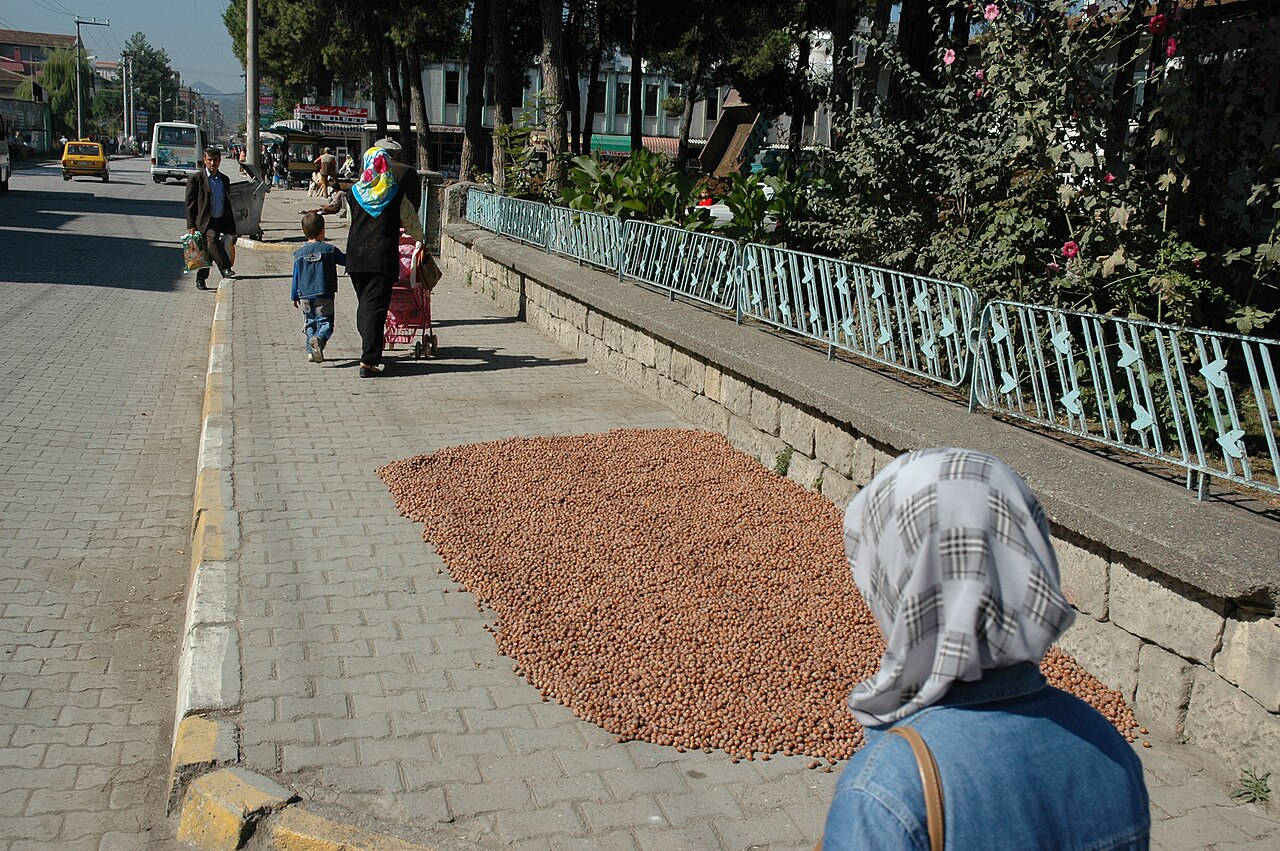
In the first few years, while the orchard is just coming into production and yields do not justify the investment in a dryer, most small-scale hazelnut producers dry their nuts as they have for centuries — in the sun, on tarps, or in a ventilated attic. Natural drying is cheap and simple, but it is not a "set it and forget it" process: poor drying management leads to mold, rancidity, color loss, and in the worst case, aflatoxins. This guide provides a practical step-by-step procedure — from spreading in layers and mixing, to protection from dew and rain, to target moisture and transition to storage. This article is intended as a complement to the article on industrial drying in dryers: there you will find technology and curves; here is field practice for small quantities.
Why hazelnuts must be dried at all
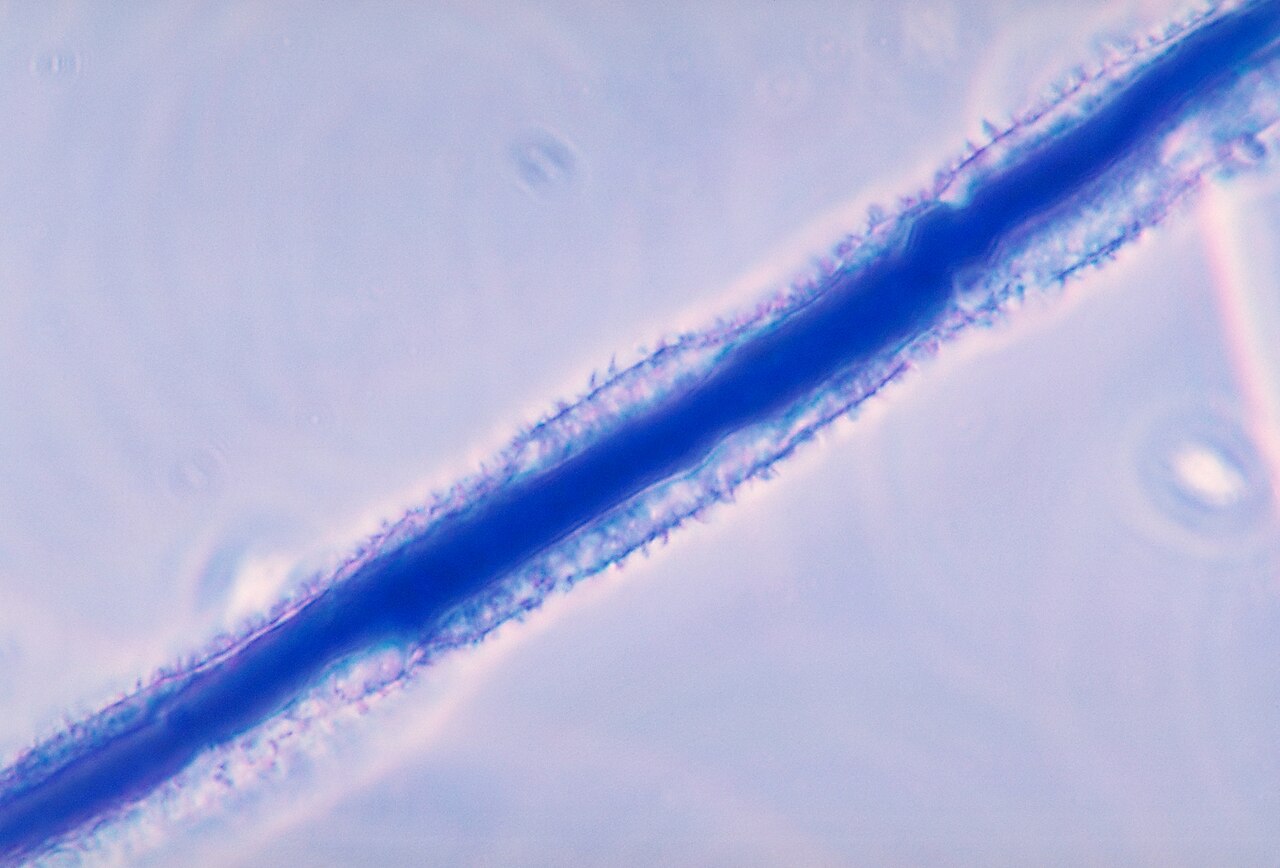
Freshly harvested nuts contain a very high amount of water. Literature states that the nut with the husk (cupule) at harvest has about 30–35 % water, and nuts that have fallen to the ground with the husk can have even more. At this moisture level, the nut is alive and "breathing": respiration occurs, mold develops, the kernel turns rancid, and under warm and humid conditions, aflatoxins — toxins from the mold genus Aspergillus that are health hazards and legally regulated — can develop.
The goal of drying is to reduce the water content to a level where the nut can be safely stored for months. Target values from the corpus and broader literature:
| Measure | Target Value | Note |
|---|---|---|
| Water in nut at harvest | 30–35 % | higher if fallen with husk |
| Water in nut after drying | 8–10 % (often cited as ~7 %) | limit for safe storage |
| Water in shell | < 10 % | above this, risk of mold |
| Water in kernel | < 5–6 % | crucial for longevity |
| Equilibrium moisture for long-term storage | ~6 % or lower | prevents rancidity |
Values are informative and depend on the cultivar, location, climate, and purpose (sale in shell, processing, seed). A dryer works on the principle of heating air (optimal is often cited as 32–34 °C, industrial up to 40–45 °C with shorter times), while natural drying uses sun and air circulation — slower, but free.
Preparation before spreading
Harvest at the right time
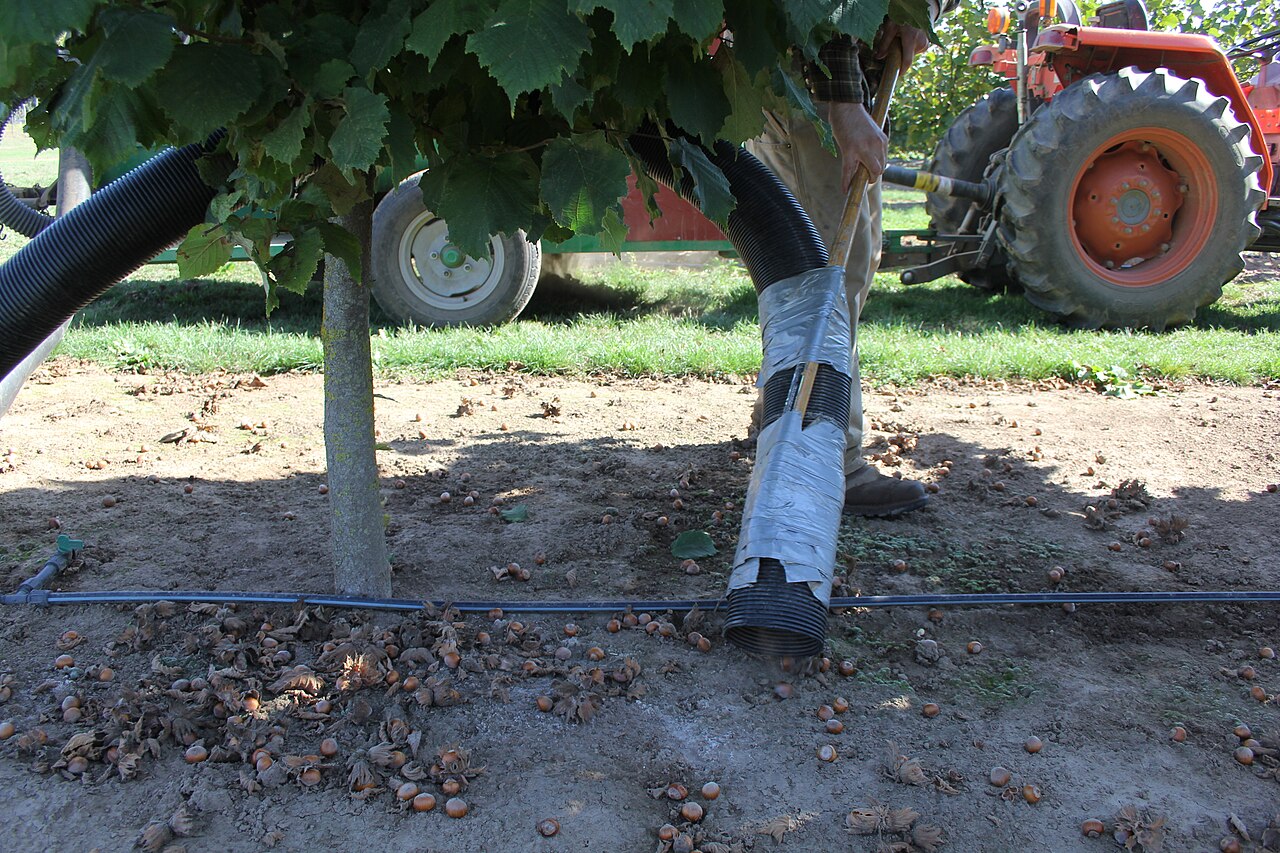
Drying begins with choosing the harvest moment. Harvested too early, nuts lose quality — kernels are shriveled and tough, and water content is even higher, prolonging drying and increasing risk. Harvest when the nut turns yellowish-brown and begins to fall out of the cupule. A more mature nut means less water at the start and easier drying.
Quick removal of the husk
The husk (cupule) contains significantly more water than the nut and slows down drying. Remove the husk from nuts that detach easily immediately. Those that cannot be removed by hand go to drying with the husk — when sun-drying, the husk cracks and the nut frees itself. A practical rule from literature: after 6–8 days of sun drying with frequent mixing, about 80 % of nuts detach from the husk; the remainder needs additional drying.
Do not wait
Drying should start immediately after harvest (ideally the same day). A pile of fresh nuts with husk heats up and begins to "burn" from the inside after just a few hours — this is the most common mistake of small producers who leave nuts in bags or crates "until tomorrow."
Step by step: natural drying in the sun and on tarps
Step 1 — Substrate and layer
Spread the nuts in a thin layer. Experience and literature recommend:
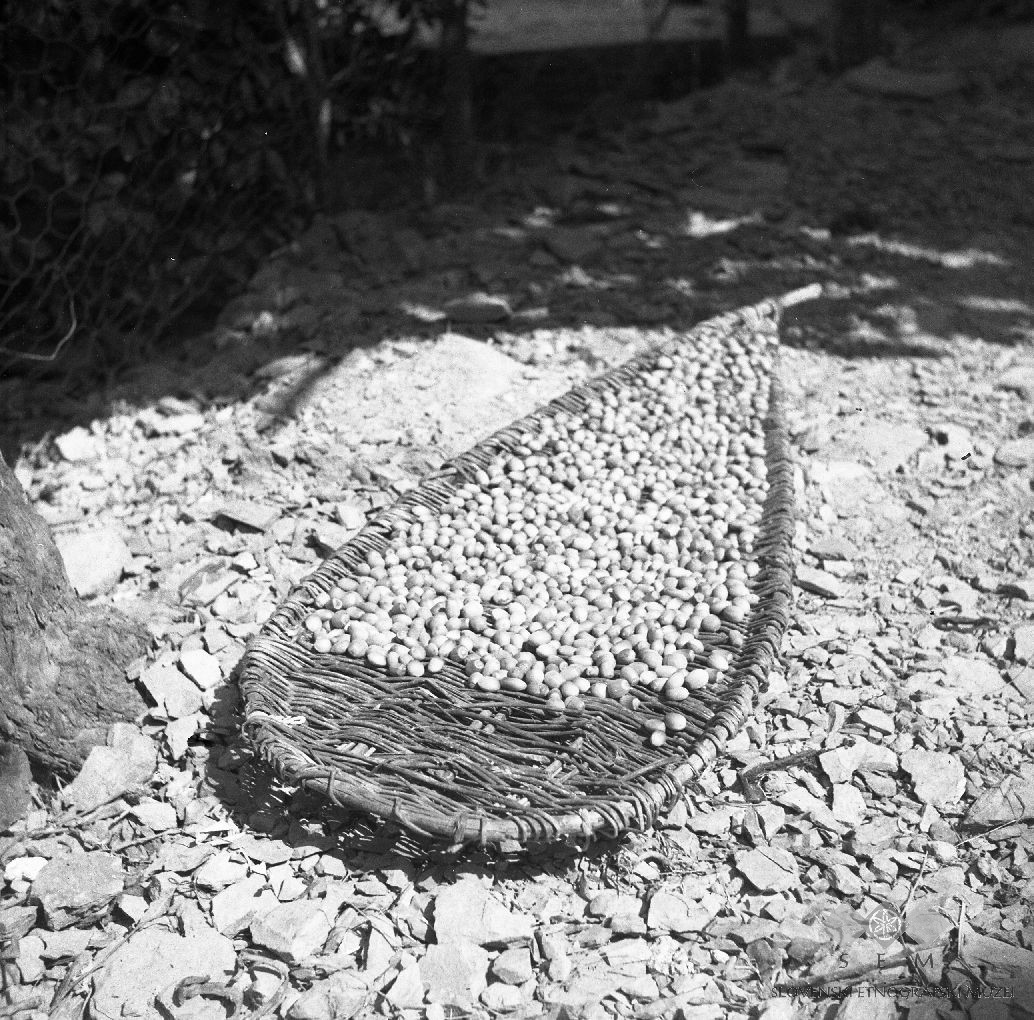
- In the sun (outdoors): layer thickness of 3–5 cm, on a clean tarp, mesh, sun-exposed floor (concrete, tiles), or raised mesh dryers. Thinner layer = faster and more even drying.
- In the shade / in the attic: can be slightly thicker, but never more than approx. 20–30 cm, and only with regular mixing.
Raised meshes (tarps stretched on a frame) are better than tarps laid directly on the ground because air circulates from below, drying is faster, and nuts do not absorb moisture from the soil.
Step 2 — Sun exposure
Classic procedure: expose nuts to the sun outdoors. At moderate temperatures (around 25–32 °C) on concrete or grassy substrates, producers in Turkey and the Mediterranean traditionally dry nuts. Sun accelerates drying, but be careful: in very strong heat (over ~40 °C surface temperature of the tarp), the kernel can burn and take on a bitter taste, and rapid drying of the outer shell can "lock in" moisture in the kernel. On very hot days, dry in morning and afternoon hours, and at noon spread thinner or move to partial shade.
An alternative used by some small family farms: drying in a ventilated attic, not directly in the sun, but in a warm place. This is slower, but gentler on color and kernel.
Step 3 — Mixing (the most important step)
Mixing is what distinguishes good hazelnuts from spoiled ones. Nuts on top of the layer dry out, those at the bottom remain moist and begin to mold. Rules:
- In the sun, dense drying: mix frequently, several times a day (with rakes, shovel, or hands).
- Attic / slow drying: mix at least 2–3 times a week to ensure even drying of the layer.
- Each time, turn the bottom layer to the top. The goal is for each nut to "breathe" equally.
Step 4 — Finishing nuts with husk
For nuts that still have husk after a few days, help them by placing them in a layer of about 30 cm in a covered, ventilated space and leaving them for 10–12 days with constant mixing. Mixing accelerates drying and mechanically separates the husk. When all nuts are cleaned, dry them in the sun for another 2–3 days (or in a dryer) until moisture drops to 8–10 %.
Step 5 — Checking readiness
Without a moisture meter, rely on simple signs of well-dried nuts:
- Sound: dry nuts "clatter" when shaken — the kernel has separated from the shell and rattles.
- Break: shell breaks dry and brittle, kernel is crunchy (not gummy or tough).
- Kernel skin (perisperm): rubs and peels off easily.
- Weight: a dried batch is noticeably lighter than fresh (water loss from 30–35 % to 8–10 % means significant mass drop).
If you want precision, it is worth buying a cheap moisture meter for grains/nuts; aim for ≤ 8–10 % in the shell. This is the line that separates safe from risky hazelnuts.
Duration: how long does natural drying take
Time depends heavily on weather, layer thickness, and initial moisture. Approximate figures from the corpus and literature:
| Phase / method | Typical duration | Conditions |
|---|---|---|
| Initial sun drying (with husk) | 6–8 days, with frequent mixing | sunny, thin layer |
| Thin layer on concrete (3–5 cm) | 2–3 days per pass | 25–32 °C |
| Drying cleaned nuts in the sun | 2–3 days | to 8–10 % moisture |
| Finishing nuts with husk in 30 cm layer | 10–12 days | covered, constant mixing |
| Entire process (classic, with husk) | often 2–3 weeks, sometimes more | depends on climate |
| Industrial dryer (for comparison) | 8–48 h | heated air 32–45 °C |
The main trap of natural drying is too slow drying: if nuts remain moist for too long (cloudy, rainy, too thick layer), the risk of souring, rancidity, and aflatoxins increases. Therefore, when weather does not cooperate, it is better to move the batch to a closed warm space with ventilation (even a regular fan and dehumidifier) than to wait for sun.
Protection from dew, rain, and other dangers
Natural drying outdoors lives and dies by the weather forecast. Nuts must not reabsorb moisture, because "yo-yo" drying (dry during the day, moist at night) is ideal for mold.
- Dew: in the evening, collect or cover the nuts, or bring them under a shelter. A tarp left outside overnight absorbs dew and returns moisture to the nuts. If using raised meshes, cover them with foil at night (but so that air still circulates slightly) or move them to a dry place.
- Rain: have a plan for quick removal — tarps with handles, crates, covered space within reach. Wet nuts go back to square one.
- Soil: do not dry directly on bare soil; always a clean tarp, mesh, or hard substrate. Contact with soil brings moisture, mold spores, and dirt.
- Birds and rodents: bird nets; protect attic and storage from mice.
- Dust and exhaust fumes: do not dry near roads or in places where dust falls.
- Hygiene: clean tarps and tools; remnants of old batches and dirt carry mold.
Thumb rule for weather conditions
Dry only while sunny and dry. As soon as dew falls or rain threatens — cover or bring inside. Better a few sunny days with nightly removal than constant exposure to changing weather.
Transition to storage
When the nut is dried to 8–10 % moisture (shell < 10 %, kernel < 5–6 %), it is ready for storage. Transition:
- Cool down. Nuts from the sun are warm; before packaging, let them cool to room temperature so that condensation does not form in closed packaging.
- Store in shell. Hazelnuts last longest if stored in the shell — the shell protects the kernel from oxygen, light, and moisture. Shell only before sale/processing.
- Dry, ventilated, cool, and darker space. Storage must be dry and ventilated; humid spaces mean mold, weight loss, and quality loss. Relative humidity of air in storage should not exceed ~70 % (optimal ~55–65 %).
- Packaging. For small quantities: jute/paper bags or well-closed containers in a dry place; avoid hermetically sealed plastic if the nut is not completely dry (condensation). For longer storage, professionals use cooling and controlled atmosphere (low oxygen), but this is the domain of industry — see article on storage.
- Longevity. Well-dried nuts can be stored for 2–3 years, but it is recommended not longer than one year because over time they lose weight and color and can become rancid.
For more detailed conditions (temperature, controlled atmosphere, cooling), see the article on storage, and for control of health safety, see the article on aflatoxins.
Common Mistakes by Small Producers
- Layer too thick without mixing — lower nuts develop mold. The most frequent error.
- Drying in sacks/boxes "until tomorrow" — fresh piles overheat and mold within hours.
- Leaving a tarp overnight in the dew — nuts absorb moisture, restarting the drying process.
- Drying too slowly in bad weather — risk of aflatoxins and rancidity; move to a closed, ventilated space in the rain.
- Too intense midday sun — bitter, scorched kernels; spread thinner or dry in partial shade.
- Packing warm nuts — condensation in packaging = mold.
- Storing unshelled but insufficiently dried nuts — always check moisture content before storage.
- Drying directly on the ground — moisture, spores, and impurities.
When to switch to a dryer
Natural drying serves well in the first years and for small quantities. As soon as yield and ambition increase (regular sales, processing, larger batches, rainy harvest seasons), it pays to switch to a dryer with controlled temperature and air flow — it is more reliable, faster, and reduces the risk of aflatoxins. Details in the article on drying in dryers.
Contingency Plan for Drying in Rainy and Humid Conditions
Natural drying depends on the weather, and the weather can fail you. Rainy autumn harvests are a regular headache for small producers: "we had quality hazelnuts until harvest, but then problems arose," testifies a fruit grower from Daruvar; "in rainy autumns, it is very difficult to dry the nuts, and without good drying, there is no market." The problem is not just aesthetic: research shows that the number of molds increases during periods of intense precipitation, and aflatoxin production is directly linked to moisture. The critical threshold from the literature is clear — Aspergillus works best at relative humidity 97–99 % and temperature 25–30 °C, and significant risk begins already above ~70 % RH with heat > 25 °C and at nut moisture 12–16 %. In other words: every additional day of wet nuts works against you. So, in the rain, do not wait for the sun — activate the plan.
Step 1 — Batch Triage by Priority
When a prolonged humid period threatens, first sort what you have. Not everything fits into a closed space at once, so proceed by risk:
- Nuts with husks (cupules) and freshly harvested nuts fallen to the ground — these are the wettest, "breathe" and heat up; they go first into the closed space.
- Wet, sour batches that have already absorbed water — these return to "square one" and take priority over those that were partially dry.
- Partially dried nuts (moisture ~12–16 %) — still in the danger zone, kept under surveillance.
- Nuts near the target (8–10 %) — lowest risk; can wait or simply finish drying.
Alongside triage, sort and discard damaged and already moldy ("hollow", darkened) nuts — effective sorting before storage is one of the key preventive measures against aflatoxins.
Step 2 — RH Threshold Triggers: When to Move from Open to Closed
The rule is simple: as soon as the environment enters a zone favorable for mold, move drying under cover. A practical decision table:
| Trigger (external conditions / state) | Action |
|---|---|
| Dry, air RH < 65 %, sunny | Continue natural drying outdoors, mix regularly |
| RH 65–75 %, cloudy / rain threatening | Reduce layer thickness, cover or bring in at night; prepare closed space |
| RH > 75–80 % for a prolonged period, fog, light rain | Move batch to a closed, ventilated space with active air flow |
| Rain / RH > 85 %, nuts wet for > 1 day | Urgent: closed space + heating/ventilation + dehumidifier; do not leave nuts on the ground |
| Storage RH > 70 % with temperature > 25 °C | Aflatoxin production zone — dehumidification mandatory |
The numbers are not arbitrary: at 85 % RH, aflatoxin production is significantly lower than at 95 % RH (Gürses et al.), and lowering nut and ambient moisture below these thresholds is the best cheap defense. The goal of every emergency intervention is the same as with the sun — reduce nut moisture to 8–10 % (shell < 10 %, kernel < 5–6 %).
Step 3 — Cheap Emergency Alternatives
You do not need a professional dryer immediately; there is a ladder of solutions from almost free to more effective:
- Above a stove or radiator. Small quantities can be dried by hot air flow above a stove or radiator for 2–3 days. A classic "attic" solution for one or two sacks.
- Unused greenhouse. In autumn, many seedling greenhouses are empty (September–October) — owners often lend them. A greenhouse provides heat and rain protection; ventilation is mandatory to let moisture out.
- Passive solar "box". Build wooden boxes with a glass/transparent front facing south and a mesh bottom. A steeper roof angle and transparent south side enhance heating. A fan at each end of the box helps expel moisture. (Watch out for rodents — protect with mesh.)
- Forced-air box (dryer with forced air and fan). Heated and forced air significantly accelerates drying. Typical construction: an electric heater in the lower part of the box, with a fan pushing hot air through holes above through mesh trays with nuts. This is closest to a real dryer and can be assembled from cheap parts.
- Dehumidifier. In a closed space, a household dehumidifier lowers RH below critical thresholds and extracts moisture even without high temperatures — an ideal addition to a fan or heater when it is persistently humid outside.
Moisture is the trigger for aflatoxins
The most dangerous combination is heat and high moisture: just a few days of nuts at > 85 % RH above ~25 °C is enough for aflatoxin production to begin. In the rain, it is better to "overdo" ventilation, heating, and dehumidification than to wait for clear weather — energy for a fan and dehumidifier is cheaper than a ruined batch.
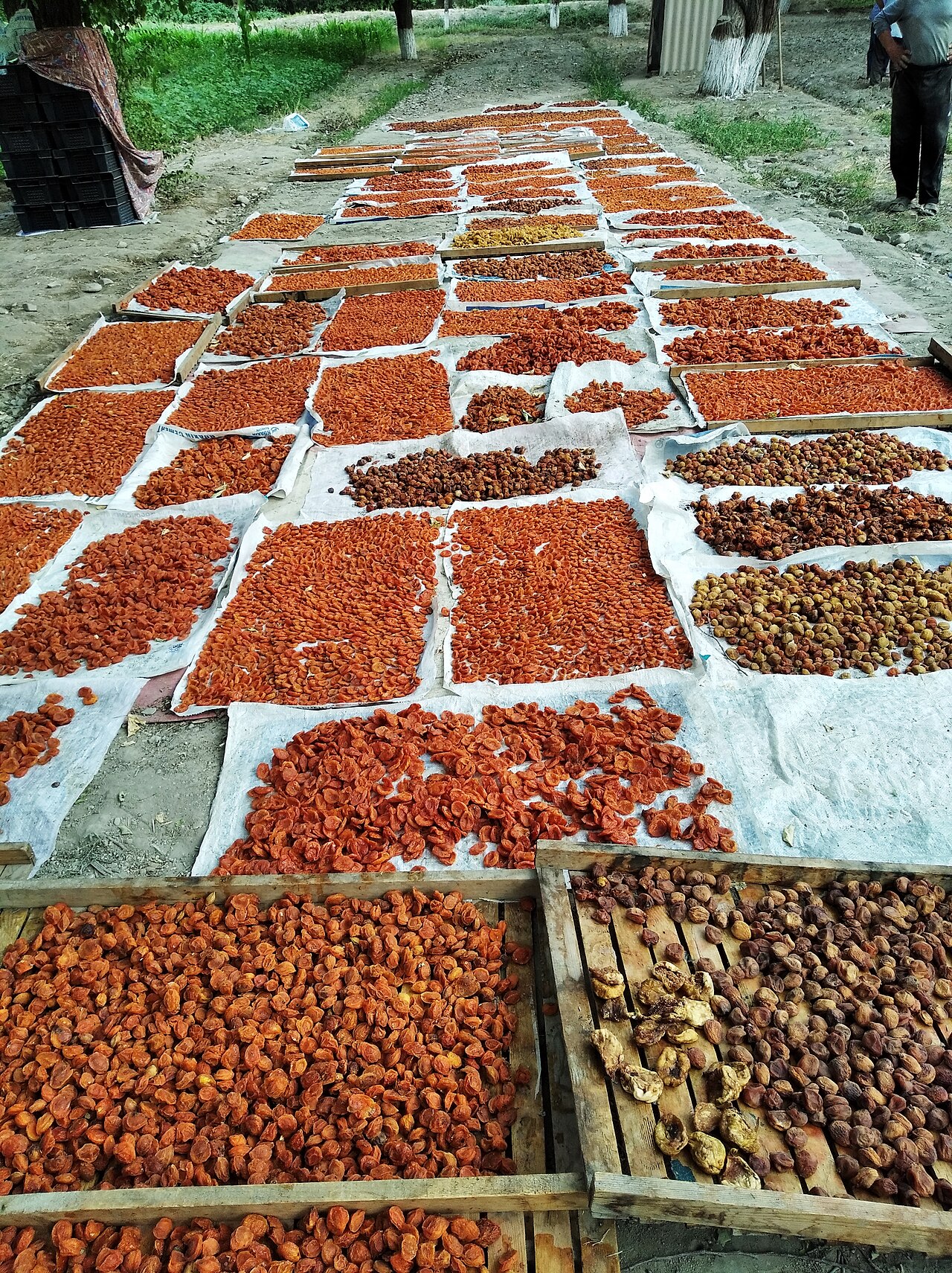
Gallery
Sources
This text is an AI summary compiled from an internal literature collection on hazelnuts (RAG corpus) and publicly available sources. Figures (moisture, duration, temperature, layer thickness) are informative and depend on cultivar, location, climate, and purpose — verify them with advisory services and official sources before application.
Main sources used:
- Harvest, drying, and storage technology of hazelnuts: Literature Review (JCEA / agr.hr) — https://jcea.agr.hr/articles/772314_Tehnologija_berbe_su_enja_i_skladi_tenja_lje_njaka_Pregled_literature_hr.pdf
- Huzjak A.: Technology and economic efficiency of organic hazelnut production on OPG Hobolić Alen (VGU Repository) — example of natural attic drying on a small farm
- Mechanization in hazelnut production and processing at Minas-zrno 1 (diploma thesis) — optimal temperatures and drying duration
- Hazelnut (Vrtlarica.hr) — drying procedure, layers, and moisture for small producers
- "Advantages of hazelnut cultivation" (Gospodarski list) — sun drying, mixing, husk processing
- USAID Private Sector Activity: Post-Harvest Guidelines — Cleaning and Drying of Hazelnut — https://issuu.com/usaid_private_sector_activity/docs/post_harvest_guidelines_-_eng/s/23195511
- The Effect of the Periodic Drying Method on the Drying Time of Hazelnuts (MDPI Foods) — https://www.mdpi.com/2304-8158/13/6/901
- Effect of drying methods on nut quality of hazelnuts (PMC) — https://pmc.ncbi.nlm.nih.gov/articles/PMC6170338/
- "Protection of hazelnut nuts from mold: Comprehensive guide" (RAG corpus) — mold increase in rainy periods, processing nuts with husks
- Hazelnut Processing 101 / Oregon Hazelnut Industry (RAG corpus) — drying in bad weather, unused greenhouses, passive solar box, forced-air box dryer with heater and fan
- Gürses et al. (2001); Sanchis et al. (1988), according to Literature Review (JCEA / agr.hr) — influence of relative humidity (85 % vs. 95 %) on aflatoxin production during storage
- "Effects of Storage Periods and Temperature on Mold Prevalence and Aflatoxin Contamination in Nuts" (2018) — optimal conditions for aflatoxins (25–32 °C, nut moisture 12–16 %, RH 85 %)
- "Hazelnut Cultivation" (Poljoprivredni forum / Gospodarski list) — experience with rainy harvest autumns and attic drying
- Oregon Hazelnut Industry Office — Technical Information (target moisture, storage) — https://oregonhazelnuts.org/buy-hazelnuts/technical-information/
See also related articles in the same series: Hazelnut Drying — Moisture and Temperature (Dryers), Hazelnut Storage — Conditions, and Aflatoxin Control and Testing.
Recommended equipment
🔎 food dehydrator — Amazon →Affiliate links — we may earn a small commission at no extra cost to you.
Food Dehydrator
For controlled drying of small batches.
| Use Case | Option Type | What to Check Before Purchase |
|---|---|---|
| Small batch drying | Stackable tray model | Tray material and airflow design |
| Uniform drying | Fan-powered unit | Temperature control accuracy |
| Commercial volume | Industrial dehydrator | Professional capacity and energy use |