Secondary and Storage Pests of Hazelnut
Content generated by artificial intelligence — verify before application
This article was automatically compiled from a collection of hazelnut literature using artificial intelligence and may contain errors or outdated data. It serves as a starting point for further research, not as professional advice. Dosages, products, and timing are informative and depend on the cultivar, location, and current regulations — always consult with an advisory service and official sources before application.
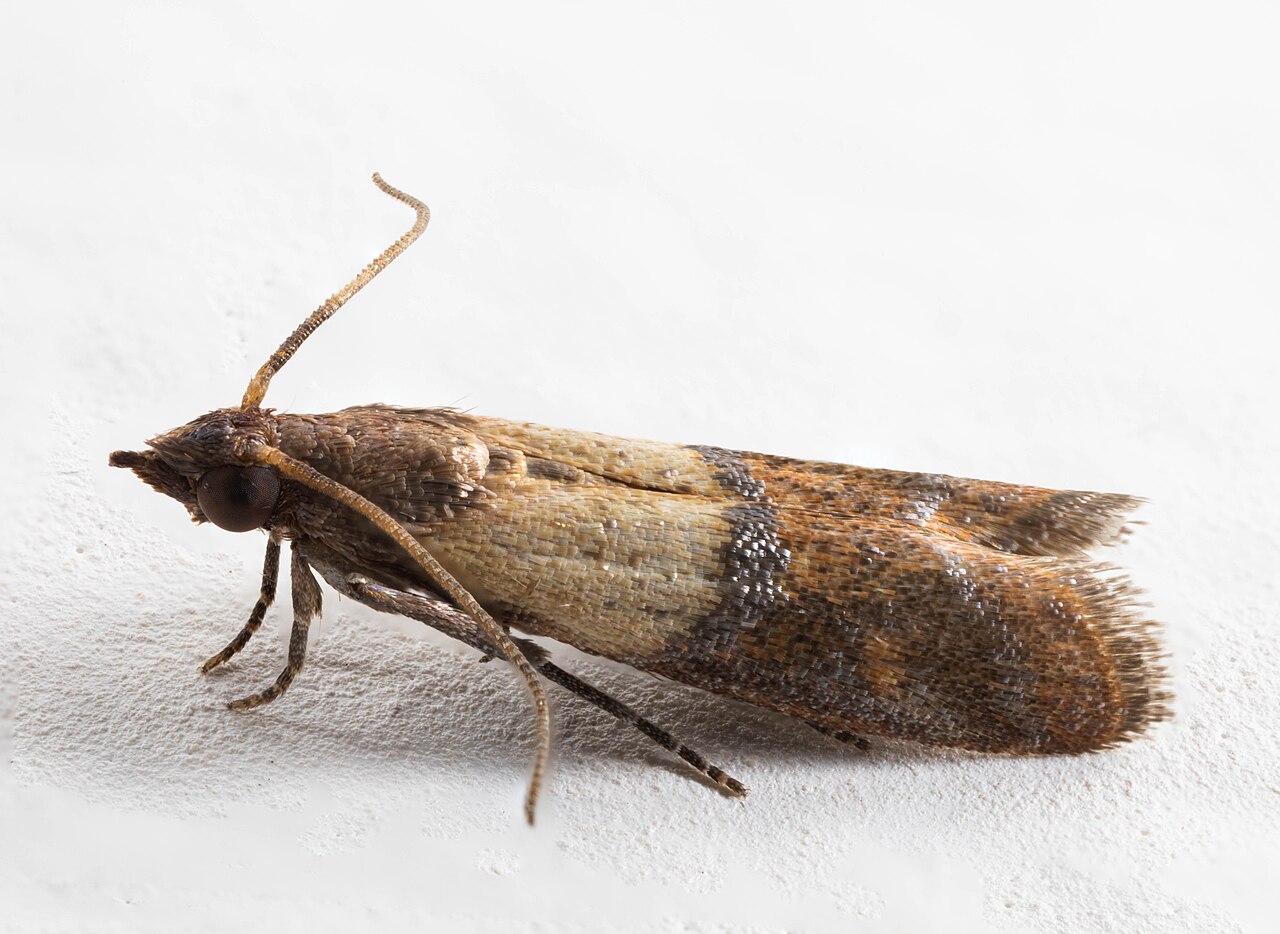
Compared to many other fruit species, hazelnut has a relatively small number of serious pests. Literature cites only six distinct major pests affecting hazelnut, and out of approximately 200 species recorded in Europe, only about ten cause significant damage. Producers rightly focus their attention on the most economically important pests in the orchard — the filbert weevil (Curculio nucum), phytophagous bugs, hazelnut mite, aphids, and weevils. However, there is another group that is often overlooked, which can cause significant cumulative losses: secondary (less important) pests in the orchard and especially storage pests that attack harvested and dried nuts during storage. This article consolidates this "second tier" of pests — from slugs and the common cockchafer to the most dangerous storage moth, the Indian meal moth Plodia interpunctella — with an emphasis on occurrence, damage, and control during hazelnut storage.
What are secondary and storage pests?
It is useful to distinguish between the two groups immediately, as they differ in where and when they cause damage:
- Secondary (less important) orchard pests — species that appear sporadically, locally, or in small populations on hazelnut and usually do not require separate treatment. Damage is most often occasional or limited to the edges of the orchard. This group includes, for example, the common (May) beetle, slugs, walnut twig moth, hazelnut aphid (when at low density), and various scale insects.
- Storage pests — insects that attack harvested, shelled, and dried nuts during storage, transport, and processing. They do not damage the tree, but rather the finished product, directly affecting the market value and export capability of hazelnuts. The most important is the Indian meal moth (also known as the Indian flour moth) Plodia interpunctella, along with other moths and beetles.
The boundary is not always sharp: some pests that damage nuts in the field (e.g., filbert weevil) create entry points and conditions for the subsequent development of rot and storage organisms, so protection in the orchard and storage hygiene are interconnected.
Part I — Secondary (Less Important) Orchard Pests
Slugs
Slugs (both slugs and snails) are sporadic pests that rarely cause economically significant damage in hazelnut, but can be unpleasant in young orchards, in humid and shaded locations, and in orchards with dense grass cover and abundant plant residues.
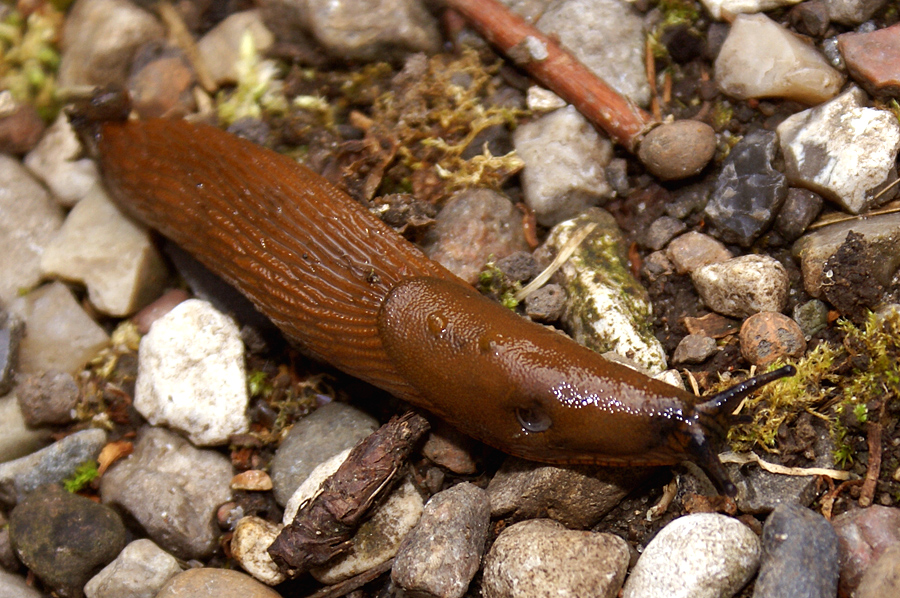
Occurrence and conditions. Slugs are active during humid periods — spring and autumn, on rainy and dewy nights. They hide during the day under plant residues, planks, stones, and in dense weeds, emerging at night and at dawn. Warm and humid microlocations, poor ventilation of the lower canopy, and a thick layer of unmowed grass favor their reproduction.
Damage. They most often gnaw tender tissue — young leaves, shoots, and bark of young saplings — leaving irregular holes and characteristic slimy trails. In productive orchards, they can damage fallen nuts on the ground before collection, thereby contributing to soiling and spoilage of the crop, but damage on the tree itself is usually negligible.
Control. The emphasis is on preventive and agronomic measures, which are usually sufficient for slugs:
- regular mowing and maintenance of low, ventilated grass cover, and removal of hiding places (piles of branches, planks, plant residues);
- promoting rapid drainage and ventilation, avoiding moisture retention near the trunk;
- timely collection of fallen nuts to prevent accumulation on wet soil;
- in young orchards, mechanical collection of slugs and, as needed and according to regulations, placement of registered molluscicides (most commonly based on iron(III)-phosphate or metaldehyde) in bait form. Products and their approval depend on current regulations and labeling — always check registration for the specific crop and purpose.
Common (May) Beetle — Melolontha melolontha
The common beetle is cited as a secondary, but occasionally very unpleasant pest. It appears sporadically, approximately every five years (in line with its developmental cycle), more frequently in the edge areas of the orchard adjacent to forests and meadows.
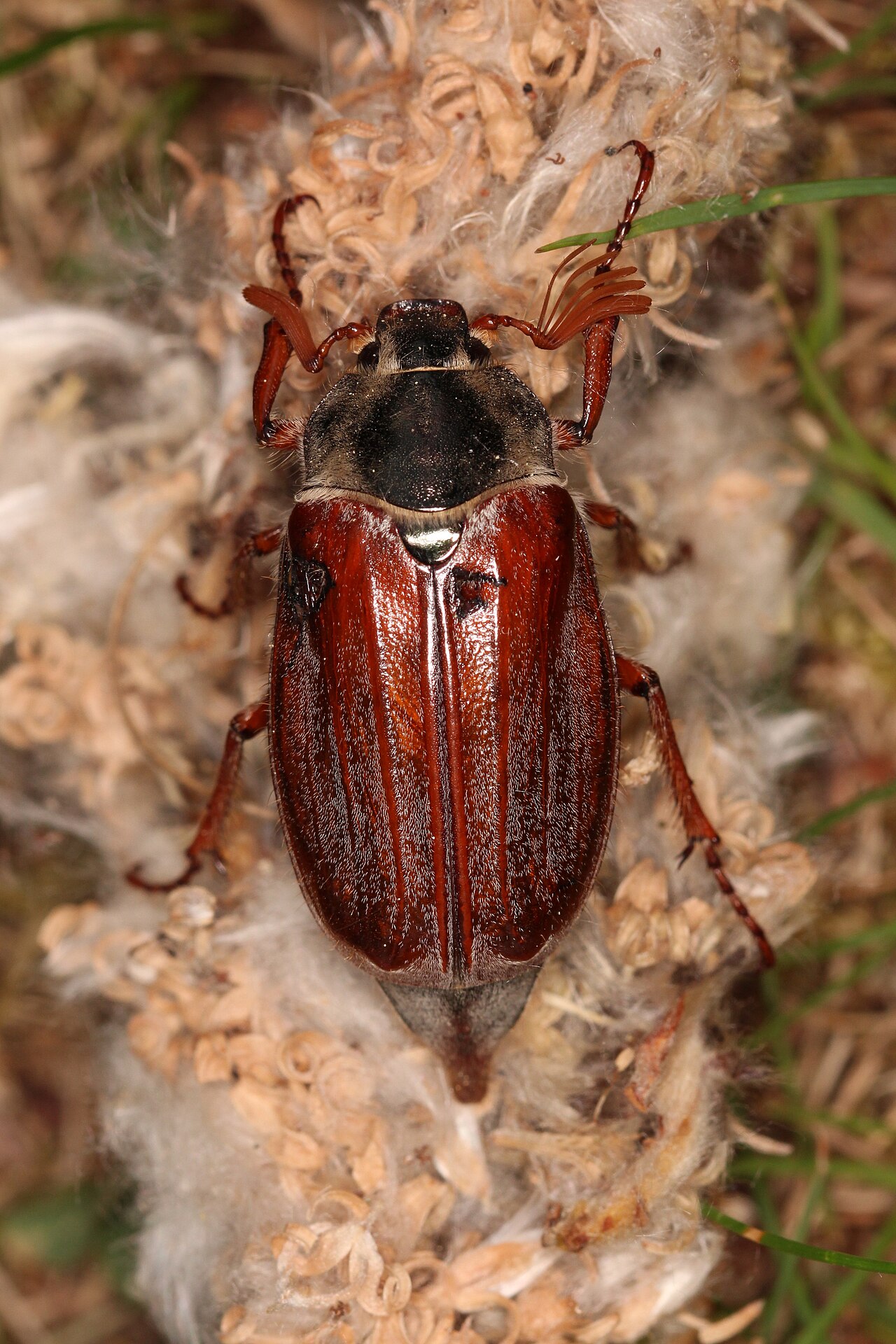
Occurrence. Adult individuals (imago) are about 25–30 mm long and emerge from the soil in late April and early May, when they feed intensively. Larvae (grubs) live in the soil and can damage roots.
Damage. Imagoes defoliate hazelnut (and other species) leaves. According to literature, the beetle can attack up to 30 % of buds, and in some cases, losses of up to 90 % are mentioned: attacked buds do not open. Damage is more pronounced during humid and cooler spring days. Larvae in the soil can harm the roots of young saplings.
Control. Due to its sporadic occurrence, the beetle usually does not require separate treatment — its control generally coincides with regular spring protection against filbert weevils and bugs, so the same treatments simultaneously reduce the beetle population. Soil cultivation around trees negatively affects larvae in the soil.
Walnut Twig Moth — Cydia amplana
The walnut twig moth is mentioned among the less significant pests of hazelnut.
Monitoring. The basis is early detection:
- pheromone sticky traps for adult males — used to detect infestation, determine timing, and assess the effectiveness of measures; at low infestation levels, they can also contribute to control itself (mass trapping);
- regular visual inspections of bags, boxes, corners, cracks, and product surfaces for webbing, caterpillars, and moths;
- maintaining records of occurrence and treatments.
Control during storage. The most effective approach is integrated storage protection, with an emphasis on prevention:
| Measure | Description | Note |
|---|---|---|
| Storage Hygiene | Thorough cleaning before introducing new goods, removal of residues and spillage, cleaning of cracks and equipment | Eliminates infestation hotspots between seasons |
| Product Dryness | Well-dried nuts (low kernel moisture) slow down insect development and mold | Drying is a key prerequisite for safe storage |
| Cooling | Low storage temperatures slow down or stop development | Cold storage significantly extends shelf life and suppresses development |
| Hermetic/MAP Storage | Impermeable packaging and modified atmosphere (reduced O₂) | Prevents cross-infestation |
| Pheromone Traps / Confusion | Monitoring and mass trapping; mating disruption | Suitable for organic and export goods |
| Heat Treatment | Heating goods/premises to lethal temperatures | Alternative to fumigation, no residues |
| Fumigation | For severe infestations; e.g., phosphine (hydrogen phosphide) in enclosed spaces | Only authorized personnel and registered products, with strict safety measures |
| Ionizing Radiation | Inhibits development of eggs and larvae | Doses for egg inhibition ≈ 450 Gy; at ≈ 1 kGy no adult emergence (experimental data) |
Dosages, products, and procedures are informative and depend on regulations, registration, product purpose, and equipment — fumigation and irradiation are carried out exclusively in accordance with the law and by authorized operators.
Other Storage Pests
In addition to the Indian meal moth, the following may appear on stored nuts:
- Almond moth Ephestia (Cadra) cautella and related Ephestia moths — similar in biology and damage to Plodia moth (caterpillars, webbing, contamination);
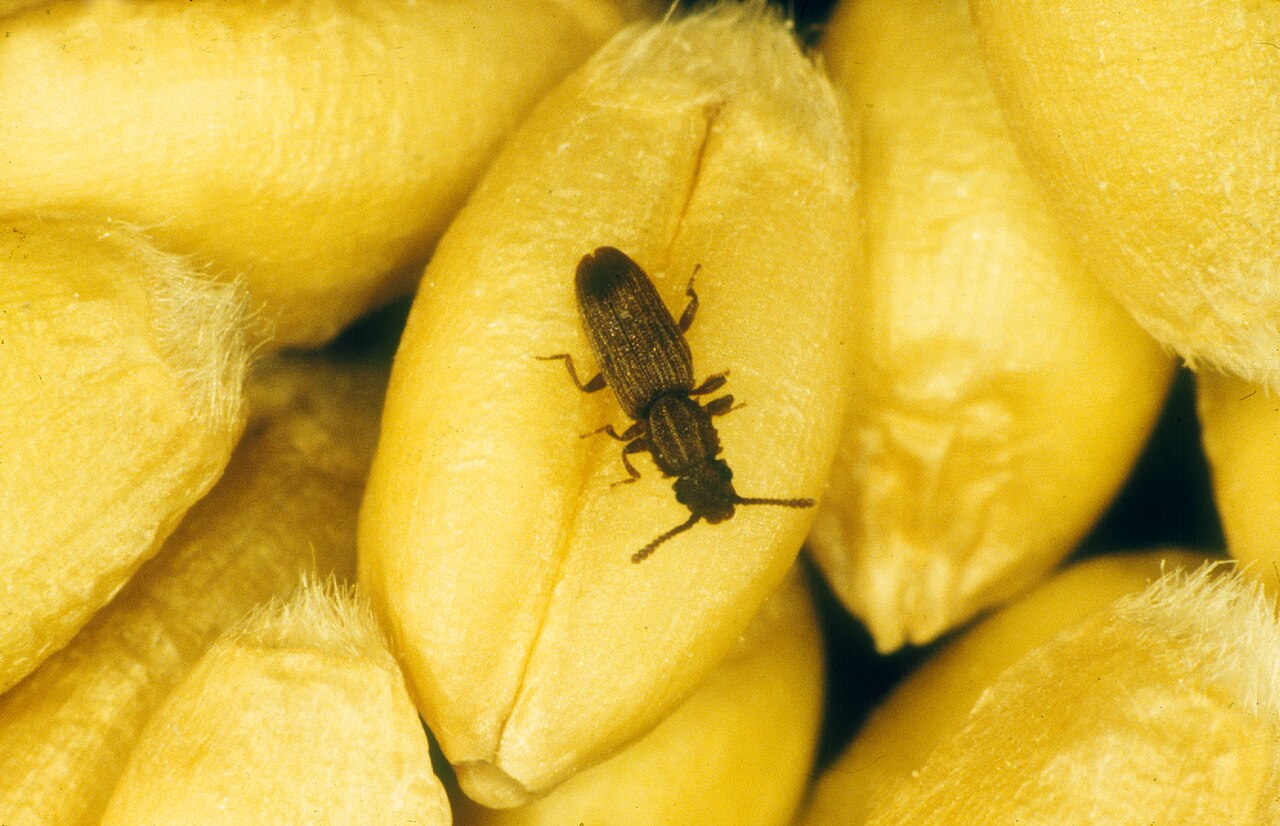
- Storage beetles — e.g., sawtoothed grain beetle (Oryzaephilus surinamensis), flour beetles (Tribolium spp.), and others that feed on damaged goods and spillage;
- Rodents (mice, rats) — contaminate goods with feces and hair and damage packaging; controlled by hygiene, sealing entry points, and rodenticide treatment.
Protection measures for all of them are essentially the same as for Plodia interpunctella: hygiene, dryness, cooling, atmosphere control, monitoring, and — if necessary — heat treatment or fumigation.
Practical Recommendations and Common Mistakes
Recommendations
- Treat storage protection as a continuation of orchard protection: healthy, undamaged, and well-dried nuts are significantly more resistant to storage pests and rot.
- Place pheromone traps for Plodia at the start of the storage season and inspect them regularly — early detection is the cheapest measure.
- Principle of "first in — first out" (FIFO): do not mix old and new goods; the old batch is often the source of infestation for the new one.
- Clean the storage empty, before introduction, including cracks, pallets, and equipment.
- Secondary pests in the orchard (beetles, walnut twig moth) are generally covered by regular spring/summer protection rather than separate, unnecessary treatments.
Common Mistakes
- Storing insufficiently dried nuts — favors both moths and molds.
- Neglecting storage hygiene and residues from the previous season as a constant source of infestation.
- Reacting only when moths and webbing appear — by then, a generation is already underway; the focus should be on prevention and monitoring.
- Self-administered fumigation without authorization and safety conditions — phosphine is very dangerous and legally regulated.
- Treating every occasional pest in the orchard separately — unnecessarily increases costs and burdens beneficial organisms.
Sources
This article is an AI-generated summary compiled from an internal hazelnut literature collection (RAG corpus) and supplemented with public internet sources. The content is informative and requires verification from official sources and advisory services before application. Main sources used:
- Bošnjak, D. et al. — Hazelnut Diseases and Pests (Repository; 2020) — overview of major and minor hazelnut pests.
- D. Bošnjak — Hazelnut (presentation, Agro-klaster, 2023) — https://agro-klaster.hr/wp-content/uploads/2024/01/dr.sc_.-D.-Bo%C5%A1njak-Lijeska-2.pdf — common leafroller, phytophagous bugs, registered products.
- Most Significant Hazelnut Pests (2011) — https://doi.org/10.31727/gzb — scale insects and other pests.
- Hazelnut Pests – Pinova / Agroklub — less significant pests (hazelnut aphid, walnut moth Cydia amplana).
- Plant Protection Bulletin 3/2023 (HDBZ) — stored product moths and nematodes as a control tool.
- Notice to Owners of Plantation Hazelnut Orchards — Ministry of Agriculture, Forestry and Fisheries (advisory service) — agrotechnical and hygiene measures.
- UF/IFAS — Indianmeal Moth, Plodia interpunctella (EENY-026) — https://ask.ifas.ufl.edu/publication/IN153 — biology and control.
- Inhibition of egg and larval development of Plodia interpunctella and Ephestia cautella by gamma radiation in decorticated hazelnuts — ScienceDirect — https://www.sciencedirect.com/science/article/abs/pii/S0022474X05000299 — radiation doses.
- Biology and management of Plodia interpunctella in stored products — USDA-ARS — https://www.ars.usda.gov/ARSUserFiles/30200530/pdf/980_JSPR_43.302.pdf.
- Methyl Benzoate ... for Controlling the Indian Meal Moth — NCBI PMC — https://www.ncbi.nlm.nih.gov/pmc/articles/PMC7823944/ — natural fumigants.
- Ecolab — Fumigation for Warehouse and Storage — https://www.ecolab.com/offerings/fumigation-for-warehouse-and-storage — phosphine and storage protection methods.
Recommended equipment
🔎 pheromone insect trap orchard — Amazon →Affiliate links — we may earn a small commission at no extra cost to you.