Consolidated Table of Critical Hazelnut Temperatures by Phenophases and Organs
Content generated by artificial intelligence — verify before application
This article was automatically compiled from a collection of hazelnut literature using artificial intelligence and may contain errors or outdated data. It serves as a starting point for further research, not as professional advice. Dosages, products, and timing are informative and depend on the cultivar, location, and applicable regulations — always consult with an advisory service and official sources before application.
Hazelnut (Corylus avellana L.) is a biological oddity among fruit species because it blooms in the middle of winter — often already in December and January — so its most sensitive organs (male catkins and female flowers) are exposed to frost during a period when other fruit crops are still in deep dormancy. Therefore, hazelnut cold hardiness is not a single number but a series of thresholds that depend on the organ, the phenophase in which that organ is located, and a range of external factors (tree nutrition, cultivar, speed and duration of cooling, prior hardening). This article consolidates quantitative data from Croatian and international literature into a single, canonized, source-supported table of critical and lethal temperatures. All related Lijeskopedia articles — botany and flowering biology, BBCH phenophases, frost protection, climate risks, and orchard insurance — refer to the values listed here as a common starting point.
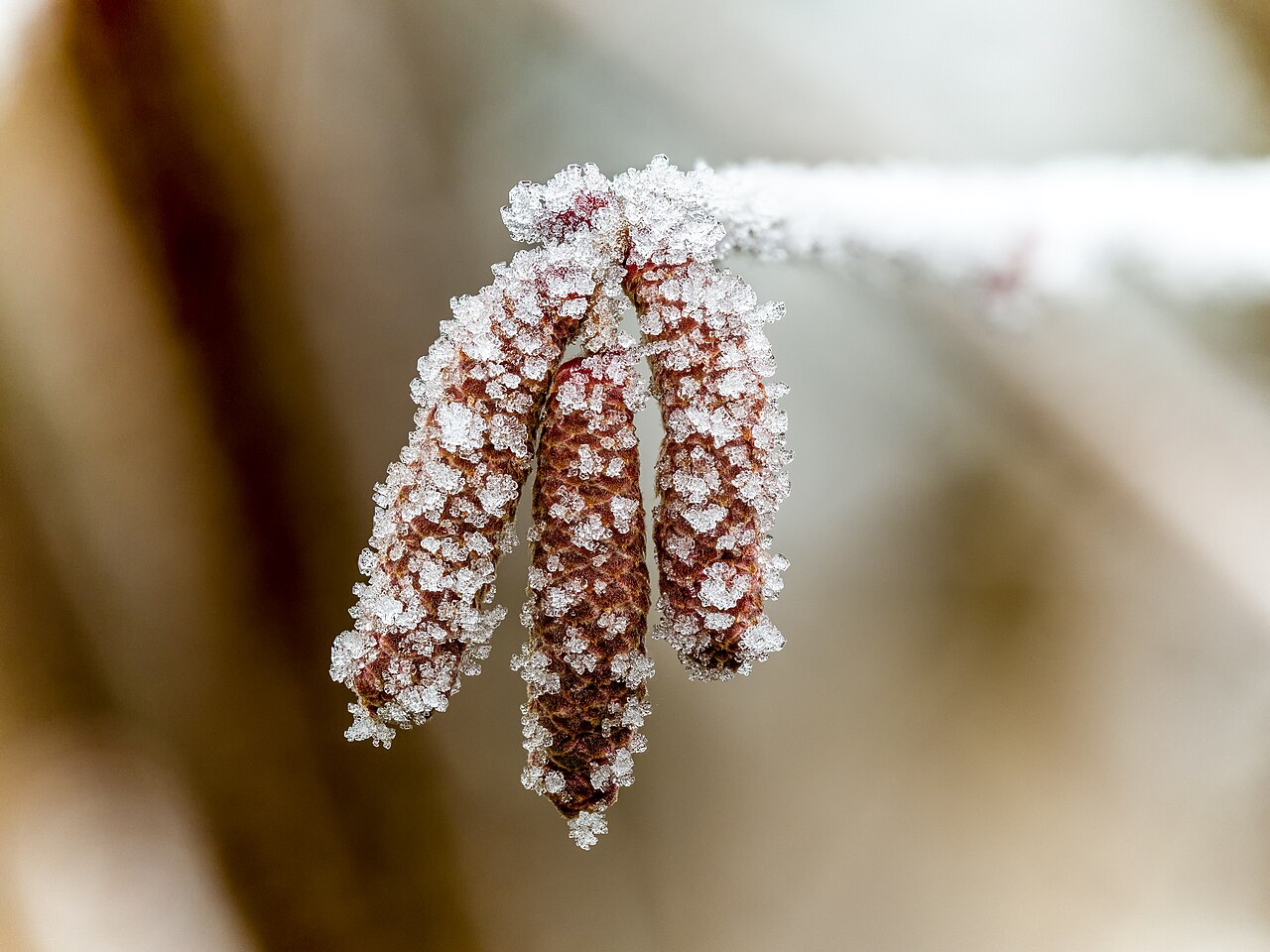
How to read thresholds: not all "critical temperatures" are the same
Before the table, it is important to distinguish concepts because they are often mixed in the literature:
- Critical temperature — the temperature at which organ damage begins (usually the first signs of damage, partial tissue injury, or reduced yield), but not necessarily complete death.
- Lethal temperature — the temperature at which the organ dies (in scientific literature often expressed as LT50, the temperature at which 50% of the sample is killed).
- Absolute minimum temperature — the lowest temperature the tree can withstand in a given phase (usually deep dormancy) without permanent damage.
Croatian hazelnut literature most often cites approximate critical/lethal thresholds derived from older European studies (Miljković, Romisondo, Stritzke, Šobek, Germain and Leglise), and these vary somewhat from each other because they were measured on different cultivars, under different conditions, and with different exposure durations. Therefore, the table should be read as a range, not an absolute limit.
Three circumstances that must always be considered
In assessing critical temperatures, literature unanimously warns that one must consider: (1) the rate of temperature drop to the critical value, (2) the duration of low temperatures, and (3) the phenophase in which the frost occurs. Sudden cooling and prolonged exposure are significantly more dangerous than an equal but short-term and gradually reached temperature.
Consolidated (canonical) table of critical and lethal temperatures
The table below consolidates the most frequent citations from the corpus. Values are indicative and represent a range from multiple sources; the specific threshold for your orchard depends on the cultivar, nutrition, and cooling conditions.
| Organ / State | Phenophase (approx. BBCH) | Critical / Lethal Threshold | Note |
|---|---|---|---|
| Trunk, one-year-old shoots | Deep dormancy (0) | Freezing at −30 °C; absolute critical minimum for the tree ≈ −26 °C | With gradual cooling, many cultivars can temporarily withstand −25 to −30 °C |
| Vegetative buds | Dormancy (00–09) | Freezing at −25 °C (lower for some cultivars) | For the 'Tonda gentile delle Langhe' cultivar, vegetative buds can be more sensitive than female flower buds |
| Male catkins — closed (unopened) | Catkin emergence (51–59) | −16 to −18 °C | Unopened catkins withstand significantly lower temperatures than opened ones |
| Male catkins — fully developed | Pre-pollination (60–63) | −8 to −10 °C | Transitional state before opening |
| Male catkins — opened / shedding pollen | Pollination (65) | −5 to −7 °C (damage already at −7 to −8 °C for a few hours) | Most sensitive state of male organs; at the moment of pollen release, only −5 to −7 °C |
| Female flowers — pre-bloom | Stigma emergence (55–59) | −13 to −16 °C | Other sources cite frost damage at −9 to −15 °C |
| Female flowers — in bloom (receptive) | Bloom (61–65) | −7 to −8 °C | Red stigmas are most sensitive; −9 to −11 °C is harmful for fertilization |
| Pollen tube / fertilization | Post-pollination | −9 to −11 °C negatively affects flowering, pollination, and fertilization | Damage manifests as a lack of nut set even though the flower appears undamaged |
| Leaf buds / young shoots | Start of vegetation (07–11) | −3 to −5 °C (young shoots after leafing −4 to −6 °C) | Late spring frost of −4 to −6 °C can damage young shoots by up to 50% |
Summary, most frequently cited "template" (Investment Study, 2019)
The most compact and frequently adopted series of thresholds in Croatian literature states:
| Organ / State | Freezing Threshold |
|---|---|
| One-year-old shoots | −30 °C |
| Vegetative buds | −25 °C |
| Unopened male and female flowers | −16 to −18 °C |
| Opened male and female flowers | −7 to −10 °C |
| Leaf buds at the start of vegetation | −3 to −5 °C |
This series is useful as a quick rule (engl. rule of thumb), but the consolidated table above is more precise because it separates male and female organs and distinguishes between "pre-bloom" and "in bloom."
What the table practically means by phases of the year
Deep winter dormancy (trunk, wood, buds)
During the period of deep dormancy, hazelnut is most resistant. If cooling occurs gradually (hardening/acclimatization), a large number of cultivars can withstand −25 °C for a short time, and even −30 °C. As the absolute critical minimum for the tree in continental conditions, −26 °C is most often cited, while some sources mention −28 °C as the limit that hazelnut can withstand in dormancy. It should be noted that hazelnut in this phase is more resistant than most other nut species.
Bloom in the middle of winter — the most vulnerable period
The problem with hazelnut is not the absolute resistance of the wood but the fact that bloom begins while winter is at its peak (in the continental part, sometimes already in November/December). At that time, organs of very different sensitivity coexist on the tree:
- Male catkins are first closed and withstand −16 to −18 °C, but as soon as they open and begin shedding pollen, sensitivity suddenly rises to just −5 to −7 °C.
- Female flowers withstand −13 to −16 °C before bloom, and only −7 to −8 °C in the receptive phase (red stigmas).
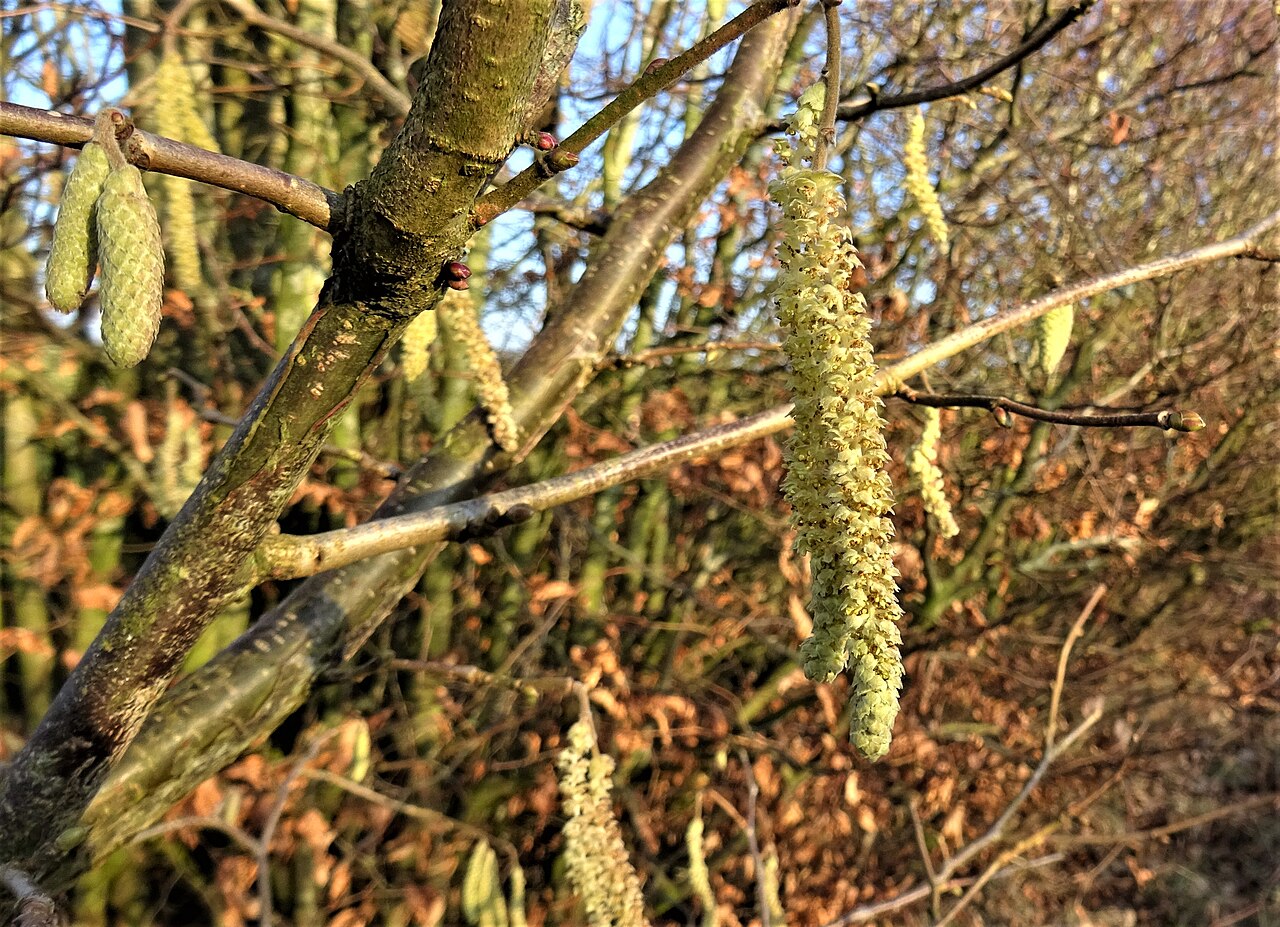
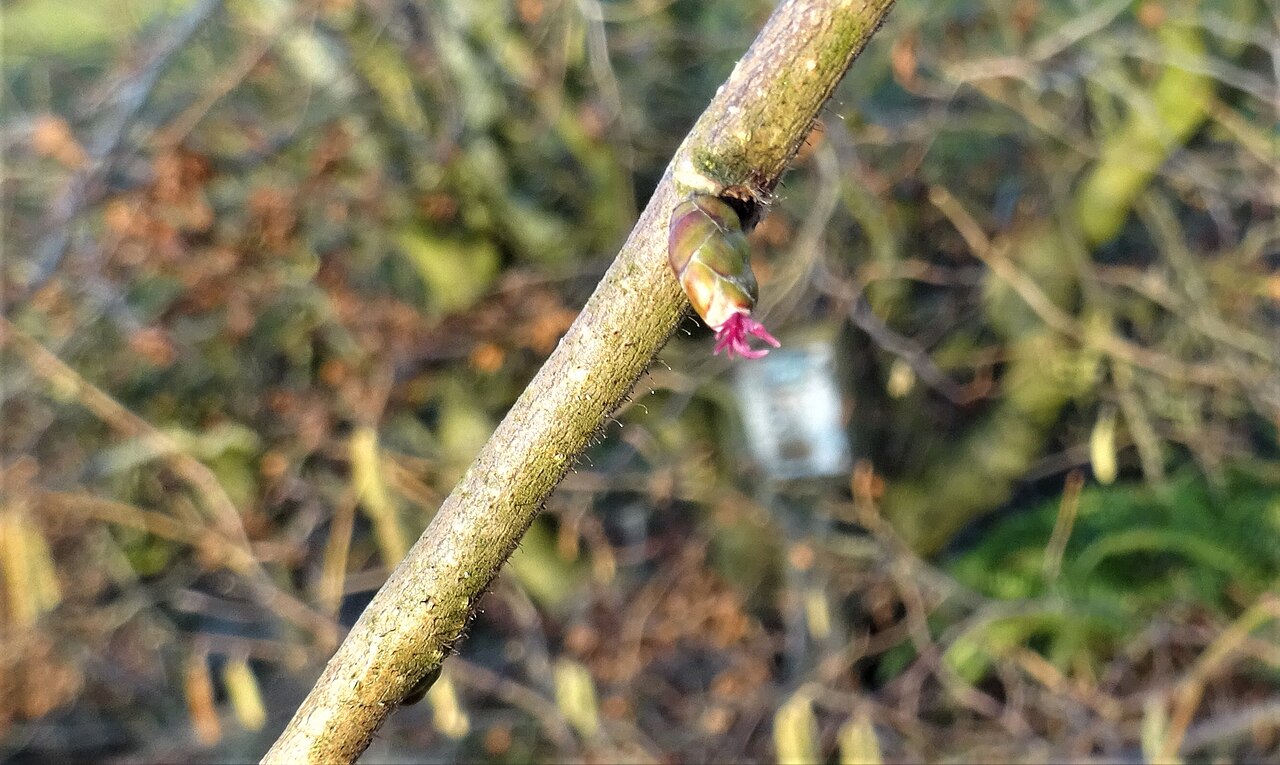
Since it can take up to four months from bloom to fertilization, a single strong cold intrusion during this long window can destroy the crop, even if the tree survives winter without any wood injury.
Start of vegetation — late spring frost
After the start of vegetation, resistance is lowest: leaf buds are damaged already at −3 to −5 °C, and young shoots after leafing at −4 to −6 °C, with damage to young shoots reaching up to 50%. Therefore, late spring frosts, although mild in absolute value, are among the most dangerous for yield.
Factors that shift thresholds: nutrition and cultivar
The table provides ranges precisely because the actual threshold is strongly influenced by two agronomic factors.
Tree nutrition
Poorly nourished trees are significantly more sensitive. Šobek's (1957) classic observation is that on poorly nourished trees, female flowers suffer frost already at −2 to −4 °C (while males withstand up to −9 °C) — a dramatic drop in resistance compared to well-nourished trees where female flowers withstand −13 to −16 °C before bloom. Conclusion: balanced fertilization (especially potassium and avoiding late, excessive nitrogen) is part of the frost protection strategy, because a well-prepared tree hardens better.
Cultivar
Resistance is cultivar-specific. Literature classifies cultivars by the sensitivity of male flowers to low temperatures:
| Sensitivity Class | Cultivar Examples |
|---|---|
| Very sensitive | Okrugli |
| Sensitive | Barcelona, Negret, Grosal |
| Moderately sensitive | Morel, Španjolski dugi, Kosford, Davijana |
| Resistant | Halski div, Pijemontski, Trebizontski, Eugenija |
For Croatian conditions, Istarski okrugli, Istarski dugi, and Rimski are cited as the most climate-adapted, along with Lambert bijeli and Lambert crveni as quality pollinizers. Specificities also occur within cultivars — for example, in the Italian 'Tonda gentile delle Langhe', vegetative buds can be more sensitive than female flower buds, showing that generic tables do not replace knowledge of the specific cultivar.
Practical consequence for site selection
Since it is impossible to "precisely define the critical threshold" because it depends on a range of factors, the most reliable protection is agroecological: protected positions, gentle slopes, and avoiding frost pockets (stationary cold air). Research in Baranja showed that more favorable positions lie above ~120–140 m above sea level and on southern and southwestern exposures, where frost damage is reduced (locally 0–20%).
Common mistakes in interpreting thresholds
- "Hazelnut withstands −26 °C, so it is safe." This number refers to the tree in deep dormancy. Flowers in bloom are damaged already at −7 to −8 °C, and late spring shoots at −3 to −5 °C.
- Ignoring duration and speed of cooling. The same temperature, gradually reached and short-term, may pass without damage, while sudden and prolonged cooling destroys the crop.
- Assuming damage is always visible. At −9 to −11 °C, fertilization may fail even though the flower looks undamaged from the outside — damage is seen only as a lack of nut set.
- Equating male and female organs. Male catkins and female flowers have different thresholds and different times of vulnerability; protection planning must separate them.
- Ignoring nutrition. An undernourished tree can lose its crop at −2 to −4 °C, which is the difference between a safe and a lost season.
Link to other Lijeskopedia articles
This table serves as a common reference for:
- Botany and flowering biology — explains why diogamy (protogyny/protandry) and winter bloom are sources of risk.
- BBCH phenophases — links thresholds to specific development codes (51–65 for catkins and bloom, 07–11 for start of vegetation).
- Frost protection — thresholds define the trigger temperature for anti-frost measures (irrigation, wind machines, smoking).
- Climate risks and orchard insurance — critical thresholds are the basis for risk assessment and frost insurance policies.
Sources
This article is an AI-generated summary from an internal hazelnut literature collection (RAG corpus) and public sources. Numerical thresholds primarily derive from Croatian professional and diploma literature that conveys classical European research (Miljković 1991, Romisondo 1978, Stritzke 1962, Šobek 1957, Germain and Leglise 1973). Main sources used:
- Impact of low temperatures on hazelnut frost damage (Baranja) — RAG corpus (Google Scholar)
- Technological and economic characteristics of hazelnut cultivation (CORE) — https://doi.org/10.46584/lm.v36i2.1141
- Investment study for the production of innovative hazelnut-based products (Corylus avellana L.), 2019 — RAG corpus
- Hazelnut cultivation: A GUIDE FOR PRODUCERS — savjetodavna.mps.hr (2024)
- Establishing new orchards (technological-economic guidelines), 2006 — RAG corpus
- Hazelnut cultivation (book) — RAG corpus
- Hazelnut — Vrtlarica — https://www.vrtlarica.com/ljesnjak/
- Frost resistance of hazelnut varieties in the Central Black Earth Region of Russia, BIO Web of Conferences (2021) — https://www.bio-conferences.org/articles/bioconf/full_html/2021/06/bioconf_biphv2021_01006/bioconf_biphv2021_01006.html
- Biological Flora of Britain and Ireland: Corylus avellana, Journal of Ecology (Hicks, 2022) — https://besjournals.onlinelibrary.wiley.com/doi/10.1111/1365-2745.14008