Planting spacing and orchard stand density
Content generated by artificial intelligence — verify before application
This article was automatically compiled from a collection of hazelnut literature using artificial intelligence and may contain errors or outdated data. It serves as a starting point for further research, not as professional advice. Dosages, products, and timing are informative and depend on the cultivar, location, and applicable regulations — always consult with an advisory service and official sources before application.
Planting spacing and stand density are among the most critical decisions when establishing a hazelnut orchard, as they are difficult to change once the seedlings are in the ground. Future productivity, canopy light penetration, possibilities for mechanized cultivation and harvest, pollination efficiency, and the speed of return on investment all depend on them. Spacing is not a universal number: it is determined by the vigor and training system of the cultivar, soil fertility, and terrain slope, the availability of irrigation, and — increasingly — by the width and technology of the machinery to be used in the orchard. This article consolidates recommendations from Croatian and foreign literature and provides a practical framework for selecting spacing, calculating the number of seedlings per hectare, row orientation, and the arrangement of pollinizers.
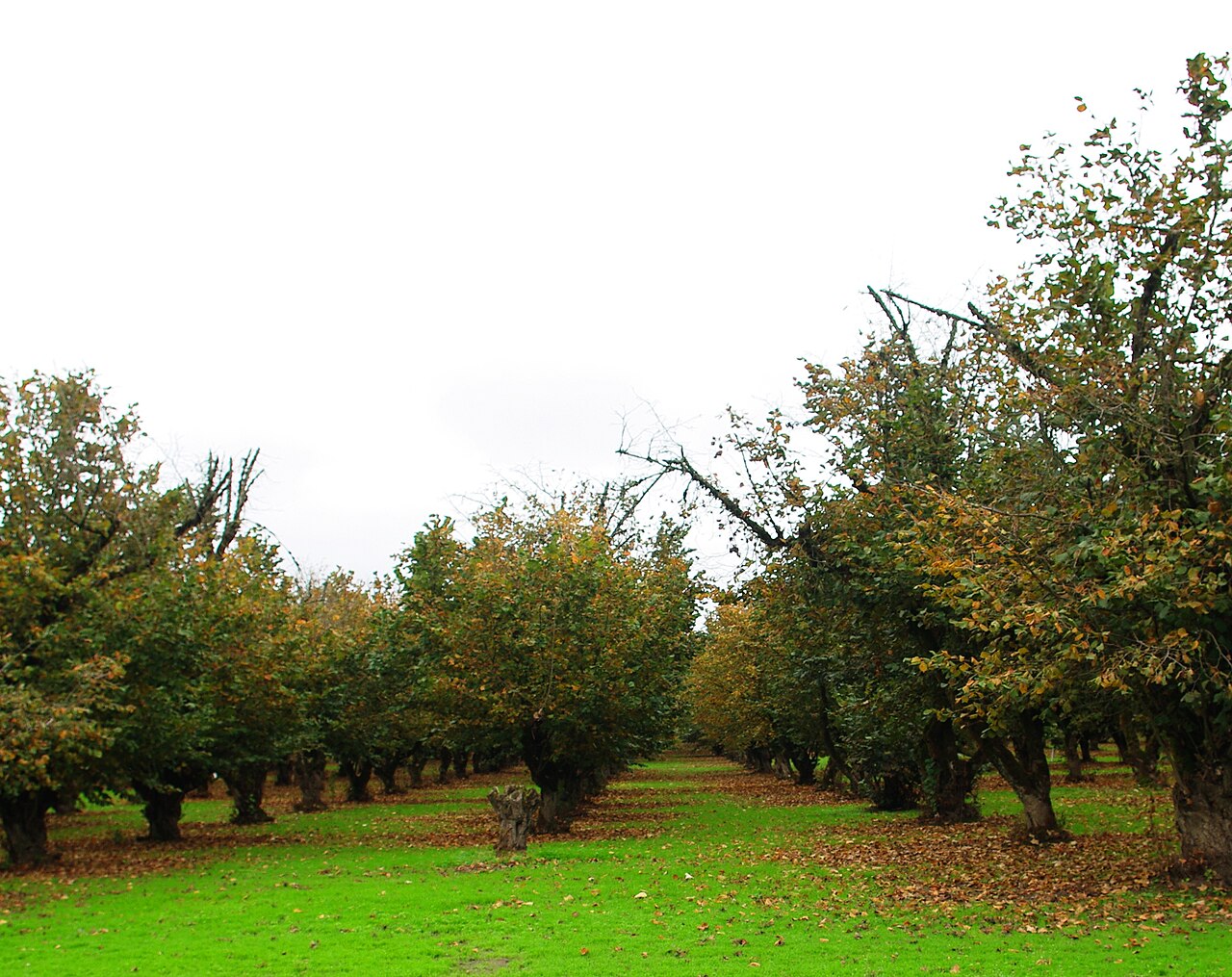
What determines planting spacing
Several factors simultaneously influence planting spacing, intertwining with one another:
- Cultivar vigor and habitus. More robust, wider-spreading cultivars (e.g., Italian Tonda di Giffoni, Tonda Gentile delle Langhe) require wider spacing than cultivars that grow taller but narrower. In the Croatian cultivar selection, the Istrian elongated variety spreads more widely, while the Roman hazelnut grows more vertically.
- Training system. A bush occupies more space than a tree; a tree system (pyramidal tree, bushy vase) allows for denser planting and easier access for machinery.
- Soil fertility and moisture. Plants grow more vigorously on more fertile and moist soils, so spacing should be increased to prevent shading; on poorer soils, spacing can be smaller.
- Irrigation. Irrigated orchards grow more vigorously, so spacing should also be increased.
- Terrain and slope. On steep and sloped terrain, spacing is reduced, and planting is recommended along contour lines (isohips) to prevent erosion.
- Machinery. Inter-row spacing must ensure the passage of tractors, sprayers, and harvesters without damaging the plants.
The golden rule above all else: adjust the inter-row spacing to the width of the widest machine you will use. If you plan to use a self-propelled harvester-collector and a sprayer with a reach of 7–8 m, rows narrower than 4.5–5 m quickly become too tight.
Spacing between rows and within rows
In literature, spacing is most often recorded as "row to row" × "within row" (e.g., 5 × 4 m means 5 m between rows and 4 m between plants in the row). Values vary widely depending on the cultivar and training system.
Recommendations by cultivar (Croatian cultivars)
| Cultivar / group | Habitus | Recommended spacing (m) |
|---|---|---|
| Roman, Istrian elongated | moderately vigorous | 4 × 5 (4 within row, 5 between rows) |
| Tonda di Giffoni, Tonda delle Langhe | more robust, vigorous | 5 × 5, 5 × 6, or 6 × 6 |
Source: final thesis on organic hazelnut production, 2022. (RAG corpus). Figures are informative and depend on location and soil.
Recommendations based on soil fertility, vigor, and training system
The classic table (M. M. Šoškić, Walnut and Hazelnut, 2006.) links soil fertility, cultivar vigor, and training system to spacing on flat and steep terrain:
| Soil fertility | Cultivar vigor | Training system | Spacing on flat terrain (m) | Spacing on steep terrain (m) |
|---|---|---|---|---|
| Poor | Low | Tree | 5 × 5 | 4 × 4 |
| Medium | Medium | Tree | 5 × 6 | 5 × 5 |
| Fertile | High | Tree | 7 × 7 | 6 × 6 |
| Poor | Low | Bush | 6 × 7 | 5 × 6 |
| Medium | Medium | Bush | 8 × 8 | 6 × 6 |
| High | High | Bush | 10 × 10 | 7 × 7 |
It is evident that bushes always require wider spacing than trees, and that spacing is reduced on steep terrain.
Spacing by training system — sparsest to densest
Another reference (Brzica, 2002.) provides a range from sparsest to densest planting for specific training systems:
| Training system | Sparsest row to row | Sparsest within row | Densest row to row | Densest within row |
|---|---|---|---|---|
| Open bush | 6 m | 5 m | 5 m | 3.5 m |
| Flat bush | 5 m | 6 m | 4 m | 4.5 m |
| Pyramidal tree | 6 m | 5 m | 5 m | 3.5 m |
| Bushy vase | 6 m | 5 m | 4.5 m | 4.5 m |
Typical values from practice
- Bush: approx. 5 × 4 m.
- Tree: approx. 6 × 4 m, and often denser — e.g., 5 × 3 m or 4 × 3 m on sloped terrain.
- Intensive cultivation: up to 5 × 2.5 m.
Stand density: number of seedlings per hectare
The number of seedlings per hectare follows directly from the spacing, according to the simple formula:
Number of seedlings/ha = 10,000 m² ÷ (spacing between rows × spacing within row)
Example: at a spacing of 5 × 4 m, the density is 10,000 ÷ 20 = 500 seedlings/ha. At 5 × 2.5 m, the density is 10,000 ÷ 12.5 = 800 seedlings/ha.
| Spacing (row × within row, m) | Seedlings/ha | Stand type |
|---|---|---|
| 7 × 7 | ~204 | Sparse, very vigorous cultivars / fertile soil |
| 6 × 6 | ~277 | Sparse, vigorous cultivars |
| 6 × 4 | ~416 | Classic tree system |
| 5 × 4 | 500 | Standard conventional stand |
| 5 × 3 | ~666 | Denser stand |
| 5 × 2.5 | 800 | Intensive / dense stand |
| 4 × 3 | ~833 | Tree system on slope / denser |
From Croatian practice: PP Orahovica established part of its orchard at 500 plants/ha (5 × 4 m), and a newer orchard at 800 plants/ha (5 × 2.5 m) with a plan to remove every second plant after 12 years.
Conventional vs. dense stand
In recent years, dense stand has become the standard in intensive cultivation (Italy, France, Chile, Georgia). The logic is as follows:
- In the first few years, yield per plant is practically the same in dense and sparse stands, so the dense stand provides twice the yield per hectare in early years, thus returning the investment faster.
- As canopies close over the years, planned thinning is anticipated — removing every second plant (e.g., after 12 years) to give the remaining plants space. This is a so-called temporary stand that gradually reduces to a permanent layout over time.
Plan thinning already at planting
If you choose a dense stand for early yield, define in the project which plants are "temporary" and when they will be removed. The geometry must be such that after removing every second plant, the remaining layout remains regular (e.g., from a 5 × 2.5 m rectangle to a 5 × 5 m layout).
Extremes: Moulis method and hedge
- Conventional: approx. 500 seedlings/ha (5 × 4 m).
- Patented Moulis method: 2,000 – 6,600 seedlings/ha (most commonly 4,800 – 5,000), with mandatory regular pruning.
- Hedge cultivation: spacing between rows 5 – 6 m, and within the row, seedlings are arranged in a special pattern (two opposite each other at 35–40 cm, angled at ~35°), with 2 – 2.5 m between such pairs — resulting in 1,400 – 2,000 seedlings/ha.
Regulations may limit density
For protected designations (e.g., Nocciola di Giffoni), the specification prescribes the maximum allowed density — e.g., up to 2,000 bushes/ha on terraced land or slope >15%, or up to 1,800 bushes/ha for older orchards near the end of their lifecycle. If you target certified or organic production, check the current specification.
Foreign reference values
Foreign literature confirms similar ranges, but often with slightly smaller cultivars and a focus on mechanization:
- Pacific Northwest USA: classic ~6 × 6 m (~267 trees/ha) to ~5.5 × 5.5 m (~331 trees/ha).
- High-density systems with temporary trees: e.g., 3 × 5.5 m (~600 trees/ha) which are thinned down to a permanent triangular layout of ~6 × 6 m.
- Newer, more compact cultivars can tolerate narrower spacing (e.g., 18 × 18 ft ≈ 5.5 × 5.5 m).
Machinery and stand density
Harvest accounts for up to 50% of total production costs, so adapting the orchard to mechanization is crucial. Guidelines from literature:
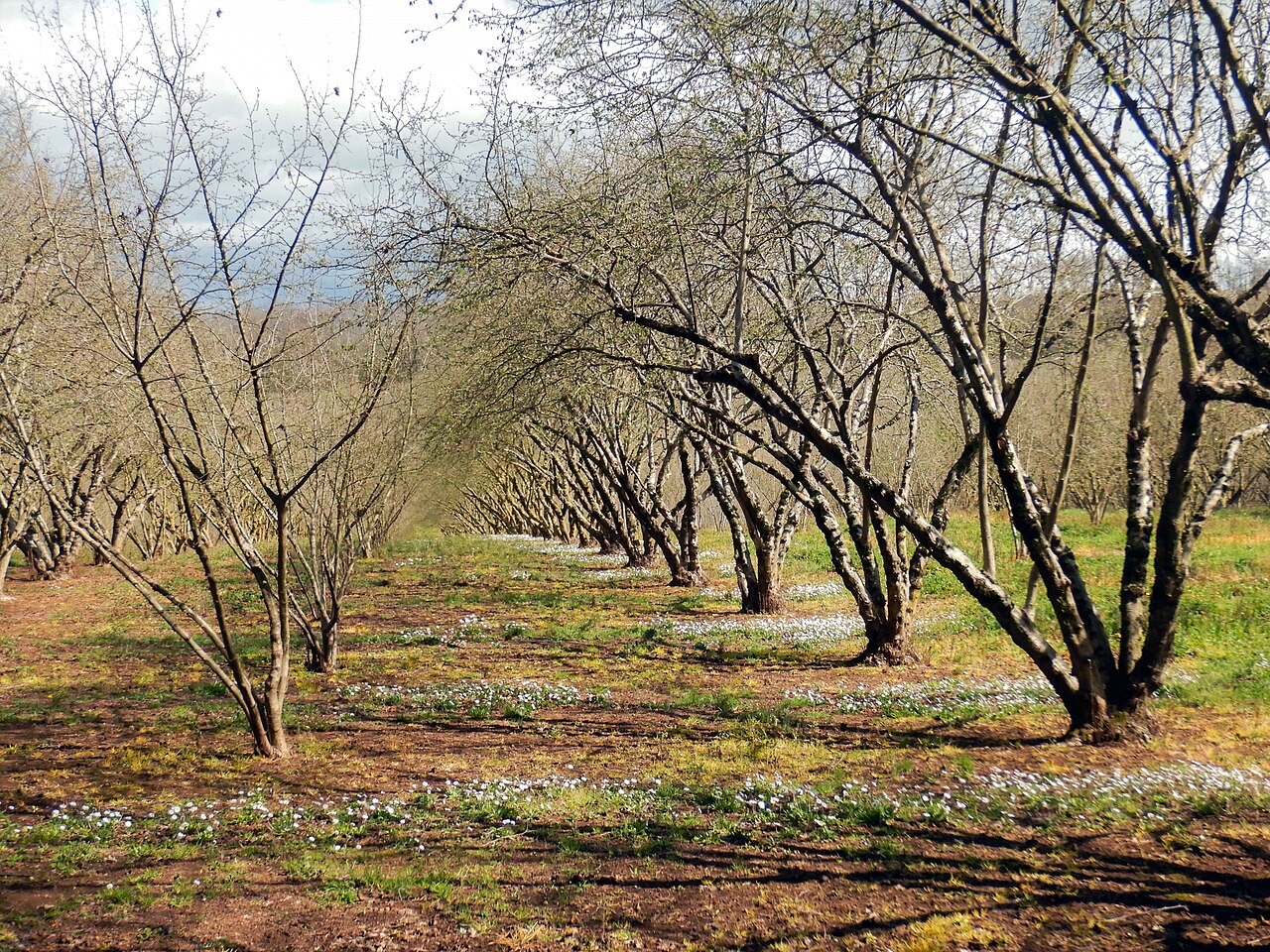
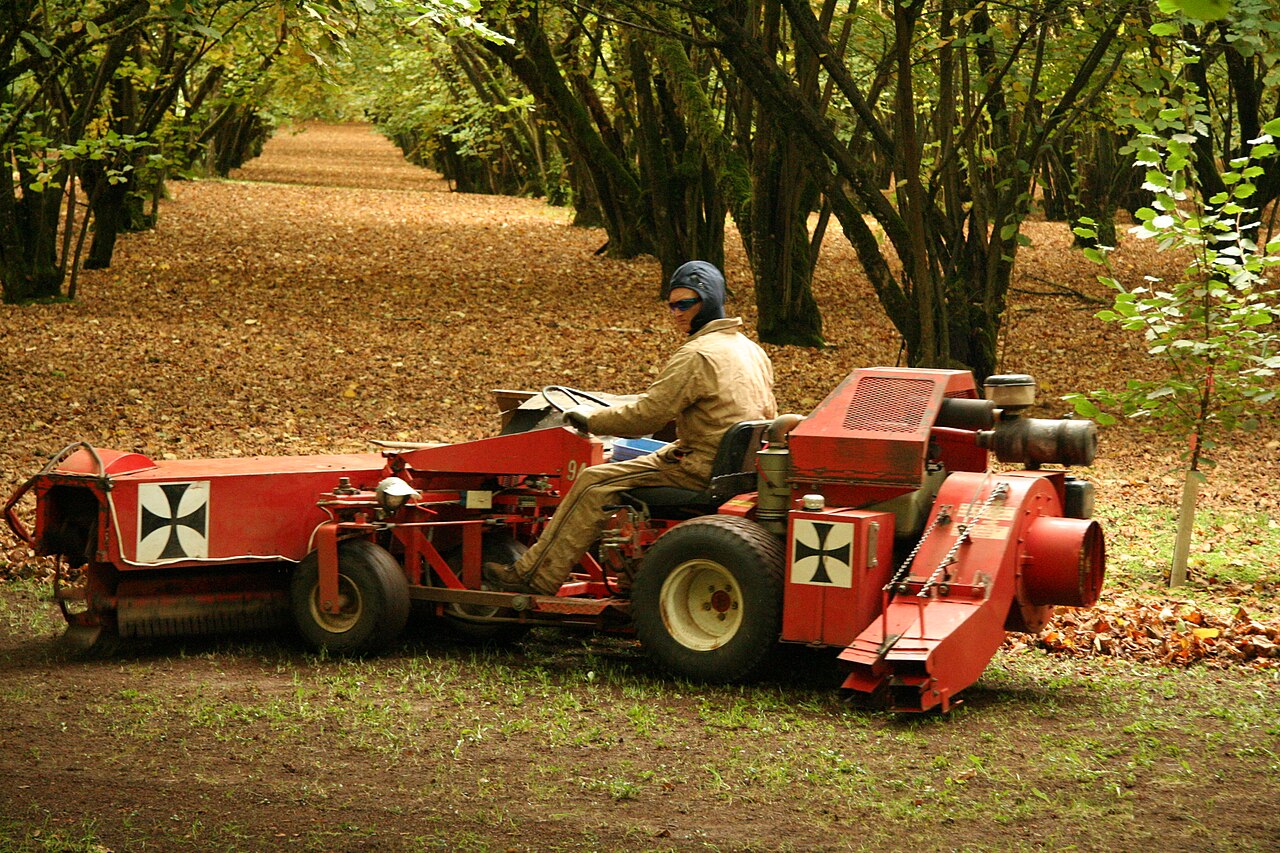
- Mechanized harvest on areas larger than ~3 ha is practically necessary; manual harvest (approx. ~50 kg/day per worker) is applicable only on small areas.
- The soil must be leveled and firm. Before nut drop, the surface under the canopy is broken with a rotary tiller and leveled with a roller so the collector can easily pick up the nuts. Gullies and ruts make mechanical harvest difficult.
- Protective strip (strip under plants) is kept weed-free and usually occupies about 30% of the inter-row width.
- Machine power: harvesting devices require at least ~30 HP; sprayers need a reach of 7–8 m in height and width due to the vigorous hazelnut canopy.
- Modern equipment allows 5 people to harvest approx. 80 ha in 10 days.
Inter-row spacing = machine passage width
Leave enough wide inter-row space for the combination of tractor and attachment (sprayer, collector, mulcher) to pass without damaging branches. This is a common argument for an inter-row spacing of at least 5 m even in denser orchards, where density is then increased by reducing spacing within the row, not by narrowing the rows.
Row orientation
The direction of rows affects light penetration, and thus productivity and uniformity of ripening:
- The recommended direction is north – south, as this ensures more even lighting of canopies throughout the day and better utilization of sunlight by plants.
- On sloped terrain, planting along contour lines (isohips) takes precedence to prevent erosion and preserve soil — this criterion can override the ideal north–south direction.
- Proper, uniform row spacing is a prerequisite for unimpeded and economical passage of machinery.
Pollinizer Arrangement
Hazelnut is a monoecious but predominantly self-incompatible and wind-pollinated (anemophilous) plant with pronounced dichogamy — male and female flowers of the same cultivar often do not bloom simultaneously. Therefore, the correct selection and placement of pollinizers is crucial for fruit set.
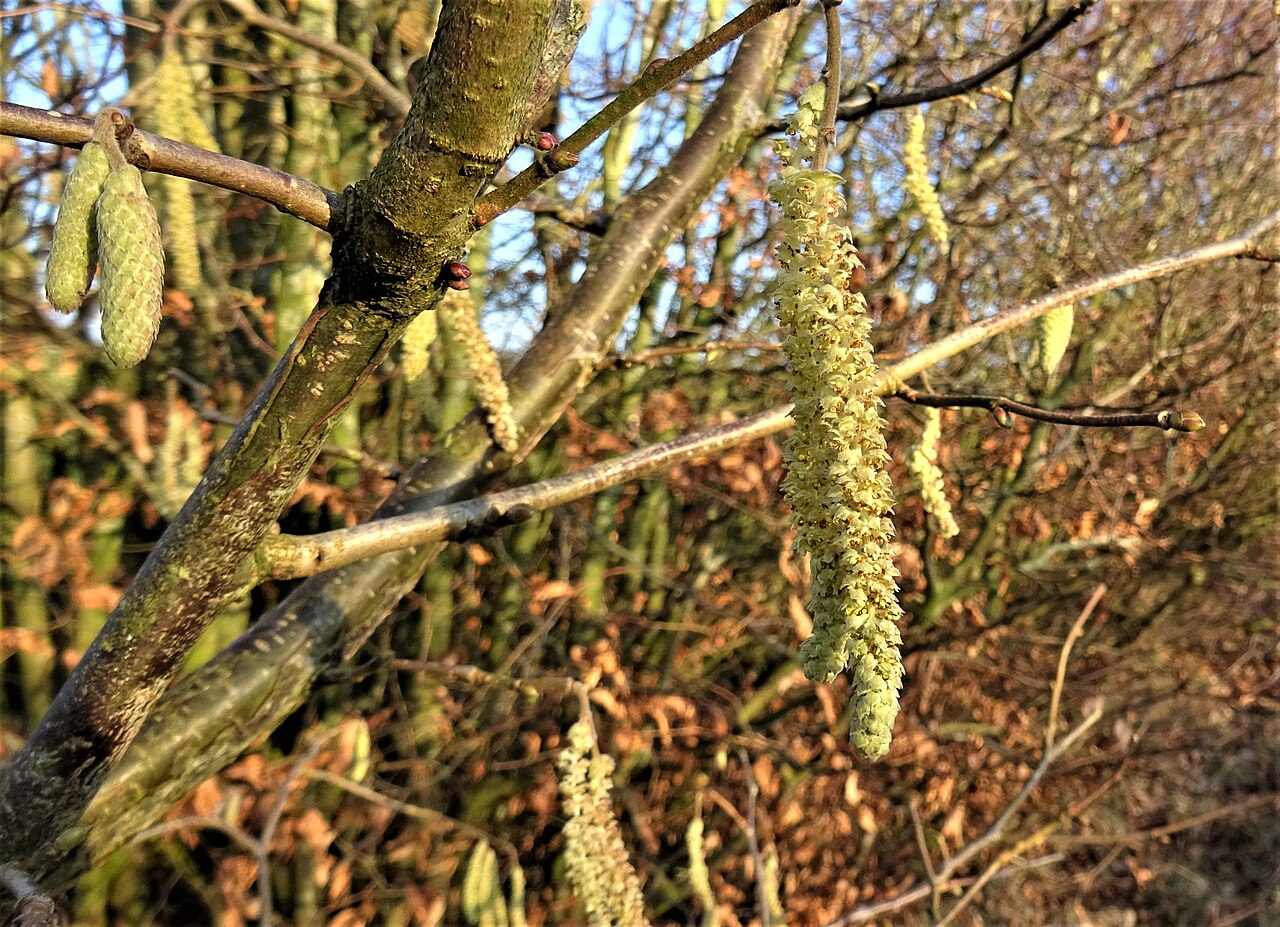
Principles:
- Plant 1–2 main (primary) cultivars along with 2–3 pollinizer cultivars; it is possible to use 1 main + 1 pollinizer, but having more pollinizers increases the security of pollination.
- The pollinizer must temporally overlap pollen release with the flowering (receptivity) of the female flowers of the main cultivar and be genetically compatible (S-alleles). When selecting, pollinizers with different bloom times are often combined to cover the entire receptivity period of the main cultivar.
- The proportion of pollinizers is orientatively around 7 – 20 % of the orchard (the ratio of main cultivar to pollinizer is often cited as 80 : 20).
- Since pollen is carried by the wind, pollinizers should be arranged so that prevailing winds disperse pollen over the main cultivar.
Typical Arrangements:
| Arrangement | Description | Suitable for |
|---|---|---|
| Every 4th–5th row is a pollinizer | e.g., four rows of main cultivar followed by one row of pollinizer | large, mechanized plantations |
| Pollinizer every 4th–5th plant in the row | pollinizers scattered within the row | smaller orchards |
| Border + internal arrangement | pollinizers on the field edges and scattered internally | small holdings, combined approach |
Separate cultivars for mechanical harvest
If cultivars are planted mixed in rows, fruits ripening at different times will mix, complicating and increasing the cost of mechanical harvest (requiring more passes). Therefore, group cultivars by ripening time and, wherever possible, plant pollinizers in separate, easily identifiable rows. Orchards where cultivar separation was not carefully managed are difficult to harvest later.
Even number of rows per cultivar
Literature recommends that the number of rows of a single cultivar be even, especially when combining cultivars with different ripening times — this facilitates grouping and harvesting.
Practical Recommendations and Common Mistakes
Recommendations:
- Before planting, conduct a soil analysis and an economic feasibility analysis; adjust spacing according to soil fertility, cultivar, and machinery.
- Adjust inter-row spacing to accommodate the widest machine; consider high-density planting with planned thinning if early return on investment is a priority.
- North–south row direction on flat terrain; contour lines on slopes.
- Separate main cultivars and pollinizers by rows, group them by ripening time, and ensure ~7–20 % pollinizers.
- Keep the soil level and free of erosion from the start — this is the foundation of inexpensive mechanical harvest.
- Plant the sapling at the same depth it was in the nursery; planting too deep halts growth for up to three years.
Common Mistakes:
- Rows are too narrow, preventing later passage of the harvester or sprayer.
- Mixed cultivars in rows → difficult mechanical harvest and uneven ripening.
- Too few or genetically/phenologically mismatched pollinizers → poor pollination and lower yield.
- High density without a thinning plan → mutual shading, reduced fruitfulness, and disease.
- Neglecting irrigation when choosing spacing → vigorous plants "outgrow" the planned spacing.
Sources
This article is an AI summary compiled from an internal collection of hazelnut literature (RAG corpus) and publicly available sources. Main sources used:
- Technological and Economic Characteristics of Hazelnut Cultivation (CORE, 2018.) — https://doi.org/10.46584/lm.v36i2.1141
- State and Trends in Hazelnut Production and Consumption (2017.); includes spacing table according to Šoškić, Walnut and Hazelnut, 2006. — https://doi.org/10.31727/gzb.42.3.9
- Brzica (2002.), spacing table according to training system — https://doi.org/10.46584/lm.v36i2.1141
- Economic Comparison of Different Training Systems for Hazelnuts (University of Josip Juraj Strossmayer, 2015.) — Moulis method and living fence
- Economic Viability of Hazelnut Production (2022.) — https://www.savjetodavna.hr/2017/10/24/od-sadnje-do-berbe-lijeske/
- Mechanization in Hazelnut Production and Processing at Minas-zrno 1 Company (2021.)
- Hazelnut Diseases and Pests (2020.) — examples of arrangements and spacing from practice
- Establishing a Permanent Hazelnut and Plum Orchard (BBZ, 2020.) — https://bbz.hr/doc/uprava/elaborat_zastite_okolisa_visegodisnji_nasadi_lijeske_i_sljive.pdf *Specification for the Nocciola di Giffoni label (maximum allowed densities) — https://doi.org/10.18690/978-961-286-335-7.8
- Ministry of Agriculture — From Planting to Harvest of Hazelnut — https://savjetodavna.mps.hr/2017/10/24/od-sadnje-do-berbe-lijeske/
- PP Orahovica — Hazelnut Cultivation and Hazelnut Saplings — https://pporahovica.hr/djelatnosti/vocarstvo/uzgoj-ljesnjaka-i-sadnica-lijeske/
- OSU Extension — Growing Hazelnuts in the Pacific Northwest: Orchard Design (EM 9077) — https://extension.oregonstate.edu/catalog/em-9077-growing-hazelnuts-pacific-northwest-orchard-design
- West Coast Nut — Orchard Layout in Hazelnut — https://wcngg.com/2021/10/01/orchard-layout-in-hazelnut-take-orchard-spacing-variety-and-equipment-into-consideration/
- Province of British Columbia — Hazelnut plant spacing — https://www2.gov.bc.ca/gov/content/industry/agriculture-seafood/agriservice-bc/production-guides/hazelnuts/hazelnut-orchard-design/plant-spacing
- Effect of Tree Density on Yield and Fruit Quality of 'Tonda Francescana®' (PMC) — https://www.ncbi.nlm.nih.gov/pmc/articles/PMC11507646/