Bending and Guiding Branches (Bowing) to Open the Hazelnut Canopy
Content generated by artificial intelligence — verify before application
This article was automatically compiled from a collection of hazelnut literature using artificial intelligence and may contain errors or outdated information. It serves as a starting point for further research, not as professional advice. Dosages, products, and timing are informative and depend on the cultivar, location, and applicable regulations — always verify with an advisory service and official sources before application.
Bending, bowing, or spreading branches is a quiet but powerful horticultural measure that is regularly mentioned in passing in hazelnut literature — as part of forming a vase, spindle, or open vase shape — but is rarely treated as a standalone, in-depth topic. This technique involves mechanically guiding a branch outward and downward (instead of cutting it) to open the center of the canopy, allow light to reach the fruiting wood, and simultaneously encourage the branch to shift from "growth" to "fruiting." This article consolidates timing, angles, materials (ties and weights), and the expected effect on fruiting versus growth in one place, relying on a collection of hazelnut literature and broader horticultural experience.
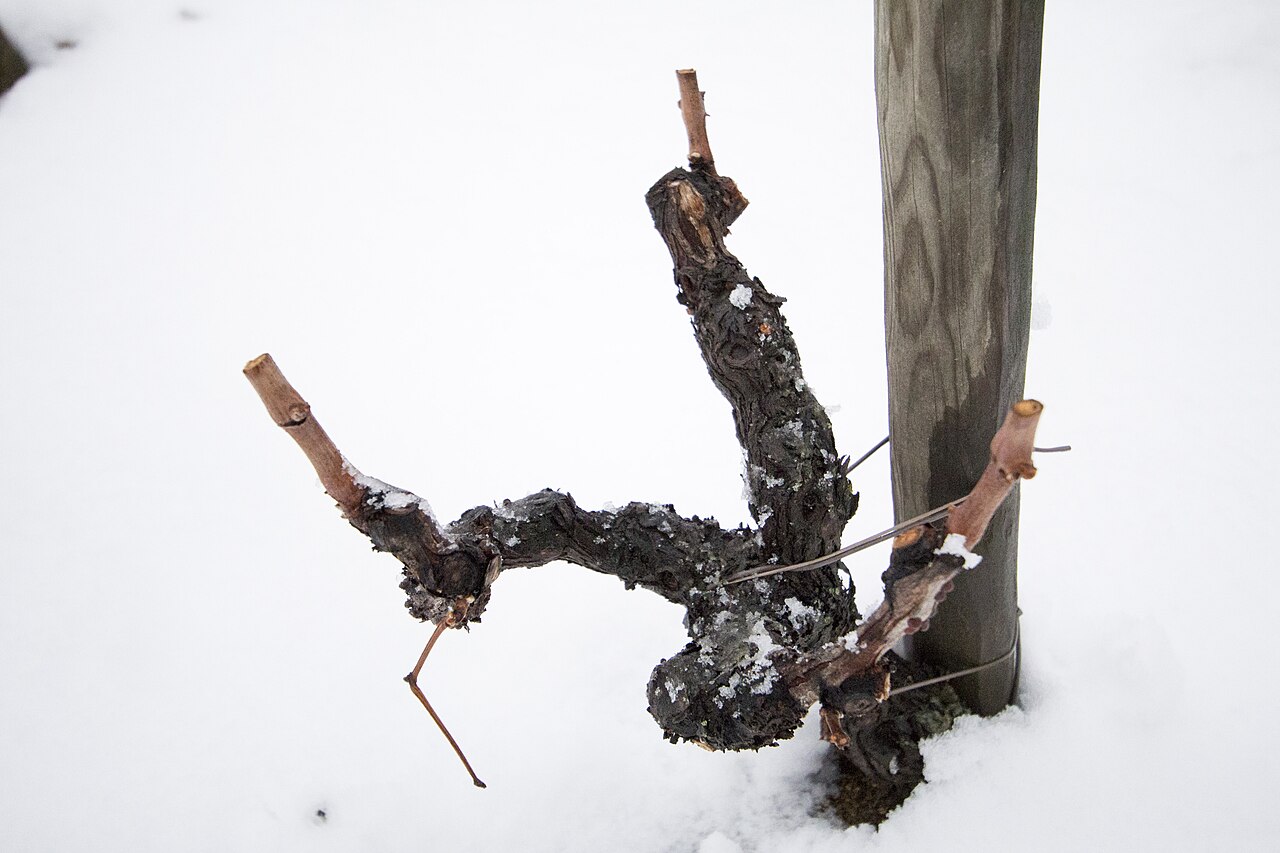
Why bend a branch instead of cutting it
Cutting and bowing are two opposing "levers" used to manage fruit trees. Cutting (especially heading back) stimulates growth: below the cut, the plant produces vigorous, upright shoots. In hazelnut, this is particularly dangerous because heading back stronger branches creates adventitious buds that form strong, unproductive shoots — hence, literature explicitly warns that primary branches and strong lateral branches should not be headed back.
Bowing does the opposite. When we lower a branch from an upright to an oblique or nearly horizontal position:
- vegetative (upright) growth slows down because the strong apical (tip) stimulus is interrupted,
- hormonal balance shifts in favor of floral (fruiting) bud differentiation,
- the center of the canopy opens, allowing light and air to reach the inner fruiting wood,
- future branch breakage is reduced under the weight of the crop because the branch assumes a more stable, natural angle.
In other words, by bowing branches earlier and more abundantly, the tree fruits sooner and more heavily, while the canopy remains low, airy, and illuminated — which is precisely the goal of the vase and open vase training forms.
Connection to the open vase and utilization of water sprouts
In practice, hazelnut is most often trained in the open vase ("improved vase") shape because this form provides the most light and the physiological basis for regular, abundant fruiting. By definition, a vase has an open, "hollow" center — without a central leader or with a minimal one — so all skeletal elements must be directed outward. Bowing is the main tool we use to achieve this without aggressive pruning.
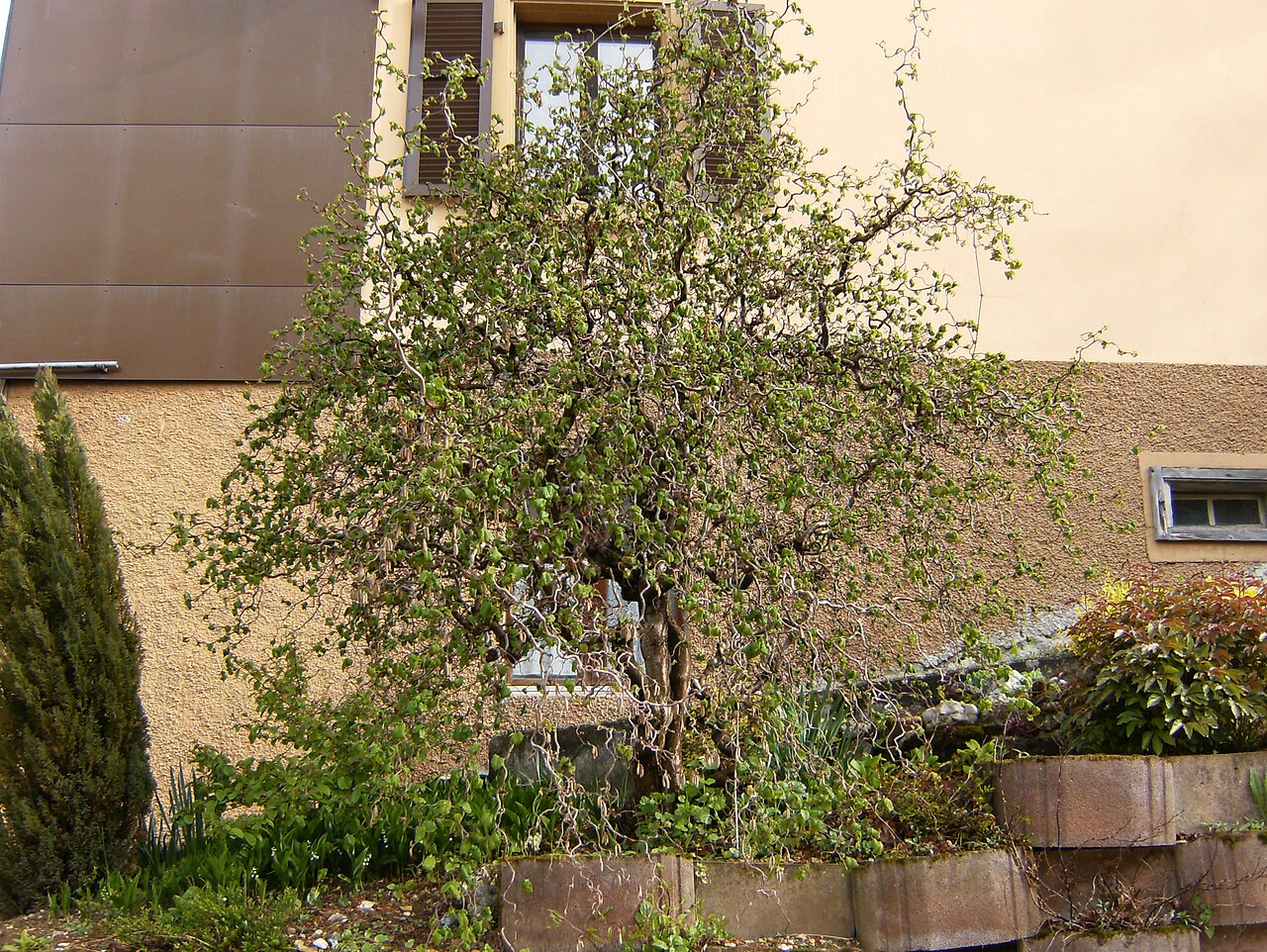
A second major area of application is water sprouts (vigorous upright shoots, "wolf branches"). Water sprouts are usually considered harmful and removed because they steal nutrients and do not fruit. However, a vigorous water sprout is not necessarily waste: if well-positioned (e.g., filling a gap in the skeleton), instead of removing it, we can bow it outward and thus "retrain" it into a fruiting element or a replacement skeletal branch. This turns vigorous growth to our advantage — filling gaps in the vase and renewing fruiting wood, which is part of the cyclical renewal of the canopy (fruiting branches are anyway recommended to be renewed approximately every 5 years).
Timing of the operation (phenology)
The golden rule running through the literature is: bend young branches while they are not yet lignified. Young, green, or semi-lignified branches are elastic and permanently "remember" the new position; old, lignified branches snap.
| Period | Branch State | Suitability for Bowing | Note |
|---|---|---|---|
| Early spring (before/during start of vegetation) | Still rigid, from previous year | Lower | Higher risk of snapping; better for coarse skeleton corrections |
| Late spring – summer (shoot 20–30+ cm) | Green, flexible | Best | Ideal for one-year-old shoots and water sprouts |
| Late summer / early autumn | Semi-lignified | Good | Branch already "remembers" position, less recoil force |
| Winter (dormancy) | Fully lignified | Lower | Cold wood is brittle; risk of breakage |
For one-year-old shoots and water sprouts, the most favorable period is late spring and summer, when the shoot is long enough to be manipulated but still soft enough not to snap. An approximate guideline from horticultural practice: the operation is easiest to perform while the shoot is approximately 20–30 cm long and flexible.
Highlighted: Ties are generally left on for one vegetation period (sometimes two for stronger branches) — until the branch "remembers" the position. After that, they must be removed to prevent girdling the bark.
Bending angle — how much to lower the branch
The angle is crucial because it determines whether the branch will continue to grow, shift to fruiting, or stop completely. There are several reference values.
| Goal | Recommended Angle | Effect |
|---|---|---|
| Skeletal (primary) branches of the vase, balance of growth and fruiting | 65–75° from the trunk axis | Faster formation of floral buds while maintaining vigor; less breakage |
| Branches to encourage earlier fruiting | ~45–60° from vertical (oblique position) | Accelerates fruiting, good mechanical support |
| Water sprouts being retrained to fruiting | Near horizontal / slightly below | Strongest growth suppression, strongest fruiting stimulus |
| Arrangement of primary branches in plan view | ~120° between three branches | Even distribution of light around the perimeter |
The most frequently cited figure from the hazelnut literature collection is an angle of 65 to 75 degrees relative to the trunk axis for branches selected for the canopy skeleton — this range promotes faster formation of floral buds and reduces later branch breakage in years of full fruiting. Broader horticultural experience adds a useful nuance rule:
- Insufficient bending (branch remains nearly upright): continues to grow vigorously, delays fruiting.
- Moderate bending (oblique position, approx. 45–60° from vertical): best balance — branch still grows slightly but fruits well.
- Excessive bending (below horizontal, tip pointing downward): growth stops abruptly, but new vigorous water sprouts often emerge at the highest point of the arc, and the branch itself quickly "nakedizes" and weakens.
The goal is not to bend the branch as hard as possible, but to bring it to a position where the growth-to-fruiting ratio is optimal for its role in the canopy.
Materials — ties and weights
There are two basic approaches: tying (tying the branch down/outward) and weighting (lowering the branch with a weight). These are often combined with spacers/prop sticks that push the branch outward from the inside.
Ties (cord, tape)
Literature is very explicit about the choice of tying material:
- Use elastic, soft fruit tree cord/tape or dedicated branch spreader ties that can stretch/shrink along with the branch's growth.
- Do not use hard, inelastic materials like "manila" rope or stiff twine. As the branch thickens, such cord cuts into the bark (girdling), disrupts conductive tissue, and can lead to branch or tree breakage — especially if the sapling is tied to a stake with it.
Ties are most often attached to:
- a stake/armature near the tree,
- the lower part of the trunk or root collar,
- an adjacent branch (mutual spreading of two branches),
- an anchor/hook in the soil for bowing nearly to horizontal.
It is good practice to place a soft padding (piece of rubber, hose, or fabric) under the tie at the point of contact with the bark to distribute pressure.
Weights
Instead of tying, we can simply load the branch:
- bags of sand or gravel hung near the branch tip,
- dedicated fruit tree weights (hooks/weights that clip onto the branch),
- improvised weights (water bottles, etc.).
The advantage of weights is that they follow the branch — they do not cut in and do not need to be repositioned with every growth spurt. The disadvantage is that they sway the branch in the wind and can slip, requiring periodic checks.
Spacers (props)
To open narrow, acute branch angles (especially when forming a vase), spacers are also used — wooden slats or dedicated plastic/metal spreaders with notches at the ends that are inserted between the trunk and the branch to push it outward. These are suitable for stronger, already semi-lignified branches that cannot be easily tied.
| Material/Tool | When to Use | Advantage | Caution |
|---|---|---|---|
| Elastic fruit tree cord/tape | Young branches, water sprouts, precise guidance | Inexpensive, stretches with branch | Must be soft; check for bark cutting |
| Dedicated branch spreader ties | Systematic bowing of skeleton | Fast, repeatable | Purchase cost |
| Weights (sand, fruit tree weights) | Lowering branch without anchor | Follows branch, does not cut in | Swaying in wind, slipping |
| Spacers/spreaders | Opening acute angles of stronger branches | No soil anchor needed | Can slip; avoid bark damage |
| Anchor/soil hook | Bowing nearly to horizontal | Strong, defined force | Easy to over-bend the angle |
Highlighted rule: Whatever you use, the contact with the bark must be soft and must not girdle the branch. Hard, inelastic ties are the primary cause of damage during bowing.
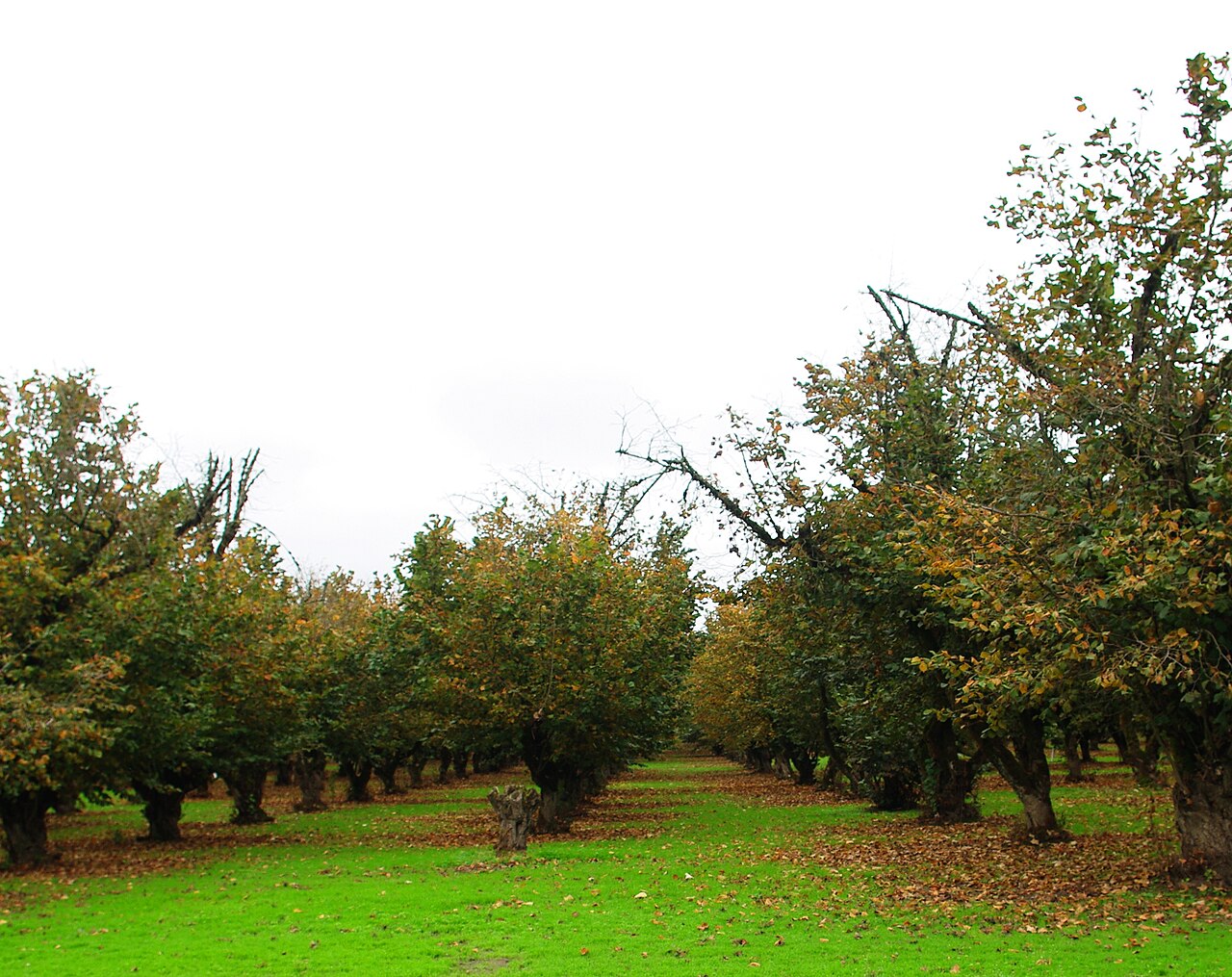
Effect on fruiting versus growth
The essence of bowing is the redistribution of the tree's energy: less upright growth, more floral buds and fruiting. The mechanism and consequences for hazelnut can be summarized as follows:
- Floral bud differentiation. Spreading (bending) one-year-old shoots aims for better and faster formation of floral buds — i.e., earlier and more reliable fruiting.
- Less breakage in full crop. A branch accustomed to an oblique/horizontal position is more stable and carries the weight of fruits in later years more easily.
- Better illumination = better quality. By opening the vase, light reaches the inner fruiting wood; regular and abundant hazelnut fruiting is physiologically linked precisely to a well-lit, airy canopy.
- Maintaining fruiting wood at lower branching levels. The productivity of fruiting shoots declines with increasing branching level, and without intervention, fruiting "moves" to the upper parts of shoots while the lower parts nakedize. Bowing (along with cyclical renewal of fruiting wood) helps keep fruiting lower and closer to the center.
Useful quantitative guidelines from hazelnut literature, which help assess if a branch is in a "fruiting" state:
| Indicator | Value | Meaning |
|---|---|---|
| Optimal length of one-year-old shoot | 15–20 cm | Indicator of good fruiting regardless of tree age |
| Length of branch with most glomerules (fruiting clusters) | 15–35 cm | Such branches are not headed back in winter — they are fruit bearers |
| Age of fruiting branch to start renewal | 3 years | This is when "fruit pruning" begins |
| Cycle of fruiting surface renewal | ~5 years | Renew fruiting wood cyclically |
It is important to maintain balance: excessive bending (tip below horizontal) does indeed stop growth, but often triggers a new wave of water sprouts at the tip of the arc and premature aging of the branch. The goal is to give the branch exactly the slope needed to shift to fruiting while keeping it vital.
Practical Recommendations and Common Mistakes
Recommendations
- Work on young, flexible branches — best in late spring/summer, when shoots are 20–30 cm long.
- Set scaffold branches at an angle of 65–75° from the central leader; strongly lower water sprouts (bend them from an oblique to nearly horizontal position).
- Use elastic, soft ties or weights; place a protective padding under the ties.
- Remove ties after one (maximum two) growing seasons, as soon as the branch holds its position.
- Utilize well-positioned water sprouts: instead of cutting them, bend them into fruiting wood or into a replacement scaffold branch.
- Combine bending with removing branches that grow into the interior of the canopy and those that droop toward the ground — the goal is an open, airy vase shape.
Common Mistakes
- Hard twine / manila — cuts into the bark and breaks the branch; the most frequent error.
- Over-bending — bending the tip below horizontal stops growth but stimulates water sprouts and causes bare patches on the branch.
- Forgotten ties — left on for two or more years, they girdle the branch.
- Bending woody branches — they snap; it is better to correct such branches with props or renew them by cutting back to a younger shoot.
- Heading back primary branches instead of bending — stimulates adventitious buds and vigorous, unproductive shoots.
- Bending in cold weather (deep winter) — the wood is brittle and prone to cracking.
Gallery
Sources
This text is an AI-generated summary derived from an internal literature collection on hazelnut (RAG corpus) and public horticultural sources. Figures regarding angles, shoot lengths, and renewal cycles are indicative and depend on cultivar, location, training system, and current recommendations — consult the advisory service before implementation. Main sources used:
- Cultivation of Hazelnuts — Harvesting, Drying, and Storage (HR, 2022) — bending branches at 65–75°, ties, danger of "manila" twine and girdling
- GUIDE for Hazelnut Cultivation — Ministry of Agriculture / Advisory Service (HR, 2024) — savjetodavna.mps.hr
- Hazelnut Pruning (HR) — productivity of fruiting shoots, renewal of fruiting wood, prohibition of heading back primary branches
- How to Naturally Maintain High-Yielding Hazelnuts (HR) — vase/bushy vase shape and optimal shoot length of 15–20 cm
- Hazelnut (Vrtlarica, HR) — fruiting branch length 15–35 cm, glomeruli; vrtlarica.com/ljesnjak
- Technological Guidelines for Orchards (HR, 2023) — bending lateral shoots, reduction cuts, renewal of fruiting wood
- Establishing New Orchard Plantings — Techno-Economic Guidelines (HR, 2006) — spindle shape, bending and removing branches from the leader
- Planting Hazelnuts (AgroPortal, HR) — bushy vase, arrangement of primary branches; agroportal.hr
- Pruning and Training Home Fruit Trees to an Open Center — Penn State Extension — extension.psu.edu
- How to Weigh Down Fruit Tree Branches: Limb Spreaders & Weights — Orchard People — orchardpeople.com
- Training and Pruning Basics for Hazelnut Trees — West Coast Nut — wcngg.com
Recommended equipment
🔎 bypass pruning shears — Amazon →Affiliate links — we may earn a small commission at no extra cost to you.
Bypass Pruning Shears
Designed for manual pruning of young shoots and thin branches.
| Use Case | Option Type | What to Check Before Purchase |
|---|---|---|
| Precision cutting | Standard bypass design | Blade sharpness and spring tension |
| Ergonomic handling | Adjustable grip size | Handle comfort and leverage ratio |
| Heavy duty tasks | Loppers or saws | Professional tool selection for thick wood |