Pollination Biology: Dihogamy and Wind Pollination
Content generated by artificial intelligence — verify before application
This article was automatically compiled from a collection of hazelnut literature using artificial intelligence and may contain errors or outdated data. It serves as a starting point for further research, not as professional advice. Dosages, products, and timing are informative and depend on the cultivar, location, and applicable regulations — always consult with advisory services and official sources before application.
Hazelnut (Corylus avellana L.) possesses one of the most unusual reproductive biologies among temperate fruit species. It blooms in the middle of winter — when most other fruit trees are dormant — and is exclusively wind-pollinated (anemophily). The period from pollination to actual fertilization can span several months. Furthermore, on the same plant, male and female flowers are rarely active simultaneously: a phenomenon known as dihogamy. Understanding this biology is not an academic triviality; it directly determines how you structure your orchard assortment, how many pollinizers to plant, how to arrange windbreaks, and why, in some years, despite abundant flowering, the crop fails. This article explains dihogamy (protandry and protogyny), the dynamics of pollen release and dispersal, and the weather conditions required for successful fertilization.
Hazelnut as a monoecious, dihagmous, and self-incompatible species
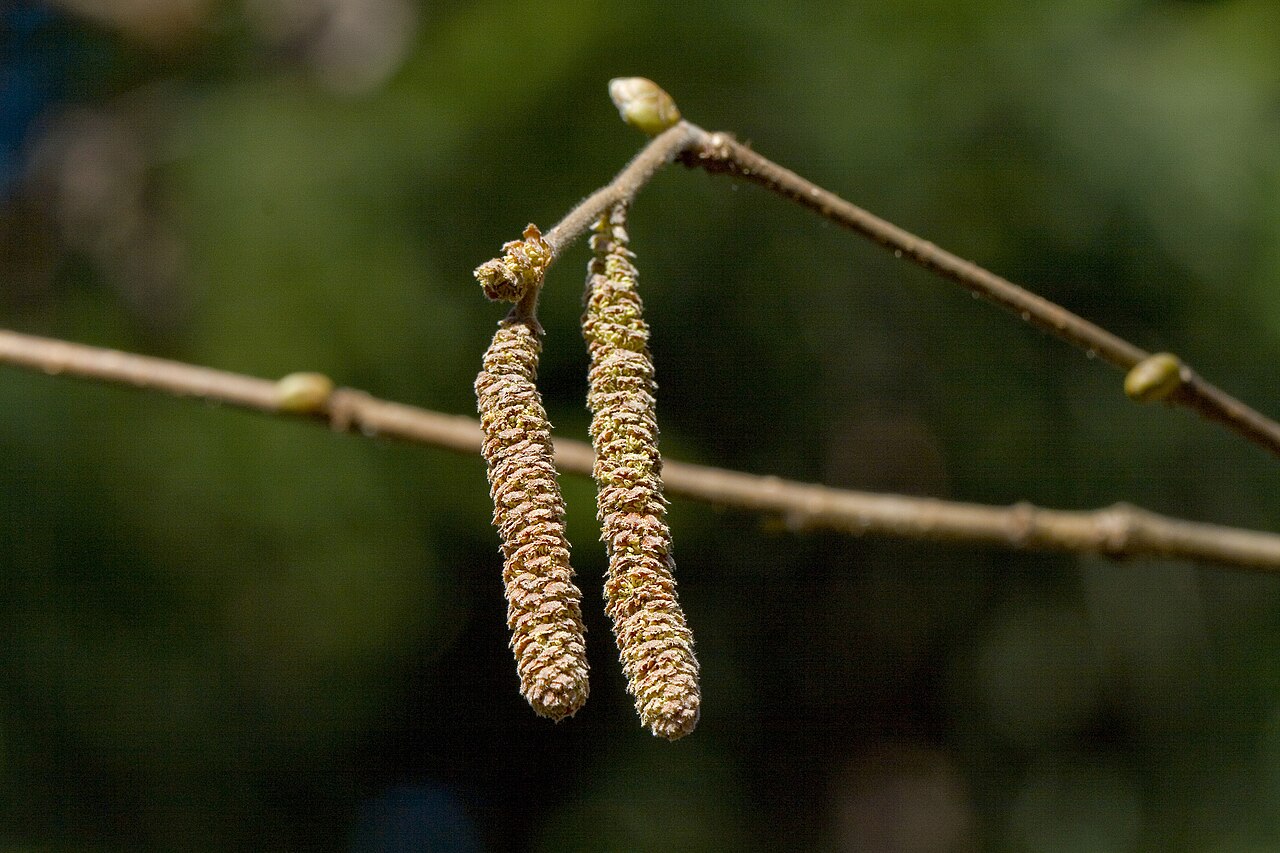
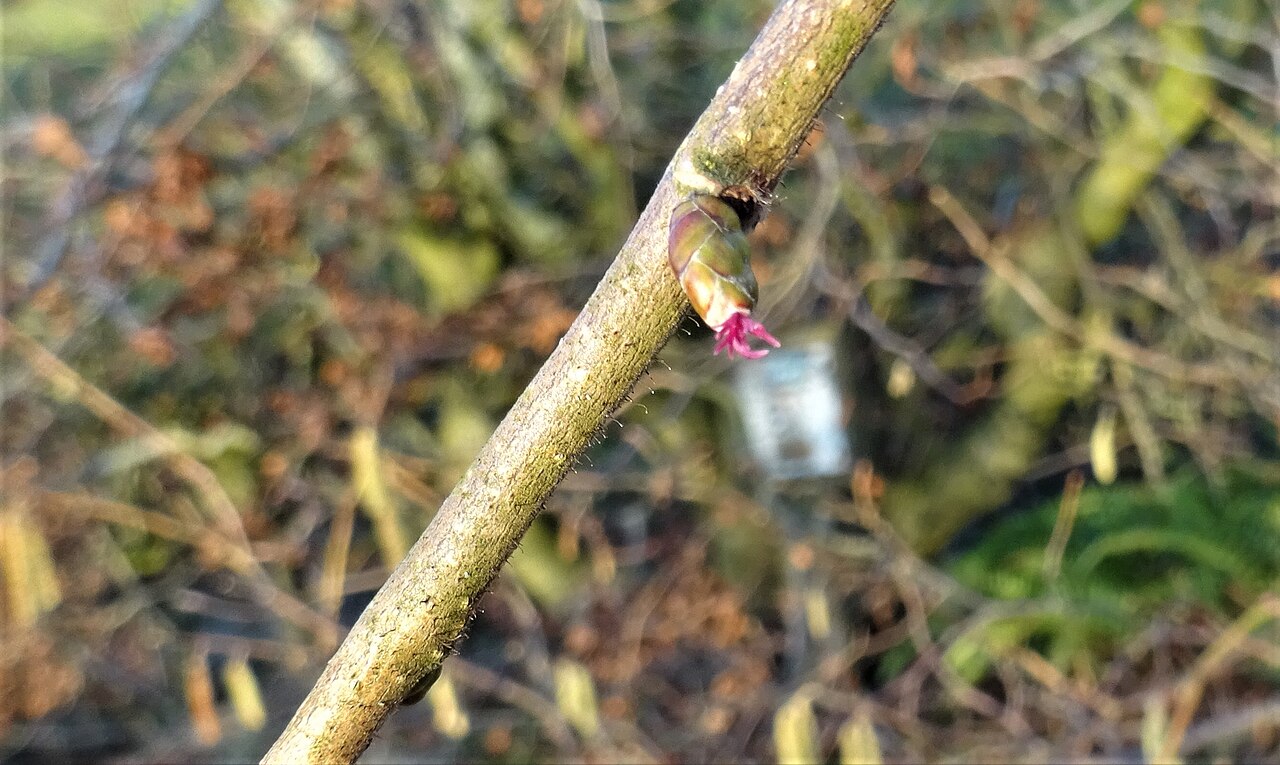
Hazelnut is a monoecious plant: male and female flowers are present on the same plant, but separate. Male flowers are grouped into hanging catkins (maces, amenta) 1–2 cm long, yellowish-red in color, located on the underside of branches in the upper part of the canopy. Female flowers are small, clustered in upright bud-like inflorescences yellowish-green in color, from which red brush-like appendages (stigmas) emerge during flowering.
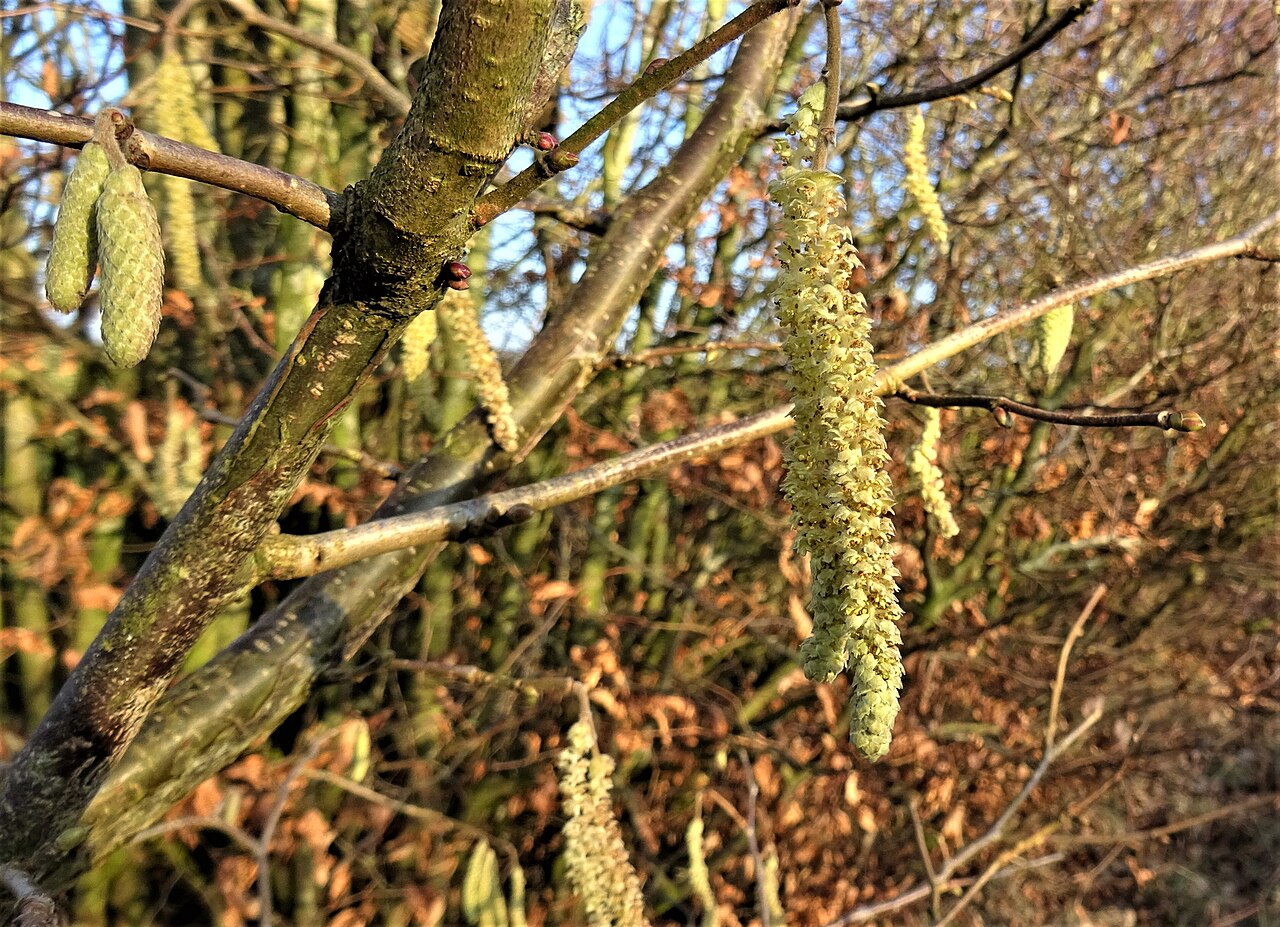
Although monoecious, hazelnut generally cannot rely on its own pollen. Most cultivars are self-incompatible (autosterile) or only weakly autofertile. It was long believed that the main cause of this infertility was dihogamy — the temporal mismatch in the flowering of male and female flowers. Later research, however, showed that the cause lies deeper: even when female flowers are artificially pollinated with well-germinating pollen from the same cultivar, fertilization does not occur, while pollination with pollen from a different cultivar yields a heavy crop (Modic, 1969.). This is true gametophytic self-incompatibility, controlled by a genetic system, and dihogamy is an additional mechanism that further reduces the chances of self-pollination.
The practical consequence is clear: hazelnut must be planted as a mixture of cultivars, where the main (commercial) cultivar and pollinizer cultivars have synchronized flowering and mutual pollen compatibility.
Dihogamy: protandry, protogyny, and homogamy
Dihogamy means that the male and female flowering phases on the same plant do not occur simultaneously. In hazelnut, we distinguish three patterns:
| Pattern | Definition | When it predominates |
|---|---|---|
| Protandry | Male flowers (catkins) bloom and shed pollen before female stigmas are receptive | Warm areas, Mediterranean climate; milder temperatures before flowering |
| Protogyny | Female flowers become receptive before male flowers begin shedding pollen | Colder areas, long and cold winters (e.g., continental Croatia, southern Ontario) |
| Homogamy | Male and female phases overlap simultaneously or with very little difference | Transitional, moderate conditions; specific cultivars |
A key finding from Croatian research (Vujević et al., 2008, 2014, 2015, conducted in an orchard in Orahovica) is that the type of dihogamy is not solely a cultivar trait, but depends significantly on location and the meteorological conditions of a given year. The same cultivar may exhibit protandry in one year and protogyny in another. In the Orahovica area, protogyny is most common; protandry appears less frequently, specifically in years with a higher sum of mean daily temperatures in the decade preceding flowering.
This link between temperature and flowering pattern is well quantified in the Croatian Hazelnut Cultivation Guide (Ministry of Agriculture, 2024):
- at temperatures of 4 to 9 °C, protogyny predominates (female inflorescences bloom first),
- at temperatures above 9 °C, protandry occurs (male inflorescences bloom first).
Generally, the rule holds: milder temperatures before flowering enhance protandry, while low temperatures favor homogamy and even protogyny. Literature also notes a tendency for American cultivars to be predominantly protogynous and European cultivars predominantly protandrous — but these tendencies can be modified by ecological conditions, primarily temperature (HAZELNUT CULTIVATION, 2017.).
Why this matters for cultivar selection
Since the pattern of dihogamy varies from year to year, it is not sufficient to select just one pollinizer. It is recommended to use 2–3 pollinizer cultivars that cover different parts of the pollen-shedding season, ensuring that in every year — regardless of whether protandry or protogyny dominates — the receptive female stigmas of the main cultivar are met by a cloud of fresh, compatible pollen.
Flowering phenogram: a tool for synchronizing cultivars
Since the overlap of male and female phases changes, the most reliable tool for orchard design is the flowering phenogram — a graphical representation that records for each cultivar at a specific location:
- the start and end of male catkin shedding,
- the period of female stigma receptivity.
Croatian research (Vujević et al., 2014) showed that three observed cultivars — Istarski duguljasti, Rimski, and Haleški — complement each other well and ensure good pollination regardless of unfavorable climatic conditions during flowering. Similarly, phenology shows that Istarski duguljasti and Rimski overlap well in flowering and can successfully pollinate each other (Jurkin, 2023.).
Practical procedure: record phenophases on your own site for two to three years before making a final decision on pollinizers, as literature data from other locations may not apply to your microclimate.
Recording phenophases in the field
According to phenological guidelines, the start of flowering is recorded when the first male catkins of yellowish-red color are observed in the upper part of the canopy and when upright female inflorescences are visible from which red stigmas emerge. When monitoring, distinguish between:
- male phase — catkins elongate, become loose, and release a visible cloud of yellow pollen when touched or by breeze;
- female phase — red stigmas emerge from bud-like inflorescences, ready to receive pollen.
Dynamics of pollen release and dispersal (anemophily)
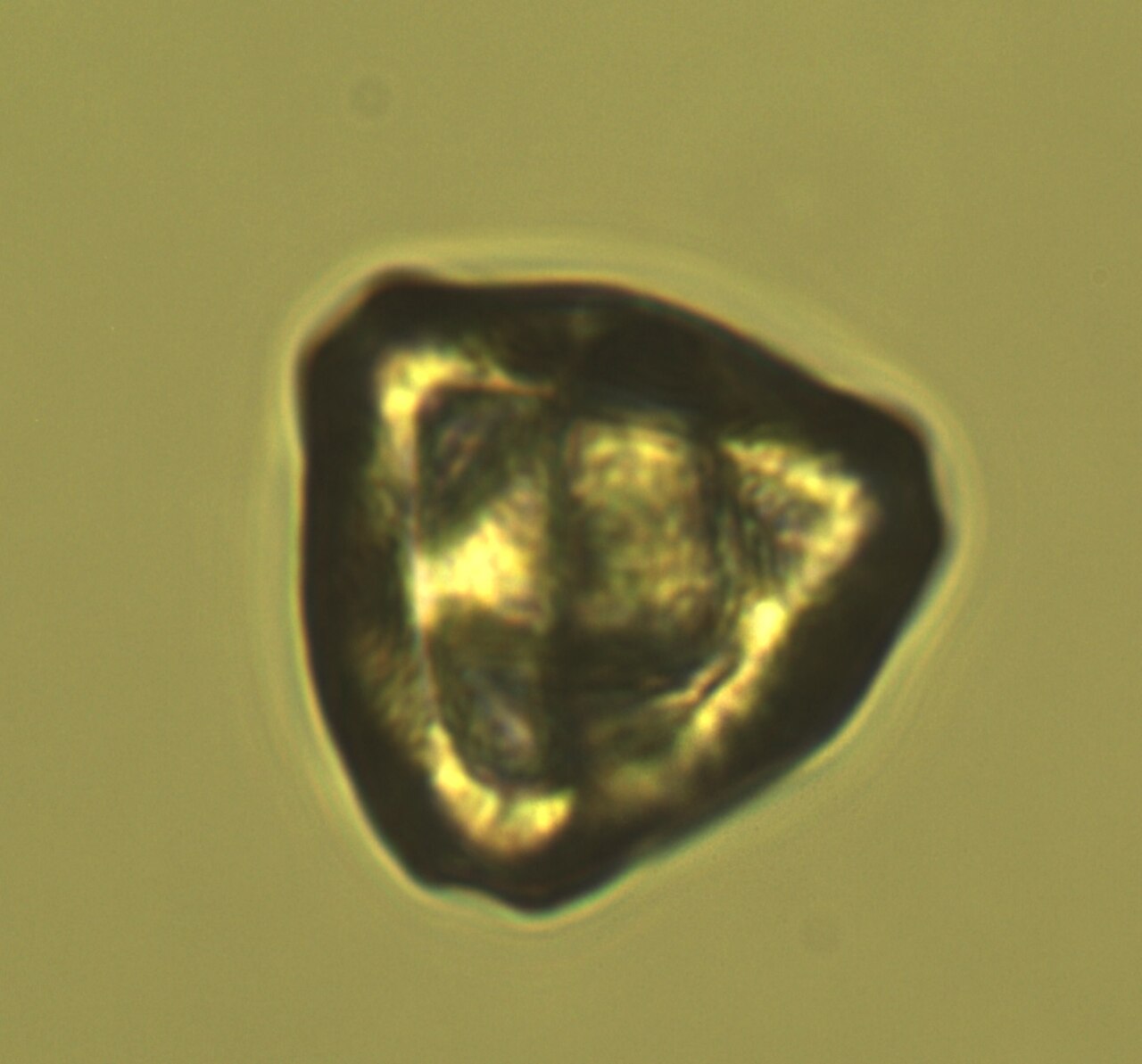
Hazelnut is a typical anemophile — it is pollinated exclusively by wind. It blooms very early (usually from December to March, depending on the region and year), precisely because the canopy is leafless at that time, allowing wind to carry pollen unimpeded. The entire flowering period can last up to 60 days, while active pollen shedding lasts only 2 to 25 days, depending on weather conditions (PDF Hazelnut Cultivation, 2009.).
Several biological facts have direct practical implications:
- Wind is the pollen carrier. The most important factor for the intensity of fertilization is the sufficient quantity of compatible pollen (pollinizers) and wind as the medium for its transport (PZ Našjlešnjak, 2025.). Without air movement, pollen simply does not reach the stigmas.
- Pollen is partially hydrated and sensitive. Hazelnut pollen at release contains more than 30% water and cannot regulate moisture loss itself. Therefore, transport to the receptive stigma must be fast enough to keep the pollen alive.
- Temperature determines pollen viability in flight. Pollen remains vital for several weeks at around +4 °C, but for some cultivars, it deteriorates rapidly at +20 °C. Therefore, cooler weather during flowering actually benefits pollination by extending the "shelf life" of pollen in the air.
- Stigma receptivity is long-lasting. If pollination fails, stigmas can remain receptive for up to three months, which is a kind of biological insurance against short periods of poor wind conditions.
Meteorology affects pollen shedding most significantly through temperature, precipitation, air humidity, sunshine hours, and wind speed. Rain physically washes pollen out of the air and moistens the catkins, temporarily halting shedding; dry and warm days promote the bursting of anthers and the release of pollen clouds.
The role of wind: beneficial, but also dangerous
| Type of wind during flowering | Effect |
|---|---|
| Mild, warmer breezes, moderate humidity | Desirable — transport pollen and aid pollination and fertilization |
| Dry winds | Harmful — dry out the stigma and style, disrupting normal pollination and fertilization |
| Cold winds | Undesirable during flowering |
| Strong / stormy winds | Dangerous — tear off immature clusters before harvest; during vegetation, increase transpiration and dry out leaves |
For this reason, windbreak strips are recommended for windy locations. A smart solution is to plant a strip of forest hazelnut (Corylus avellana) or Turkish hazelnut (Corylus colurna), as such strips can simultaneously serve as an additional source of pollen (pollinizers).
From pollination to fertilization: a delayed process
Perhaps the most unusual characteristic of hazelnut is the time lag between pollination and fertilization. Although wind pollination occurs in February or March (and earlier for early cultivars), fertilization does not happen immediately:
- Pollen grains land on the stigma and germinate, but the growth of the pollen tube (tube) then stalls — at the time of flowering, the female flower’s ovary is not yet fully developed.
- Pollen remains dormant on the stigma until the ovary and ovule develop.
- Only when temperatures rise (on average around 9 °C) does the process resume: the tubes penetrate through the tissue of the stigma and style toward the ovary within 2 to 10 days.
- Pollen tubes reach the sporogenous tissue of the ovary from only one, very rarely two pollen grains.
- Ovules develop a month or more after pollination, and the embryo sac with a mature egg cell differentiates only in late May, June, or exceptionally in July.
Thus, up to 6 months can pass from flowering to actual fertilization. After fertilization, the fruits develop intensively from June to September.
Consequences of delayed fertilization
The long period between pollination and fertilization means that final yield is influenced by weather conditions throughout that entire period, not just during flowering. Drought with very high daily temperatures, early fungal infection, pest attacks, or poor nutrition can cause abortion (necrosis) of the kernel even after successful pollination.
When pollination does not result in a crop
It is useful to distinguish between two types of failure:
- No pollination (stigma did not receive pollen) → the fruit does not develop at all.
- Pollination occurred, but fertilization did not or the pollen was incompatible → early fruit development may begin in spring, but this is soon followed by kernel abortion and the formation of empty shells ("shells").
Lower fertilization success is often the result of unfavorable meteorological conditions before, during, and at the time of fertilization, which can result in a high percentage of empty shells and significantly reduce yield.
Weather conditions for successful fertilization
Taken together, "ideal" conditions for good pollen transfer and fertilization in hazelnut involve several factors:
| Factor | Favorable for pollination/fertilization | Unfavorable |
|---|---|---|
| Temperature during shedding | Moderately cool (e.g., ~4–9 °C) — prolongs pollen viability | High temperatures (≈+20 °C) quickly kill pollen of some cultivars |
| Temperature for fertilization continuation | Rise to ~9 °C and above triggers pollen tube growth | Prolonged low temperatures delay the process |
| Wind | Gentle, warmer, moderately humid breezes | Dry, cold, or stormy winds |
| Humidity / Precipitation | Moderate air humidity | Dry air (dries out stigmas); rain washes away pollen |
| Late frosts | — | Frost can damage open flowers and germinating pollen |
Note on frost: Mature (dormant) pollen is extremely cold-resistant — Corylus colurna (Turkish hazel) pollen can withstand temperatures down to −26 °C without damage — but germinating pollen is damaged at −10 to −14 °C (Alteheld, 1996). This means the critical moment is when flowers are open and pollen is active on the stigma: even moderate frost can negate pollination at this stage.
All the aforementioned temperature and weather figures are informative and depend on cultivar, location, and year; use them as a guide, not as absolute thresholds.
Practical recommendations
- Plant multiple cultivars. Combine the main commercial cultivar with 2–3 compatible pollinizers distributed across the shedding season, as the pattern of diachasm varies from year to year.
- Check pollen (in)compatibility, not just flowering overlap. Two cultivars that bloom simultaneously may be mutually incompatible.
- Create a flowering phenogram for your own location over 2–3 years before making final cultivar decisions.
- Ensure sufficient pollen. Pollinizers should shed abundantly — choose cultivars with many catkins and high pollen germinability.
- Arrange pollinizers so that wind carries pollen to the main cultivar; in practice, they are often planted in rows or "scattered" throughout the orchard, taking into account the direction of prevailing winds during flowering.
- Raise windbreak belts of forest or Turkish hazel that can also serve as pollinizers; they protect against stormy and dry winds but must not completely stop air movement.
- Monitor micronutrient nutrition. For good and long-lasting pollen germinability, boron (B) is crucial, along with molybdenum (Mo) and phosphorus (P); adjust autumn foliar fertilization to the specifics of flowering (informative — align with leaf/soil analysis and product label).
Common mistakes
- Monoculture of a single cultivar. Without compatible pollinizers, yield is absent despite abundant flowering.
- Relying on a single pollinizer. In years when its shedding phase "misses" the receptivity of the main cultivar, pollination fails.
- Ignoring wind direction when arranging pollinizers.
- Excessive, non-selective pruning of the canopy edges. Hazelnut is a heliophile and forms fruiting buds on the periphery of the canopy — overly aggressive pruning removes exactly the fruiting and male flower-bearing structures.
- Attributing empty shells ("shells") exclusively to pests. The cause can also be poor pollination/fertilization or kernel abortion due to drought and stress.
Sources
This article is an AI summary compiled from an internal literature collection on hazelnut (RAG corpus) and publicly available scientific and professional sources. Main sources used:
- Hazelnut Cultivation Guide — Croatian Ministry of Agriculture / Advisory Service (2024.) — https://www.savjetodavna.hr
- Vujević et al. (2014.): Flowering period of hazelnut cultivars and occurrence of diachasm in the agroecological conditions of continental Croatia (RAG corpus)
- Status and Importance of Hazelnut Cultivation in the Republic of Croatia (2018.) (RAG corpus)
- Jurkin, T. (2023.): Flowering phenology of hazelnut cultivars "Istarski duguljasti" and "Römische Zellernuss", Faculty of Agriculture, supervisor T. Jemrić (RAG corpus)
- PDF Hazelnut Cultivation (2009.) (RAG corpus)
- Technological and Economic Characteristics of Hazelnut Cultivation (2018.) — https://doi.org/10.46584/lm.v36i2.1141
- Environmental Impact Assessment — Establishment of Permanent Hazelnut and Plum Orchards (2020.) — https://bbz.hr/doc/uprava/elaborat_zastite_okolisa_visegodisnji_nasadi_lijeske_i_sljive.pdf
- Hazelnut Cultivation (book, 2017.) (RAG corpus)
- PZ Naš lješnjak (2025.) — pollination, fertilization, and kernel abortion (RAG corpus)
- Influence of nutrient medium and plant growth regulators on micropropagation of Corylus colurna L. (2025.) — pollen frost resistance (RAG corpus)
- Autumn foliar fertilization of woody crops (2026.) — boron and pollen germinability (RAG corpus)
- Hazelnut Pollination — International Society for Horticultural Science (ISHS) — https://www.ishs.org/ishs-article/351_19
- Hazelnut floral phenology in southern Ontario, Canadian Journal of Plant Science (2021.) — https://bioone.org/journals/canadian-journal-of-plant-science/volume-101/issue-6
- Viability and germinability in long term storage of Corylus avellana pollen, ScienceDirect — https://www.sciencedirect.com/science/article/abs/pii/S0304423816306112
- The role of sucrose in maintaining pollen viability and germinability in Corylus avellana L., Protoplasma (Springer) — https://link.springer.com/article/10.1007/s00709-024-02015-z
- Hazelnut Pollen Phenotyping Using Label-Free Impedance Flow Cytometry, Frontiers in Plant Science — https://www.frontiersin.org/articles/10.3389/fpls.2020.615922/full