Preparing the orchard floor for mechanized harvest
Content generated by artificial intelligence — verify before application
This article was automatically compiled from a collection of hazelnut literature using artificial intelligence and may contain errors or outdated information. It serves as a starting point for further research, not as professional advice. Dosages, products, and timing are informative and depend on the cultivar, location, and current regulations — always consult with an advisory service and official sources before application.
In hazelnut production, nuts are not harvested from the tree but are collected from the ground after they naturally drop from the husk. Therefore, the orchard floor — the soil surface beneath and between the bushes — is effectively the "workbench" for the entire harvest. If this floor is uneven, soft, overgrown with grass, or full of mowing residues, mechanized vacuum harvesting becomes slow, losses increase, and the collection chamber fills with too much soil, leaves, and twigs. This article explains how to prepare a low, smooth, firm, and clean orchard floor that enables efficient vacuum harvesting of nuts and high-quality harvested hazelnuts.
Why floor preparation is critical for mechanized harvest
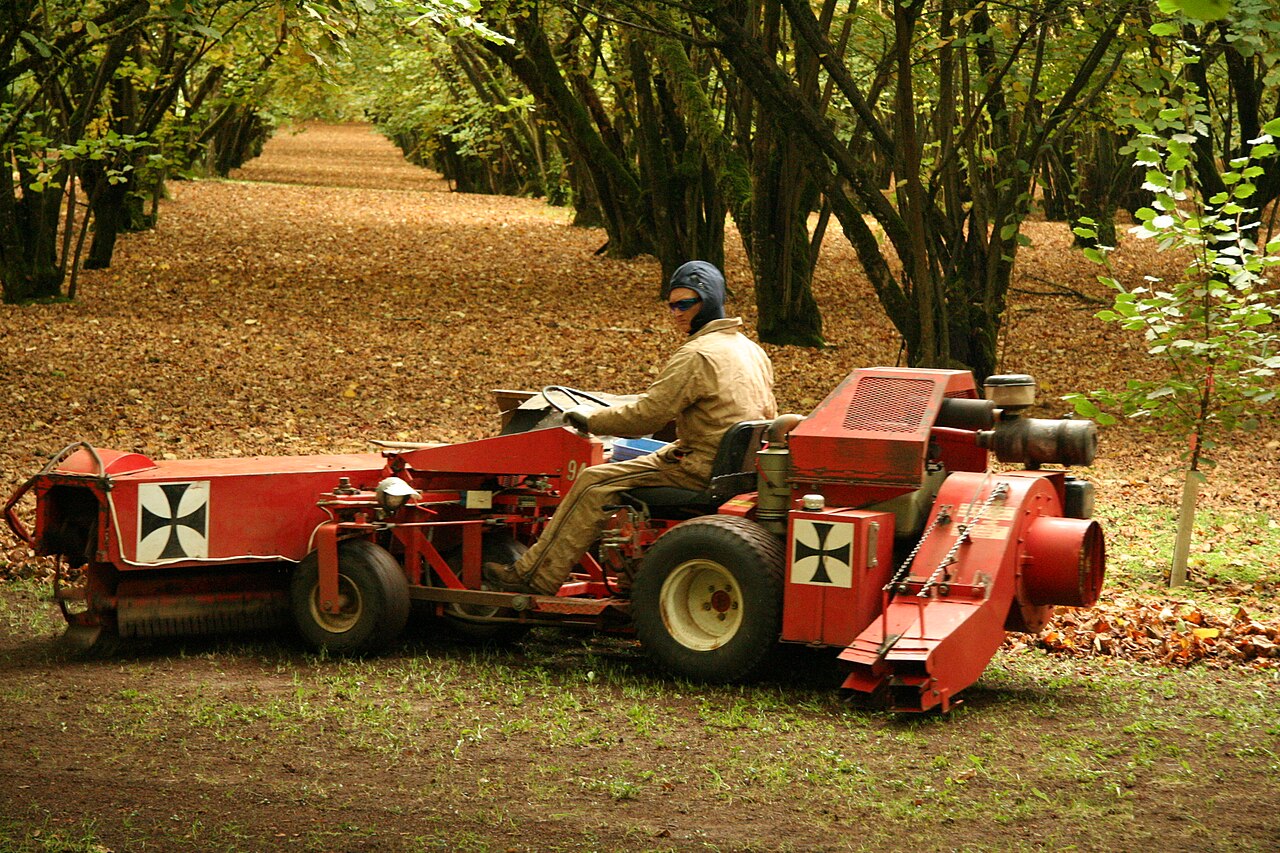
Mechanized hazelnut harvesting almost always follows the same principle: nuts fall to the ground, are swept toward the center of the row by rakes or brushes, and are then vacuumed from the soil by a self-propelled or mounted harvester through flexible pipes, separating them from debris in an air stream. The efficiency of this entire chain depends directly on the condition of the floor.
From a review of harvesting technology literature (Vrtodušić et al., 2022, relying on Olsen and Peachey, 2013, and Islam, 2018), a clear rule emerges:
The soil before harvest must be weed-free, firm, and smooth. Adequately firm and smooth soil allows the vacuum head height to be adjusted for maximum efficiency, thereby minimizing contamination with foreign material.
There are three main reasons why investing in floor preparation pays off:
- Machine efficiency. A smooth, low surface allows the vacuum head (or brush sweeper) to be lowered very close to the ground and pass evenly, without skipping over depressions or digging into bumps. An uneven floor forces the operator to raise the head, leaving nuts in cracks and depressions.
- Cleanliness and lower contamination. The less loose material available (grass clippings, leaves, branches, soil clods), the less debris the vacuum stream pulls in. A clean substrate means lower processing losses and a lower risk of soil contamination on the nuts — which is important for preventing aflatoxins.
- Lower nut moisture and better quality. A nut lying on a clean, airy, and dry surface loses water faster and is less exposed to molds that thrive in warm, humid environments. The elaboration for the orchard in Grubišno Polje states this concisely: a clean surface means nuts have lower moisture content, and harvest efficiency increases.
| Goal | What it enables | Consequence for harvest |
|---|---|---|
| Low surface (short grass/stubble) | vacuum head operates close to the ground | fewer missed nuts |
| Smooth, leveled soil | uniform machine passage | fewer losses in depressions |
| Firm, settled soil | machine does not "sink" or lift soil | less soil in the nuts |
| Clean substrate without clippings | clean vacuum stream | lower contamination and better processing |
Long-term preparation: leveling during orchard establishment
The cheapest and best floor preparation begins years before the first commercial harvest, while the bushes are still young and heavy machinery can move freely through the orchard.
Based on experience from production areas (OSU Extension; NMSU), it is recommended that the orchard floor be leveled at least one year before the first harvest. The reason is simple: leveling involves removing loose soil from mounds and pushing it into depressions, and this compacted layer needs time to settle and harden. If leveled immediately before harvest, the machine will operate on soft, unsettled soil.
Good long-term preparation includes:
- Removing mounds around the trunk/bush so that the sweeper and vacuum head can pass right up to the plant, to the base itself.
- Filling in wheel tracks, pits, and local depressions, as this is where nuts are "lost."
- Dragging a leveler (dragger/board, so-called float — a rectangular metal frame) over the entire surface to lower high points and fill depressions.
- Planning slope and drainage so that water drains away, and the floor remains passable and during wetter periods.
Settlement rule
Dragging and leveling lower high points, but loose soil pushed into depressions needs time to settle and harden. Therefore, level the floor early, and only roll and fine-tune it just before harvest.
Note on training form: the possibility of mechanized harvest also depends on how the orchard is shaped. In Oregon, hazelnuts are mostly grown in a tree form (single trunk) specifically to enable machine harvesting and unobstructed passage of machines under the canopy. The bush form with many shoots at the base makes it difficult for the vacuum head to approach and exacerbates the problem of suckers (wolf shoots) that dirty the floor.
Seasonal floor maintenance during the growing season
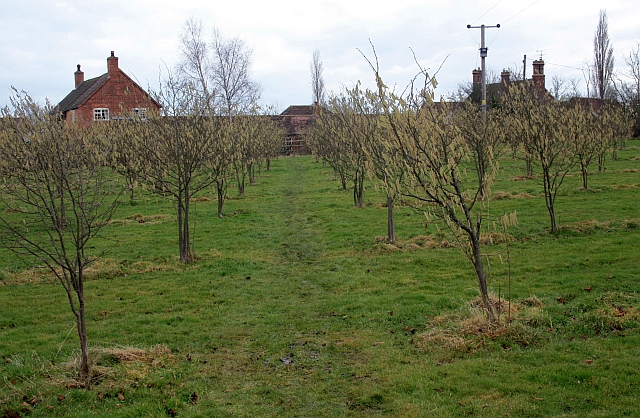
For the floor to be "in shape" before harvest, it is maintained throughout the season. In practice, two zones are most often combined:
- Herbicidal (clean) strip in the row, under the canopy, approximately as wide as the branches reach — the goal here is a bare, clean, and flat substrate onto which nuts fall.
- Grassed (mowed) inter-row space, which supports mechanization, protects the soil from erosion and compaction, and is regularly mowed low.
From domestic literature (e.g., maintenance description at Balog Farm), the soil can be kept as fallow, bare, mulched, treated with herbicides, or a combination thereof — for example, bare soil in the inter-row, and mulching or herbicides in the row around the bushes. The choice depends on terrain slope, soil type, and amount and distribution of precipitation.
During the growing season, it is key to:
- Regular low mowing/mulching of inter-rows, multiple times during the season, so grass never grows too tall.
- Controlling suckers (shoots) around the bush base, as they create a "jungle" through which the machine cannot collect nuts.
- Avoiding conditions that promote premature leaf drop — potassium deficiency, water stress, frost damage, and heavy aphid infestation lead to early leaf fall, which then interferes with vacuuming.
Low mowing and cleaning immediately before harvest
The final cycle of operations takes place in the weeks immediately before harvest and determines how clean and fast the harvest will be.
1. Low, fine mowing / mulching
Grass and weeds in the row and inter-row are mowed low, and the clippings should ideally be chopped and removed or distributed so that they do not form a mat on which nuts disappear from the machine's field of view. Practitioners confirm this: before harvest begins, it is important to chop and mow grass between bushes/trees so that harvesting proceeds faster and more efficiently, and by mulching, the soil is cleared of weeds and grass so that harvesting proceeds as easily as possible.
When mulching in two directions (diagonally), avoid creating wheel tracks and "ribbed" clippings in one direction.
2. Breaking and leveling the surface layer
The classic procedure for fine floor preparation was described by Bulatović (1985.) and Modic (1985.): first, the surface layer is broken with a rotary tiller (culti-packer), and then leveled with a roller. The goal is a smooth, fine-crumbly, yet firm surface without clods.
3. Rolling (compacting) the floor
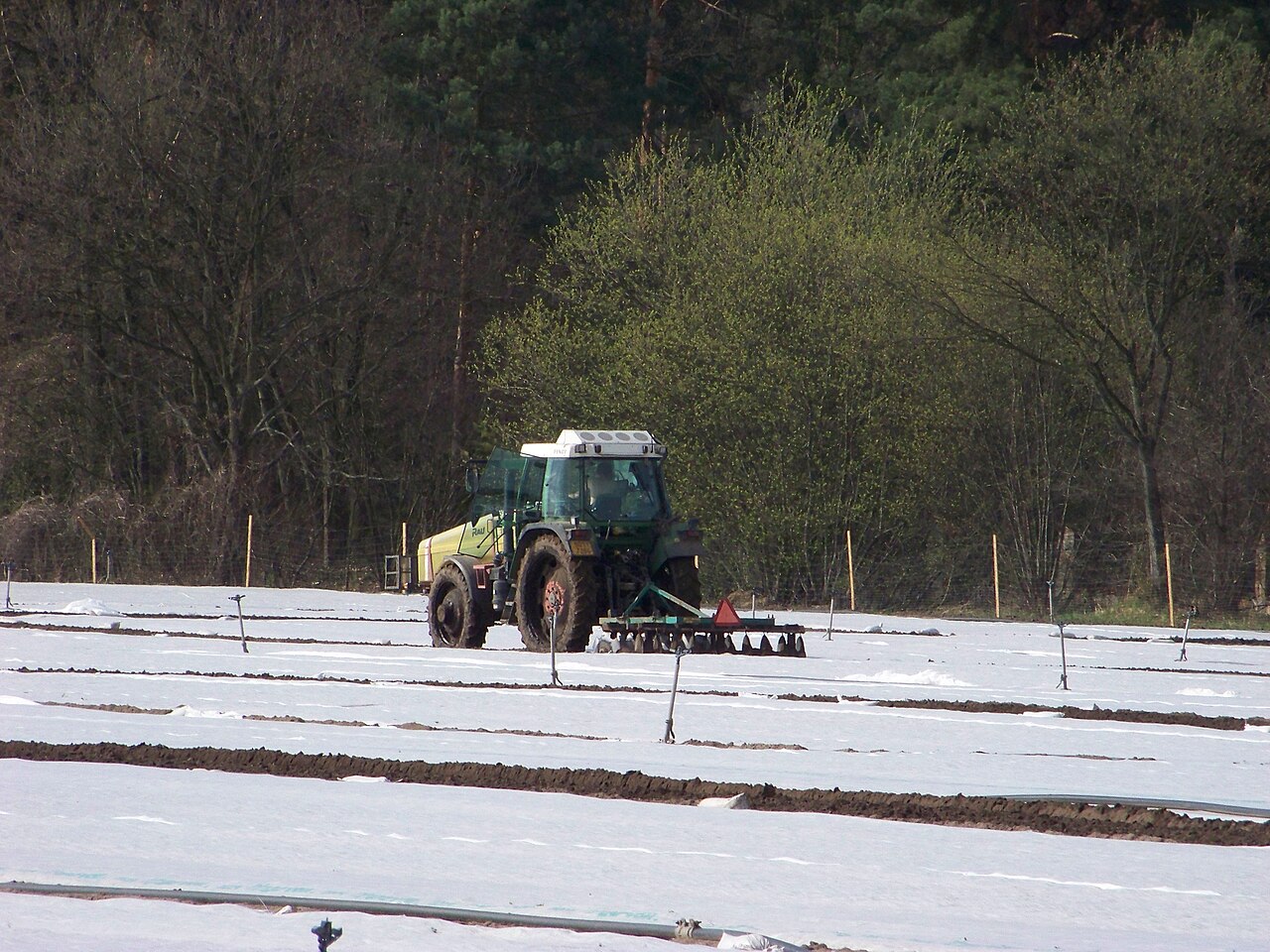
Rolling is the step that makes the surface flatter and harder, so that brush sweepers "wipe" nuts from the ground during passage, and the vacuum head operates at a minimal, constant height. In irrigated areas, the floor is sometimes moistened and then rolled to form a flat, hard crust; in our region, the same role can be played by light rain before harvest, which settles dust and hardens the soil (Olsen and Peachey, 2013). Caution: too much water on heavy, clayey soils causes cracking after drying.
Do not drive on the floor after final preparation
Literature on nut crops strongly recommends that after final leveling and rolling, the harvester (or shaker) should be the first to enter the orchard. Any passage of heavy vehicles before harvest creates new wheel tracks and ruins the very smoothness that you rolled for.
4. Final tuning and "pre-harvest sweep"
Hazelnuts with empty shells drop earlier than sound nuts. Therefore, it is recommended that after these have dropped (usually towards the end of August), and before the main drop of healthy nuts, final soil preparation be carried out to fill small depressions, or that a "pre-sweep" be performed to eliminate these empty shells. Thus, the main harvester pass collects a cleaner and higher-quality mass.
Approximate sequence and timing (informative)
| Phase | Approximately when | Operation | Goal |
|---|---|---|---|
| Long-term leveling | ≥ 1 year before 1st harvest | dragging, float, filling pits | permanently level, settled floor |
| Seasonal maintenance | during growing season | low inter-row mowing, clean strip in row, controlling suckers | low and clean floor |
| Pre-sweep for empty shells | end of August | pre-pass / soil tuning | removal of empty shells, filling depressions |
| Final mowing | days before harvest | low mulching + removing clippings | clean substrate |
| Tilling + rolling | immediately before harvest | breaking layer, leveling, compacting | smooth and firm surface |
| Harvest | September – October | vacuuming nuts | maximum efficiency, minimal contamination |
Timing is informative and depends on cultivar, location, soil, and weather. Hazelnut harvest in Croatia usually falls in September and October, and for some cultivars begins as early as late August.
How prepared soil accelerates and reduces the cost of vacuum harvesting

Hazelnut vacuum harvesters operate with flexible hoses approximately 10–12 cm in diameter; powerful suction is generated by fans mounted on a trailer behind a tractor or on a self-propelled machine (Modic, 1985). The suction stream pulls nuts along with leaves, debris, and fine soil, while heavier nuts fall into the collection chamber, and lighter impurities are separated by the air stream and sieves.
This leads to practical logic:
- The cleaner and smoother the floor, the less ballast the suction stream pulls in, allowing separation (sieves, filters) to operate with less strain and faster.
- Italian harvesters (e.g., Facma Cimina) vacuum from two rows simultaneously; under favorable conditions and with a prepared floor, such a machine can harvest approximately 0.75 ha per day. A poor floor drastically reduces this efficiency.
- Vacuum head capacity varies by design, reaching up to 1,500–2,000 kg/h with an air flow of approximately 3,500 m³/h (Italian sources) — but only on flat and clean ground; on uneven terrain, the head must oscillate and loses suction contact.
| Floor Condition | Typical Outcome |
|---|---|
| Low, smooth, firm, clean | Fast passage, low losses, clean mass, less post-harvest cleaning |
| High mow / overgrown | Nuts hidden in grass, slow operation, high losses |
| Soft, uncompacted | Machine lifts soil → contamination, sieve clogging |
| Uneven, with depressions | Nuts remain in depressions, uneven head height |
Practical recommendations and common mistakes
Recommendations
- Level the floor while the orchard is young and heavy machinery can still access all areas; later leveling is difficult and expensive.
- Maintain a permanently low inter-row grass cover and a clean strip under the canopy throughout the season — final preparation is then just "fine-tuning," not damage control.
- Mow/mulch in two directions and remove or finely shred the mowed material.
- Roll only after the soil added to depressions has settled; ideally, use light rain or controlled irrigation to create a firm crust.
- Remove mounds and hummocks at the base before harvest.
- If possible, ensure the harvest machine is the first to enter the orchard after final preparation.
Common mistakes
- Leveling and rolling too late (unsettled, soft soil) — machine lifts soil.
- Leaving mow too long on the floor — nuts disappear into the grass, humidity increases, and mold risk rises.
- Ignored wheel tracks and holes — permanent nut losses in depressions.
- Premature leaf drop due to potassium deficiency, water stress, or aphids — leaves clog the vacuum system.
- Excessive moisture when compacting heavy soils → crust cracking and new unevenness.
- Driving heavy machinery on the floor after final rolling.
Gallery
Sources
This text is an AI summary compiled from an internal literature collection on hazelnuts (RAG corpus) and publicly available sources. Data, dosages, and timelines are informative — verify them with advisory services and official sources before application. Main sources used:
- Vrtodušić et al. (2022): Harvest, drying, and storage technology of hazelnuts — Literature Review, Journal of Central European Agriculture, DOI: 10.5513/JCEA01/23.2.3493 — https://jcea.agr.hr/articles/772314_Tehnologija_berbe_su_enja_i_skladi_tenja_lje_njaka_Pregled_literature_hr.pdf (relies on Olsen and Peachey, 2013; İslam, 2018; Bulatović, 1985; Modic, 1985)
- Environmental Impact Assessment — Establishment of permanent hazelnut and plum orchard, location "Grubišno Polje" (2020) — https://bbz.hr/doc/uprava/elaborat_zastite_okolisa_visegodisnji_nasadi_lijeske_i_sljive.pdf
- Mechanization in hazelnut production and processing (Minas-Zrno 1) (2021) — RAG corpus (Facma Cimina harvester, harvest capacity)
- Technology and economic efficiency of organic hazelnut production (2021) — RAG corpus (mulching and cleaning before harvest)
- Economics and establishment of hazelnut orchard (OPG Balog) (2021) — RAG corpus (soil maintenance methods)
- Hazelnut cultivation: Guide for… (2024) — RAG corpus (surface preparation for harvest)
- OSU Extension (EM 9079): Growing Hazelnuts in the Pacific Northwest: Orchard Floor Management — https://extension.oregonstate.edu/catalog/pub/em-9079-growing-hazelnuts-pacific-northwest-orchard-floor-management
- BC Government: Hazelnut orchard floor management — https://www2.gov.bc.ca/gov/content/industry/agriculture-seafood/agriservice-bc/production-guides/hazelnuts/hazelnut-orchard-establishment/managing-established-nut-bearing-trees/orchard-floor-management
- NMSU (H-628): Orchard Floor Preparation for Mechanical Harvesting — https://pubs.nmsu.edu/_h/H628/index.html (nut crops; leveling, dragging, rolling)
- Ministry of Agriculture / advisory service: From planting to hazelnut harvest — https://savjetodavna.mps.hr/2017/10/24/od-sadnje-do-berbe-lijeske/