Sporophytic Incompatibility, S-Alleles, and Pollinizer Selection
Content generated by artificial intelligence — verify before application
This article was automatically compiled from a collection of hazelnut literature using artificial intelligence and may contain errors or outdated information. It serves as a starting point for further research, not as professional advice. Dosages, products, and timing are informative and depend on the cultivar, location, and applicable regulations — always consult an advisory service and official sources before application.
Hazelnut (Corylus avellana L.) is one of the few fruit species where selecting a pollinizer is not just about matching bloom times, but primarily about the genetics of incompatibility. Almost all commercially important cultivars are self-incompatible (self-sterile) — their own pollen cannot fertilize their own female flowers, so an orchard planted with only one cultivar will not produce a crop, even if it contains thousands of bushes. Understanding the S-allele system and sporophytic incompatibility is the foundation for the correct selection, proportion, and arrangement of pollinizers in the orchard. This article explains the biological background, provides compatibility tables, and offers practical recommendations for orchard planning.
Why hazelnut is a special case
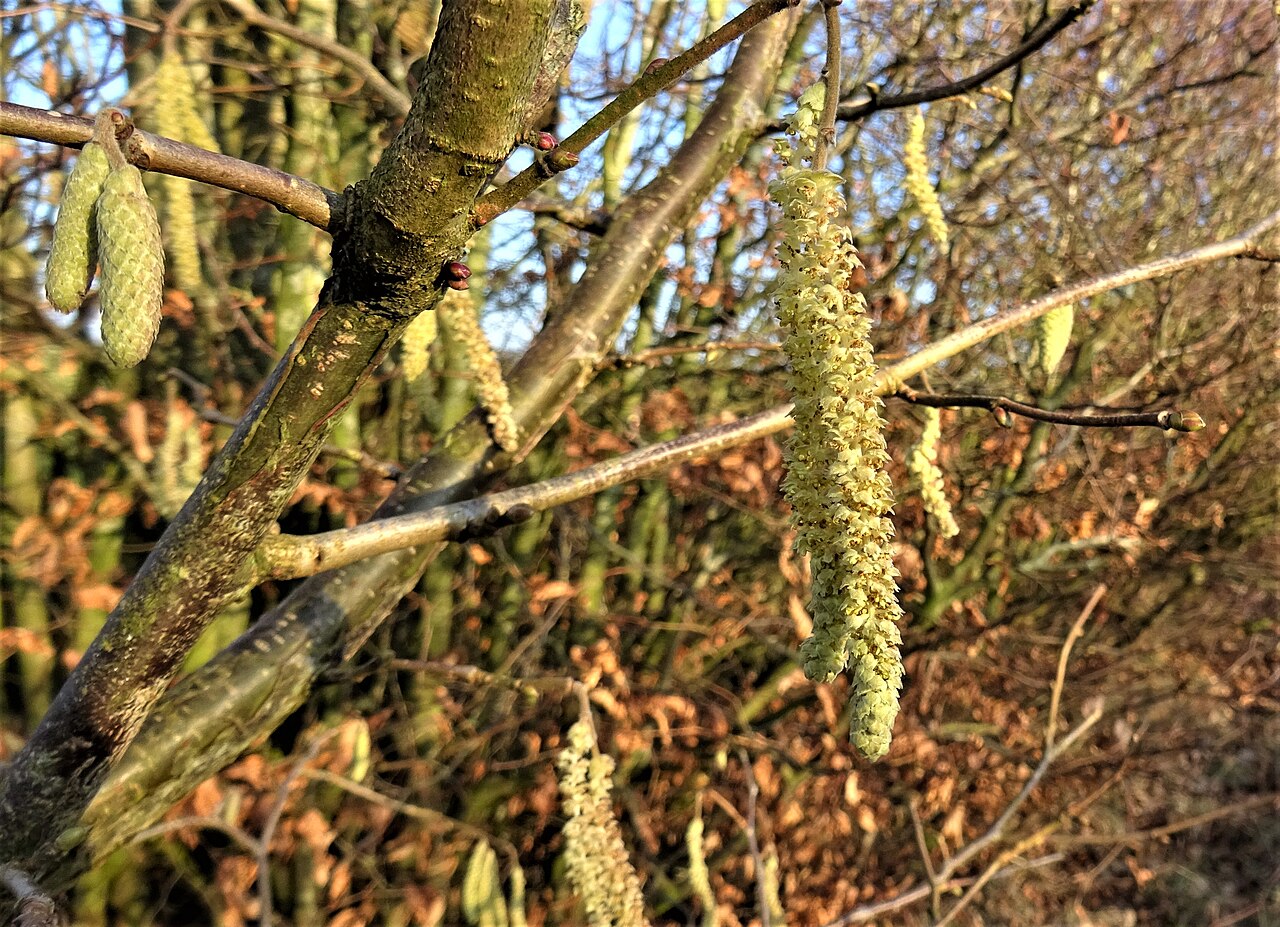
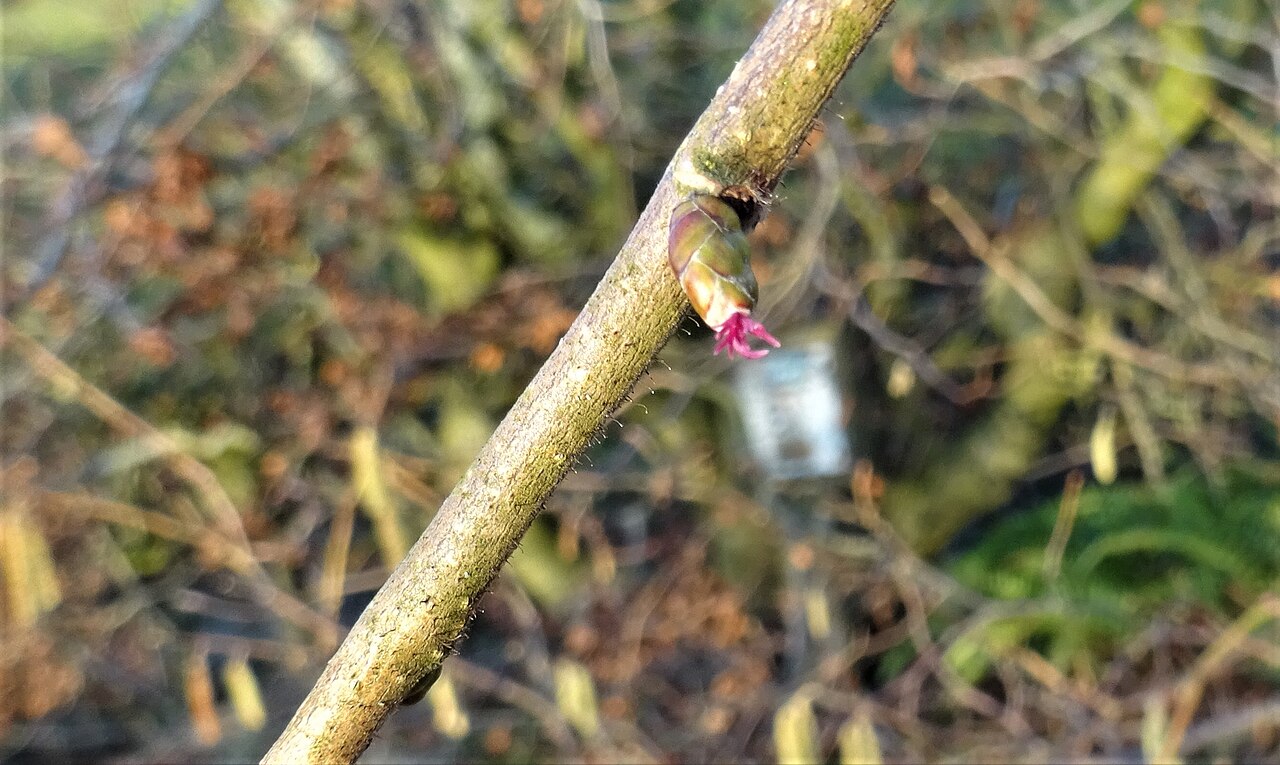
Hazelnut is monoecious, but with separate male and female flowers on the same plant: male flowers are catkins (aments), and female flowers are tiny bud-like structures with red stigmas. It is wind-pollinated (anemophily) and blooms very early and for a long time — in our conditions, from December to February. A peculiarity is that it takes up to four months from pollination to actual fertilization: pollen arriving on the stigma in January only results in kernel fertilization from mid-May to early June.
This leads to two conditions that must be met simultaneously for fruit set:
- Genetic compatibility — the pollen of the pollinizer and the stigma of the main cultivar must not carry the same S-alleles (see below).
- Bloom time synchronization — the period of pollen shedding (male bloom) of the pollinizer must overlap with the receptivity period of the stigmas (female bloom) of the main cultivar, which lasts two to three weeks.
If only one condition is met, fertilization will not occur. Therefore, pollinizer planning is always guided by both axes: S-alleles and bloom phenology.
Genetics of incompatibility and S-alleles
Sporophytic self-incompatibility system
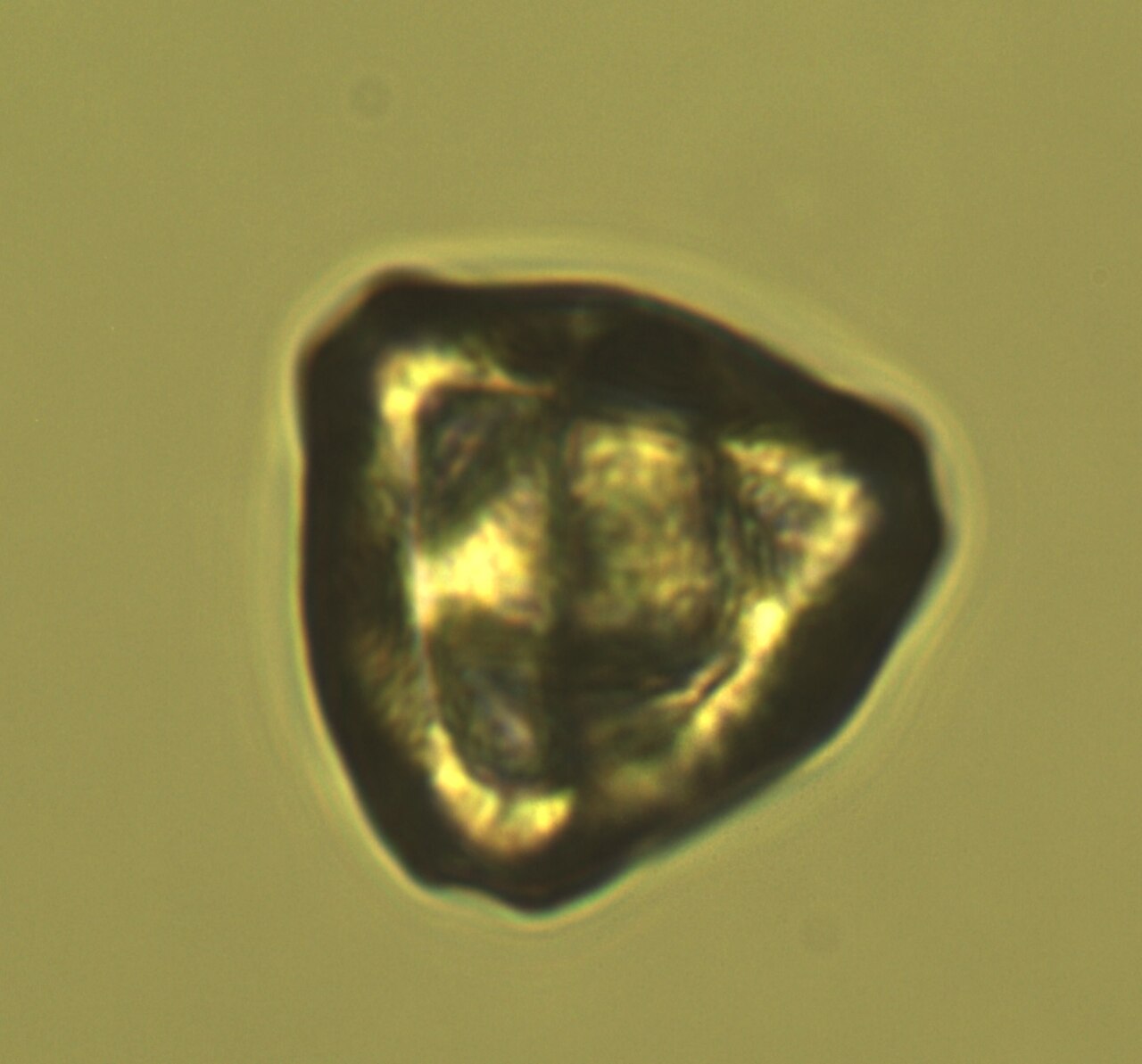
In hazelnut, sporophytic self-incompatibility (SSI) operates, controlled by a single gene locus (S-locus) with a large number of alleles. "Sporophytic" means that the behavior of the pollen grain is not determined by its own (gametophytic) genotype, but by the genotype of the parent plant that produced the pollen — i.e., both S-alleles of the paternal plant are expressed in the pollen via the anther tapetum.
The reaction mechanism occurs on the surface of the stigma: if an S-allele found on the stigma is already present in the stigma tissue, the pollen does not germinate or its growth is arrested, so fertilization does not occur. The rule is often summarized as follows:
If "like meets like" — the reaction is incompatible.
Dominance and reciprocal differences
Hazelnut is diploid, and almost all cultivars are heterozygous at the S-locus (carrying two different alleles, e.g., S1S3). A key feature of the sporophytic system is dominance among alleles: in the stigma, both alleles are usually expressed, but in the pollen, often only one (the dominant) is expressed. This leads to reciprocal (asymmetric) differences — the combination of cultivars A × B may be compatible in one direction, but incompatible in the reverse.
Practical consequence: the pollinizer must pollinate the main cultivar, but for a stable orchard, it is desirable that the relationship is mutual (cross-fertility) — because the pollinizer also needs to produce a crop and must be pollinated by others. This is why at least three mutually compatible cultivars are planted in an orchard, not just two.
Example from literature (offspring of TGL × Cosford): genotypes with alleles S3S7 fertilize TGL (S2S7), but cannot fertilize themselves — a classic case of reciprocal difference. Mutual compatibility exists, however, between Cosford and offspring with alleles S2S11 and S7S11.
How many S-alleles are there and how are they distributed?
In European hazelnuts, about 33 alleles at the S-locus have been described to date, and for each, there is a reference "pollen tester" for laboratory determination. Compatibility can be determined in less than 24 hours using fluorescence microscopy of pollen germination on the stigma.
Alleles are not evenly distributed — the most common allele differs by geographical groups of cultivars:
| Geographical group of cultivars | Most common S-allele |
|---|---|
| Spanish-Italian | S2 |
| Central European | S5 |
| English | S3 |
| Black Sea (Turkish cultivars) | S4 |
This distribution has practical value: combining cultivars from different geographical groups reduces the likelihood of sharing the same allele, thus increasing the chances of compatibility. However, this is no guarantee — the decision must always be confirmed by the specific genotype of the cultivar.
Illustration of compatibility logic
For a cultivar with genotype S1S2, the following applies (example from literature, simplified to show dominance):
| Pollinizer Genotype | Reaction with S1S2 |
|---|---|
| S1S4, S1S5, S2S3, S2S4, S2S5 | 100% incompatible (shared allele) |
| S3S4, S3S5 | compatible (no shared allele) |
The message is clear: it is sufficient for the pollinizer to share one S-allele with the main cultivar (with appropriate dominance) for the combination to fail. Therefore, pollinizers are selected from published S-genotype lists, not "by eye."
Cultivar compatibility tables and practical selection
Compatibility Index (IPI)
In addition to determining S-alleles, compatibility is also expressed quantitatively in practice, e.g., by the pollination index (IPI), which describes how well a pollinizer fertilizes the main cultivar. Example values from a study of Turkish cultivars:
| IPI Value | Interpretation |
|---|---|
| ≥ ~1.0 | fully compatible |
| ~0.3 – ~1.0 | partially compatible |
| ≤ ~0.15 | incompatible |
Thus, for example, in that study, for the main cultivar Tombul, the pollinizer Çakıldak was rated as fully compatible (IPI ≈ 1.87), while Kalınkara was incompatible (IPI ≈ 0.10). These figures are informative and apply to the conditions in which they were measured.
Recommended pollinizers for cultivars common in Croatia and the region
The following table summarizes recommendations from literature and advisory practice. It serves as a starting point — when purchasing specific seedlings, request confirmation of the S-genotype and local recommendations from the nursery.
| Main Cultivar | Status | Good Pollinizers (from literature) |
|---|---|---|
| Rimski (Tonda Gentile Romana) | self-incompatible | Pijemontski, Tonda di Giffoni, Mortadella, Nocchione |
| Pijemontski (Tonda Gentile delle Langhe) | self-incompatible | Tonda Gentile Romana, Negret, Cosford, Cutard, Mortadella, Nocchione |
| Tonda di Giffoni | self-incompatible | Tonda Gentile Romana, Pijemontski, Mortadella, Nocchione |
| Istarski duguljasti | self-incompatible | Rimski (Rimski is a good pollinizer for most cultivars) |
| Tonda Gentile (generally) | self-incompatible | min. 2 pollinizers with different bloom periods (e.g., one medium-early: Pauetet/Camponica; one medium-late: Tonda Romana/Nocchione) |
For North American cultivars, the same principle applies: e.g., 'Santiam' is not compatible with pollinizers whose pollen expresses S3 or S15 (Willamette S1S3, Lewis S3S8, Hall's Giant S5S15, Delta S1S15) — an example of how the list of "unacceptable" pollinizers is derived directly from the S-genotype.
Autofertile cultivars
There are also autofertile (self-fertile) cultivars that can be grown in pure stands. However, literature records higher and more stable yields in combinations of multiple cultivars, so pollinizers are recommended even in these cases.
Bloom time synchronization (phenology)
Genetic compatibility is necessary, but not sufficient. Pollen from the pollinizer must be available exactly while the stigmas of the main cultivar are receptive. Therefore, the following rules apply:
- Do not plant cultivars that bloom simultaneously as the only pair — a difference in bloom time of up to ~2 weeks is desirable to cover the entire female bloom period of the main cultivar.
- For safety, use at least 2–3 pollinizers with different pollen shedding periods (early / medium / late), thereby covering variability between years.
- Hazelnut blooms very early (already late February in some years), when there is a risk of frost. Distributing bloom over multiple timings reduces the risk that a single frost wave "hits" the entire bloom.
Croatian example of good practice: pair Rimski (main) + Istarski duguljasti (pollinizer). Rimski blooms earlier and is more exposed to frost, while Istarski starts blooming slightly later — when Rimski is in full bloom, Istarski is just starting, thereby extending the pollination period and increasing yield.
| Phase | Period (orientational, HR) |
|---|---|
| Bloom and pollination | December – February |
| Fertilization | Mid-May – early June |
| Fruit growth and development | June – July |
| Kernel growth | July – August |
| Ripening | August – September |
Note: The most favorable temperatures during fertilization are above ~22 °C; at lower temperatures, increased fruit drop occurs due to poorer fertilization.
Pollinizer Proportion and Layout in the Orchard
How many pollinizers?
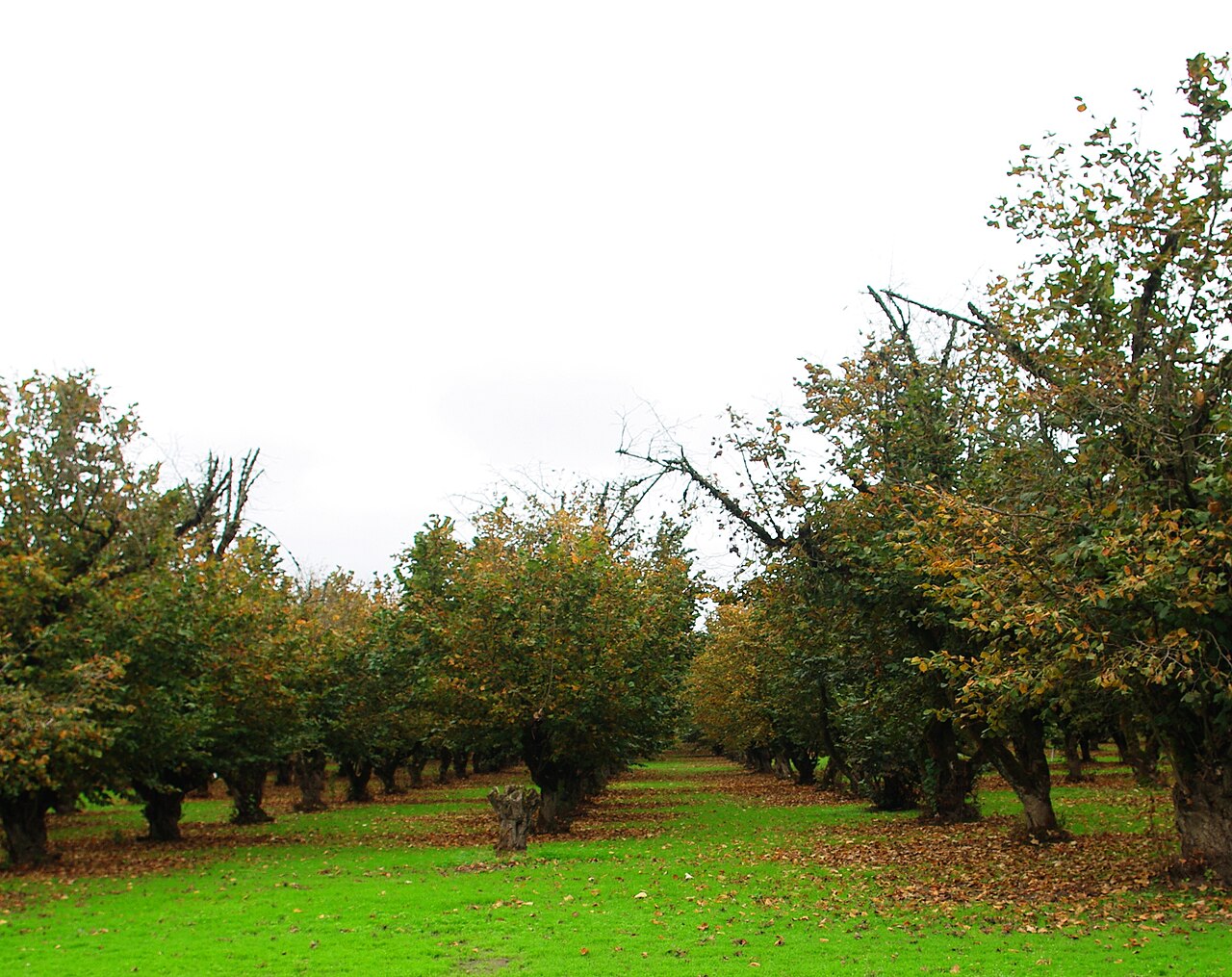
Recommendations from literature and practice vary depending on the training system, but generally fall within the following ranges:
| Source / Practice | Recommended Pollinizer Proportion |
|---|---|
| Spanish practice (book "Hazelnut Production") | no more than 25% of the area |
| North American practice (nurseries) | ~8% of new trees |
| Classic layout (OSU, low density) | every 3rd tree in every 3rd row (3×3) ≈ 11% |
| Typical orchard composition (HR practice) | 1–2 main cultivars + 2–3 pollinizer cultivars |
A specific Croatian example from an orchard plan (Grubišno Polje): cultivars Rimski : Istarski duguljasti in a ratio of 80% : 20%, density 500 seedlings/ha, spacing 5 m between rows × 4 m within rows.
When a natural pollen source is nearby (e.g., wild hazelnut adjacent to the orchard or a hedgerow), the proportion of cultivar pollinizers can be moderately reduced — literature mentions a reduction of one order of magnitude to 6–8% of the total number of plants in such cases. However, one should not rely entirely on this.
Where and how to layout pollinizers?
The key is that pollen is physically accessible to every part of the orchard. Wind can carry pollen for up to a kilometer, but significantly better results are achieved when pollinizers are close:
- Pollinizer spacing of ~30 m (from the book "Hazelnut Production"); North American experience notes a drop in nut set when the distance exceeds ~15 m (50 ft) from the nearest pollinizer.
- Do not plant pollinizers in separate, compact rows — they should be distributed throughout the entire orchard (diagonally, alternating by rows, or in a regular pattern).
- Orient the layout according to the direction of the dominant (winter) wind during the flowering period — one row of pollinizers every ~20 rows, placed perpendicular to the wind carrying pollen toward the main cultivar, is a common pattern.
- Consider harvest and machinery operations: if cultivars ripen at different times, the layout must allow for practical harvesting (which is why pollinizers are sometimes grouped in recognizable positions, compromising with uniform pollination).
Example layout (indicative)
For an orchard with one main cultivar at a spacing of 5 × 4 m, the common pattern "every 3rd tree in every 3rd row" yields about 11% pollinizers with very uniform coverage. If using multiple pollinizers, alternate them so that every part of the orchard has access to at least one pollinizer during each flowering period.
Practical Recommendations and Common Mistakes
Recommendations:
- Plan pollinizers before planting — later "insertion" of pollinizers into a mature orchard is expensive and slow (hazelnut bears fruit late).
- Request the S-genotype of each cultivar from the nursery and verify it against published lists; do not rely solely on the cultivar name (synonyms and labeling errors exist).
- Use at least 3 cultivars that are mutually compatible and cover early/mid/late flowering periods.
- Align pollinizers with the climatic conditions of the site (frost, exposure), not just the main cultivar.
- Verify that selected cultivars and pollinizers are on the lists of permitted/recommended cultivars and comply with current regulations and incentive schemes (advisory service, official sources).
Common Mistakes:
- Monocultivar orchard of a self-incompatible cultivar → lack of yield.
- Selection of a pollinizer that shares the S-allele with the main cultivar (the combination "looks good" but is genetically incompatible).
- Pollinizer with good genetics, but incorrect phenology (flowers too early/late for the female flowering of the main cultivar).
- Insufficient proportion or poor layout of pollinizers (all in one corner/row) → unfertilized parts of the orchard.
- Relying solely on wild hazelnut in the vicinity without cultivar pollinizers.
- Neglecting reciprocal differences — assuming "compatible in both directions" when it is not.
Sources
This article is an AI summary compiled from an internal collection of hazelnut literature (RAG corpus) and publicly available sources. Figures and recommendations are informative and depend on the cultivar, location, and applicable regulations. Main sources used:
- Pollen incompatibility in Portuguese hazelnut landraces — ISRN / Hindawi (2012) — https://www.hindawi.com/journals/isrn/2012/154723/
- Mehmedi et al., S-alleles and compatibility in progeny of TGL × Cosford — International Journal of Agriculture & Biology (2004)
- Çakıldak/Tombul et al., pollination indices (IPI/IS) — Turkish Journal of Food and Agriculture Sciences (2019)
- Meyve Ağaçlarında Uyuşmazlık ve Mekanizması (sporophytic incompatibility, example S1S2) (2015)
- Santiam Hazelnut, EM 8890-E — Oregon State University Extension Service (2005)
- Geographic Distribution of Incompatibility Alleles in European Hazelnut — J. Amer. Soc. Hort. Sci. 139(2) (2014) — https://journals.ashs.org/jashs/view/journals/jashs/139/2/article-p191.xml
- Growing Hazelnuts in the Pacific Northwest: Pollination & Orchard Design — OSU Extension (EM 9074, EM 9077) — https://extension.oregonstate.edu/catalog/em-9077-growing-hazelnuts-pacific-northwest-orchard-design
- Pollinizers — Province of British Columbia, Hazelnut Orchard Design — https://www2.gov.bc.ca/gov/content/industry/agriculture-seafood/agriservice-bc/production-guides/hazelnuts/hazelnut-orchard-design/pollinizers
- GUIDE FOR hazelnut production — Ministry of Agriculture of the Republic of Croatia / advisory service (2024)
- Environmental Protection Plan – Establishment of a permanent hazelnut and plum orchard, Grubišno Polje — Mundo Melius d.o.o. (2020)
- Good hazelnut yield depends on good pollination (overview of pollinizers by cultivar) (2015)
- "Hazelnut Production" (book) — pollinizer proportion and layout (2017)
- Our country and Italian hazelnut together — wealth of BiH (selection and layout of pollinizers)
- State and trends in hazelnut production and consumption (2017); Phenology of flowering of hazelnut cultivars "Istarski duguljasti" and "Römische Zellernuss" (2023)