Annual Operational Costs of Hazelnut Orchards by Growth Stage
Research-grounded draft (sources cited) — adapt to local context
Article adapted to the United States (Oregon), based on Croatian/EU research literature (see Sources). Figures come from the cited studies and are indicative for the United States (Oregon): verify local equivalents with USDA, FSA, state Departments of Agriculture (e.g. Oregon), OSU Extension, Oregon Hazelnut Commission.
Operational (current) costs for maintaining a hazelnut orchard are the annual expenses a producer incurs to keep the orchard growing, healthy, and productive — from fertilization and protection, through pruning, soil maintenance, and irrigation, to labor, fuel, and energy. Unlike one-time establishment costs (soil preparation, seedlings, fencing, irrigation systems), operational costs repeat every year, but their structure and magnitude change significantly with the orchard phase: in the early years, care and protection dominate with no income, and only at full maturity do operational costs stabilize and the orchard begin to "pay back" the investment.
This article breaks down these costs by year and by item, relying on Croatian/EU calculations and international comparisons, to help you realistically plan the cash flow of your orchard. Note: All figures below are derived from Croatian/EU sources [1]–[7]. For United States/Oregon application, verify local equivalents for labor rates, input costs, and yields.
Cost Logic by Orchard Phase
Hazelnuts are a perennial crop with a long "waiting period." A clear timeline emerges from the data:
- Years 1–3 (Establishment and Young Orchard Care): Production generates no income (except potential subsidies). Costs are almost exclusively investment in care: replanting, shaping, weed control, pest/disease protection, and basic fertilization.
- Years 4–6 (Entering Production): First fruits appear around the fourth year; costs rise as harvesting, drying, and more intensive pruning begin, but yields are not yet full.
- From ~Year 7 (Full Maturity): The orchard is in full production, yields can reach 3–4 t/ha (conservative calculations often use 2 t/ha), and operational costs stabilize at an annual level.
This dynamic has a key consequence for cash flow: according to one Croatian analysis, in the first year after planting, costs per hectare exceeded income by 1,641.48 kn, with subsidies covering 82.59% of total costs that year. It is not until the sixth year that the same calculation shows a positive difference (surplus) of 5,301.25 kn/ha [1].
Note on Currencies and Periods
Croatian sources in the corpus are expressed partly in Kuna (kn) (calculations up to 2022) and partly in Euros (€) (newer works). For orientation, the fixed conversion rate is 7.5345 kn = 1 €. Figures from different years and sources are not directly comparable (inflation, energy prices, varieties, mechanization) and serve as orders of magnitude, not as current price lists. For US/Oregon planning, convert these estimates to USD and verify against local input costs.
Operational Costs by Year (Young Orchard)
In the period before full maturity, the largest share of cost falls to care and protection without income. From one organic calculation for the first three years of business, the structure looks like this (per hectare, originally in kn):
| Item (Avg. Years 1–3) | Amount (kn) | Share |
|---|---|---|
| Wages (Labor) | 6,110.00 | 18.3% |
| Other costs (mechanization, drying, fencing, depreciation, insurance, utilities) | 6,000.00 | 18.0% |
| Fuel and lubricants | 950.00 | 2.8% |
| Pruning | 850.00 | 2.6% |
| Mechanical harvesting | 340.00 | 1.0% |
| Jute/PVC bags | ~290.00 | <1% |
| Organic certificate + inspection | ~500.00 | ~1.5% |
| Total (3 years) | 33,394.00 | 100% |
From the same analysis: costs are highest in the first year, then drop in the second and third. In the total structure, the largest cost is seedling acquisition, followed by mineral fertilizer — but these are predominantly establishment costs, not operational. Some costs (harvesting, pruning, drying) appear only from the third year, when the orchard begins to bear fruit [2].
Another source gives "investment needs" for a young orchard with clearly separated labor:
| Item (Year 1, Young Orchard) | Quantity / Price | Amount |
|---|---|---|
| Material and equipment | — | 2,323.50 € |
| Tractor labor hour | 57 h × 16 € | 912.00 € |
| Human labor hour | 277 h × 2 € | 554.00 € |
A third calculation for the 3rd year of the orchard lists material at 699.00 €, tractor labor at 816.00 €, and human labor at 630.00 €, with a cumulative total for years 1–5 of approximately 6,463.50 €/ha [3], [4]. In other words, five years of maintaining a young orchard easily exceeds 6,000 €/ha before the orchard enters full production.
Practical Lesson for Young Orchards
In the first few years, the most expensive "unproductive" cost is labor — shaping, sucker removal, and weed suppression. Savings are greatest with family labor: one calculation notes that "no hired labor was used, but family members worked on it," which significantly reduces cash outlays.
Operational Costs at Full Maturity
When the orchard enters full production (≈Year 7), a representative annual calculation appears. The most detailed in the corpus is an analytical calculation of conventional cultivation in the 6th vegetative year (Lipovac location), which simultaneously gives labor hours per operation and monetary items:
Labor by Operation (Hours per Hectare)
| Operation | Worker Hours/ha | Machine Hours/ha |
|---|---|---|
| Soil maintenance (mulching) | 5 | 5 |
| Pruning and branch removal | 16 | 4 |
| Fertilization | 6 | 6 |
| Calcification | 1 | 1 |
| Pesticide spraying | 8 | 8 |
| Herbicide spraying | 2 | 2 |
| Combine harvesting | 10 | 8 |
| Organization | 5 | — |
| Annual leave / sick leave | 5 | — |
| Total | 58 h | 34 h |
Labor price in that calculation: 30.00 kn/h for human labor and 65.00 kn/h for machinery.
Monetary Items (Year 6, kn/ha)
| Item | Amount (kn) |
|---|---|
| Protection (chemicals) | 3,200.00 |
| Fertilizers | 2,300.00 |
| Machine labor | 2,210.00 |
| Worker labor | 1,740.00 |
| Other (consumables) | 572.04 |
| Operational costs | 500.00 |
| Management | 500.00 |
| Service | 500.00 |
| Depreciation | 800.00 |
| Interest | 100.00 |
| Total Costs | 12,422.04 |
| Income from subsidies | 2,323.29 |
| Income from sales (1,100 kg × 14 kn) | 15,400.00 |
| Difference (Profit) | +5,301.25 |
It is visible that in a productive orchard, protection and fertilization together make up nearly half of the non-material costs, and labor (human + machine) adds another ~4,000 kn/ha.
Second Calculation (Continental Conditions, 1 ha)
An independent calculation for a productive orchard (yield 2,000 kg/ha, price 11 kn/kg) breaks down variable costs as follows:
| Variable Item | Amount (kn/ha) |
|---|---|
| Harvesting cost | 5,714.29 |
| Protection cost | 3,218.44 |
| Own mechanization costs | 2,463.14 |
| Pruning cost | 1,800.00 |
| Mineral fertilizer cost | 1,360.82 |
| Other costs (and drying) | 1,000.00 |
| Replanting cost | 150.00 |
| Bags (PVC) | 100.00 |
| Total Variable Cost | 15,806.69 |
| Total Income (2 t × 11 kn) | 22,000.00 |
| Profit | 6,193.31 |
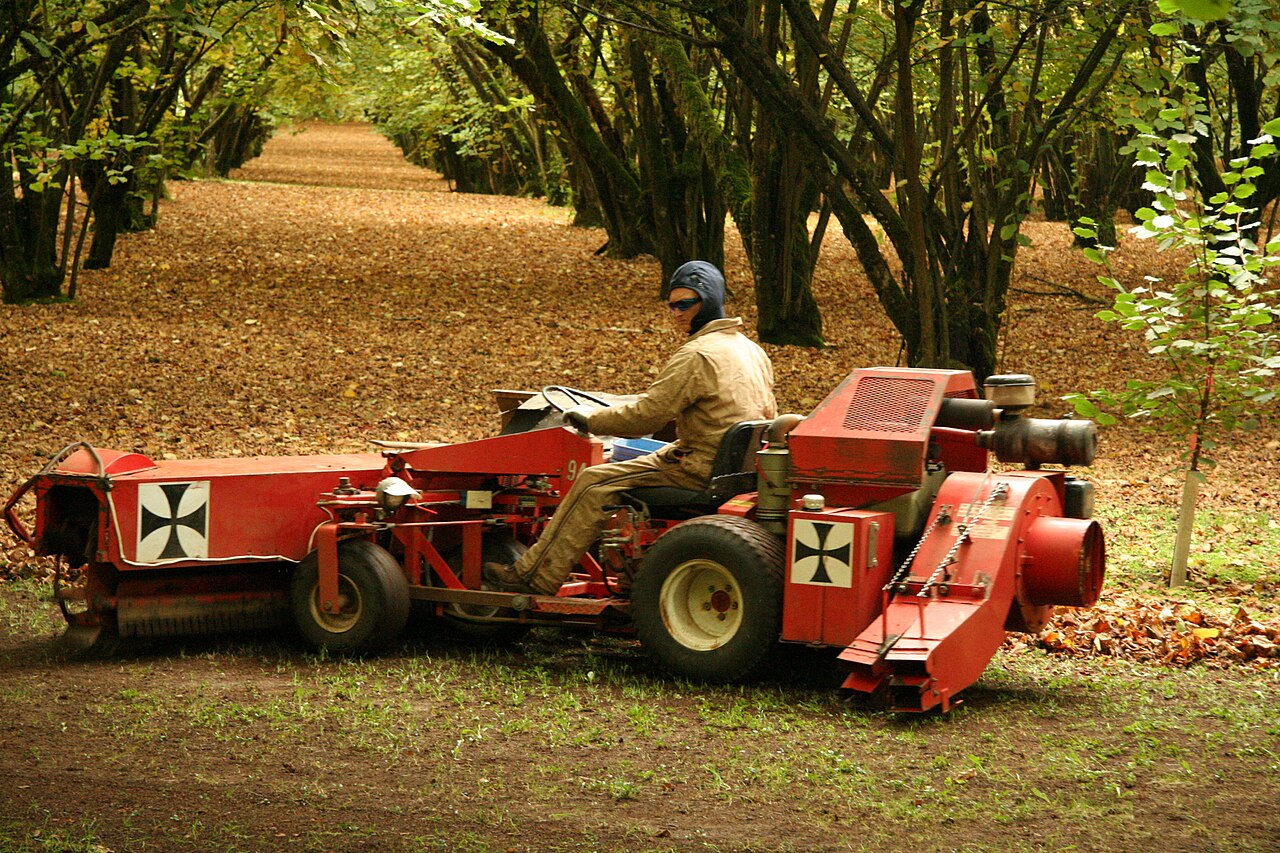
This calculation confirms a repeated finding in the corpus: harvesting is the largest single variable cost of a productive orchard (approximately one-third of variable costs), which is why mechanized harvesting is crucial for profitability. It is explicitly stated: manual harvesting is "slow and very expensive" — one worker collects ~20 kg of fruit in 8 hours, which "burdens total income by 15 to 20%," while machine sweepers (shakers + vacuums) significantly reduce the cost per kilogram [1], [5].
Operational Cost Items Up Close
Fertilization
Fertilization depends on the phase and soil analysis. From the corpus:
- First four years (with previous ameliorative fertilization with phosphorus and potassium), hazelnuts are fertilized only with nitrogen in early spring: about 0.5 kg KAN (27%) per bush in the first year, 0.6 kg in the second, 0.8 kg in the third, and 1 kg in the fourth year.
- From year 4 to 8, the system switches to complex NPK fertilizers + KAN over the entire area: orientationally ~20 kg P/ha and ~150 kg K/ha (NPK in autumn) and ~100 kg N/ha (≈350 kg/ha KAN) in spring.
- In a productive orchard, fertilizer cost in calculations amounts to ~1,360–2,300 kn/ha annually, and in one expense review of a business, artificial fertilizer amounted to 7,652 kn gross (at the business level, not per ha).
Doses are informative — actual fertilization must be based on soil analysis and recommendations. Labor cost for fertilization is relatively low (≈6 hours of worker + 6 hours of machine per hectare in a productive orchard).
Protection (from Diseases, Pests, and Weeds)
Protection is one of the two largest operational items. In a productive orchard, the cost of chemicals amounts to ~3,200–3,218 kn/ha annually (conventional). Labor: ≈8 hours of worker + 8 hours of machine for pesticide spraying and ≈2+2 hours for herbicides.
For an organic orchard, one elaboration lists orientation doses (per ha): Neoram 2 kg, NeemAzal 2 × 0.5 l, Cocana 2.5 l, Myco Sin 1 kg. Herbicide maintenance usually boils down to a strip under the bushes (~30% of inter-row width), while the inter-row space is maintained as mowed grass.
Chemicals and Doses Depend on Registration
Plant protection products may only be applied according to valid registration/label and recorded in the pesticide use list. Lists and doses from literature are illustrative and may be outdated — check current permits before purchase and application.
Pruning
Pruning is labor-intensive but cheap in terms of materials. In a productive orchard, it requires ~16 hours of worker + ~4 hours of machine per hectare (pruning and branch removal/disposal), and is monetarily estimated at ~850–1,800 kn/ha annually, depending on intensity and whether it is done by own or hired labor. Pruning is regularly accompanied by removal of root suckers, especially in young years.
Irrigation and Water
Investment in an irrigation system is a one-time establishment cost; operationally, it appears as water + energy (electricity/fuel) for pumping. Specific amounts are small relative to protection and harvesting — in one business, water was 473 kn, and in an elaboration, 15,000 kWh/year of electricity was planned for cooler operation. An orientation irrigation norm in one source is up to ~5,000 m³/ha annually. Water and energy costs rise in dry years and on permeable soils.
Labor and Energy (Fuel, Electricity)
Labor, viewed over the entire lifespan, is the largest cumulative item. In a productive orchard, total annual engagement is ~58 hours of human and ~34 hours of machine labor per hectare for all operations combined. Energy:
- Fuel: in a productive orchard ~950 kn/ha annually; one elaboration plans 5,000 l/year for ~500 hours of tractor work (at the farm level).
- Electricity: mainly for post-harvest/drying and cooling (e.g., 15,000 kWh/year).
At the level of the entire business (with post-harvest and larger mechanization), the expense structure looked like this (orientation, kn):
| Expense (Business Level) | Gross (kn) |
|---|---|
| Depreciation | 83,940 |
| Other costs (utilities, interest, consumables…) | 69,580 |
| Worker wages | 52,235 |
| Contributions of OPG owner | 23,270 |
| Protection agents | 22,422 |
| Insurance (frost, hail, wind) | 15,405 |
| Mechanization maintenance | 7,666 |
| Artificial fertilizer | 7,652 |
| Fuel | 6,061 |
| Electricity | 2,993 |
| Water | 473 |
This is an example of a large, mechanized business with post-harvest processing — it shows that in such systems, depreciation, labor, and "other costs" dominate, while fertilization and water are relatively small items.
Fixed vs. Variable Costs
For planning, it is useful to separate:
- Variable Costs (grow with yield/activity): fertilizers, protection agents, fuel, harvesting, drying, bags, replanting, seasonal labor. In the Croatian calculation, total variable cost of a productive orchard ≈ 15,800 kn/ha.
- Fixed Costs (exist regardless of yield): depreciation of equipment and systems, orchard insurance, registration and maintenance of mechanization, loan interest, management/utilities, contributions.
In a young, non-productive orchard, fixed costs dominate (equipment exists, no income). At full maturity, variable costs grow (especially harvesting), but are covered by income.
The Big Picture: Annual Maintenance Cost
In summary, according to the corpus and international comparisons:
| Orchard Phase | Annual Operational Cost (Orientation) | Income |
|---|---|---|
| Years 1–3 (Young Orchard) | Low cash outlay for labor/protection; Cumulative Years 1–5 ≈ 6,000–6,500 €/ha | None (subsidies only) |
| Years 4–6 (Entering Production) | Rising (harvesting, drying, intensive pruning begin) | Partial, positive difference possible from ~Year 6 |
| From Year 7 (Full Maturity) | ≈ 12,400–15,800 kn/ha (conventional, depending on included items) | ≈ 22,000 kn/ha at 2 t × 11 kn |
One broader source estimates that for an orchard ~10 years old with a yield of 10 t, all business costs (tractor registration and maintenance, protection agents, fertilizers, fuel, etc.) reach ~60,000 kn, with income ~100,000 kn (10 kn/kg) — with the note that "annual cultivation costs of hazelnuts are low compared to other fruit crops" [7].
International Comparison (Orientation): Canadian (Fraser Valley) and American (Oregon) sources indicate total annual operational costs for a productive orchard on the order of ~$1,800–2,750 per acre, with labor ~$1,000/acre and fertilization+protection ~$300/acre — confirming that labor and harvesting are dominant items outside Croatia as well [6]. Note: US/Oregon specific subsidy program names and amounts are not provided in the sources; verify local equivalents.
Practical Recommendations and Common Mistakes
- Plan cash flow 6–7 years in advance. The biggest mistake is underestimating the "income-free period": five years of maintaining a young orchard easily requires 6,000+ €/ha just for care and protection.
- Utilize subsidies. In observed examples, subsidies covered over 80% of first-year costs. Check current measures (production-linked support for fruit; organic measures — e.g., EKOP/EKO for perennial plantations). Note: the same surface cannot simultaneously use an organic measure and production-linked support for fruit.
- Mechanize harvesting as soon as scale justifies it. Harvesting is the largest variable cost; manual harvesting "eats" 15–20% of income. Shaker + sweeper drastically reduces cost per kilogram.
- Fertilize by soil analysis, not "by feel." Overdosing nitrogen is wasted money and risk; doses from literature are only a starting point.
- Do not forget fixed costs. Depreciation, frost/hail insurance, and interest are often omitted from "home" calculations but constitute a large part of expenses in mechanized farms.
- Keep records by operation. Tracking labor hours and chemical usage per treatment is the only way to know where you are really spending and where you can save.
Sources
- VANJSKOTRGOVINSKA RAZMJENA I EKONOMIČNOST PROIZVODNJE LJEŠNJAKA (2014)
- Ekonomska isplativost proizvodnje lješnjaka (2022)
- Bolesti i štetnici lijeske (2020)
- Bolesti i štetnici lijeske (2020)
- PDF EKONOMSKA USPOREDBA RAZLI ITIH SUS 7e28c0da (2015)
- Orchard Economics: The Costs and Returns of Establishing and Producing Hazelnuts in the Willamette Valley (2008)
- gap harvest Stanje I Tendencije Proizvodnje I Potro 9ae51e3d (2017)