Boron, Zinc, and Other Micronutrients in Hazelnut Nutrition
Content generated by artificial intelligence — verify before application
This article was automatically compiled from a collection of hazelnut literature with the aid of artificial intelligence and may contain errors or outdated data. It serves as a starting point for further research, not as professional advice. Dosages, products, and timing are informative and depend on the cultivar, location, and applicable regulations — always consult with an advisory service and official sources before application.
Hazelnuts consume micronutrients (boron, zinc, iron, manganese, copper, and molybdenum) in very small quantities, but they are just as critical for yield and fruit quality as macronutrients (nitrogen, phosphorus, potassium). Precisely because their requirements are low, deficiencies are easily overlooked — and the consequences (poor pollination, empty shells, "hollow" hazelnuts, stunted growth, chlorotic foliage) directly impact the quantity and market value of the crop. This article explains the role of key micronutrients in hazelnut nutrition, how to recognize deficiency symptoms, and how to effectively correct them through foliar feeding, with a focus on boron and zinc, which are the most common limiting factors in hazelnut production.
Why Micronutrients and Why Foliar Application?
Hazelnuts thrive best on soils with neutral to slightly acidic reaction (pH approximately 5.0–7.5). The problem is that on alkaline (calcareous, carbonate) soils, many micronutrients — iron, manganese, boron, zinc — are chemically "locked up": there is enough of them physically, but they are in forms that the roots cannot uptake. In such cases, soil analysis may show adequate quantities, yet the plant still suffers from deficiency.
Therefore, for micronutrients, foliar feeding is often more effective and faster than soil fertilization:
- nutrients go directly into the leaf, bypassing the blockage in the soil;
- utilization efficiency is significantly higher — for zinc, a ratio of up to 1:12 in favor of foliar application compared to root uptake is cited;
- application can be precisely timed to sensitive phenological stages (flowering, pollination, fruit set, kernel growth).
Foliar feeding does not replace balanced fertilization and soil management, but complements it and corrects acute deficiencies at critical moments.
Diagnosis before therapy
The most reliable path is leaf analysis (foliar analysis) combined with soil analysis. Visual symptoms often overlap among elements, and the same symptom can have multiple causes. The dosages listed below are informative and serve as a starting point — make the final decision based on analysis, cultivar, orchard condition, and product label permissions.
Boron (B) — The Element of Pollination and Yield
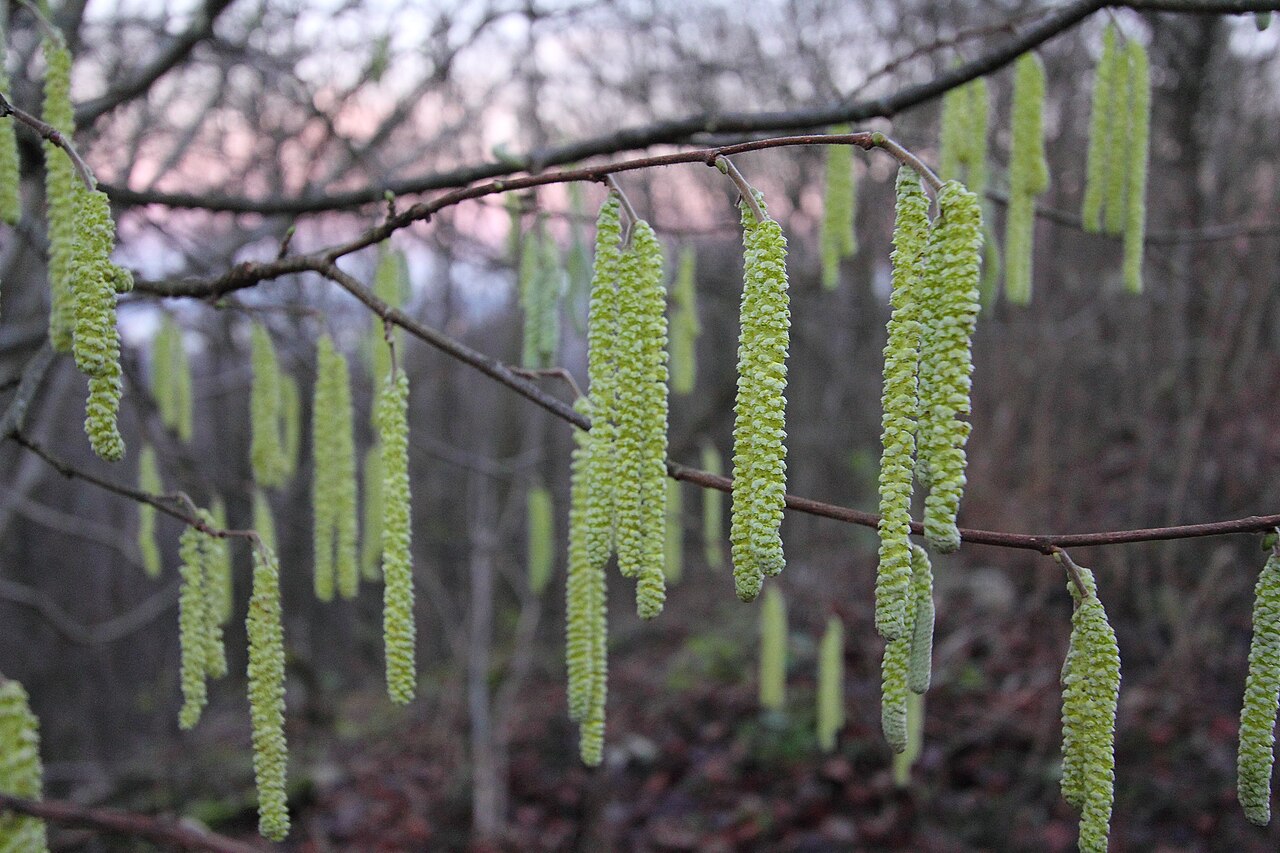
Boron is likely the most important micronutrient for hazelnuts because it directly affects flowering, pollination, and fruit set, which is regularly a limiting factor in hazelnut production.
Role of Boron
- Participates in calcium metabolism and cell wall formation.
- Crucial for pollen viability and pollen tube growth — i.e., for pollination itself.
- Enables sugar transport to growth points; in boron deficiency, sugar accumulates in the leaf but does not reach shoot tips.
- Important for the proper development of the hazelnut kernel.
Hazelnut has an unusually long pollination process: wind pollination occurs in winter (approximately December–March, before leaf-out), but after germination on the stigma, the pollen tube remains dormant, and actual fertilization and fruit development can take several months, until May. Therefore, boron must be ensured in reserve (via autumn feeding) and at the time of fertilization/fruit set (via spring-summer feeding).
Symptoms of Boron Deficiency
- increased flower/catkin drop and poor pollination → higher proportion of empty ("hollow") nuts;
- delayed or irregular flowering, non-functional pollen, abortion (drying) of set flowers;
- dieback of shoot tips (terminal buds) and brittleness of leaves and shoots;
- poorly developed or aborted kernels, smaller and lower-quality nuts.
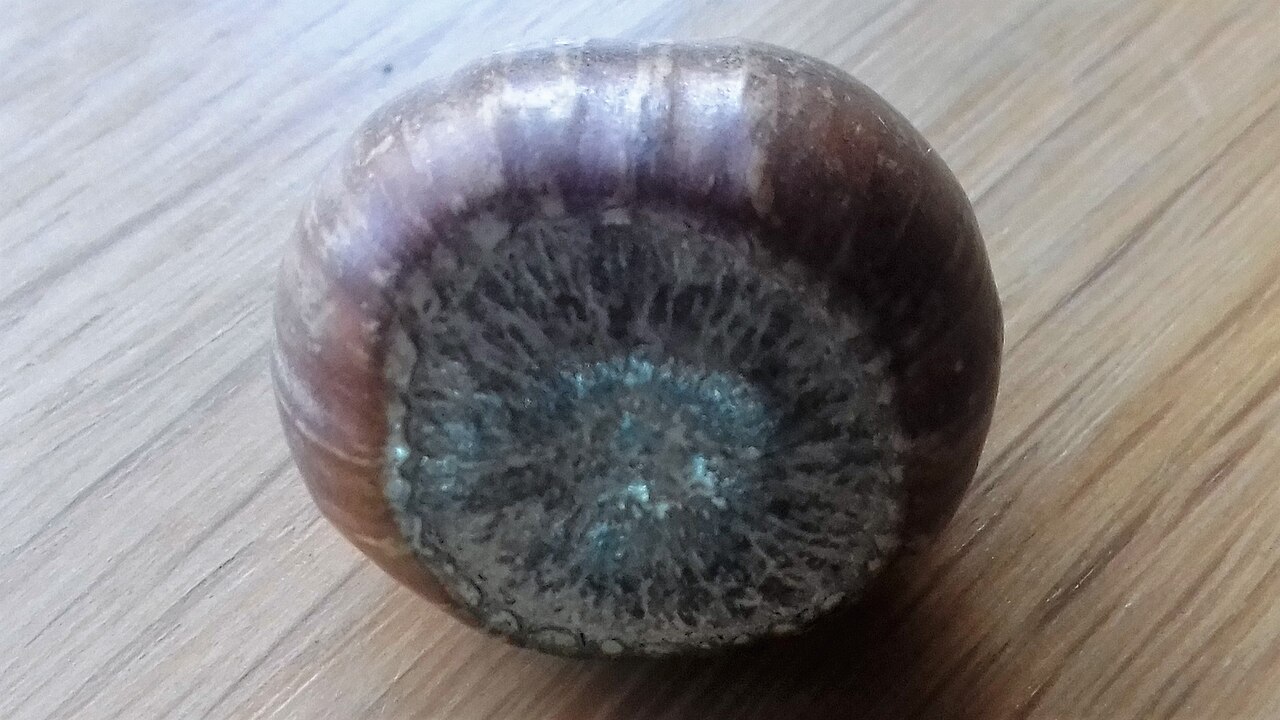
Turkish sources note that boron deficiency increases the proportion of empty nuts and can drop the kernel percentage below 50%. The deficiency threshold in soil is usually set around 0.5 ppm (mg/kg) of available boron.
Dosages and Reference Values for Boron
| Indicator | Reference Value | Note |
|---|---|---|
| Optimal B content in leaf | ~25–30 mg/kg dry matter (for good fruit set) | from scientific literature |
| Lower threshold for application | foliar B < 100 mg/kg d.m. | consider feeding |
| "Stop" limit (overload) | B in leaf ~200 ppm | skip feeding for 1–2 years |
| Liquid B fertilizer (e.g., boron-ethanolamine) | ~1.0 L/ha per treatment | from HR guide for foliar fertilization |
| Summer boron treatments | 1–2 treatments | kernel development |
| Borax (soil, per bush) | ~50–100 g | Turkish recommendation |
Boron has a narrow safety margin
Boron is one of the few elements where the gap between deficiency and toxicity is very small. Even a small excess is as harmful as a deficiency — growth stops. Never exceed the recommended dosage and do not repeat treatments if leaf analysis shows high B (around 200 ppm). It is better to apply less and more frequently than too much at once.
Zinc (Zn) — Growth Hormone and Drought Resistance
Zinc is the second pillar of hazelnut micronutrition, especially important in the fruit growth phase.
Role of Zinc
- Stimulates the synthesis of the natural growth hormone auxin, which manages fruit growth and development.
- Participates in the activity of numerous enzymes.
- Increases plant resistance to drought.
Symptoms of Zinc Deficiency
- interveinal chlorosis (veins remain green), with "mottling" (speckling) of the blade;
- shortening of internodes and accumulation of small leaves in a rosette shape at the shoot tip;
- in severe deficiency, shoot growth stagnation, fewer buds, bud drying without opening;
- stunted and uneven fruit development.
Zinc deficiency typically occurs on carbonate/calcareous soils and in cases of excessive phosphorus fertilization (phosphorus "binds" zinc and reduces its availability).
Dosages and Zinc Form
For foliar feeding of hazelnuts, liquid or micro-granular fertilizers based on Zn-EDTA chelates are recommended — they are well compatible with protection products, quickly absorbed, and easily taken up by the leaf. Zinc is most useful applied in the initial phase of fruit growth.
| Indicator | Reference Value | Note |
|---|---|---|
| Form for foliar application | Zn-EDTA chelate (liquid/micro-granular) | rapid uptake, good compatibility |
| Annual Zn application (approx.) | ~2–5 kg/ha | depending on condition and analysis |
| Foliar vs. root utilization | ratio ~1:12 in favor of leaf |
Boron and Zinc Together — Synergy for Yield
The most convincing argument for the combined application of boron and zinc comes from trials on the European hazelnut cultivar Tonda di Giffoni. Combined spraying of B + Zn at fruit set and early fruit development increased yield and quality even in trees that did not show deficiency:
- tested concentrations: boron 800 and 1,600 mg/L, zinc 400 and 800 mg/L;
- programs: 4 sprays through spring, or 2 early, or 2 late;
- stabilized production increased from ~550 kg/ha (control) to ~1,270 kg/ha with B800 + Zn400 treatment — approximately 2.5 times more;
- the proportion of empty nuts decreased significantly, sometimes almost to zero;
- kernel percentage increased by 10–14% in stronger treatments.
Conclusion from literature: two to four foliar applications of B + Zn in concentration ranges of approximately 500–2,000 mg/L, timed to fruit set and early fruit development, consistently improve set and quality — with late spring applications proving most effective.
Iron (Fe) — Green Leaves and Photosynthesis
Iron is essential for chlorophyll formation and normal photosynthesis. Hazelnut, like other micronutrients, needs small amounts, but on calcareous soils, it is highly susceptible to so-called calcareous (induced) chlorosis.
Symptoms of Iron Deficiency
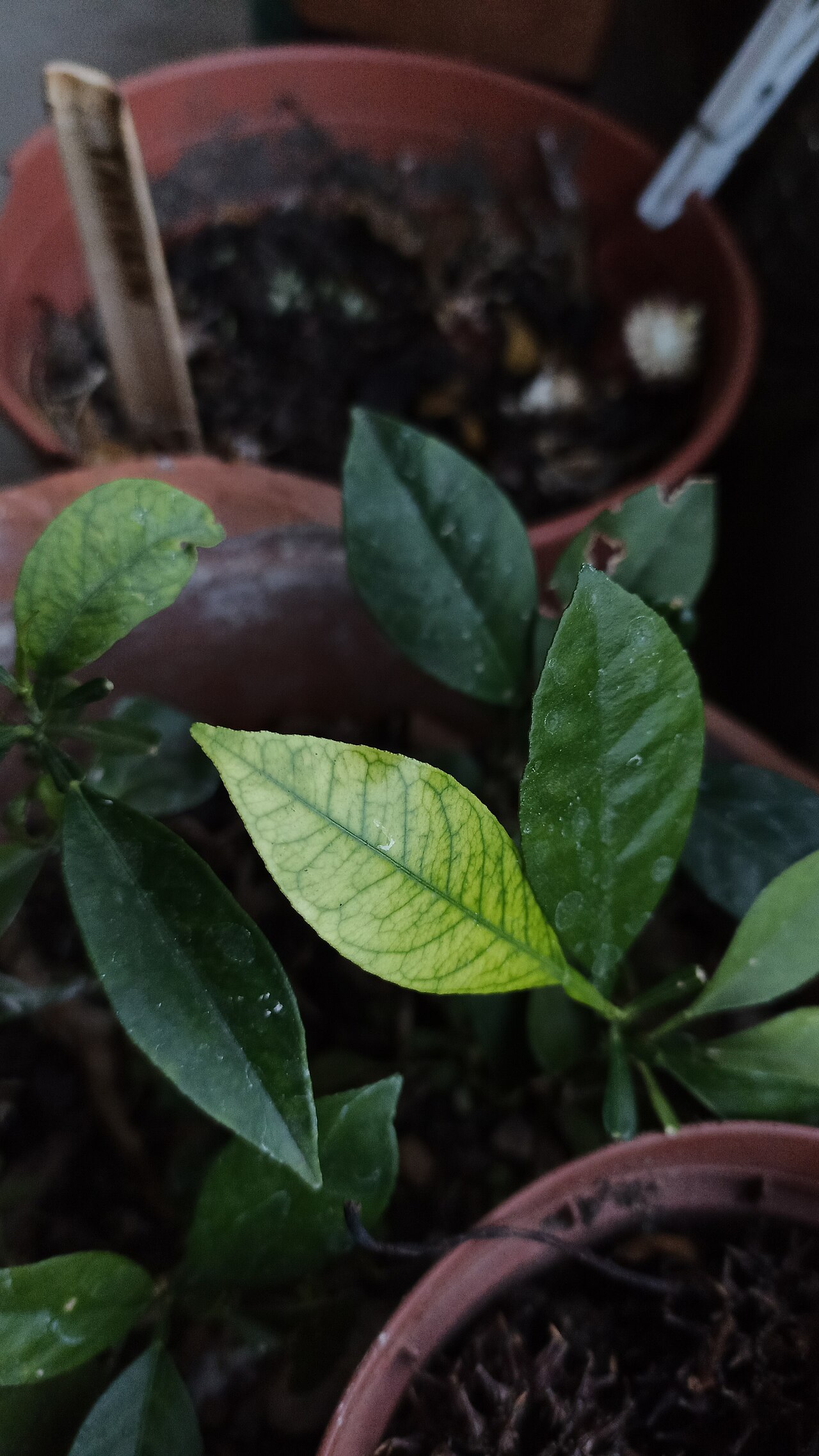
- first fading (light green color) of young leaves — because iron is poorly mobile, symptoms appear on the youngest leaves at the shoot tips;
- then pronounced interveinal chlorosis: blade yellows, vein network remains green;
- in severe cases, leaves completely lose green color, brown necroses and edge drying may occur.
Iron deficiency is relatively easy to recognize precisely due to characteristic interveinal chlorosis on young leaves. Correction uses Fe-chelates (e.g., Fe-EDTA, and on high pH, more effective Fe-EDDHA) foliarly and/or in soil.
Manganese (Mn) — Enzymes and Synergy with Iron
Manganese participates in photosynthesis and the function of many enzymes and is closely linked to iron metabolism.
Symptoms of Manganese Deficiency
- interveinal chlorosis, similar to iron deficiency, but first appears on medium-aged and older leaves (manganese is slightly more mobile than iron), with a finer green vein network;
- more uniform, "mosaic" yellowing of the blade;
- in severe deficiency, small necrotic spots.
Differentiation from iron: Fe = young leaves, sharp vein network; Mn = older/middle leaves, finer vein network. In case of doubt, it is safer to rely on foliar analysis. Correction is foliar application of Mn-EDTA chelate.
Other Micronutrients: Molybdenum, Copper
- Molybdenum (Mo) — closely linked to boron in the pollination process; along with boron and phosphorus, it contributes to good and long-lasting pollen viability. Often found in combined B+Mo foliar products for hazelnut fruit set.
- Copper (Cu) — deficiency is rare in practice because copper is regularly introduced via copper-based protection products. Symptoms (delayed flowering, blue-green leaves, whitening of tips, shoot curling) appear on the youngest leaves. Beware of the opposite: repeated copper application can lead to accumulation in the soil.
Calendar and combined foliar feeding
Approximate annual schedule for micronutrient feeding in hazelnut (informational; align with cultivar, phenophase, and label):
| Period / Phenophase | Goal | Typical Elements |
|---|---|---|
| Autumn, after harvest, before leaf fall | Creating reserves for spring | boron (accumulation for better pollination), Mg, Fe/Mn/Zn as needed, nitrogen (urea), algal biostimulators |
| Winter/early flowering (December–March) | Supporting pollination | boron, molybdenum (reserves from autumn) |
| Pre-flowering / start of vegetation | Pollen viability | boron (1–2 L/ha), Mo |
| Fruit set and early fruit growth (spring) | Yield and quality | boron + zinc (e.g., B 800–1600, Zn 400–800 mg/L) |
| Summer, kernel growth | Kernel development, drought resistance | boron (1–2 treatments), zinc (Zn-EDTA) |
| During vegetation upon appearance of symptoms | Correction of chlorosis | Fe-chelate, Mn-chelate |
An example of a combined autumn/spring foliar micronutrient mix from Croatian practice contains chelated micronutrients along with boron and magnesium (orientational, as percentage content in the preparation): Fe-EDTA ~4.2 %, Mn-EDTA ~4.2 %, Zn-EDTA ~0.8 %, B ~0.9 %, MgO ~5.1 %. Always read specific doses and concentrations from the product label.
Practical recommendations and common mistakes
Recommendations:
- Diagnose before application — leaf analysis + soil analysis; relying solely on visual symptoms makes it easy to miss the correct element.
- Time according to phenophase — boron in autumn (reserve) and pre-flowering/fruit set; zinc in early fruit growth; Fe/Mn as soon as chlorosis appears.
- Use chelated forms (EDTA, EDDHA for iron at high pH) — better stability and uptake.
- Spray under favorable conditions — early morning or evening, in calm weather, ensuring good coverage of the leaf underside; avoid heat and strong sun.
- Prefer smaller, more frequent doses rather than a single large application, especially for boron.
Common mistakes:
- Boron overdose — narrow safety margin; excess is as harmful as deficiency. Do not repeat if leaf B is ~200 ppm.
- Ignoring pH — on calcareous soils, micronutrients are blocked; soil fertilization alone does not help without foliar correction or pH adjustment.
- Excessive phosphorus — high P doses in soil induce zinc deficiency.
- Confusing Fe and Mn chlorosis — incorrect diagnosis leads to incorrect correction; distinguish by leaf age and vein appearance.
- Incompatible tank mixes — always check compatibility of micronutrients with plant protection products before mixing.
Gallery
Sources
This article is an AI summary compiled from an internal hazelnut literature collection (RAG corpus) and public sources. Main sources used:
- Foliar fertilization of hazelnut for higher and better quality yield — RAG corpus (hr)
- Autumn foliar fertilization of woody crops — RAG corpus (hr)
- Guide for hazelnut foliar fertilization 2021 (gnojidba.info) — PDF
- Recommendations for permanent hazelnut orchard owners — RAG corpus (hr)
- Orientational protection and fertilization programs (eco) — RAG corpus (hr)
- Relationship of Boron to Reproduction in Hazelnut (Corylus avellana L.) — RAG corpus (en)
- Fındık Yetiştiriciliğinde Gübreleme / Fizyolojik Hastalıklar / Entegre Mücadele — RAG corpus (tr)
- Fındık bahçelerinde toprak ve ürünlerdeki mikroelement dağılımı — RAG corpus (tr)
- UZGOJ LIJESKE (pdfcoffee) — RAG corpus (hr)
- Combined Spraying of Boron and Zinc During Fruit Set and Premature Stage Improves Yield and Fruit Quality of European Hazelnut cv. Tonda di Giffoni — Frontiers in Plant Science / PMC8201987
- Fertilizing Hazelnuts: What Nutrients Do They Need? (Hazelnut Hub) — hazelnuthub.com
- Physiological disorders of hazelnut fruits (Gospodarski list) — gospodarski.hr
- Boron (B) in fertilization of woody crops / Importance of autumn boron treatment — gnojidba.info
Recommended equipment
🔎 fruit tree fertilizer — Amazon →Affiliate links — we may earn a small commission at no extra cost to you.