Hazel aphids (Myzocallis coryli, Corylobium avellanae)
Content generated by artificial intelligence — verify before application
This article was automatically compiled from a collection of hazelnut literature using artificial intelligence and may contain errors or outdated information. It serves as a starting point for further research, not as professional advice. Dosages, products, and timing are informative and depend on the cultivar, location, and current regulations — always consult an advisory service and official sources before application.
Aphids (family Aphididae) are among the most widespread pests in hazelnut orchards worldwide. Two species are regularly found on hazelnut: the green hazelnut aphid Myzocallis coryli (Goeze) and the large hazelnut aphid Corylobium avellanae (Schrank). Myzocallis coryli is more common and of greater agricultural significance, while Corylobium avellanae usually appears in weaker populations and is rarely considered a dangerous pest. Both species damage the plant by sucking plant sap, weakening tree vitality, and — which is often the biggest problem for producers — excreting abundant honeydew on which sooty mold fungi develop. This article combines the biology, symptoms, population monitoring, and control of aphids, with an emphasis on preserving beneficial insects, which in many orchards keep aphid populations below the economic injury threshold without any treatment.
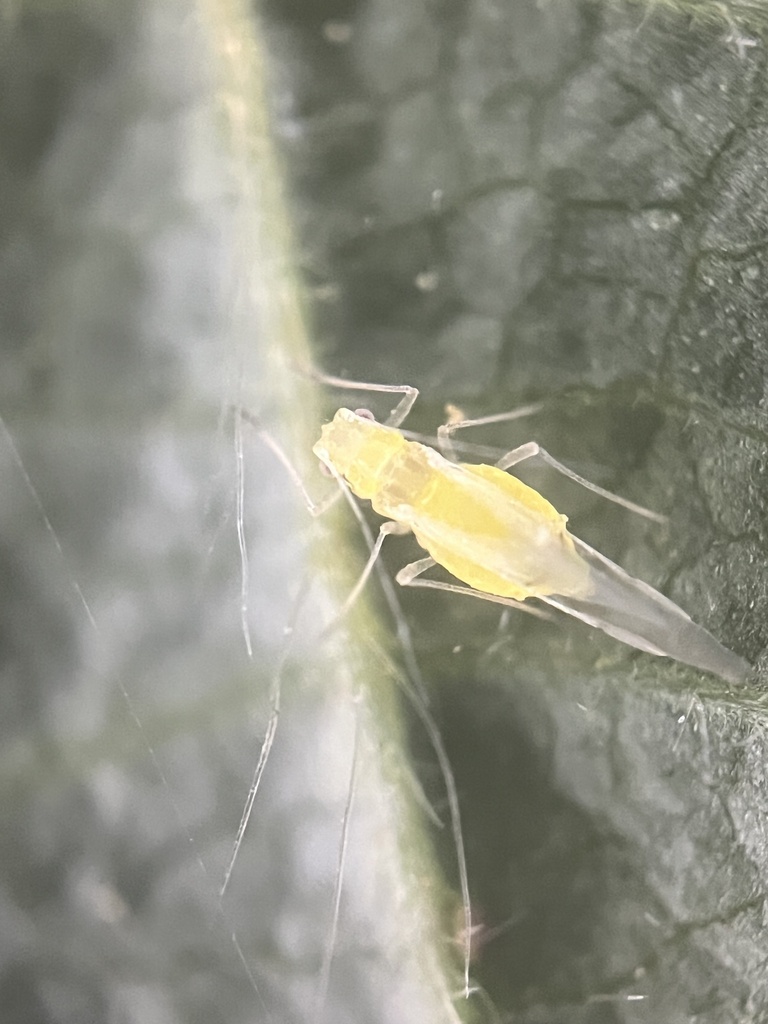
Two species of aphids on hazelnut
Although they are often mentioned together in practice as "aphids," it is useful to distinguish between the two species because they differ in appearance, feeding location, and risk.
| Characteristic | Myzocallis coryli (green hazelnut aphid) | Corylobium avellanae (large hazelnut aphid) |
|---|---|---|
| Frequency | Very common, regularly present in orchards | Less common, weaker populations |
| Color | Light to dark green | Darker green |
| Adult size | ≈ 1.5–2.5 mm | Larger, with elongated legs and prominent siphunculi (cornicles) |
| Feeding location | Leaf undersides, shoots, fruits | Initially leaves, later mainly twigs and the bract (cupule) of the fruit |
| Economic significance | Main species of interest | Usually below threshold, secondary pest |
Values are informative and vary with literature, location, and developmental stage.
Myzocallis coryli is of European origin, but today it is widespread wherever hazelnuts are grown — in Europe, Turkey, Asia, North and South America, Australia, and New Zealand. It is a monoecious and holocyclic species (the entire life cycle occurs on hazelnut, with alternating sexual and asexual generations).
Biology and life cycle
Identification
Adult Myzocallis coryli are light to dark green, averaging about 1.5–2.5 mm in length. Young individuals (nymphs) are yellowish-white, approximately half the size of adults, and their bodies are covered with long hairs. Eggs are black, oval, about 0.5 mm in size, and are present only during winter, laid on twigs and near buds.
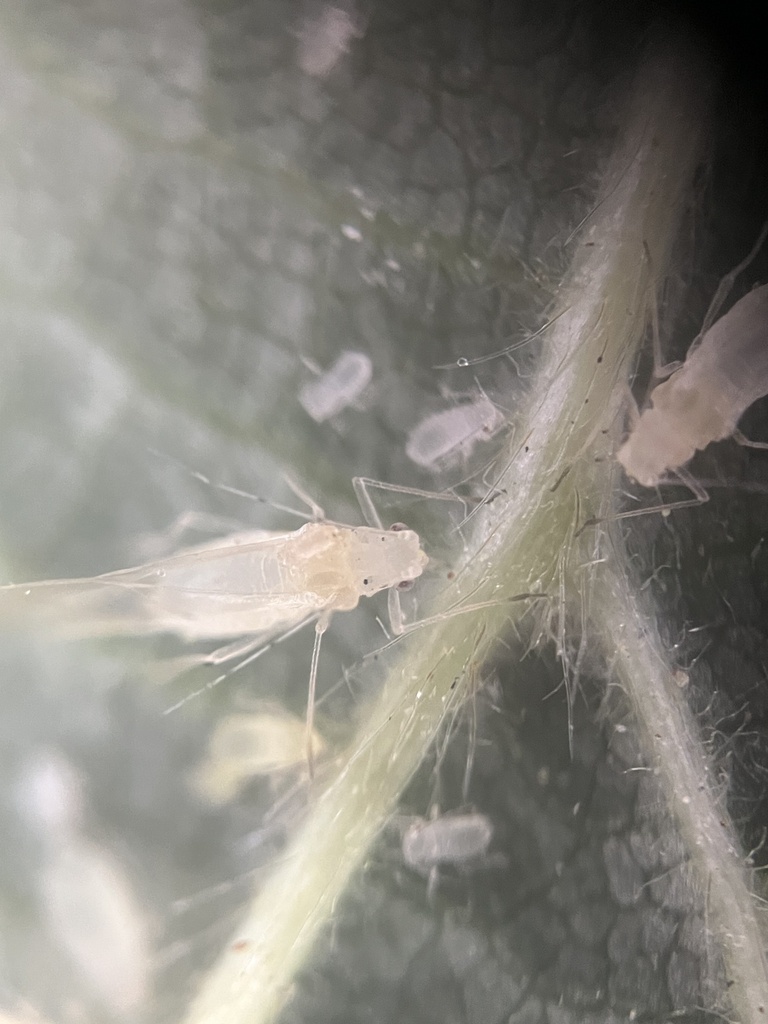
Seasonal life cycle
The aphid overwinters in the egg stage on one-year-old twigs. Development through the season proceeds roughly as follows:
- Early spring (March): First nymphs hatch from overwintering eggs. Black eggs become shiny black before hatching.
- Spring: Nymphs molt four times and give rise to winged generations that reproduce parthenogenetically (without fertilization) — each female gives birth to live, already developed young aphids, so the population can grow very rapidly.
- Late spring: Visible nymphs are found on the undersides of leaves; in May, peak populations of both species are often recorded.
- Summer: Aphids feed on leaves, shoots, bracts, and young fruits, excreting abundant honeydew. At high temperatures, the sticky layer of honeydew partly protects the colony from desiccation.
- Autumn: Sexual generations appear; fertilized females lay black winter eggs on twigs, closing the cycle.
In favorable conditions, several generations of aphids can develop on hazelnut during the season (literature on related pests on hazelnut cites 2 to 3 generations per year with high potential for damage to leaves and fruit).
Damage from sucking and honeydew (sooty mold)
Aphids cause damage in two ways — directly through sucking and indirectly via honeydew and sooty mold.
1. Direct damage — sucking sap
Aphids use piercing-sucking mouthparts to extract sap from young leaves, shoots, bracts, and young fruits. The consequences are:
- Loss of leaf turgor: attacked leaves lose firmness, develop a dried appearance, turn yellow, curl at the edges, and may drop prematurely.
- Weakening of the tree: vitality and growth of fruiting branches decrease; under strong and repeated attacks, the overall condition of the orchard suffers.
- Damage to fruit: when aphids are numerous, nut size decreases, and often the kernel fails to develop — the hazelnut shell remains empty (so-called "empty" nuts). Premature leaf drop further reduces kernel filling and quality.
It should be noted that literature highlights a nuance: attack intensity varies greatly depending on the year and tree potential, so some sources for hazelnut aphids do not recommend specific control measures — control is advised only when stronger, visually visible damage occurs.
2. Indirect damage — honeydew and sooty mold
Aphids excrete large amounts of honeydew — a sweet, sticky liquid rich in sugars. It is an ideal substrate for the development of sooty mold fungi (soot), which cover leaves and fruits with a black coating. Consequences of sooty mold:
- Reduced photosynthesis: the black coating covers the leaf blade and reduces light access.
- Contamination and spoilage of fruit: honeydew on fruits is a substrate for spore germination and the development of sooty mold and fruit rot; market value drops.
- "Wet leaf": a typical symptom of heavy attack — leaves look wet/sticky, which in practice is a clear sign that aphid populations are high.
- Netting, rusting, curling, and leaf depigmentation, and in extreme cases, defoliation.
Honeydew also attracts ants, which protect aphids from natural enemies so they can also benefit from the excretion — thus, the presence of ants on branches can be an indirect sign of an aphid colony.
Population monitoring and injury threshold
The professional rule for aphids is: monitor first, and only then treat if necessary. Blind, calendar-based treatments against aphids are the most common cause of disrupting natural balance and leading to heavier attacks in subsequent years.
How to monitor
- Visual inspection of leaf undersides from early spring (March–May), with an emphasis on May when peak populations occur.
- Inspection of young shoots, bracts, and fruits for the presence of colonies, nymphs, and honeydew.
- The "wet leaf" sign and the appearance of sooty mold/ants are signals that the population is already high.
- Winter inspection of twigs for the presence of black eggs helps assess pressure for the next season and decide on possible winter treatment.
Injury threshold
For the hazelnut aphid, the economic injury threshold is poorly studied and not firmly defined (older sources, e.g., Olsen 1996, note that little is known about the threshold). Therefore, the decision relies on a combination of visual assessment of colony density, presence of beneficial insects, and orchard developmental stage.
As a guideline, the approach known from aphid control in other fruits can be used, where the threshold is expressed as the percentage of attacked shoots or the number of colonies per 100 shoots, with the rule that vigorous orchards tolerate a higher threshold:
| Indicator (orientational, from analogy with other fruits) | Approximate value |
|---|---|
| Number of colonies per 100 shoots (green aphids) | ≈ 8–10 colonies |
| Attacked leaves / shoots (more harmful species) | significantly lower values |
Note on threshold
The figures above are not specific official thresholds for hazelnut, but an analogy from aphid control in other fruit crops. In practice, hazelnut is treated at strong, visually visible attacks and the appearance of honeydew. Request specific thresholds and recommendations from the advisory service.
Control while preserving beneficial insects
The best results are achieved through Integrated Pest Management (IPM), which combines agronomic, biological, and — only when necessary — chemical measures, while consciously preserving natural enemies.
Beneficial insects (biological control) — the foundation of protection
In many orchards, natural enemies alone keep aphid populations below the economic injury threshold, making treatments unnecessary. The grower’s main allies are:
- Parasitic parasitoid wasps: Trioxys pallidus (a highly effective parasitoid of hazel aphids; in some growing regions, it is so well established that insecticide treatments for aphids become unnecessary) and Praon dorsale as a parasitoid of Corylobium avellanae.
- Ladybugs (ladybird beetles): adults and larvae; among specialized predators of hazel aphids, Adalia angulifera is also noted.
- Green lacewings: larvae of Chrysoperla spp. (e.g., Chrysoperla rufilabris) are extremely voracious on Myzocallis.
- Predatory bugs (mirids, anthocorid bugs) and syrphid fly larvae (Syrphidae).
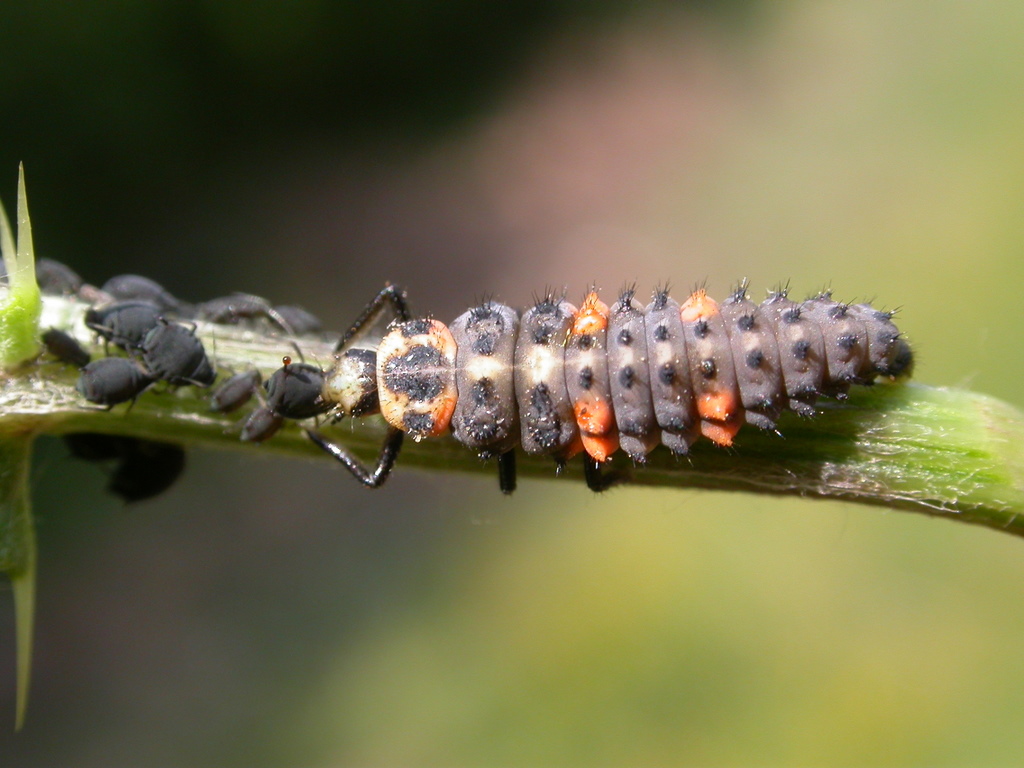
Key rule: applying broad-spectrum insecticides against aphids destroys their natural enemies, causing aphid populations to explode after such treatment (released from biological control). Therefore, when treatment is truly necessary, prefer selective aphicides that spare beneficial insects.
Agronomic (preventive) measures
- Moderate nitrogen fertilization. Excess nitrogen promotes lush, succulent growth that aphids love; balanced fertilization reduces the orchard’s attractiveness to them. (Powdery mildew also occurs more frequently in orchards over-fertilized with nitrogen — another reason for moderation.)
- Removal of colonies by pruning. Branches where aphid colonies are observed should be removed during pruning, in the hazel dormancy phase — this reduces the number of overwintering eggs.
- Open canopy through pruning — reduces humidity, hinders sooty mold development on honeydew, and facilitates access for beneficial insects.
- Promoting biodiversity (flower strips, cover crops, avoiding unnecessary treatments) to maintain populations of natural enemies.
Chemical and low-risk control
Chemical measures are employed only in case of severe attacks that natural enemies cannot control, and then in a targeted manner. The following groups and preparations are mentioned in literature and practice (the list is informational — registrations change):
A) Low-risk, contact agents (suitable for organic production):
- Insecticidal soaps and horticultural/mineral oils — suffocate aphids by contact; thorough coverage (including the underside of leaves) is essential. Mineral oils are used while buds are still closed.
- Preparations based on silicone polymers (e.g., Silmax EC and similar) — create a sticky surface that immobilizes the pest and prevents spread across plant organs; can be added to other preparations.
B) Selective and systemic insecticides:
| Active ingredient | Example preparation (informational) | Note |
|---|---|---|
| Spirotetramat | Movento | Systemic; registered for controlling aphids in hazelnut |
| Deltamethrin | Decis 100 EC | Contact and stomach action; other deltamethrin-based preparations (Scatto, Rotor super, Demetrina 25 EC, Deltagri) may be used for IPM from bud swell to early flowering (BBCH 50–59), i.e., as a treatment for overwintering eggs |
| Pirimicarb | Pirimor 50 WG | Selective aphicide — an example of a product that spares natural enemies |
| Flonicamid | Beleaf 50 SG | Selective aphicide (foreign practice) |
| Neonicotinoids (imidacloprid, thiamethoxam, acetamiprid) | Admire Pro, Actara 25 WG, Mospilan 20 SP | Systemics, effective, but broad-spectrum — use with caution due to bees and beneficial insects; apply according to current restrictions |
Resistance
Practice shows that aphid populations in recent years have become increasingly resistant to certain active substances, including deltamethrin. Therefore, avoid repeating the same mode of action, rotate active substance groups, and do not treat “just in case.”
C) Seasonal treatment schedule (orientational, older model — Šoškić, 2006): one winter spray, first spring spray (immediately before flowering), second spring spray (after flowering), third approximately two weeks after the second, and further actions as needed. This is a historical framework; modern IPM aims for a minimal number of treatments and treats only when there is a real need.
All dosages, concentrations, phenological phases, and timing above are informational and depend on the cultivar, location, formulation, and — most importantly — on the current registration and label instructions. Always verify if the product is approved for hazelnut, respect the pre-harvest interval, properly dispose of packaging waste, and keep records of pesticide use.
Practical recommendations and common mistakes
Recommendations:
- Start with monitoring, not spraying: regular inspection of leaf undersides from March, intensified in May.
- Protect beneficial insects — they are the cheapest and most durable protection; choose selective aphicides when treatment is needed.
- Reduce nitrogen if you record frequent severe attacks — lush shoots attract aphids.
- During pruning, remove infested branches with eggs and maintain an open canopy.
- If honeydew/sooty mold appears, address the cause (aphids), not just the symptom; heavy honeydew indicates you were late with your inspection.
Common mistakes:
- Calendar-based spraying of aphids with broad-spectrum insecticides — destroys natural enemies and triggers a rebound, more severe attack (“resurgence” effect).
- Repeating the same active substance → development of resistance (especially to pyrethroids like deltamethrin).
- Confusing symptoms: swollen buds are not aphids but bud mites (Phytoptus avellanae); fruit deformation and honeydew can also be caused by scale insects — identify the real culprit before treatment.
- Excessive nitrogen fertilization which itself “produces” aphid and powdery mildew problems.
- Poor coverage with contact agents (soaps, oils) — without spraying the leaf underside, the effect is absent.
Sources
This article is an AI summary compiled from an internal literature collection on hazelnut (RAG corpus) and publicly available sources. The content consolidates multiple documents of varying reliability and language; figures, dosages, and timing are informational. Main sources used:
- Most significant hazelnut pests — Plant Protection Gazette (Croatia), doi:10.31727/gzb — biology of Myzocallis coryli, Corylobium avellanae, honeydew, Trioxys pallidus, treatment schedule.
- Handbook for hazelnut protection / Hazelnut protection (2012, 2020) — description and damage of hazelnut aphid, honeydew, and sooty mold.
- Diseases and pests of hazelnut — Repository (2020), https://hrcak.srce.hr/file/358595 — aphids and scale insects, hazelnut protection measures.
- Recommendation for permanent hazelnut orchard owners (2025) — registered products (spirotetramat/Movento, deltamethrin/Decis), IPM notes, resistance, “wet leaf.”
- Orchard tips: More important hazelnut pests and diseases (Agroklub, 2016) — aphid appearance in May, neonicotinoids (Actara, Mospilan).
- HAZELNUT — from planting to harvest and Hazelnut (Vrtlarica.hr) — seasonal dynamics, control with approved products.
- Significant pests and diseases of pome and stone fruit (2023) — honeydew, sooty mold, defoliation; thresholds and selective aphicides (Predložak, 2012).
- Pacific Northwest Pest Management Handbooks — Hazelnut-Aphid, https://pnwhandbooks.org/insect/nut/hazelnut/hazelnut-aphid
- OSU Extension — Growing Hazelnuts in the Pacific Northwest: Integrated Pest Management, https://catalog.extension.oregonstate.edu/em9081/html
- Province of British Columbia — Hazelnut insect management, https://www2.gov.bc.ca/gov/content/industry/agriculture-seafood/agriservice-bc/production-guides/hazelnuts/hazelnut-insect-management
- influentialpoints.com — Myzocallis coryli (Hazel aphid) and Corylobium avellanae (Large hazel aphid): identification, ecology, control.
- CABI Compendium — Myzocallis coryli (filbert aphid), https://www.cabidigitallibrary.org/doi/10.1079/cabicompendium.35629
- Antropocene.it — Corylobium avellanae: Systematics, Habitat, Life cycle (natural enemies, Praon dorsale).
Recommended equipment
🔎 pheromone insect trap orchard — Amazon →Affiliate links — we may earn a small commission at no extra cost to you.