Bacterial Blight and Canker of Hazelnut (Xanthomonas, Pseudomonas)
Content generated by artificial intelligence — verify before application
This article was automatically compiled from a collection of hazelnut literature using artificial intelligence and may contain errors or outdated data. It serves as a starting point for further research, not as professional advice. Dosages, products, and timing are informative and depend on the cultivar, location, and applicable regulations — always consult with an advisory service and official sources before application.
Bacterial diseases of hazelnut (Corylus avellana) are among the most significant economic health issues for this crop. Two related but distinct bacterioses with similar symptoms occur on hazelnut: bacterial blight caused by Xanthomonas arboricola pv. corylina, and bacterial canker and decline caused by pseudomonads — primarily Pseudomonas avellanae (syn. P. syringae pv. avellanae) and related strains resembling P. syringae pv. syringae. Both attack all above-ground parts of the plant, creating dark spots and cankers from which bacterial exudate oozes, and in severe cases, lead to the drying of branches or entire trees. Like all bacterioses, they are difficult to control: there is no "cure," but rather a combination of hygiene, agronomy, healthy planting material, and preventive copper treatments. This article explains how to distinguish between the two diseases, how they spread, and which protection measures are effective under Croatian conditions.
Two diseases, similar symptoms — why distinguish them
In literature and in the field, names are often mixed (in some sources Xanthomonas is called "bacterial canker"), but these are two different pathogens with different risks and prognosis:
| Feature | Bacterial Blight | Bacterial Canker / Decline |
|---|---|---|
| Pathogen | Xanthomonas arboricola pv. corylina | Pseudomonas avellanae (P. syringae pv. avellanae), and strains resembling P. s. pv. syringae |
| English Name | bacterial blight | bacterial canker / hazelnut decline |
| Distribution | common and widespread, the most economically important hazelnut disease | rarer and localized, but potentially the most damaging |
| Host | exclusively hazelnut (Corylus) | hazelnut |
| Typical Outcome | spots, drying of shoots and branches, fruit damage | rapid wilting and dieback of branches or entire trees |
| Status in Croatia | present / very likely (laboratory confirmation still pending in some orchards) | P. avellanae has not yet been confirmed in Croatia (according to available sources) |
Field Rule
If you see leaf spotting and gradual drying of shoots with typical necroses surrounded by a chlorotic halo — it is most likely Xanthomonas. If you see sudden wilting and dieback of entire branches or trees with deep cankers and whitish exudate, suspect pseudomonas (decline) and report it immediately to the advisory/phytosanitary service for confirmation.
Bacterial Blight — Xanthomonas arboricola pv. corylina
Significance and Host
Xanthomonas arboricola pv. corylina attacks only hazelnut and is considered the most economically important disease of this crop. Some sources state that bacterial blight has greater economic significance than all other hazelnut diseases combined. The disease was first described in Oregon (USA) in the early 20th century and is now widespread in all major production areas. The most susceptible are young plants (approximately 1–4 years old) and trees under stress (drought, frost, injuries).
The name "blight" comes from the fact that infected leaves look as if they have been scorched by flame — the edges dry out and are damaged.
Symptoms
Symptoms appear on all above-ground parts: leaves, buds, shoots, branches, trunk, catkins, and nuts.
On leaves:
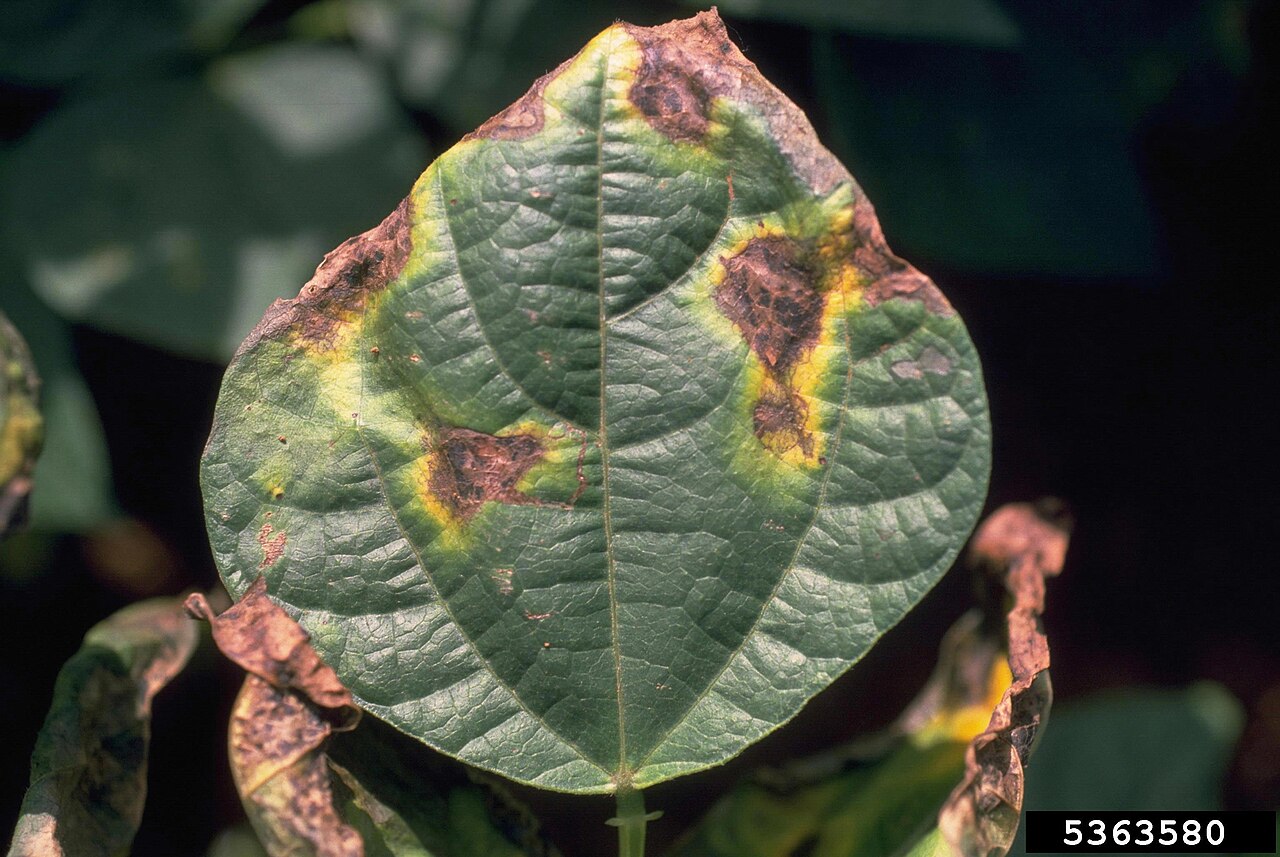
- small, angular to irregular necrotic spots (mostly 1–2 mm), initially water-soaked;
- initially yellow-green to dark green, later reddish-brown to brown-black in color;
- spots are surrounded by a chlorotic (yellow) halo;
- under favorable conditions, spots expand and merge into larger irregular necrotic zones; the leaf dries but often remains on the branch (does not fall off immediately).
On buds and shoots:
- buds darken first on the surface, then internally; infected buds do not break;
- on shoots (summer growth), the tip is damaged first; bark cracking and sunken areas appear;
- due to the ring-like (girdling) spread of spots, summer shoots bend and break, and tips dry out and characteristically curl into an "umbrella handle" shape;
- dried shoots are clearly visible during summer.
On branches and trunk:
- appearance of cankers; after removing the bark below the infected area, dark necrosis is visible, which diffuses into healthy tissue;
- yellowish, slimy bacterial exudate oozes from the cankers during wet weather.
On nuts:
- slightly sunken, dark, water-soaked spots on the husk (exocarp/green cupule) and shell; rarely affecting the kernel.
The greatest economic significance lies in the infection of young bearing branches, as these are the ones that carry the crop.
Conditions for Development and Spread
- Optimal temperature for bacterial growth is around 28 °C; the disease occurs more intensively in wet and rainy years.
- The bacterium overwinters in infected buds, cankers, and plant debris.
- Over short distances within the orchard, it spreads via rain and splash (rain splash), wind, and dew.
- The main pathway for spread over long distances is infected (non-certified) planting material — therefore, healthy, labeled planting material is the first line of defense.
- Entry points for infection are wounds: from pruning, hail, frost, insect bites, etc. Therefore, every cut and every mechanical injury is a potential site of infection.
Bacterial Canker and Decline — Pseudomonads (Pseudomonas avellanae)
Significance and Status
Pseudomonas avellanae (taxonomically described also as P. syringae pv. avellanae) is the causal agent of bacterial canker and decline of hazelnut. Unlike bacterial blight, this disease is less widespread and rarer, but potentially the most damaging — because it directly leads to the drying and decay of trees. Severe epidemics have been recorded in central Italy and northern Greece, where thousands of trees died, and recently the pathogen has been confirmed in Serbia (European hazelnut decline). According to available Croatian sources, P. avellanae has not yet been confirmed in Croatia, but given its spread in the region, caution and monitoring are warranted.
Symptoms
It is crucial that pseudomonas affects the vascular (conducting) tissue, which explains the sudden collapse of the plant:
- the first signs are drying of catkins; later during the growing season, female flowers may also dry out;
- this is followed by rapid wilting of shoots, branches, or the entire tree; drying initially often affects only individual branches or part of the plant;
- leaves on dried branches turn brown but do not fall off;
- on living parts of the plant, leaves are smaller and chlorotic, yield is drastically reduced or almost non-existent;
- deep cankers appear along branches and trunk; woody tissue is darker, brownish in color;
- in advanced stages, whitish (white) bacterial exudate appears on the trunk;
- an infected tree may "linger" for several seasons before final dieback.
Spread
- The main pathway for entry into the orchard and spread over long distances is infected planting material.
- Within the orchard, it spreads via rain, splash, and through wounds (pruning, frost, mechanical damage); non-disinfected pruning tools are an important vector.
- Plant stress (drought, frost, poor nutrition) increases susceptibility and disease severity.
Suspected Decline = Report
Sudden drying and decay of adult trees with deep cankers and white exudate may indicate P. avellanae. Since the disease is (so far) not confirmed in Croatia, any serious suspicion should be reported to the competent advisory/phytosanitary service for laboratory confirmation, before the infection spreads.
Control — an integrated approach
There is no curative chemical treatment for hazelnut bacterial diseases. Successful defense relies on a combination of preventive measures; copper-based preparations only reduce disease pressure but do not eliminate it. An additional problem is that there are very few registered preparations for hazelnuts in Croatia, with a trend toward further reduction.
1. Healthy planting material and resistant cultivars
- Plant certified, labeled, and healthy planting material from a reliable source — this is the most effective measure against the introduction of both diseases.
- Choose less susceptible cultivars adapted to the site (susceptibility to Xanthomonas varies among cultivars; for example, in the literature, the well-known cultivar Tonda di Giffoni is cited as prone to severe outbreaks under favorable conditions).
- Young trees under stress are most susceptible to infection — ensure a good start (irrigation, nutrition, protection from frost and hail).
2. Pruning hygiene (critical measure)
Pruning is a double-edged sword: it removes infection, but every cut creates a wound — an entry point for bacteria.
- Pruning timing: perform main (shaping) pruning during dormancy (winter), in dry weather; avoid pruning in rain and humidity when bacterial spread is highest.
- Sanitary (selective) pruning: remove infected branches as soon as you notice them, even during the growing season, to prevent spread.
- How much to prune: cut infected branches 30 cm below the visibly infected (dry) part; in severe attacks, sources also cite cutting 60–90 cm below the infected site, and heavily infected scaffold branches down to the base.
-
Tool disinfection: disinfect tools between every tree (ideally between every cut on an infected plant) — infection occurs due to the use of non-disinfected tools. Use e.g., 70% alcohol or sodium hypochlorite-based solutions (bleach); follow recommendations from advisory services.
-
Removal of residues: remove pruning residues from the orchard and burn them; infected material must not be mulched or left in the orchard. Removing pruning residues should become standard practice in infected orchards.
- Wound protection: after pruning and in case of hail/frost damage, the plant is "open" — these are typical times for preventive copper treatment (see below).
Fewer branches = cheaper protection
It is useful to perform necessary pruning before spring spraying: this reduces the canopy volume to be treated and simultaneously removes infected branches before vegetation starts.
3. Copper (preventive) treatments
Copper-based preparations act preventively and contact-wise and have a broad spectrum (bacterial and fungal diseases). Key timing is early spring protection (after pruning, around bud break / "mouse ears") and autumn protection during leaf fall, when numerous leaf scars remain as entry points.
An important practical detail: for protection against bacterial/fungal canker in spring, some sources recommend waiting until the end of flowering (dark red catkins, dark brown aments) and the appearance of the first leaf tissue, and only then applying a copper preparation (e.g., copper hydroxide, or a combination of copper hydroxide and copper oxychloride).
Active substances and example preparations cited in sources for hazelnuts (informational — check current registration in FIS and the label):
| Type / Active Substance | Example Preparations from Literature | Purpose |
|---|---|---|
| Copper hydroxide | Champion WG 50, Cuprablau Z (35 WG) | Bacterial and fungal diseases (preventive) |
| Copper oxychloride | Cuprocaffaro, Neoram WG, Airone SC (combination) | Bacterial diseases, bark canker |
| Copper sulfate (Bordeaux mixture) | Bordoška juha Caffaro 20 WP | Bacterial diseases, fruit rot |
| Sulfur (complementary) | Chromosul 80, Cosavet DF, Kumulus DF | Powdery mildew and mites (not against bacteria) |
Approximate doses and quantities appearing in sources (informational; depend on cultivar, phenophase, formulation, and label):
| Item | Approximate Value |
|---|---|
| Cuprablau Z (concentration) | ~0.5% (≈ 500 g per 100 L water) |
| Cuprocaffaro 50 WP | ~0.8–1.0% |
| Bordoška juha Caffaro 20 WP | ~1.0–1.5% |
| Bordeaux mixture (stronger early application) | up to ~1% |
| Water consumption (spraying) | ~1000–1500 L/ha (depending on canopy) |
Copper is not harmless nor unlimited
Copper accumulates in the soil and in organic production is quantitatively limited (EU/HR regulations on the maximum permitted annual amount of copper per hectare). Additionally, bacterial strains resistant to copper have been recorded worldwide, so excessive and unprofessional use reduces effectiveness. Use preparations exclusively according to the label, keep records of pesticide use, and dispose of packaging waste properly.
4. Agrotechnics and stress reduction
- Reduce plant stress: irrigation during dry periods, balanced nutrition (avoid excessive nitrogen which produces lush, sensitive tissue), protection from frost and hail, biostimulators/plant strengtheners.
- Canopy ventilation: ensure good light penetration and rapid drying of the canopy after rain through pruning — a wet, dense canopy favors bacteria.
- Weather monitoring: wet and rainy periods (especially with hail/frost) are a signal for intensified monitoring and timely protection.
- Monitoring: regularly walk the orchard and remove the first infected parts early — a small number of cankers multiply quickly if not addressed.
Protection Calendar (approximate)
| Period / Phenophase | Measure |
|---|---|
| Winter (dormancy), dry weather | Shaping and sanitary pruning; removal and burning of residues; tool disinfection |
| Early spring — bud break / "mouse ears", after pruning | First preventive copper treatment (wounds = entry points) |
| End of flowering + first leaves | Copper treatment against bacterial/fungal canker (as needed, according to recommendation) |
| Vegetation (wet periods) | Monitoring; sanitary removal of infected branches; avoid pruning in rain |
| After hail/frost | Copper treatment on fresh wounds as soon as possible |
| Autumn — leaf fall | Copper protection (autumn); orchard cleaning |
Practical Recommendations and Common Mistakes
Recommendations
- Invest in healthy, certified planting material — it is cheaper than years of control.
- Disinfect tools — this is the most underestimated yet very effective measure.
- Remove and burn infected material; do not leave it in the orchard.
- Treat preventively, at the right timing (around wounds), not only when symptoms have spread.
Common Mistakes
- Pruning in rain and humidity and without disinfecting tools — direct spread of infection.
- Mulching infected residues in the orchard — source of inoculum for the next season.
- Expecting copper to "cure" an already developed infection — copper is preventive, not a cure.
- Excessive nitrogen fertilization and neglected, dense canopy — creates sensitive tissue and a humid microclimate.
- Ignoring sudden drying of mature trees — it may be P. avellanae; it should be reported and confirmed.
Gallery
Sources
This article is an AI summary compiled from an internal collection of hazelnut literature (RAG corpus) and public sources. Doses, preparations, and timings are informational and depend on the cultivar, location, and current registration of products (FIS) — always check the label and consult with advisory services. Main sources used:
From RAG Corpus (collection of hazelnut literature):
- Plavec et al. (2024): Xanthomonas arboricola pv. corylina, cause of bacterial blight of hazelnut in nurseries and orchards in Croatia.
- Fruit Growing Advice / Eco-Fruit Growing (2015): Bacterial diseases of hazelnut — Xanthomonas arboricola pv. corylina and Pseudomonas syringae pv. avellanae.
- Most Significant Diseases of Lupinoid Fruits, Bajamas, Walnuts, Hazelnuts (2016).
- Recognize Diseases and Pests on Hazelnuts (2020).
- Diseases and Pests of Hazelnuts (PDF, 2020).
- Ministry of Agriculture: Recommendation for Owners of Permanent Hazelnut Orchards (2021, 2023).
- Chromos Agro: Current Hazelnut Protection / Now is the Time for Early Spring Hazelnut Protection (2025).
- Agroklub: Time for Early Spring Hazelnut Protection (2017).
- Registered Preparations in Hazelnut Production / Approximate Program for ECO Protection and Fertilization of Hazelnuts 2023.
- Notices to Hazelnut and Walnut Producers (Ministry of Agriculture, 2018, 2019, 2020).
- Manual for Hazelnut Protection (2020).
- Popović, Milovanović et al. (2026): Pseudomonas avellanae causing European hazelnut decline in Serbia, Phytopathologia Mediterranea.
- Scortichini et al. (2003): The Pseudomonads Associated with Bacterial Canker and Decline of Hazelnut (Corylus avellana L.).
Public Web Sources:
- Xanthomonas arboricola disease of hazelnut: current status and future perspectives — https://pmc.ncbi.nlm.nih.gov/articles/PMC8578823/
- Susceptibility of some Corylus avellana L. cultivars to X. arboricola pv. corylina — https://pmc.ncbi.nlm.nih.gov/articles/PMC8719002/
- Severe Outbreak of Bacterial Blight on Hazelnut cv. Tonda di Giffoni in Central Italy — https://apsjournals.apsnet.org/doi/10.1094/PDIS-04-12-0375-PDN
- Hot water treatment to control X. arboricola pv. corylina on propagative material — https://www.sciencedirect.com/science/article/abs/pii/S0304423816304186
- Management of Bacterial Diseases of Hazelnut (Encyclopedia MDPI) — https://encyclopedia.pub/entry/39827
- Emended description of Pseudomonas syringae pv. avellanae — https://link.springer.com/article/10.1007/s10658-015-0753-1
- Pseudomonas avellanae causing European hazelnut decline in Serbia — https://oajournals.fupress.net/index.php/pm/article/view/16806
- Bacteria associated with hazelnut decline: P. avellanae and strains resembling P. s. pv. syringae — https://pmc.ncbi.nlm.nih.gov/articles/PMC126672/