Hazelnut Harvesting Machines: Types, Capacity, and Selection
Content generated by artificial intelligence — verify before application
This article was automatically compiled from a collection of hazelnut literature using artificial intelligence and may contain errors or outdated data. It serves as a starting point for further research, not as professional advice. Dosages, products, and timing are informative and depend on the cultivar, location, and current regulations — always consult with advisory services and official sources before application.
Harvest is the most technologically and economically demanding stage in hazelnut production. Unlike most fruits, hazelnuts are not picked from the tree but are collected from the ground after natural abscission, turning the entire harvest into a collection problem rather than a picking one. Therefore, the choice of harvesting machine directly determines how quickly, cleanly, and cost-effectively you will gather the yield, as well as how much you will invest in it. This article explains the main types of sweepers and harvesters (self-propelled, trailed, and suction), their capacity, terrain adaptation, and selection criteria based on orchard size and layout.
Why Harvest Hazelnuts Mechanically
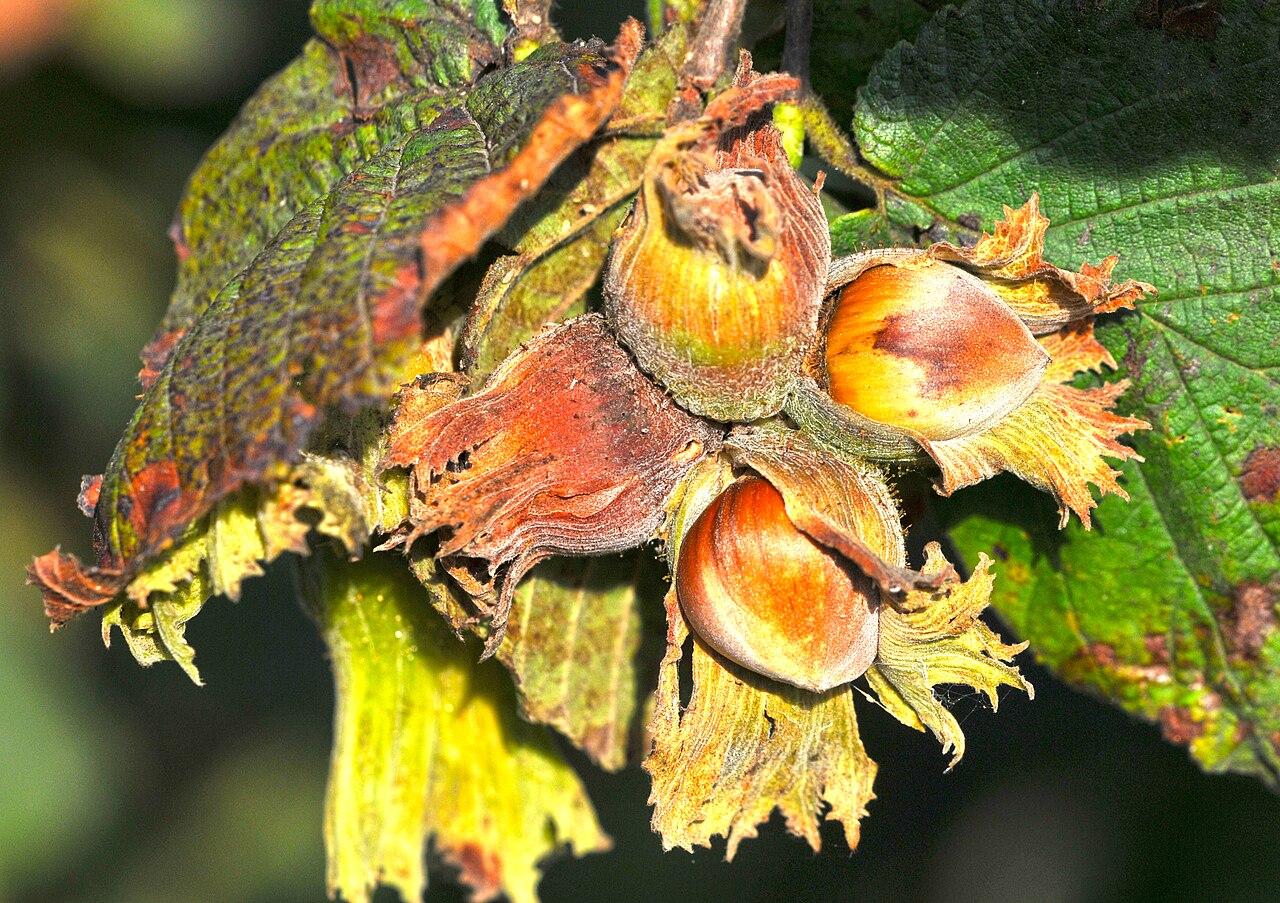
In small, household, or newly established orchards, harvesting is still done manually — using rakes, manual sweepers like the "nut wizard" (a basket that scoops up nuts without bending), or simply by hand. In larger specialized orchards, where significantly higher yields are achieved, manual harvesting becomes too expensive and slow, leading to a transition to mechanized, machine harvesting. According to literature, the power required for harvesting equipment ranges from about 30 HP to several hundred HP, depending on the complexity of the design and the equipment's capacity.
Machine harvesting always begins with soil preparation. Before the nuts abscise, the area under the trees must be well leveled and cleared of weeds to improve accessibility and visibility of the nuts. Often, a preliminary collection is performed in late August to eliminate nuts with empty shells (which fall first) and to level out minor depressions in the soil. Nuts that have not yet fallen are shaken from the tree mechanically or manually, and then on the ground, they can be raked or blown into rows or piles for easier collection by the harvester.
Main Working Principle: How the Machine Collects Nuts
Regardless of the design, almost all sweepers operate on one of two principles for picking up nuts from the ground:
- Suction (aspirating) principle — a strong air jet created by fans sucks up the nuts along with leaves, twigs, dust, and small soil particles. Heavier nuts fall into the collection chamber, while lighter impurities are separated through sieves and ejected back into the orchard.
- Mechanical (pick-up) principle — rotating rakes, fingers, paddles, rubber belts, or metal chains mechanically gather the nuts from the ground and feed them into the cleaning chamber. The system can be lateral-flow (lateral) or with a rotating drum.
Many modern machines combine both approaches: mechanical pick-up gathers the mass from the ground, and then fan-based (aspirating) cleaning with sieves separates the nuts from leaves and impurities. Side (lateral) brushes, which can be raised and folded hydraulically, bring nuts from under the canopy and from the row towards the suction/collection head.
Types of Hazelnut Harvesting Machines
1. Suction Sweepers with Tubes
The simplest and most affordable mechanized design. The machine operates on the principle of suctioning nuts from the ground, and power is usually obtained from the tractor via a PTO (power take-off) shaft. It has one or two flexible suction tubes manually operated by a worker walking behind the machine, between the rows.
- The diameter of the suction tubes usually ranges from 8–20 cm, depending on orchard density and yield height (other sources cite 10–12 cm).
- The machine consists of an aspiration chamber, a fan for removing impurities, a selection sieve, a pneumatic system, and a system for transferring nuts into two bags or directly into a trailer.
- Nuts are filtered through two mesh drums of different sizes; impurities and green husks (cupules) are ejected back into the orchard.
This design is suitable for small and medium orchards and for hard-to-reach areas where large harvesters cannot pass. The drawback is higher dependence on manual labor (the worker must direct the tubes) and lower capacity compared to self-propelled machines.
2. Trailed (Tractor) Sweepers
The trailed harvester is an implement pulled by a tractor, and power is obtained via the PTO shaft and the tractor's hydraulics. This is the "workhorse" of medium-sized orchards: a lower purchase price than a self-propelled machine because it uses a tractor that the farm already owns.
- Typically covers about 0.2–0.4 ha per hour.
- Usually operates on the mechanical pick-up principle with aspirating cleaning, using sieves and a fan.
- Side brushes and a loading trailer pulled by the same machine can be mounted.
- Example from literature: Facma C380T — capacity during collection around 900 kg/h, length 3840 mm, height 2020 mm, width 1830 mm, weight 1100 kg, required power of the towing machine 60 kW (75 HP).
Trailed machines work best on flat and well-maintained plots, where the tractor with the implement has enough space for maneuvering at headlands.
3. Self-Propelled (Aspirating/Mechanical) Harvesters
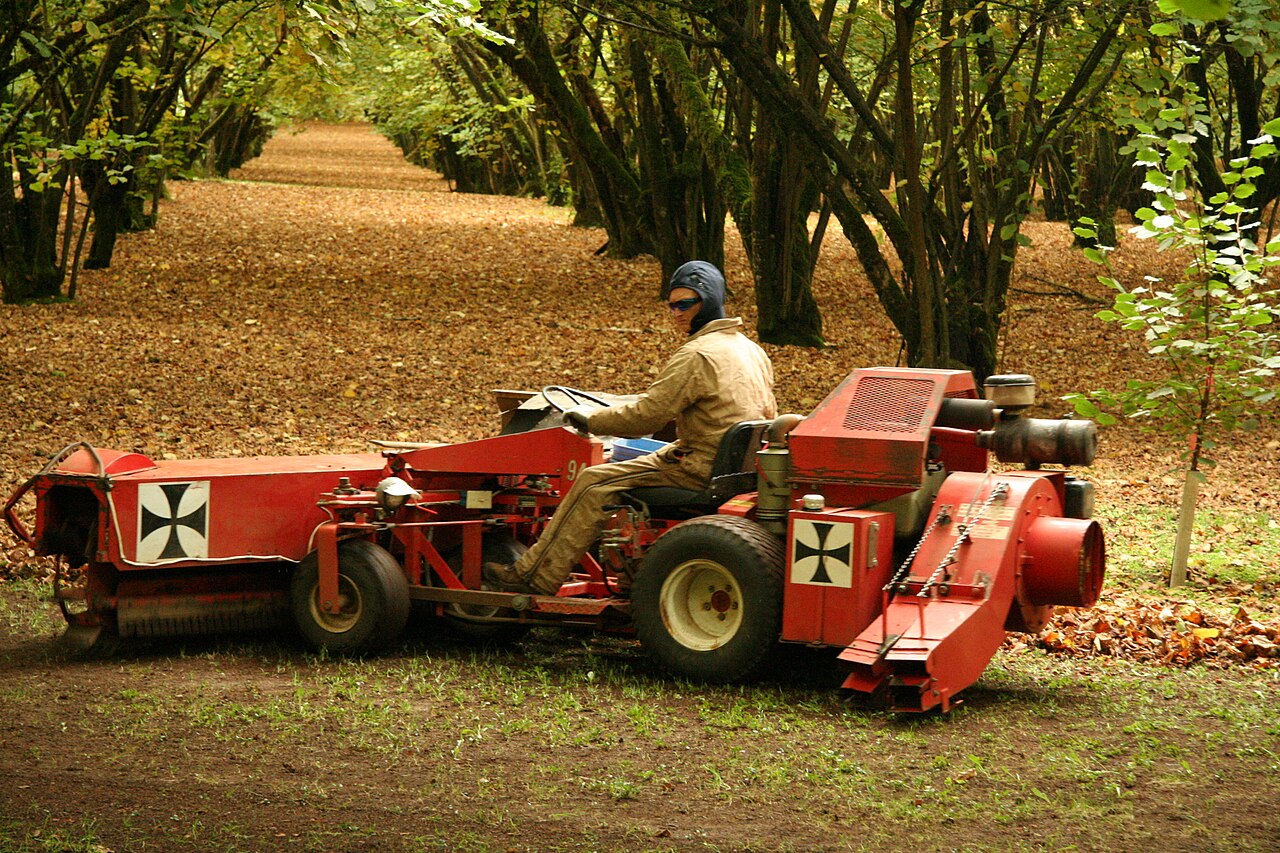
The self-propelled harvester has its own engine and does not require a tractor. This is the most productive, but also the most expensive category, intended for larger orchards and professional production.
- Typically covers about 0.35–0.5 ha per hour; theoretical capacity of top machines can be less than 1 h/ha, but actual performance depends on yield, plot size, and soil condition.
- Advantages: highest harvesting efficiency, operation by a single person (driver), high maneuverability, and often four-wheel drive (4×4) with automatic differential lock and low-pressure wide-profile tires that minimize impact on the soil and handle steeper slopes.
- Example from literature (PP "Orahovica"): three self-propelled Facma machines, capacity around 1000 kg/ha, machine weight 2200 kg, engine power 62.5 kW (85 HP).
- Top models feature self-cleaning tank belts, large pick-up diameter adjustable for different nuts, hydraulically movable front bulkhead for working with large amounts of impurities, and a powerful "Turbo jet" side fan with continuously adjustable speed.
In global practice, self-propelled machines of the "over-the-row" type (crossing over the row) with a shaking mechanism (slapper) are also distinguished, which are used in single-trunk orchard systems in the USA and France.
4. Manual and Walking (Compact) Sweepers
For small orchards, organic production, and hard-to-access or steep terrain, there are manual tools (e.g., "nut wizard") and small walking motorized or battery-powered sweepers. Their advantage is low cost and minimal soil compaction; the disadvantage is low capacity. In mountainous areas, designs mounted on single-axle garden tractors have also been developed.
Comparative Overview of Machine Types
| Machine Type | Power Source | Working Principle | Approximate Capacity | Typical Orchard Size | Investment |
|---|---|---|---|---|---|
| Manual / Walking | manual, motor, or battery | mechanical pickup | low | up to ~1–2 ha, steep terrain, eco | very low |
| Suction with tubes | tractor (PTO) | aspiration with manual tube guidance | low–medium | small and medium, hard-to-reach areas | low–medium |
| Trailed harvester | tractor (PTO + hydraulics) | mechanical pick-up + aspiration | ~0.2–0.4 ha/h; e.g., ~900 kg/h | medium, flat maintained plots | medium |
| Self-propelled harvester | own engine | mechanical pick-up + aspiration | ~0.35–0.5 ha/h; ~1000 kg/ha | large, professional | high |
Note: Capacity values are informative and can vary significantly depending on yield per hectare, plot size and shape, soil moisture and condition, and work organization.
Capacity: What Actually Determines Performance
Theoretical capacity listed in brochures is rarely achieved in the field. According to literature, actual harvesting performance depends on several factors:
- Yield (crop load) — denser crops mean more material per meter, but slower passage; sparse crops mean larger empty passes.
- Plot size and shape — longer, regular rows reduce time lost turning at headlands.
- Soil condition — unevenness, molehills, tire tracks from spraying, wet or muddy soil, and disturbed soil (e.g., from wild boars) slow down work and increase losses and impurities.
- Cleaning type — machines with stronger aspiration and sieves provide cleaner nuts, reducing later work in processing.
Turkish sources cite working capacities of mechanical sweepers in the range of 300–500 kg/h, depending on soil condition, while Italian technical literature cites a theoretical capacity of less than 1 h/ha for self-propelled machines. The difference between these figures clearly shows how crucial field conditions are.
Terrain and Condition Adaptation
The choice of machine depends not only on size, but also on the configuration and condition of the terrain:
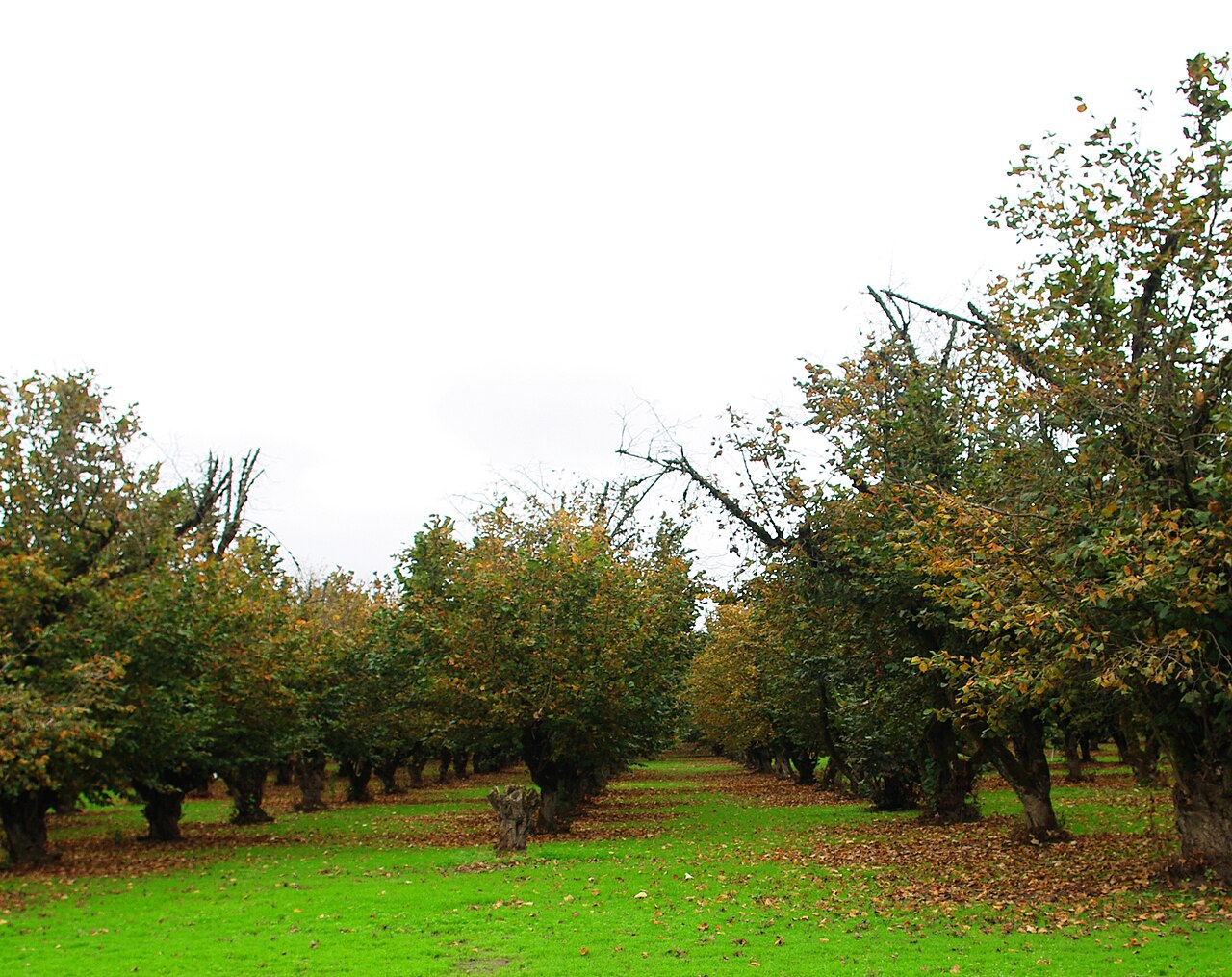
- Flat, maintained terrain — offers the most options for trailed (cheaper) models and allows for the highest capacity.
- Larger and more complex areas, gentle slopes — require self-propelled machines due to maneuverability and 4×4 drive.
- Wet conditions — quality self-propelled machines with mechanical pick-up work well in wet conditions; pick-up adaptation to soil depends on soil condition and width.
- Steep and mountainous terrain — walking machines or single-axle designs; for self-propelled machines with rear-wheel steering only, care must be taken regarding lateral sliding on slopes (Hangabdrift).
- Dust and noise — suction and self-propelled machines generate significant dust and noise, which should be considered for occupational health and safety (personal protective equipment, filters).
Very demanding high-capacity machines (e.g., Facma SEMEK 1000, ~30–60 ha) require flawlessly flat and maintained surface between rows — without tire tracks, hardened molehills, disturbed soil, gullies, and similar issues. This means that buying a large machine is not enough; the orchard must also be appropriately prepared.
Machine Selection Based on Orchard Size
The literature corpus provides a concrete reference table linking plantation size, machine type, and required tractor specifications (example from the Facma product line):
| Plantation Size (ha) | Machine Type | Required Tractor | Note |
|---|---|---|---|
| up to 5 | C 120 T | 30–40 HP | without side brush |
| 4–8 | C 200 T | 55–70 HP | side brush + trailer possible |
| 7–12 | C 300 T | 75–90 KS | side brush + trailer mounting possible |
| 10–15 | C 380 T | 80–100 HP | side brush + trailer mounting possible |
| 5–15 | C 180 S | self-propelled | recommended tow of loading trailer |
| 10–25 | C 200 S | self-propelled | trailer with all models |
| 20–35 | C 300 S | self-propelled | — |
| 20–40 | C 380 S | self-propelled | — |
| 30–60 | SEMEK 1000 | self-propelled | high capacity; requires perfectly flat and maintained surface |
The "T" designation indicates towed (tractor-drawn) models, while "S" indicates self-propelled models. The table is informative and specific to the manufacturer's product line; figures and required power depend on the model, year, and equipment.
Practical rules derived from this:
- Small orchards (up to ~5 ha): manual tools, vacuum collectors with tubes, or smaller towed models with a 30–40 HP tractor. Investment in a self-propelled machine is hard to justify.
- Medium orchards (~5–15 ha): medium-class towed harvester with an appropriate tractor (55–90 HP), with the option of side brushes and loading trailers. Entry into smaller self-propelled models is also on the borderline.
- Large orchards (15 ha and more): self-propelled harvesters, and for over 30 ha, high-capacity machines requiring perfectly maintained soil.
Economics and Common Mistakes
Hazelnut harvest machines are expensive, and since harvesting takes place for only a few weeks each year, utilization is a problem. Literature explicitly emphasizes that automatic (self-propelled) machines offer high efficiency and a small workforce, but require high utilization rates to be cost-effective. Therefore, for smaller producers, joining multiple farms for joint purchase of a machine is often recommended, thereby distributing the cost and increasing annual utilization.
Most common mistakes in selection and operation:
- Oversized machine on unprepared soil — purchasing a high-capacity self-propelled harvester before the orchard is leveled and cleared leads to losses, dirty nuts, and breakdowns.
- Neglecting soil preparation — without leveling, weed removal, and "pre-collecting" empty nuts, even the best machine performs poorly.
- Ignoring the entire technological chain — alongside harvesting, the drying facility, grader, cracker, and trailers must be planned; nuts are harvested at around 30–35% moisture content and must be dried quickly.
- Incorrectly estimated tractor power — towed models require a tractor of appropriate power (from ~30 to ~100 HP depending on the model); an underpowered tractor cannot drive the machine on demanding soil.
- Underestimating dust and noise — without PPE and filters, self-propelled/vacuum machines can be hazardous to the operator.
Practical Recommendations
- Choose the machine based on the combination of orchard size, plot shape and slope, and soil condition — not just hectares.
- Before purchase, verify the actual, not just declared, capacity under conditions similar to yours (yield, soil, plot shape).
- Prepare the soil in advance: leveling, weed removal, forming nut rows, and "pre-collecting" empty nuts.
- Consider side brushes and loading trailers as equipment that increases efficiency.
- For small orchards, seriously consider joining forces for joint procurement or using custom harvesting services.
- Plan harvesting as part of the entire processing chain (drying, grading, cleaning, storage).
Sources
This article is an AI summary compiled from an internal literature collection on hazelnuts (RAG corpus) and supplemented with public internet sources. Main sources used:
- Parameters for selecting machines and equipment for hazelnuts (plantation size / machine type / tractor table) — internal RAG corpus
- Vrtodušić et al.: Harvesting, drying, and storage technology of hazelnuts: Literature review — https://jcea.agr.hr/articles/772314_Tehnologija_berbe_su_enja_i_skladi_tenja_lje_njaka_Pregled_literature_hr.pdf
- Tractor attachment for hazelnut harvesting (vacuum collectors, tube diameter, power) — internal RAG corpus
- Mechanization in hazelnut production and processing (PP Orahovica, Minas-Zrno; self-propelled machine capacity) — internal RAG corpus, https://doi.org/10.18485/bibliotekar.2025.67.2.6
- Environmental protection study (mechanical harvesting with self-propelled harvester, 1.5 m³ trailer) — internal RAG corpus
- Economic analysis of hazelnut production — internal RAG corpus
- ILT — Vortrag Haselnusstag 2009 (types of self-propelled machines, terrain adaptation) — https://www.lfl.bayern.de/mam/cms07/ilt/dateien/ilt1_vortrag_haselnusstag_2009.pdf
- Monchiero / Flory technical documentation for self-propelled harvesters — internal RAG corpus
- Raccolta delle nocciole — Manuale tecnico (Italian; capacity h/ha) — internal RAG corpus
- Turkish sources on the working capacity of mechanical collectors (300–500 kg/h) — https://doi.org/10.33409/tbbbd.1110496
- Agri-export: How to Harvest Hazelnuts: Modern Methods and Machinery — https://www.agri-export.it/en/2025/09/03/hazelnut-harvest_en/
- Hazelnut Hub: Innovations in Hazelnut Harvesting — https://hazelnuthub.com/hazelnut-harvesting-innovations/
- FACMA / SEMEK 1000 and Cimina (types and selection based on size and terrain) — public manufacturer materials
Recommended equipment
🔎 nut harvester machine — Amazon →Affiliate links — we may earn a small commission at no extra cost to you.
Hazelnut Harvesting Equipment
Compare manual, semi-mechanized, and larger solutions.
| Use Case | Option Type | What to Check Before Purchase |
|---|---|---|
| Small gardens | Manual rakes and nets | Handle length and net durability |
| Medium orchards | Semi-mechanized sweepers | Engine power and collection capacity |
| Large plantations | Over-the-row harvesters | Professional machinery specifications |