Forming the training shape of hazelnut in the first years
Content generated by artificial intelligence — check before application
This article was automatically compiled from a collection of hazelnut literature using artificial intelligence and may contain errors or outdated data. It serves as a starting point for further research, not as professional advice. Dosages, products, and timing are informative and depend on the cultivar, location, and current regulations — always consult with an advisory service and official sources before application.
The training shape you establish during the first three to four years after planting will determine the productivity, light penetration, and ease of maintenance of the hazelnut orchard for the next twenty years. Hazelnut naturally grows as a branched shrub with multiple trunks, is highly heliophilous (sun-loving), and bears fruit on one-year-old shoots. Therefore, any training system must reconcile three requirements: good light penetration into the interior, a sufficient number of quality one-year-old growths, and a feasible, low-cost harvest. This article describes how to gradually build a shrub or open-center vase shape: how to select leaders (main branches), at what height to position the trunk, and how to open the center so that light reaches all parts of the plant.
Why early training shape is crucial
Hazelnut growing spontaneously forms an extremely dense bush: shoots and sprouts that constantly emerge become long, densely interwoven branches. Excessive branches elongate excessively without differentiating flower buds, and in the lower part of the bush, they become an obstacle for soil cultivation and harvesting. The goal of training is precisely the opposite: to shape the canopy to be as natural as possible, yet airy and well-lit, where fruit buds differentiate evenly, not just at the tips and edges.
Important warning from literature: do not over-prune in the first years. If young hazelnut is pruned too heavily, and shoots are thinned immediately after planting, the plant will bear fruit late. Therefore, for the first three years, only light pruning is typically performed — directing and thinning, not severe shortening.
Choosing the training shape
In practice, hazelnut is grown in several shapes; they differ by whether they have a trunk and how the skeleton is built.
| Training Shape | Trunk | Skeleton | When to choose |
|---|---|---|---|
| Natural shrub | no trunk | multiple trunks from the base | extensive cultivation, dry areas without irrigation, snowy and higher altitude areas |
| Open-center vase (Shrub vase) | no trunk (or low, up to ~60 cm) | 3–4 primary branches angled away from the axis | most common recommendation in HR, good balance of productivity and light penetration |
| Vase with trunk | 30–70 cm | 3–4 main branches | soils with irrigation, more fertile sites |
| Standard tree | 60–90 cm | 3–4 distributed branches + central leader | easier harvest; disadvantage is vulnerability (damage to the tree ruins the whole plant) |
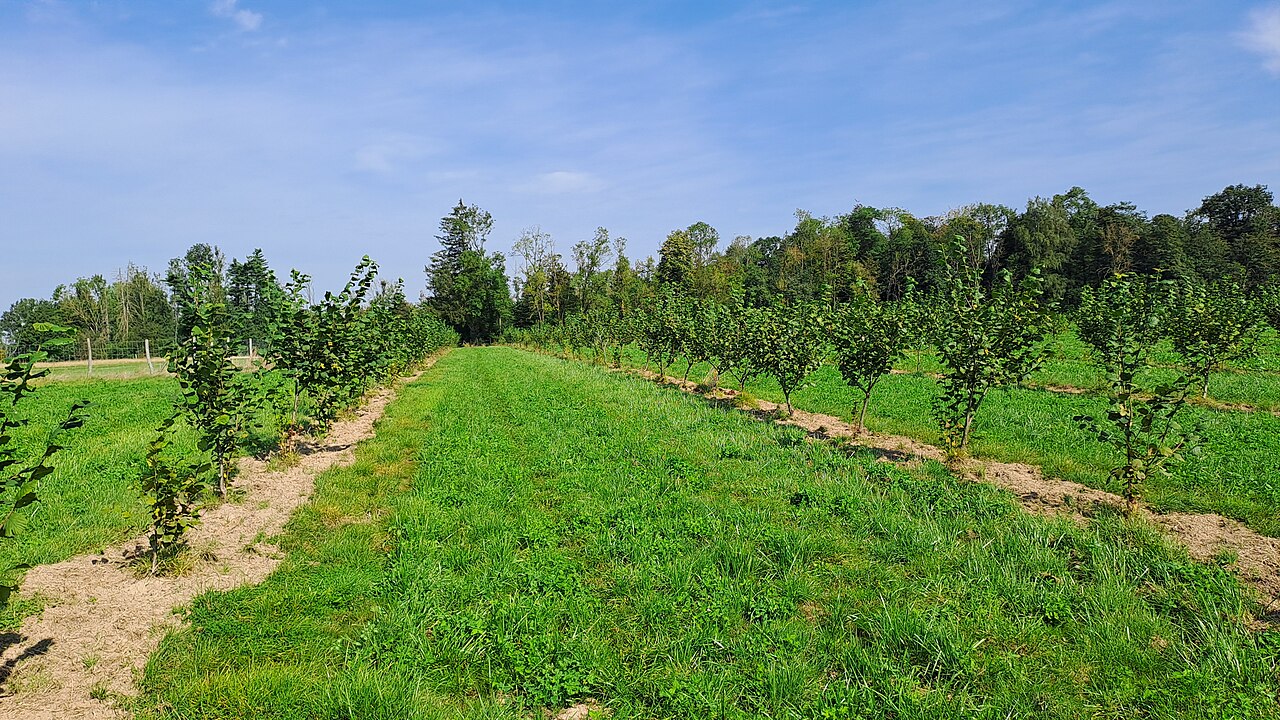
Most Croatian sources and studies cite the open-center vase (shrub vase) as the best shape in practice because it best aligns the natural requirements of hazelnut with good and regular productivity. This is a combination of a natural shrub and a vase: a shrub without a prominent central leader, with an open, well-lit center.
Standard tree vs. Shrub
- Standard tree (trunk 60–90 cm, one central leader) facilitates harvesting and fruit collection as well as soil cultivation, but if the tree is damaged by frost, pests, or mechanical injury, the entire plant is lost and restoration is difficult.
- Shrub / Open-center vase more naturally suits the biology of hazelnut, is easier to restore (there are always new shoots), but requires permanent and consistent removal of root suckers (water sprouts).
Step by step: building the shape through the years
The following is a summarized timeline. The numbers (heights, distances, number of branches) are informative and depend on the cultivar, vigor, site conditions, and irrigation.
| Year | Main Action | Goal |
|---|---|---|
| Planting / Year 1 | Shortening the seedling; selecting future leaders | Stimulate branching at the base |
| Year 2 | Development of secondary branches; removing competitors | Stabilize the skeleton |
| Year 3 | Light thinning; opening the center | Ensure light and air circulation |
| Year 4 | Finishing the shape; beginning of fruiting | Transition to fruiting pruning |
Planting and the first year
At planting, the seedling is shortened. Literature cites a range of interventions:
- For a shrub: the seedling is cut low after planting (about 25–30 cm), which stimulates the emergence of multiple shoots from the base. During the first summer, shoots grow and are not removed.
- For a standard tree: the seedling is cut to one or two buds; when the shoots grow to ~10 cm, leave the most vigorous, upright shoot, and remove vegetative buds from the others. This upright shoot is tied to a support and shortened when it reaches 1.5–2 m.
It is crucial to plant at the same depth as the seedling was in the nursery; if planted too deep, it may stagnate for up to three years.
Selecting leaders (main branches)
Leaders are the permanent skeleton of the plant. Rules from the corpus:
- For the open-center vase, leave 3–4 primary branches, properly angled away from the imaginary central axis. In the case of a three-branch shape, they form an angle of approximately 120° with each other, evenly distributed around the shrub.
- Branches should grow from the center of the shrub in different directions, spaced apart from each other, so they do not overlap or shade each other.
- The number of main branches depends on the vigour of the cultivar — leave as many as necessary to not reduce the overall growth of the plant.
- Remove all injured, diseased, weak, deformed, and competing stems. Be careful not to let the shrub become too dense.
The selection process for a shrub often goes like this: in the spring of the second year, keep several of the strongest shoots emerging from the ground (some gardening sources mention up to ~10 shoots in the initial phase), and by further thinning, reduce this to the final 3–4 load-bearing leaders.
For a standard tree, a different pattern applies: leave 5 shoots, of which 4 are cut back to the same level, and the central main shoot is left 2–3 cm higher and serves as the central leader; all other shoots are gradually removed throughout the year.
Trunk height
Trunk height distinguishes the shapes and directly affects harvesting and soil cultivation:
| Shape | Recommended Trunk Height |
|---|---|
| Open-center vase (no trunk) | 0 cm — branches from the base |
| Open-center vase with low trunk | about 60 cm |
| Vase with trunk | 30–70 cm |
| Standard tree | 60–90 cm |
Generally: lower trunk = closer to natural shape, easier restoration; higher trunk = easier mechanized harvest, but greater vulnerability. In shapes with a trunk, the main branches are formed from buds located below the point where the seedling was cut.
Development of secondary (skeletal) branches
Once the leaders are selected, secondary skeletal branches are built in the second and third years:
- Secondary branches develop from primary ones, at specific distances and positions.
- The recommended distance between secondary branches is cited differently: one source mentions about 50 cm apart, while others (Krpina et al.) recommend 15–20 cm at an angle of 15–20° to the central axis. Differences arise from the cultivar and planting density — adjust them to the vigour.
- The tips of secondary branches and the leader should be kept open (unshaded) at all times.
Caution with shortening the skeleton
Primary branches and strong lateral branches should not be cut back, as this stimulates the formation of adventitious buds and vigorous, unproductive shoots. The skeleton is shaped by selection and thinning, not by shortening.
Opening the center of the shrub
Opening the center is crucial because hazelnut is heliophilous: the most flower buds differentiate in illuminated areas, so a shaded interior remains unproductive.
Practical guidelines:
- Remove to the base all summer shoots that grow inward, as well as shoots of unfavorable growth and those that grow too upright (they obstruct other branches and cast shadows).
- The goal is a bowl or "boat" shape — an open, airy center. In some systems, the central guide of the vase canopy is shortened, and outer shoots are bent outward to free up the center.
- The simplest pruning rule: always cut above a bud facing outward, which directs growth away from the center.
- Thinning is usually done in spring, when buds begin to open; excessively developed, weak, and too closely spaced branches are removed.
Removal of root suckers (water sprouts)
Root suckers (water sprouts) compete with the shrub for water and nutrients, deplete it, and shade the central part:
- They are removed 2–3 times during the growing season.
- In the first years of formation, they are removed manually with shears, cut back to the base.
- The intensity of shoot emergence depends on the cultivar and whether the plant is on its own roots (hazelnut on its own roots produces many shoots; the C. colurna rootstock produces almost none).
Timing and tools
- The best time for winter pruning is during vegetative dormancy, when temperatures are above 0 °C.
- Heavy pruning on already formed plants is traditionally associated with the time of female flower blooming (for visual control of productivity), but in the formation phase, interventions are mild.
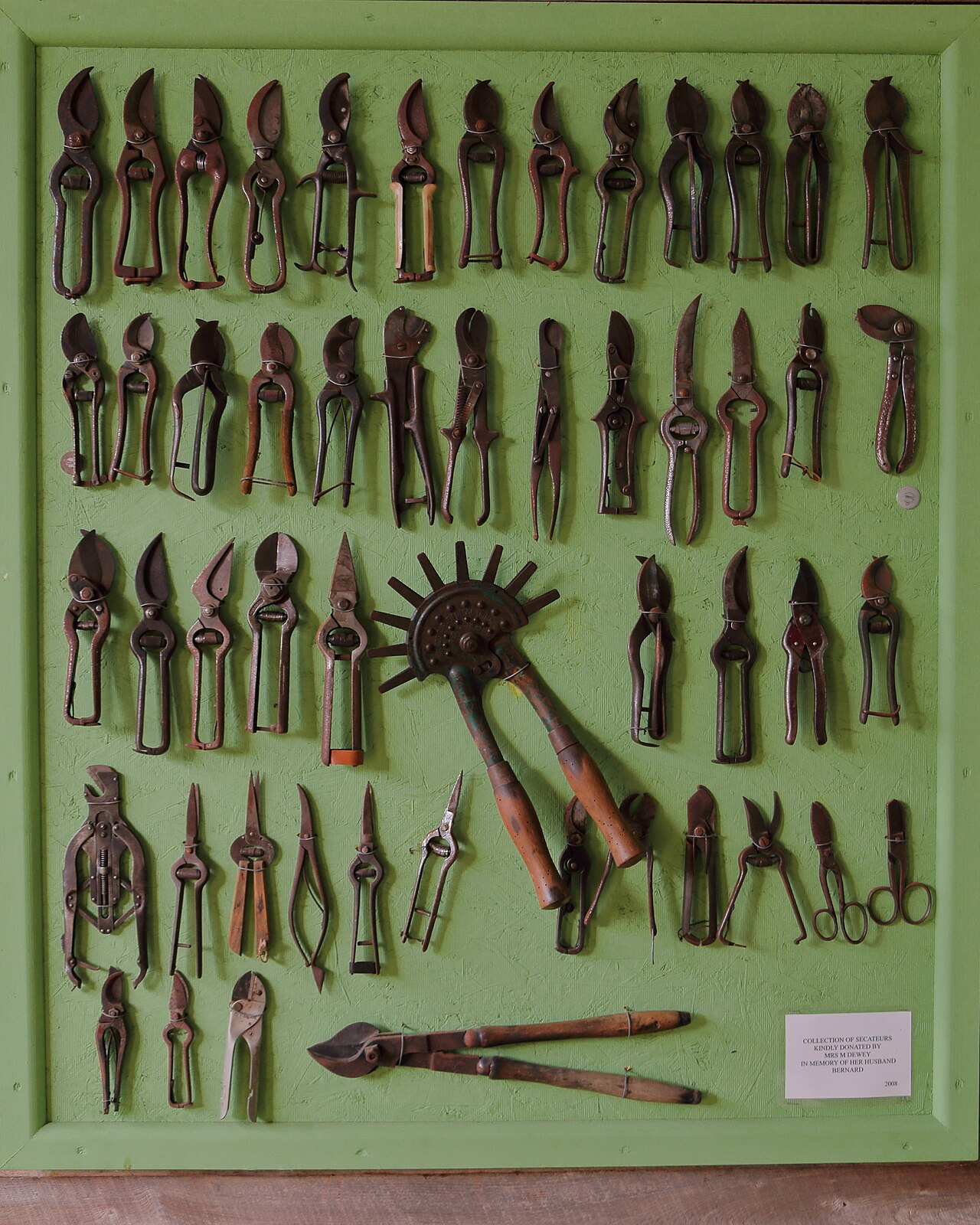
- Use clean and sharp shears for branches up to about 2.5 cm and a saw for thicker branches; be careful not to damage the bark and leave enough strong buds for future growth.
Key numbers to remember
- 3–4 primary branches (leaders) for the open-center vase.
- ~120° mutual angle in the three-branch shape.
- 15–20 cm (or up to ~50 cm, depending on the cultivar) distance between secondary branches.
- Trunk height: 0 (shrub) / 30–70 cm (vase) / 60–90 cm (standard tree).
- One-year-old fruiting growth: 15–25 cm (fruiting occurs on it).
- Water sprouts: remove 2–3× annually.
- First 3 years: only light pruning.
Practical recommendations and common mistakes
Recommendations
- Decide on the training shape before planting — trunk height and planting distance (e.g., 4×4, 4×5, or 5×4 m for the open-center vase, about 500 shrubs/ha) depend on the choice.
- Build the skeleton by selection and thinning, not by shortening.
- Keep the center open from the first year — it is easier to prevent thickening than to fix it later.
- Remove water sprouts regularly and consistently; neglect quickly leads to a dense, unproductive bush.
Common mistakes
- Too heavy early pruning — delays fruiting; be restrained in the first years.
- Shortening primary branches — causes vigorous adventitious shoots instead of fruiting wood.
- Planting too deep — the plant stagnates for years.
- Neglecting water sprouts — deplete the shrub and shade the center.
- Too many leaders — overly dense shrub, poor light penetration, poor bud differentiation.
Gallery
Sources
This text is an AI-generated summary compiled from a collection of hazelnut literature (internal RAG corpus of reports, guides, and professional articles) and supplemented with public web sources. Main sources used:
- Hazelnut Cultivation: GUIDE (savjetodavna.mps.hr, 2024.)
- Environmental Impact Assessment – Establishment of a permanent hazelnut and plum orchard, Grubišno Polje (MUNDO MELIUS d.o.o., 2020.) — bbz.hr
- Environmental Impact Assessment – hazelnut orchard, Vojnić Municipality (EcoMission d.o.o., 2021.)
- Economic analysis of hazelnut production (Krpina et al., 2004., cited; document 2023.)
- Hazelnut pruning — agronomija.info, D. Marjanović (2017.)
- Hazelnut pruning — AgroPortal.hr
- Hazelnut planting — AgroPortal.hr
- PDF HAZELNUT CULTIVATION (pdfcoffee, 2009.)
- From planting to hazelnut harvest — savjetodavna.mps.hr
- Hazelnut cultivation — Voćkarica&Vrtlarica
- Planting plan and training systems of the hazelnut tree — Vivai Nicola
- Pruning of the bushy-vase hazelnut tree — Vivai Nicola
- A Basic Guide to Pruning Hazelnut Trees — OSU Extension
- Practical guideline on pruning of hazelnut trees — FAO
Recommended equipment
🔎 bypass pruning shears — Amazon →Affiliate links — we may earn a small commission at no extra cost to you.
Bypass Pruning Shears
Designed for manual pruning of young shoots and thin branches.
| Use Case | Option Type | What to Check Before Purchase |
|---|---|---|
| Precision cutting | Standard bypass design | Blade sharpness and spring tension |
| Ergonomic handling | Adjustable grip size | Handle comfort and leverage ratio |
| Heavy duty tasks | Loppers or saws | Professional tool selection for thick wood |