Hazel leaf sawfly (Croesus septentrionalis)
Content generated by artificial intelligence — verify before application
This article was automatically compiled from a collection of hazelnut literature using artificial intelligence and may contain errors or outdated information. It serves as a starting point for further research, not as professional advice. Dosages, products, and timing are informative and depend on the cultivar, location, and current regulations — always consult with an advisory service and official sources before application.
The hazel leaf sawfly (Croesus septentrionalis) is an occasional, but sometimes very conspicuous, pest of hazel. Although it is rarely economically significant in mature, established hazelnut orchards, its larvae can completely defoliate the leaves of young bushes and saplings in just one to two days, leaving only the main leaf veins. The peculiarity of this pest lies not only in the speed of the attack but also in the fact that there is not a single insecticide registered in Croatia specifically for its control, and furthermore, some biological preparations that otherwise effectively control caterpillars (e.g., Bacillus thuringiensis) do not work — because this is not a butterfly, but a hymenopteran (sawfly). Below, we present its biology, identification, economic threshold, and realistic control options.
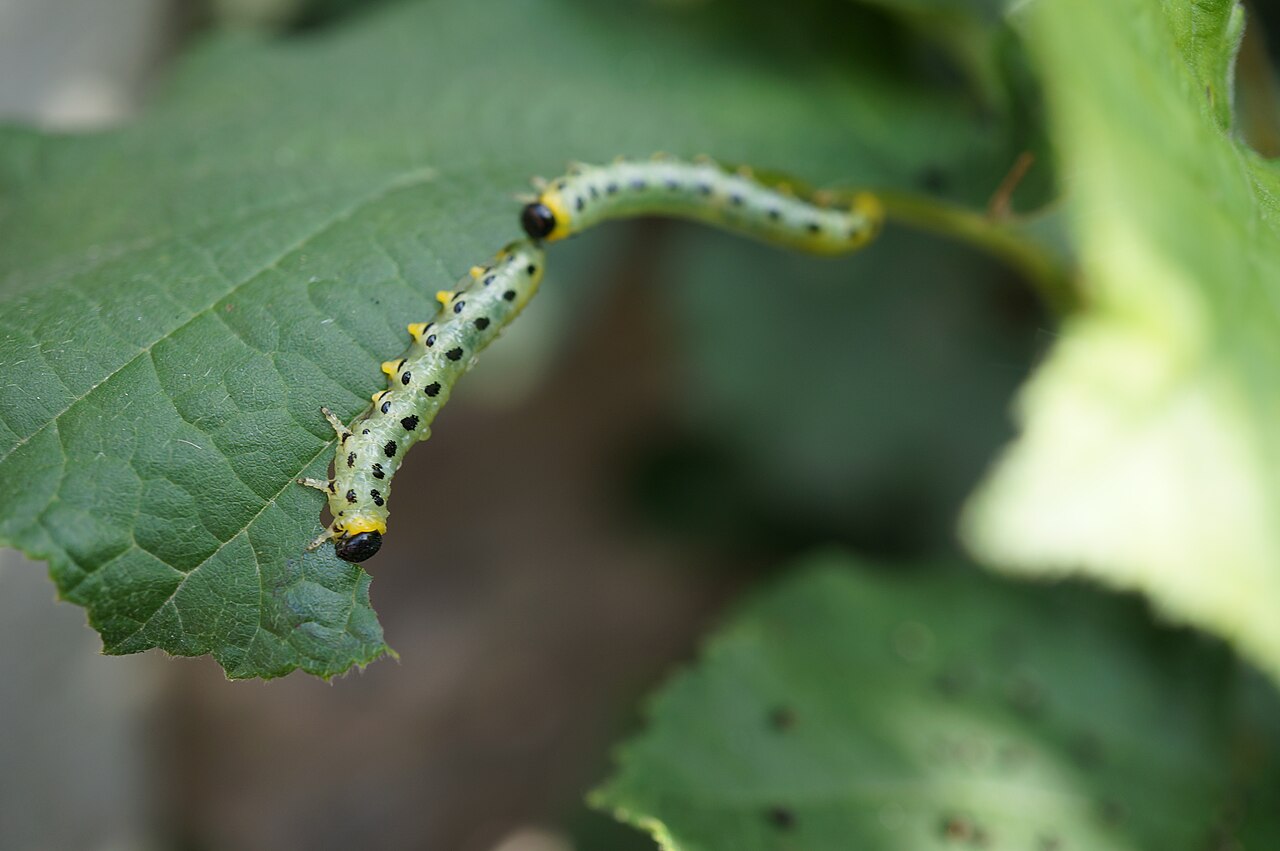
What is the hazel leaf sawfly and why is it special?
The hazel leaf sawfly belongs to the family of sawflies (Tenthredinidae), order Hymenoptera. This is systematically important: its larvae are not true caterpillars (caterpillars are larvae of butterflies, order Lepidoptera), but sawfly larvae or "false caterpillars." The difference is more than terminological, as it directly determines which control measures can actually work.
Sawfly larvae resemble caterpillars in appearance but differ in the number of prolegs (usually six or more pairs of abdominal prolegs, whereas true caterpillars have at most five pairs) and in behavior. Due to this biological difference:
- Bacterial preparations based on Bacillus thuringiensis (Bt) do not work on sawfly larvae. Bt toxins target the intestinal epithelium of lepidopteran larvae; hymenopteran larvae (sawflies) are not sensitive to them. Therefore, despite being a common "bio" choice against caterpillars, Bt is useless against the hazel sawfly.
- For the same reason, caution is needed when transferring recommendations "for caterpillars" to this pest — some of them (especially microbiological ones) are simply not applicable.
In the hazelnut literature corpus, this pest is mentioned under the name Croesus septentrionalis (in older and folk sources also as Craesus septentrionalis), and is described as an occasional defoliator that "attacks leaves at the margins" and lives in groups.
Identification and symptoms
Larvae
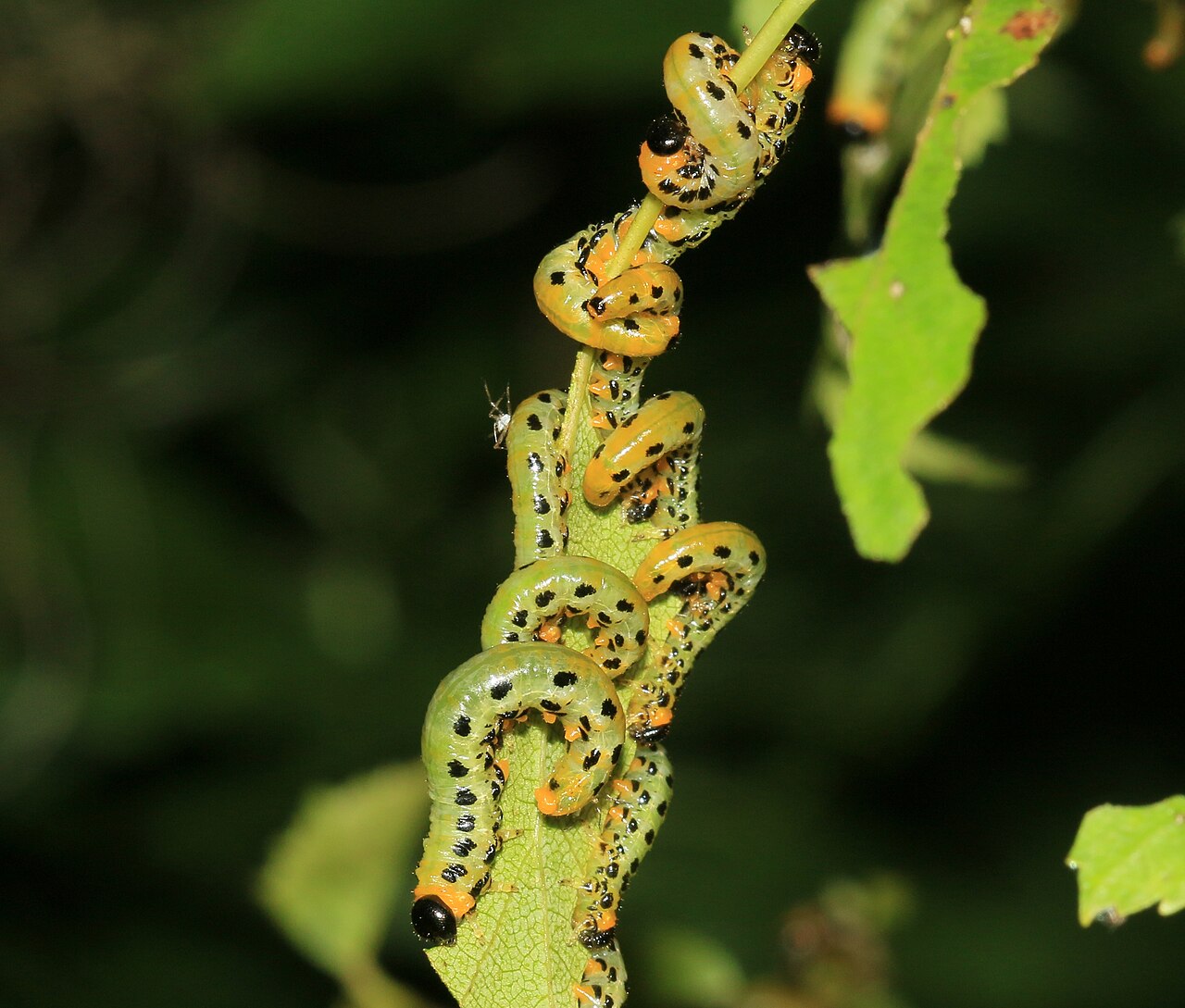
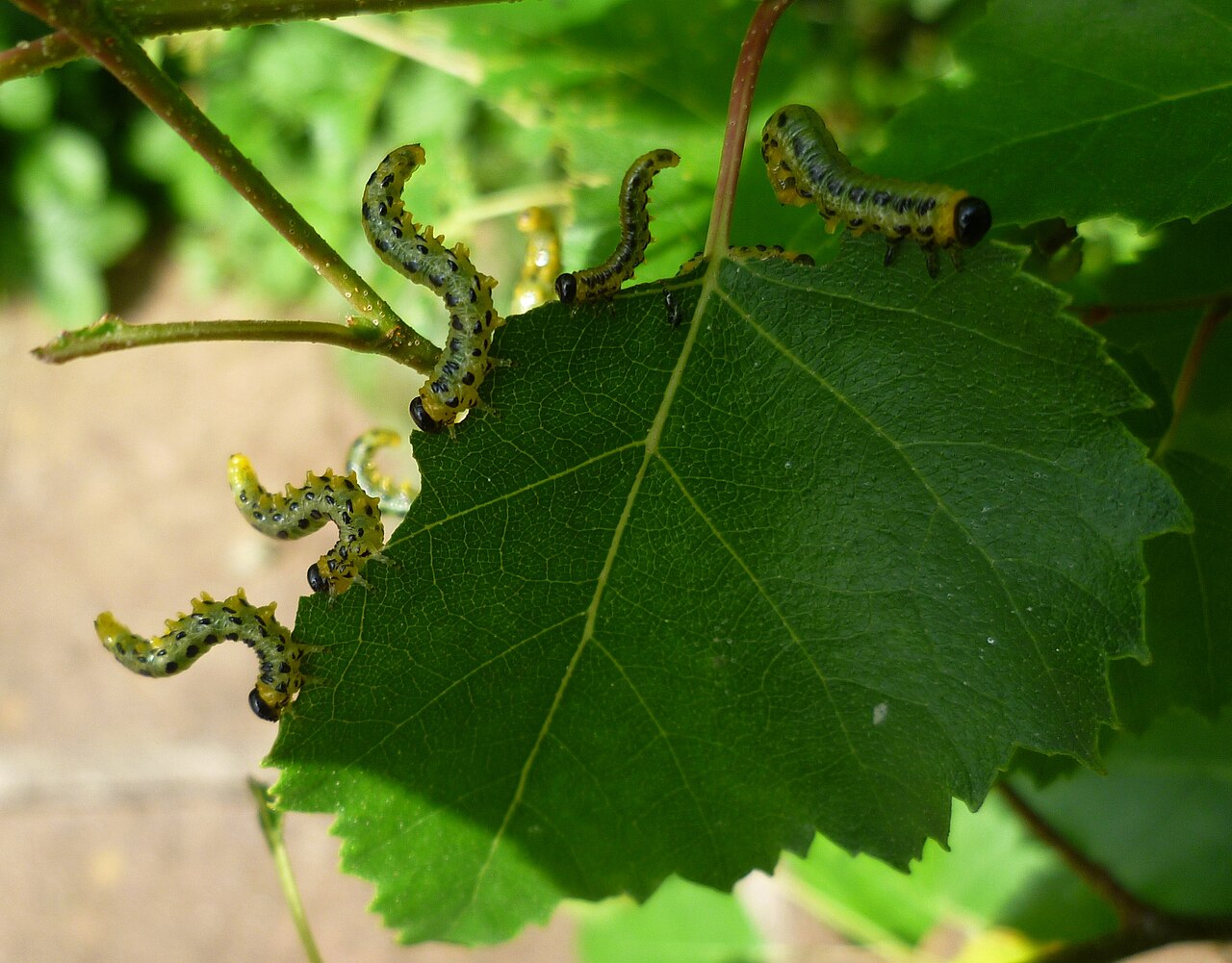
The characteristic appearance of the larvae facilitates diagnosis:
- length up to almost 3 cm (about 25 mm when fully developed);
- golden-yellow to yellow color, with a black head and transverse dark dorsal stripes/lines;
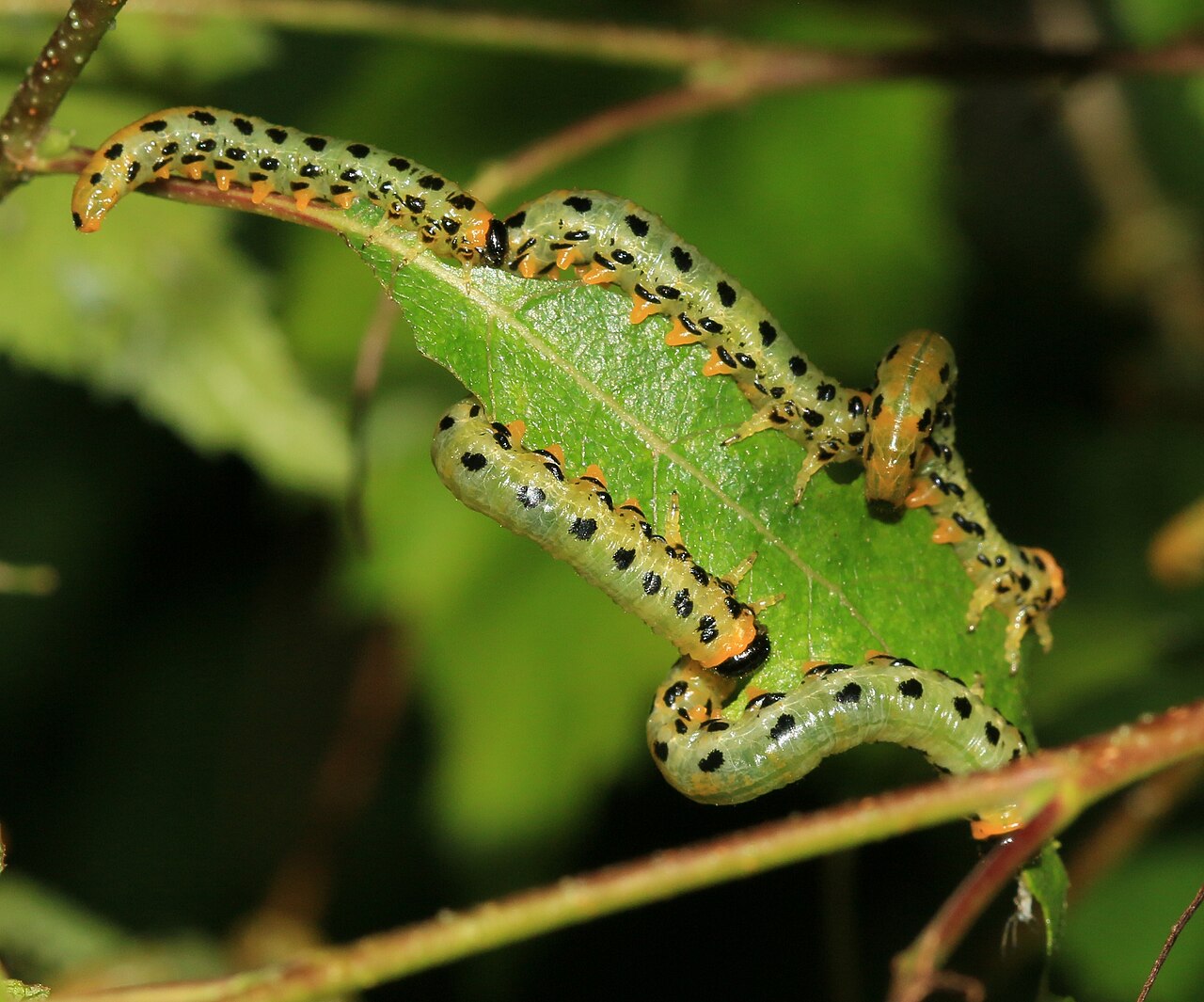
- live and feed in groups (gregarious), making them easily noticeable at leaf margins;
- when the colony is disturbed, they often synchronously raise the posterior part of their body into a recognizable "S" defensive pose (aposematic, warning behavior).
Leaf damage
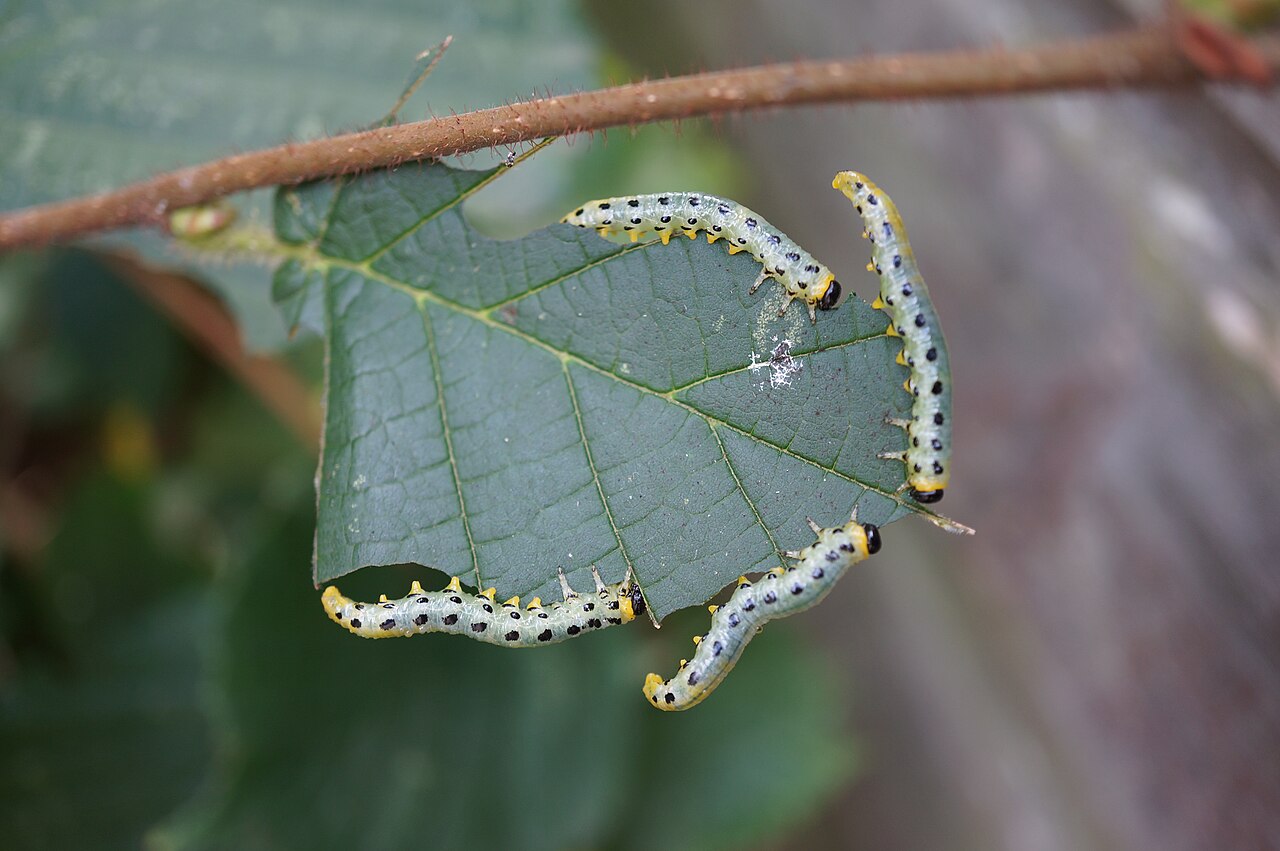
Sawfly larvae attack the leaf from the margin inward and skeletonize the entire leaf blade so that eventually only the main (primary) veins remain. This leaf "skeleton" is very characteristic and distinguishes sawfly damage from chewing that leaves irregular holes.
The attack can be stealthy and rapid: literature describes a case from 2020 where damage on young saplings was "enormous in just one to two days," and leaf mass on individual plants almost completely disappeared — the plants looked "as if something had grazed them."
| Characteristic | Hazel leaf sawfly (Croesus septentrionalis) |
|---|---|
| Pest group | sawfly (Tenthredinidae), Hymenoptera — not a butterfly |
| Damaging stage | sawfly larvae (false caterpillars) |
| Larva size | up to ~25–30 mm |
| Color | golden-yellow/yellow, black head, transverse dark stripes |
| Behavior | gregarious (in groups), marginal leaf chewing |
| Typical symptom | leaf skeletonized to main veins ("leaf skeleton") |
| Most vulnerable | young bushes, saplings, plants in the formative growth stage |
Biology and life cycle
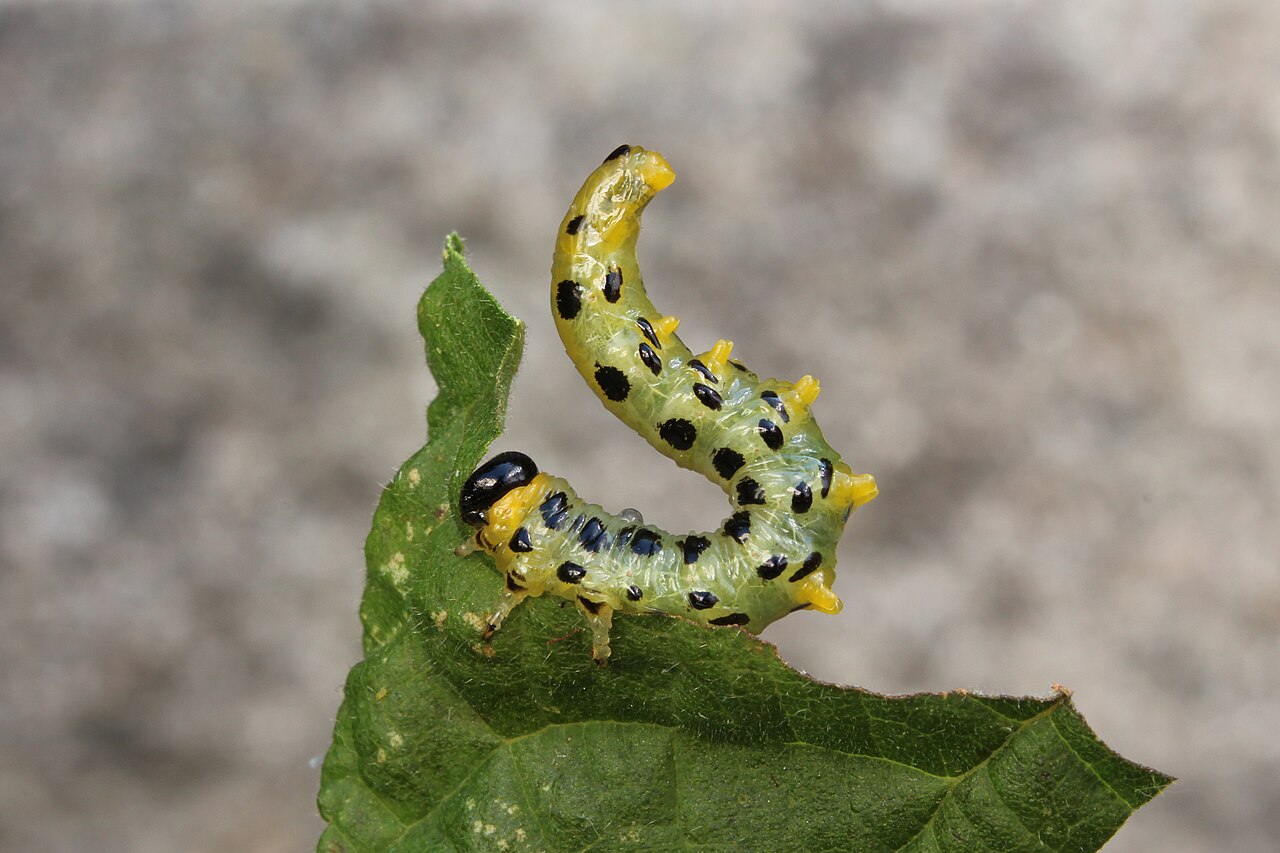
In our conditions, the hazel sawfly typically develops two generations per year. Key phases:
- Egg laying. Females lay eggs on hazel leaves (and other host plants — see below).
- Larval feeding. Larvae remain in groups and feed from the leaf margin. They are present:
- first generation — from mid-June,
- second generation — until mid-September.
- Pupation in soil. After feeding is completed and development is complete, larvae descend into the soil for transformation. Just below the soil surface, their brown pupae in cocoons are found.
- Overwintering. Second-generation larvae overwinter in cocoons in the soil and in spring, after transformation, give rise to new adult sawflies — and the cycle begins anew.
| Phase | Period | Location |
|---|---|---|
| 1st generation larvae | from mid-June | on hazel leaves |
| 2nd generation larvae | until mid-September | on hazel leaves |
| Pupation | after feeding is completed | shallow in soil (brown cocoon) |
| Overwintering | autumn–winter | 2nd gen. larvae in cocoon in soil |
| Appearance of adult sawflies | spring | from overwintered cocoons |
The fact that the pest pupates and overwinters shallowly in the soil opens up opportunities for indirect, mechanical measures (see "Control").
Host plants
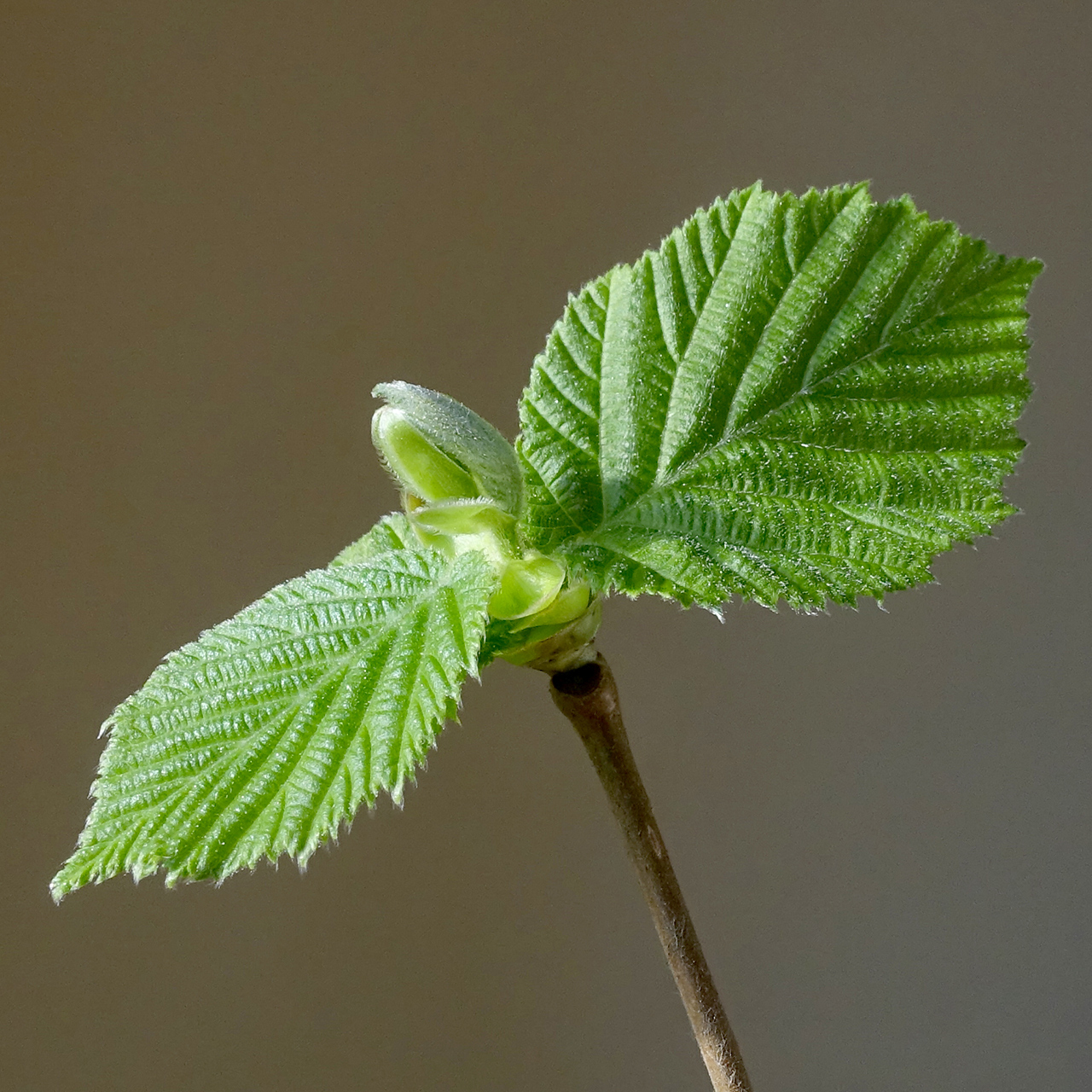
Besides hazel (Corylus avellana), the hazel sawfly also attacks a number of ornamental and forest deciduous trees from the genera Alnus (alder), Betula (birch), Carpinus (hornbeam), Acer (maple), Populus (poplar). Therefore, the source of infestation may not be just the orchard — surrounding deciduous trees can be reservoirs of the population.
Economic importance and economic threshold
In practice, it is important not to panic. From literature and field observations:
- Mature orchards with developed canopy volume are usually NOT significantly damaged by leaf sawfly larvae. Adult, vigorous hazel tolerates the loss of part of the leaf mass without a measurable effect on yield.
- Damage occurs only on individual young bushes if a large number of larvae develop on the leaves, leading to defoliation. Saplings and plants in the formative growth stage are the most sensitive, as every leaf is valuable for canopy development.
Defoliation threshold
For this pest in hazel, there is no officially prescribed, numerically defined economic threshold, so the decision to intervene should be based on an assessment of defoliation and plant age. As a guide (taken from practice with related sawflies), the rule is that intervention is usually not justified until less than ~50% of leaf mass is skeletonized on a healthy, well-developed plant. For young saplings and newly formed bushes, the threshold must be much lower — for them, even a smaller percentage of defoliation can slow development, so it is justified to react earlier.
A guide, not a rule
The mentioned ~50% should be understood as a rough guide for adult plants, transferred from experience with related sawflies. For nurseries, young orchards, and individual bushes around homesteads, a "zero tolerance for defoliation" approach applies because the goal is to preserve leaf mass needed for canopy development.
The practical consequence: in most mature, productive orchards, it is sufficient to only monitor (monitoring) and, if necessary, locally mechanically remove colonies, while targeted treatment is considered mainly in nurseries, young orchards, and during strong, localized outbreaks on young plants.
Control
1. Mechanical and Preventive Measures (First Line of Defense)
Since sawfly larvae live in dense groups and are easily visible, mechanical measures are often the most effective and cost-efficient — especially in small orchards and on individual bushes:
- Regular monitoring of young bushes and saplings from mid-June and again in late summer (September), as these are the peaks of two generations.
- Manual removal (plucking and destruction) of infested leaves with entire colonies while the sawfly larvae are still clustered — this quickly removes a large portion of the population.
- Shallow tillage/turning of the soil around bushes in autumn and spring, which disrupts pupation and overwintering (pupae are shallow below the surface), similar to control measures for Corylus aphid (ljeskotoč).
- General orchard hygiene (weed removal, regular maintenance) and monitoring surrounding deciduous trees (alder, birch, hornbeam, maple, poplar) which can be sources of infestation.
2. Chemical and Botanical Control — What (Does Not) Work
Key Fact: In Croatia, there are no registered insecticides for controlling the hazelnut sawfly. This means this pest should not be treated "specifically", but rather relies on the secondary (side) effect of products registered in hazelnut for other purposes (aphids, leafrollers), while strictly adhering to the label instructions.
- Bt (Bacillus thuringiensis) — DOES NOT work. It is a sawfly (Hymenoptera), not a moth; sawfly larvae are not sensitive to Bt toxins. Therefore, Bt is not an option.
- Deltamethrin (side effect). Products based on deltamethrin (e.g., Decis 100 EC, Rotor Super, Scatto, Deltametrin 25 EC) are permitted in hazelnut for controlling aphids and some leafrollers, and because they are broad-spectrum, they will be effective against hazelnut sawfly larvae when applied during that window. In practice, this is the most common way of "control" — incidental, not specific.
- Neonicotinoids. Literature states that "all neonicotinoids are equally effective" on sawfly larvae; however, the registration status and permissions for neonicotinoids are changing (EU restrictions), so only what is currently permitted in hazelnut may be applied.
- Plant-based (botanical) preparations for organic/integrated production — suitable for young orchards and individual bushes:
- azadirachtin (e.g., NeemAzal-T/S) — good efficacy on sawfly larvae is cited in literature;
- natural pyrethrin from Dalmatian chrysanthemum (e.g., Abanto, Asset Five, Pyregard, Krisant EC).
No registration = Caution and Label Compliance
Since no product is registered specifically for the hazelnut sawfly, any application must rely on a preparation permitted in hazelnut for another (registered) purpose and strictly adhere to the permitted crop, dose, number of applications, pre-harvest interval (PHI), and all conditions on the label. Additionally, check with the advisory service and the official plant protection product database before each application.
Overview of Options and Informative Doses
| Approach / Product | Active Substance | Informative Dose / Concentration | Status in Hazelnut | Note |
|---|---|---|---|---|
| Manual removal of colonies | — | — | always permitted | most effective on small/young plants |
| Soil tillage (turning) | — | — | always permitted | disrupts pupation/overwintering |
| Decis / Rotor Super / Scatto / Deltametrin 25 EC | deltamethrin | e.g., ~0.4–0.5 l/ha (according to label for aphids/leafrollers) | permitted for aphids/leafrollers | side effect on sawfly |
| NeemAzal-T/S | azadirachtin | ~0.2–0.3 % (2–3 l/ha) | organic/integrated | good efficacy on sawfly larvae |
| Abanto / Asset Five / Pyregard / Krisant EC | natural pyrethrin | ~0.075–0.09 % | organic/integrated | rapid "knock-down", short residual activity |
| Bt preparations | Bacillus thuringiensis | — | — | DOES NOT work (sawfly, not moth) |
All doses and concentrations in the table are informative, taken from hazelnut literature, and refer to the registered purpose of the preparation (most commonly aphids/leafrollers). The actual dose, number of applications, and pre-harvest interval depend on the cultivar, location, specific preparation, and current label and regulations — always check before application.
Practical Recommendations and Common Mistakes
Recommendations
- Focus monitoring on young orchards, nurseries, and saplings; mature bearing orchards rarely require intervention.
- Exploit the gregarious behavior of the pest: while larvae are clustered, manual removal of leaves removes the entire colony at once.
- Time monitoring to two phenological phases: from mid-June (1st generation) and during August–September (2nd generation).
- In autumn/spring, shallowly till the soil around affected bushes to disturb pupae.
- If treatment is absolutely necessary, use a permitted deltamethrin product while respecting the label and pre-harvest interval, or botanical preparations (azadirachtin, pyrethrin) in organic/integrated production.
Common Mistakes
- Applying Bt "against caterpillars". The most common and costly misconception — Bt does not work on sawflies.
- Unnecessary treatment of mature bearing orchards due to visually striking but economically insignificant infestation.
- Treating a side effect as "specific treatment" and exceeding the permitted number of applications or pre-harvest interval.
- Ignoring the second generation (September) after the first generation has "passed".
- Ignoring surrounding deciduous trees (alder, birch, hornbeam, maple, poplar) as sources of re-infestation.
Summary
The hazelnut leaf sawfly is an intermittent defoliator whose larvae skeletonize leaves down to the main veins, develops two generations (June and September), and pupates and overwinters shallowly in the soil. It is economically significant almost exclusively on young plants; in bearing orchards, monitoring is sufficient. The most important factor for protection decisions: in Croatia, there is no registered insecticide for this pest, Bt does not work (sawfly, not moth), so control relies on the side effect of deltamethrin (permitted for aphids/leafrollers) or on botanical preparations in organic/integrated production — with mechanical measures as the first line of defense.
Gallery
Sources
This article is an AI summary compiled from a collection of hazelnut literature (internal RAG corpus) and publicly available sources. Main sources used:
- Do you know how to control the hazelnut sawfly? — Gospodarski list — https://gospodarski.hr/rubrike/vocarstvo-rubrike/znate-li-kako-suzbijati-ljeskovu-osicu/
- Diseases and pests of hazelnut — repository/thesis (with photo of sawfly larvae and symptom description)
- Hazelnut leaf sawfly — Advisory Service — https://www.savjetodavna.hr/2016/10/05/ljeskova-lisna-osica/
- Control of harmful organisms in hazelnut orchards (sawfly larvae, neonicotinoids, deltamethrin) — agronomic expert article
- Most significant hazelnut pests — Glasnik zaštite bilja (2011.)
- Growing hazelnut: Control hazelnut aphid by turning the soil — Agroklub (mechanical soil tillage measures)
- Croesus septentrionalis / Birch sawfly — Forestpests.eu — https://www.forestpests.eu/pest/croesus-septentrionalis
- Craesus septentrionalis — Wikipedia — https://en.wikipedia.org/wiki/Craesus_septentrionalis
- Croesus septentrionalis (hazel, sawfly) — CABI — https://www.cabi.org/isc/datasheet/16216
- Gregariousness, field distribution and defence in the sawfly larvae Croesus varus and C. septentrionalis — Springer — https://link.springer.com/article/10.1007/BF00320623
- Sawflies — University of Minnesota Extension (Bt does not work on sawfly larvae) — https://extension.umn.edu/yard-and-garden-insects/sawflies
Recommended equipment
🔎 pheromone insect trap orchard — Amazon →Affiliate links — we may earn a small commission at no extra cost to you.