Pre-spraying checklist for hazelnut orchards
Content generated by artificial intelligence — verify before application
This article was automatically compiled from a collection of hazelnut literature using artificial intelligence and may contain errors or outdated data. It serves as a starting point for further research, not as professional advice. Dosages, products, and timing are informative and depend on the cultivar, location, and current regulations — always verify with advisory services and official sources before application.
Spraying is the moment where agronomy, machinery, regulations, and the safety of people and the environment converge. A mistake made in a few minutes of preparation — wrong product, faulty nozzle, excessive wind, or overlooked pre-harvest interval (PHI) — can negate an entire season's work, cause damage to the orchard or neighboring properties, endanger bees, and lead to exceedances of Maximum Residue Levels (MRLs) in the nut, resulting in legal consequences. This article provides a one-page operational checklist that hazelnut growers can go through before every spraying event. Each checklist item is briefly explained and links to more detailed articles in Hazelnutpedia for each step. The goal is to ensure that spraying is legal, safe, effective, and hits the target — the hazelnut canopy — with the minimum possible drift and loss.
How to use this checklist
Print the checklist and keep it in the tractor cab or in the storage area next to the sprayer. Go through it in order every time, even when you are confident you know it by heart — routine is exactly what prevents costly mistakes. The checklist is divided into three phases:
- Before heading to the field (documentation, product, equipment, calibration).
- Immediately before spraying (weather, PPE, bees, buffer zones).
- During and after spraying (execution, PHI, record-keeping, cleaning).
| Phase | Key Items | Who/What |
|---|---|---|
| Before heading out | FIS registration and label, certificate, competency card, calibration, weighing | Office/storage |
| Immediately before | Wind, temperature, time of day, PPE, bees, buffer zone | Field |
| During/after | Driving and coverage, PHI, record-keeping, washing, packaging | Field/storage |
1. Documentation: FIS registration, label, and permits
Check this above all else. If the product is not approved for hazelnut or if the registration has changed, the rest of the preparation is pointless.
- [ ] The product is registered for hazelnut in the FIS. Croatian advisory notices consistently direct growers to before every application of any plant protection product (PPP) approved for professional use to check the Phytosanitary Information System (FIS) of the Ministry of Agriculture, as registrations can change. The public search engine is available at fis.mps.hr/trazilicaszb.
- [ ] The entire label has been read — intended use, target pest/disease, approved dosage, number of treatments per season, interval between treatments, pre-harvest interval (PHI), restrictions (bees, water, buffer zones), and PPE requirements.
- [ ] It has been verified that the product has not expired or been withdrawn, and that it is in original, undamaged packaging.
- [ ] The validity period of the registration and any "sell-off" periods have been checked.
Why check FIS every time
Registrations are cancelled or changed even within the season. A product that was approved for hazelnut last year may no longer be this year, or its PHI may have changed. Checking takes a minute and protects you from non-compliance with regulations and rejection of the crop at purchase.
For more details: see articles "Reading the plant protection product label" and "FIS search engine: how to check approved products for hazelnut".
2. Operator competency card and sprayer certificate
- [ ] The operator holds a valid competency card for the professional use of pesticides. The Law on Sustainable Use of Pesticides (NN 46/2022) introduced competency cards that are personal and stored in the FIS, replacing the previous ID cards for professional users, distributors, and advisors.
- [ ] The sprayer/atomizer has a valid certificate (regular inspection at an authorized testing station) and a sticker indicating technical fitness. According to previous practice and regulations, devices are inspected at 3-year intervals (newer devices are inspected for the first time within 5 years of purchase, then every 3 years). Handheld and backpack sprayers are usually exempt from the obligation of regular inspection.
- [ ] The sticker/certificate mark is visible and not expired.
| Item | Obligation | Typical Period | Exceptions |
|---|---|---|---|
| Operator competency card | Personal, in FIS (NN 46/2022) | Periodic renewal of training | — |
| Tractor sprayer/atomizer certificate | Inspection at authorized station | ~every 3 years | handheld/backpack sprayers |
| Fitness sticker | Visible on the device | Valid until next inspection | — |
Timelines are informative and depend on current regulations — check with advisory services and authorized testing stations. For more details: "Sprayer certificate and owner obligations".
3. Annual and seasonal calibration and nozzle check
The certificate confirms technical fitness, but calibration is what links the machine to the dosage on the label. It is performed at least once a year and repeated with every change of product formulation, nozzle, speed, or canopy condition.
- [ ] Visual inspection: hoses, connections, and valves without leaks; pressure gauge functioning and reading accurately; pump providing a steady, recommended number of revolutions.
- [ ] Filters clean — from the tank inlet to the nozzles; dirty filters replaced or cleaned.
- [ ] Nozzle flow check. Collect water from each nozzle for 1 minute and measure. Nozzles that deviate from the manufacturer's specification by more than 5 % must be replaced. A pressure difference before and after the filter greater than 10 % indicates a dirty filter or inadequate flow.
- [ ] Working pressure within the recommended range. For air-blast sprayers (atomizers), literature typically cites 2–4 bar (modern air-blast sprayers operate in a wider range of 0.7–6 bar, and cone nozzles up to 5–8 bar for fungicides/insecticides).
- [ ] Calculated spray volume (l/ha) matches the orchard type and canopy development.
Quick calibration formula
For sprayers with nozzle spacing of 50 cm on branches, the required flow per nozzle is calculated as:
K = Q × v × (50 / 60.000) [l/min]
where Q = spray volume (l/ha), v = working speed (km/h). Alternatively, the volume can be determined by the "wet" method: treat a known test area and measure the water consumed by refilling the tank to the stopper.
| Parameter | Typical Range (informative) | Note |
|---|---|---|
| Spray volume, orchard/atomizer | ~20–3000 l/ha (depends on canopy) | Hazelnut with old, large canopy requires more |
| Spray volume, herbicide (soil application) | ~100–300 l/ha | Lower volumes |
| Working pressure, air-blast sprayer | 2–4 bar (up to 0.7–6 bar) | Per nozzle and product |
| Maximum allowable nozzle deviation | 5 % | Otherwise replace |
| Maximum pressure difference before/after filter | 10 % | Otherwise clean filter |
| Height of air stream above canopy | ~50 cm | Directing the sprayer |
Values are indicative and depend on the cultivar, orchard age, planting density, and product. For more details: "Sprayer and atomizer calibration step by step" and "Nozzle selection and maintenance".
4. Calculation of volume and weighing of the formulation
- [ ] The total spray volume for the treated area (ha × volume l/ha) has been calculated, rounded so that as little excess remains as possible.
- [ ] The exact amount of formulation has been weighed/measured according to the dosage on the label (g or ml per tank volume or per hectare). Use a dedicated scale/measuring cylinder — never kitchen utensils.
- [ ] Solution preparation takes place at a location distant from surface and groundwater, on flat and impermeable ground.
- [ ] Empty packaging is rinsed at least 3 times ("triple rinse"); rinse water is poured into the sprayer tank. Packaging is then punctured and disposed of at the designated collection site.
Concentration table helps with small sprayers
For backpack and smaller sprayers, it is practical to use a "tank volume × concentration (%)" table. For example, at 0.10 % concentration for a 20 l solution, ~20 g/ml of formulation is needed, and for 100 l ~100 g/ml. However, the dosage on the label (per hectare) always takes precedence over concentration.
For more details: "Dosage and spray volume calculation" and "Solution preparation and packaging disposal".
5. Weather conditions: wind, temperature, time of day, drift
Weather determines whether the product ends up on the target or on the neighbor's field. Check just before spraying, right in the field.
- [ ] Wind is within a safe range. Best conditions are a light, steady breeze. Foreign literature recommends spraying at winds of approximately 2–8 mph (≈3–13 km/h); avoid completely calm conditions (risk of temperature inversion) and strong wind (>~10 mph / ~16 km/h). For airborne/drift hazard of 2,4-D, a threshold of ~6 mph is cited.
- [ ] No temperature inversion. Inversion (warmer air above cooler air near the ground) traps fine droplets low and carries them in a concentrated cloud to the side. Signs: morning fog, dew, frost, smoke spreading horizontally in layers. Inversions are common on calm nights and early mornings and usually dissipate ~2 hours after sunrise.
- [ ] Temperature and humidity favorable. At high temperatures and low humidity, droplets evaporate and drift and volatilization increase (for some substances significantly above ~29 °C); in such cases, adjust equipment to coarser droplets or postpone spraying to a cooler part of the day.
- [ ] Time of day adjusted. Avoid the middle of a hot day; early morning (after inversion dissipates) or late afternoon are often more favorable — but watch out for bees (see below).
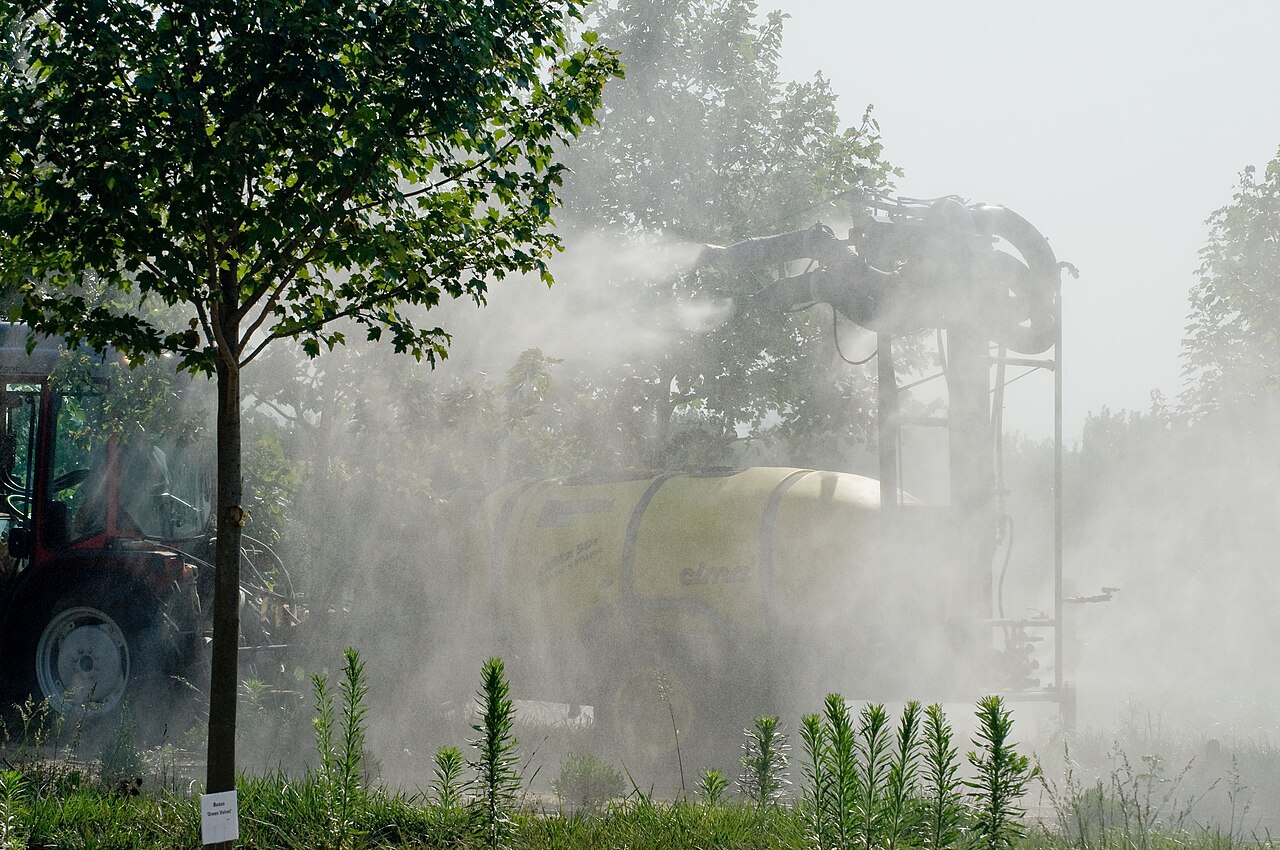
- [ ] Drift mitigation measures taken: drift-reduction nozzles (e.g., air-induction/turbo), lower pressure for coarser droplets, shields where applicable.
| Condition | Favorable (informative) | Avoid |
|---|---|---|
| Wind speed | ~3–13 km/h (light breeze) | calm (inversion) and >~16 km/h |
| Temperature | moderate, more humid | hot + dry (volatilization, evaporation) |
| Time of day | early morning / late afternoon | middle of hot day, night inversion |
| Droplet size | medium–coarse for drift | very fine in dry/hot conditions |
Coverage check with water-sensitive paper
A piece of water-sensitive paper at the top and bottom of the canopy confirms whether the spray is hitting the target and if nozzle settings and airflow are correct. An inexpensive control that reveals both too little and too much deposition.
For more details: "Drift and how to reduce it" and "Temperature inversions for operators".
6. Personal Protective Equipment (PPE)
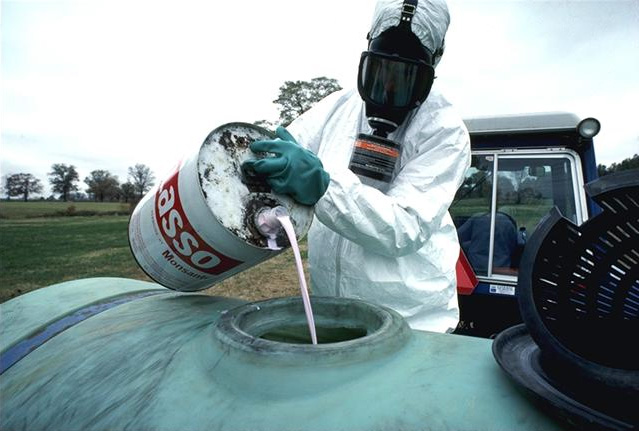
- [ ] PPE meets label requirements — typically: chemical-resistant gloves, eye/face protection, respirator/mask when prescribed, coveralls or long clothing, chemical-resistant footwear, apron when mixing and filling.
- [ ] PPE is intact and clean, without cracks or leaks; maintained and washed separately from other laundry.
- [ ] When mixing and filling, stand upwind (back to the wind) and never work alone in enclosed spaces.
- [ ] First aid kit available (soap/detergent for quick skin rinsing, bandages, water for eye rinsing).
- [ ] No eating, drinking, or smoking during work; wash hands and exposed skin before meals and after work.
For more details: "Personal protective equipment during pesticide application" and "Safe handling and first aid".
7. Buffer zones and bee protection
- [ ] Respect buffer zones for water bodies and sensitive areas as indicated on the label; treat the parcel boundary adjacent to a watercourse at the prescribed distance or leave it untreated.
- [ ] Check wind direction relative to neighboring crops and habitats — do not spray when the wind blows toward sensitive areas or water.
- [ ] Bee protection. If the product is not harmless to bees, do not spray during flowering or bee flight periods; apply in the late evening or early morning when bees are not flying. Remove/mow flowering ground cover before treatment and, where mandatory, notify nearby beekeepers.
- [ ] Protect neighboring sensitive crops (e.g., 2,4-D drift can delay hazelnut kernel drop and cause leaf symptoms) using appropriate distances and low-drift nozzles.
More details: "Buffer zones for water bodies and sensitive areas" and "Bee protection during orchard spraying".
8. Pre-harvest interval (PHI) and record-keeping
- [ ] Pre-harvest interval (PHI) (period from last treatment to harvest) has been checked on the label/FIS and is feasible given the planned harvest date. The PHI depends on the product (e.g., for some copper preparations, it is stated as ~21 days), so align the treatment schedule with the harvest.
- [ ] Respect the maximum permitted number of treatments per season and the prescribed interval between treatments (e.g., restrictions such as "maximum 3× with a 5-day interval").
- [ ] Enter data into the Register of Plant Protection Product Use immediately after application. According to the Law on the Sustainable Use of Pesticides (NN 46/2022), the application must be recorded in a register that the user must keep for 3 years, along with invoices for purchased pesticides. Professional users must keep records in an electronic, machine-readable format from January 1, 2026.
| Record Data | Example |
|---|---|
| Date and time of application | 22.06.2026., 06:30 |
| Parcel / crop | ARKOD no., hazelnut |
| Product name and dose | e.g., g-ml/ha according to label |
| Area and amount used | ha; total spray volume |
| Target pest/disease | e.g., hazelnut weevil |
| PHI / planned harvest | days until harvest |
| Weather conditions and operator | wind, temp.; name |
More details: "PHI and harvest planning" and "Keeping records of PPP applications".
9. During and after spraying
- [ ] Constant, calibrated driving speed along rows; rows covered evenly, without overlap or gaps.
- [ ] Atomizer directed toward the canopy, air stream ~50 cm above the canopy top; sides not being sprayed are turned off.
- [ ] Spraying stopped upon wind gusts or change in conditions.
- [ ] Sprayer rinsed with clean water after work, preferably at the application site, to prevent nozzle clogging and residue transfer.
- [ ] Packaging waste disposed of properly; OZO (triple-rinsed) removed, rinsed, and stored; hands and face washed.
Most common errors prevented by this checklist
- Skipping the FIS "because the product was allowed last year" — registrations change within the season.
- Spraying in calm weather under the assumption that it is ideal — often this refers to inversion and high drift risk.
- Clogged filters and worn nozzles that "still work" — flow rate deviates, dose is incorrect, effect is poor.
- Estimating "by eye" and using kitchenware for preparation.
- Spraying during flowering or over flowering ground cover — bee mortality and potential legal liability.
- Forgotten record entry or ignored PHI — non-compliance with regulations and risk of exceeding MRLs in the nut.
Gallery
Sources
This article is an AI summary compiled from an internal hazelnut literature collection (RAG corpus) and supplemented with public Croatian and international sources. Main sources used:
- Hazelnut Protection Manual (RAG corpus) — procedure for measuring water consumption and calibration.
- Calibration of equipment for applying plant protection products for fruit trees, Syngenta (RAG corpus) — checking nozzles, filters, pump; rinsing packaging.
- Crop and orchard protection and foliar nutrition programs (RAG corpus) — nozzle flow, working pressure, safety measures.
- Plant protection and nutrition program, Galenika-Fitofarmacija (RAG corpus) — concentration table; equipment washing and packaging disposal.
- Mechanization in hazelnut production and processing, Minas-zrno (RAG corpus) — atomizers, nozzles, rinsing after spraying.
- Notices to hazelnut growers/producers, Ministry of Agriculture / advisory service (RAG corpus) — FIS, records, PHI.
- 2,4-D drift delays kernel drop in hazelnut; specimen labels (GLUFOSINATE 280 SL, KOP-5, ArVida 70 WP, Envidor) (RAG corpus) — wind, inversion, drift, OZO.
- Phytosanitary Information System (FIS) — public PPP search engine — fis.mps.hr/trazilicaszb
- Law on the Sustainable Use of Pesticides (NN 46/2022) — narodne-novine.nn.hr
- HAPIH: New Law on the Sustainable Use of Pesticides Introduces Credentials — hapih.hr
- Ordinance on Machinery for Applying Pesticides and Testing Stations (NN 141/2021) — narodne-novine.nn.hr
- Sprayers 101: Spraying Weather, Ten Tips for Spraying in the Wind, Thermal Inversions for Sprayer Operators, Water Sensitive Paper for Assessing Spray Coverage — sprayers101.com
- Recommendations/notices to hazelnut orchard owners, savjetodavna.mps.hr — savjetodavna.mps.hr
Recommended equipment
🔎 backpack sprayer — Amazon →Affiliate links — we may earn a small commission at no extra cost to you.