Mechanized hazelnut harvesting: Vacuum harvesters and sweepers
Content generated by artificial intelligence — verify before application
This article was automatically compiled from a collection of hazelnut literature with the aid of artificial intelligence and may contain errors or outdated data. It serves as a starting point for further research, not as professional advice. Dosages, products, and timing are informative and depend on the cultivar, location, and applicable regulations — always consult with an advisory service and official sources before application.
Harvesting is the most expensive single operation in hazelnut production — according to several sources, it accounts for up to 50% of total production costs. In mature orchards, manual collection of nuts from the ground quickly becomes uneconomical: one harvester collects only about 20 kg per day, or just 6–8 kg per hour. As orchard area and yield increase, mechanized harvesting becomes the only economically viable option — machines that collect nuts from the ground, not from the bush. This article explains how vacuum harvesters, sweepers, and self-propelled harvesters (combines) work, their efficiency, where losses occur, and how to select equipment based on orchard size.
Why hazelnuts are harvested from the ground, not from the tree
Unlike many fruit species, in most hazelnut cultivars, the ripe nut falls out of the husk (cupule) and drops to the ground beneath the bush. Ripening is spread over 20–30 days, so nuts do not all fall at once. This defines the logic of mechanized harvesting:
- nuts are collected from the ground, not picked from branches — machines operate on the surface below and between rows;
- harvesting is carried out in two or more passes because nuts fall in waves (in the first wave, 70–80% of the crop falls);
- prolonged contact of nuts with the ground (moisture, soil contact) increases the risk of contamination and mold development, so collection should not be unduly delayed.
An exception is cultivars where the cupule is longer than the nut and tightly encloses it (a classic example in Croatia is 'Istarski duguljasti'), where the nut does not fall out on its own — such cultivars are often harvested by shaking the tree, which complicates ground-based mechanized harvesting.
Working principle: three types of machines
Mechanized hazelnut harvesting in practice relies on three functional groups of machines. They often work in combination, and in self-propelled combines, all functions are integrated into a single pass.
1. Vacuum harvesters (vacuum collectors)
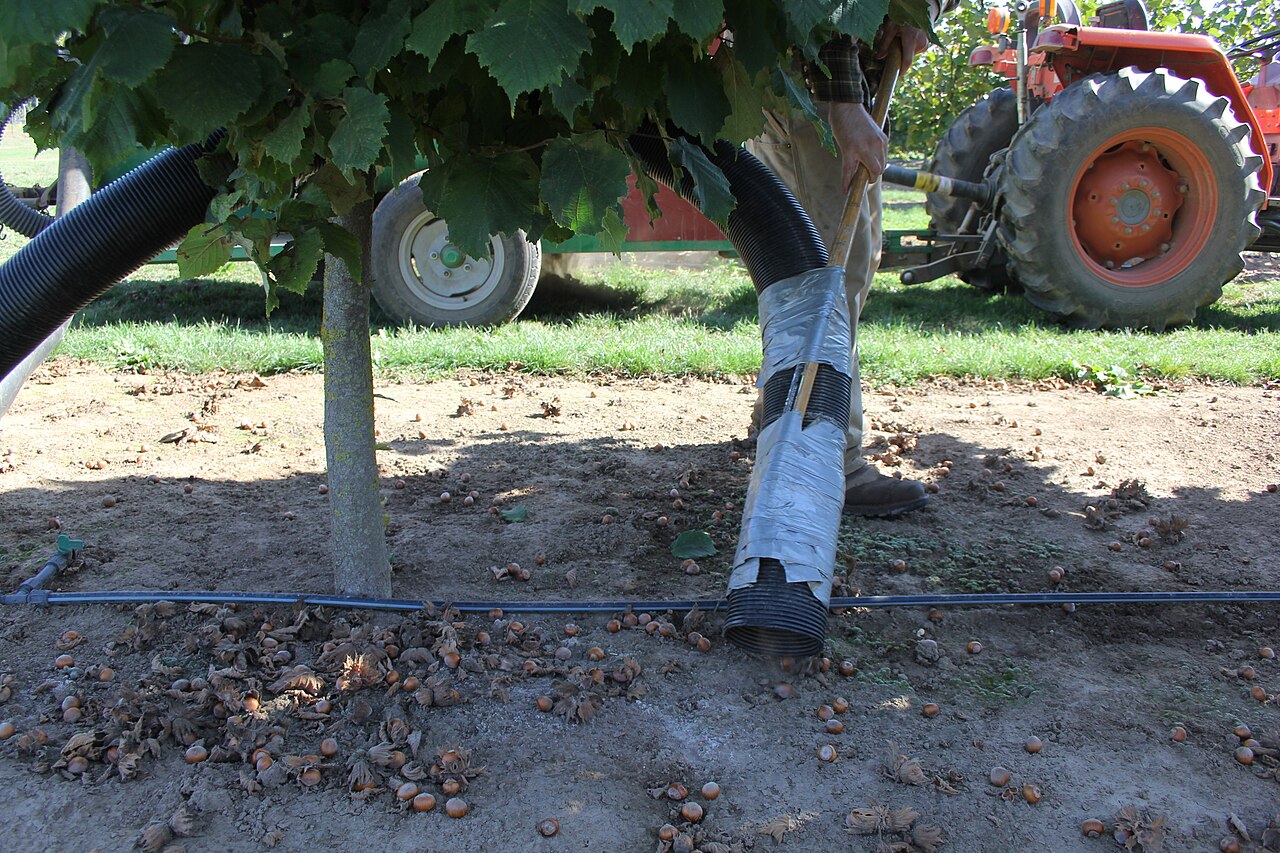
The most widespread principle is vacuum suction. Strong air jets are created by fans mounted on a trailer behind the tractor (towed machine) or on a self-propelled machine. Nuts are sucked through suction pipes (nozzles) that an operator manually directs over the nuts on the ground, or through a suction system of the machine moving between rows.
The separation principle is simple and effective: thanks to the strong air flow, heavier hazelnuts fall into a special collection chamber, while lighter impurities — leaves, debris, empty shells, small pieces of soil, and sand — are separated by ventilation and expelled outside. The machine typically consists of:
- an aspirating (suction) chamber and one or two flexible hoses;
- a fan for removing impurities;
- a selection sieve and pneumatic system;
- a system for transporting clean nuts into bags or directly into a towed trailer.
The main disadvantage of pure vacuum systems is that they suck up a lot of soil, dust, and leaves, requiring thoroughly prepared and clean surfaces, and they also generate significant dust. There are also backpack (manual) vacuum harvesters for small orchards — this is semi-mechanized harvesting: more efficient than manual, but much more affordable than full systems.
2. Sweepers / collectors (mechanical, with brushes)
The second group consists of machines that do not vacuum nuts but mechanically collect them using rotating brushes (rakes). This approach developed especially in Oregon (USA), where harvesting is done in two steps with two machines:
- a sweeper moves nuts from the tree toward the center of the row and arranges them into one or two lines (each 0.6–1.2 m wide);
- a second machine (pickup) collects these lines and places the nuts into collection packaging.
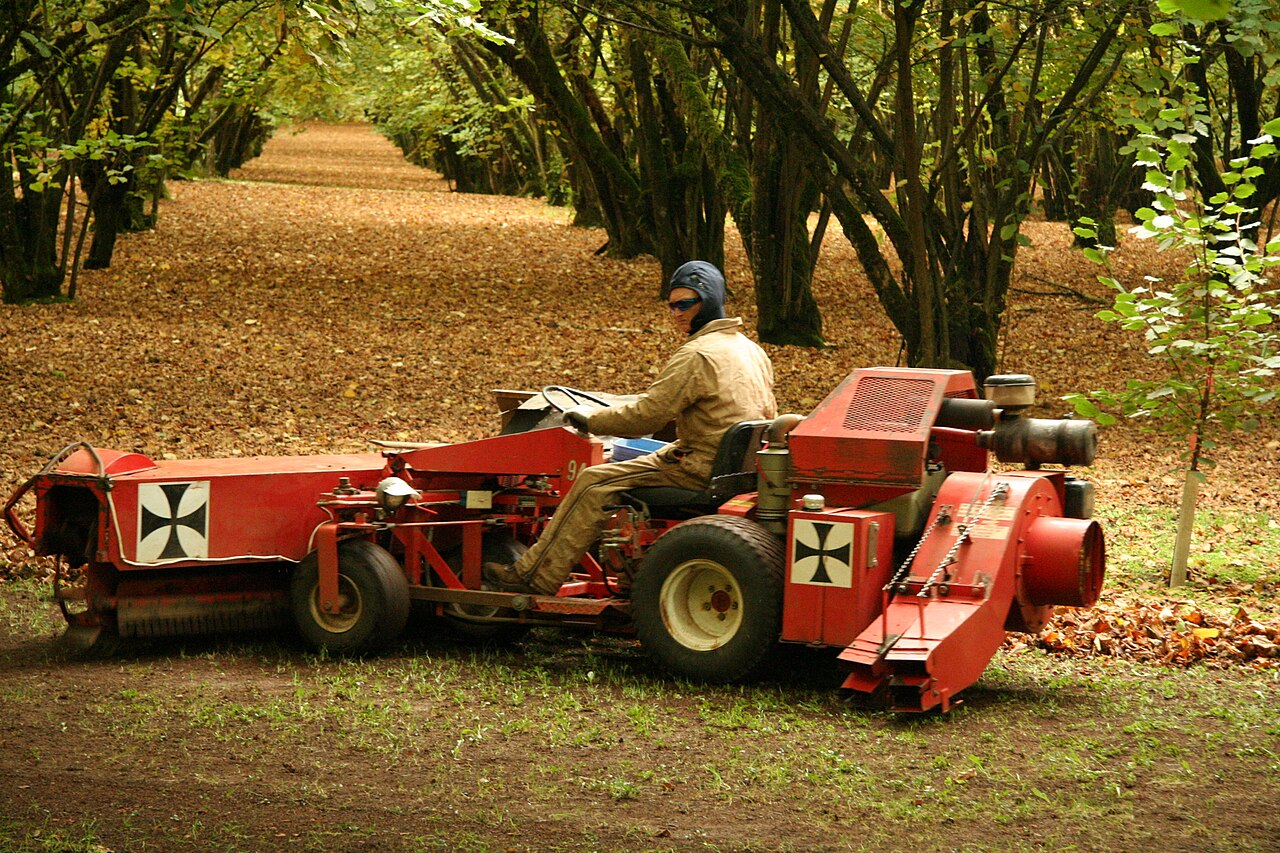
Mechanical units (e.g., type TR 200.2 from literature) work by collecting nuts and impurities from the ground with brushes and feeding them into a cleaning system, which filters impurities and green husks and expels them via ventilation, while clean nuts are transported by an Archimedes screw into the container. The advantage of mechanical collection is that it raises significantly less dust than vacuum systems and, in versions with their own cleaning, does not require mandatory tilling/rolling/grass spraying before harvesting, saving time and money. A side brush can be mounted on many models to push nuts under bushes into the pickup working belt.
3. Self-propelled harvesters (combines)
The pinnacle of mechanization is self-propelled combines that integrate collection (via vacuum, brushes, or a combination), cleaning from impurities, and transport in a single pass. Hazelnuts are transferred from the combine by air blast into a special trailer (with dual-height tilting capability). The largest combines with mechanical collection and intake into the cleaning chamber (e.g., type SEMEK 1000) achieve high capacities, but require perfectly flat and managed surfaces — without tire tracks, compacted molehills, soil disturbed by wild boars, and erosion gullies.
Power for towed machines is obtained from the tractor via a cardan shaft and hydraulics (PTO), while self-propelled units have their own engine. Required power varies widely — from 30 HP for small attachments to several hundred HP for large combines.
Efficiency and capacities
Mechanization drastically changes the economics of harvesting. For comparison, manual harvesting achieves 6–8 kg/h per harvester; machines operate in a completely different order of magnitude.
| Indicator | Approximate Value | Source / Note |
|---|---|---|
| Manual harvesting | 6–8 kg/h; ~20 kg/day per worker | accounts for 15–20% of income |
| Towed vacuum collector (e.g., Facma C380T) | ~900 kg/h | requires tractor ~60 kW (75 HP) |
| Self-propelled combine (field data) | ~740–780 kg/h; 0.10–0.12 ha/h | depends on soil preparation |
| Daily output of vacuum machine | 2–3 t/day | according to commercial data |
| Italian pickup prototype | 1.25 t/h; 0.54 ha/h | nut purity ~89.75% |
Figures are informative and heavily depend on cultivar, yield, soil preparation, moisture, and machine design. What is consistent: mechanized harvesting is tens to hundreds of times faster than manual and significantly reduces unit cost on larger areas with minimal labor.
Impact of soil preparation on performance
Field measurements clearly show how much soil preparation determines the result. At the same yield (265.5 kg/ha), same working width (1600 mm), and speed (1.6 m/s):
| Condition | Collection Efficiency | Nut Loss | Surface Efficiency |
|---|---|---|---|
| With soil preparation (OG1) | 96.05% | 3.95% | 0.116 ha/h |
| Without soil preparation (OG2) | 90.15% | 9.85% | 0.102 ha/h |
Thus, missed soil preparation can more than double losses (from ~4% to ~10%) and simultaneously slow down work.
Losses: where and why they occur
Main sources of loss in mechanized ground harvesting:
- Poorly leveled surface. Erosion gullies, machine tire tracks, molehills, and soil disturbed by wild boars trap nuts outside the machine's reach. Literature cites an orchard where soil level was not monitored, making machine harvesting significantly more difficult.
- Incorrect machine settings. Improper collection height and excessive/too low speed of rotating brushes can raise ground losses up to 20% of the crop (about 0.53 t/ha in one Italian trial).
- Excessive PTO/suction speed. Too high RPM in vacuum systems breaks (cracks) nuts; too fast emptying overloads sorting, too slow leads to accumulation of nuts and leaves and drop in flow.
- Mowing residues and weeds. Leaves, mowed grass, and weeds reduce separation efficiency, so nuts go out with impurities or remain uncaught; they also retain moisture and increase nut humidity.
- Waiting too long on the ground. Prolonged stay between passes means wildlife, rodents, and mold reduce usable mass and quality.
Preparing the orchard for low loss rates
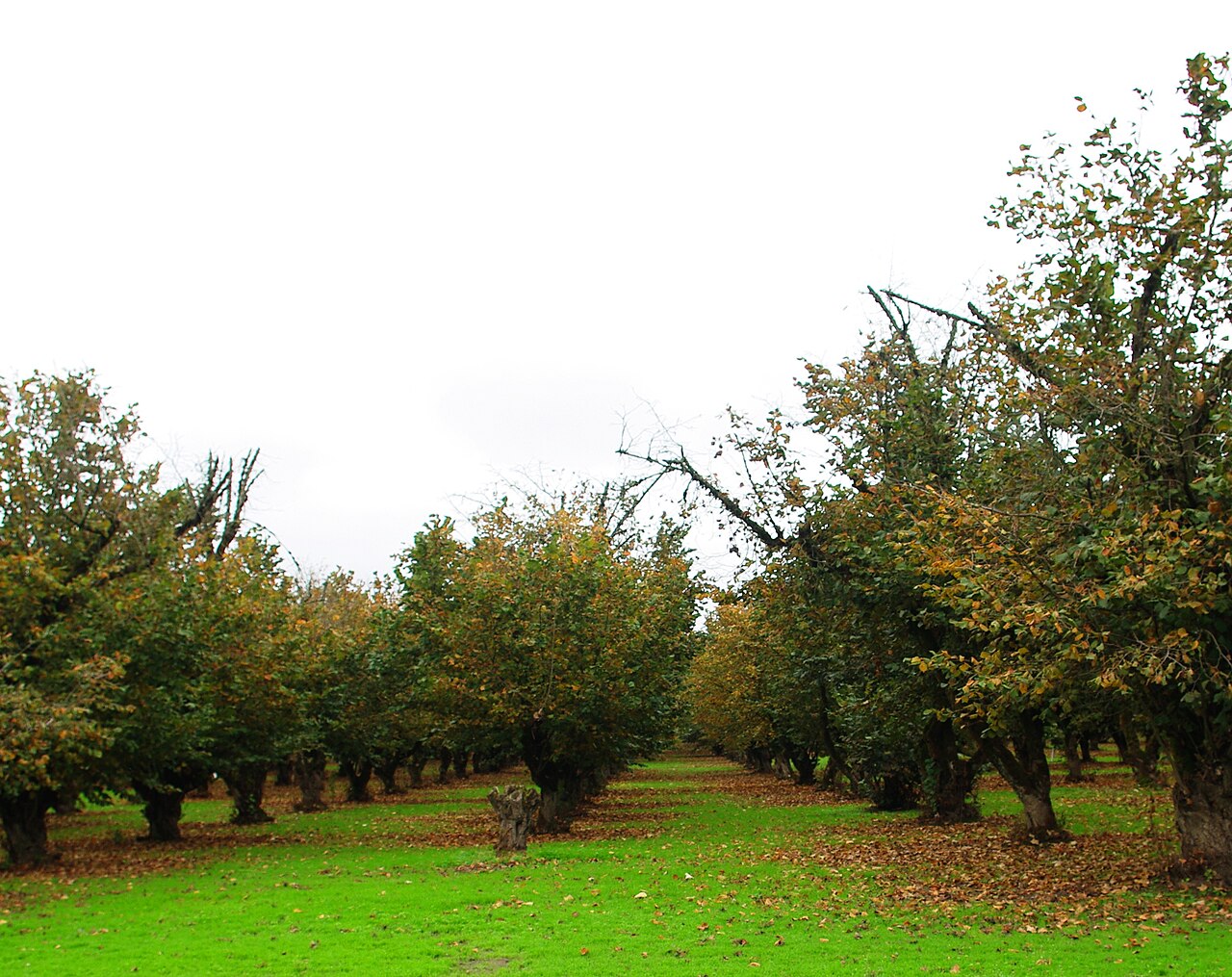
- Level the soil. Break the surface layer with a rotary tiller (cultivator) and roll with a roller so the machine slides easily on a flat plane.
- Clean the surface. Mow and remove residues; about a month before harvest, grass desiccation can be applied to obtain a clean and dry substrate, on which nuts also have lower moisture.
- Suppress root suckers. Hazelnut sends shoots from the base; if not suppressed, it grows into a multi-stem bush. In Oregon, suckers are removed to develop a single stem and easier mechanized harvesting.
- Group cultivars by ripening time. Cultivars with similar ripening dates in the same rows allow targeted passes and lower costs; mixing cultivars (as in one orchard in Orahovica) significantly complicates machine harvesting.
- Harvest in 2–3 passes following the falling waves, but without unnecessary delay.
Equipment Selection Based on Orchard Size
There is no one-size-fits-all machine. Selection depends on orchard area, yield, soil flatness, and soil condition, as well as available tractor power. General recommendations are as follows:
| Orchard Size | Solution Type | Required Tractor / Power | Note |
|---|---|---|---|
| Homestead / very small orchard | manual harvesting or backpack vacuum harvester | — | semi-mechanized; most cost-effective |
| Up to ~5 ha | trailed vacuum collector (e.g., class C 120 T) | 30–40 HP | without side brush |
| ~4–8 ha | trailed collector (class C 200 T) | 55–70 HP | side brush + trailer possible |
| ~7–12 ha | trailed collector (class C 300 T) | 75–90 HP | side brush + trailer possible |
| ~10–15 ha | trailed collector (class C 380 T) | 80–100 HP | side brush + trailer possible |
| ~5–25 ha | self-propelled (class C 180 S / C 200 S) | self-powered | recommended to tow a loading trailer |
| ~20–40 ha | self-propelled (class C 300 S / C 380 S) | self-powered | higher capacity |
| ~30–60 ha | large self-propelled harvester (class SEMEK 1000) | self-powered | requires perfectly flat soil |
Values are indicative and taken from manufacturer tables/literature; specific models, power outputs, and capacities vary by manufacturer.
Practical guidelines for selection:
- Mechanization threshold. Multiple sources indicate that on areas larger than ~3 ha in full production, a harvester (collector) becomes essential — manual harvesting is too slow and expensive in this context.
- Vacuum vs. mechanical pickup. Vacuum systems require prepared, clean soil and generate dust; mechanical systems (brushes) generate less dust and can operate on more challenging terrain, sometimes without prior soil cultivation.
- PTO-driven vs. self-propelled. For small and medium orchards, a PTO-driven machine on an existing tractor is more cost-effective; for larger areas, a self-propelled harvester offers higher capacity and autonomy, but requires greater investment and better soil condition.
- Service instead of purchase. Mechanization is expensive for medium-scale production; many producers therefore offer harvesting/processing services to others or rent out equipment. In Croatia, machine purchases are often (co-)financed through rural development programs (historically IPARD) — check current calls for proposals.
Practical Recommendations and Common Mistakes
- Do not skimp on soil leveling. This is a cheaper investment than annual crop losses; unevenness and wheel tracks directly reduce collection efficiency.
- Adjust the machine before the season. Set pickup height and RPM during a test pass; too high RPM breaks nuts, while too low height lifts soil.
- Monitor moisture and dry immediately. Nuts at harvest have ~30–35% moisture content; after mechanical harvesting (which also picks up leaves/soil), immediately proceed to cleaning and drying to prevent mold.
- Do not mix cultivars in rows. Plan planting layout by ripening time when establishing the orchard — this cannot be corrected later.
- Plan for multiple passes. One pass rarely collects the entire yield; plan for 2–3 harvests according to drop waves.
- Safety and environment. Vacuum machines generate dust (respiratory protection required); during desiccation and protection treatments, follow the product label and current regulations (FIS — Phytosanitary Information System).
Gallery
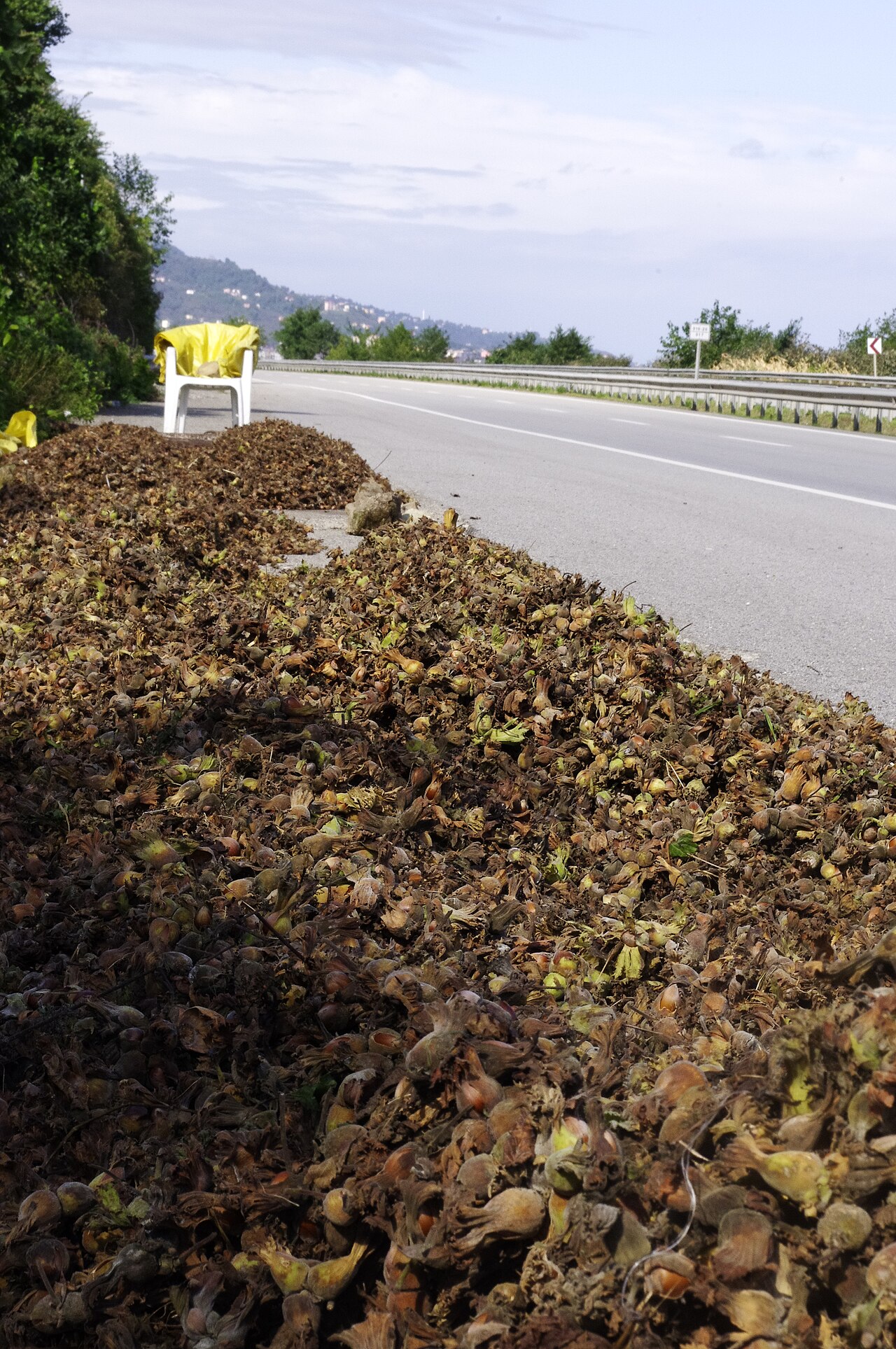
Sources
This article is an AI-generated summary created from an internal hazelnut literature collection (RAG corpus) and supplemented with public web sources. Numerical data (capacities, power, losses, doses) are informative and depend on cultivar, location, machine performance, and current regulations. Main sources used:
- Mechanization in hazelnut production and processing at Minas-Zrno 1 (2021) — University of Applied Sciences in Karlovac. repozitorij.vguk.hr
- Technology of hazelnut harvesting, drying, and storage — literature review / Hazelnut postharvest technology: A review (2022) — JCEA. jcea.agr.hr
- Tractor attachment for hazelnut harvesting — Marcel Gojak, master's thesis, FSB (2020).
- Economic analysis of hazelnut production (2023) — RAG corpus.
- Technological and economic characteristics of hazelnut cultivation (2018). doi.org/10.46584/lm.v36i2.1141
- Environmental impact assessment — AGRO UTINJA hazelnut orchard, Vojnić Municipality (2021) — RAG corpus.
- Parameters for selecting machines and equipment for hazelnuts — manufacturer table (RAG corpus).
- The Effect of Different Orchard Ground Conditions on hazelnut harvesting machine performance (2024). arxiv.org/pdf/2404.03111
- Mechanical hazelnut harvesting: first results of a pickup prototype — ISHS Acta Horticulturae. ishs.org
- Research and Experiments of Hazelnut Harvesting Machine Based on CFD-DEM Analysis — MDPI Agriculture (2022). mdpi.com
- Agroklub — Save time and money with a self-propelled harvester. agroklub.com
- Messis.hr — hazelnut collectors and harvesters (commercial capacity data). messis.hr
Recommended equipment
🔎 nut gatherer roller — Amazon →Affiliate links — we may earn a small commission at no extra cost to you.
Handheld Nut Roller Collector
For gathering nuts from the ground on small areas.
| Use Case | Option Type | What to Check Before Purchase |
|---|---|---|
| Small area collection | Manual roller device | Wheel traction and debris clearance |
| Uneven terrain | Heavy duty rollers | Frame strength and wheel size |
| Large orchards | Mechanical sweepers | Professional machinery for efficiency |