Phenological growth stages of hazelnut (BBCH scale)
Content generated by artificial intelligence — verify before application
This article was automatically compiled from a collection of hazelnut literature using artificial intelligence and may contain errors or outdated data. It serves as a starting point for further research, not as professional advice. Dosages, products, and timing are informative and depend on the cultivar, location, and current regulations — always consult with an advisory service and official sources before application.
Phenology is the branch of science that studies the timing of plant developmental stages and records the dates on which they occur in a specific environment. For hazelnut (Corylus avellana L.), understanding phenological phases is not an academic pastime but a practical tool: almost all agrotechnical operations — pruning, fertilization, pest and disease control, irrigation, and harvest — are tied to specific developmental stages. Furthermore, hazelnut is a biological oddity among fruit species because it flowers in the middle of winter, and the period from flowering to fertilization can last up to four months. For this reason, a standardized, internationally comparable description of development, such as that offered by the BBCH scale, is particularly useful for this species.
What is the BBCH scale and why is it important for hazelnut
BBCH is a decimal system for the unique coding of plant developmental phenological stages. The abbreviation comes from the German institutions that developed it (Biologische Bundesanstalt, Bundessortenamt und CHemische Industrie). The system is designed to encompass both monocots and dicots and can be applied to species for which no specific scales exist.
The entire developmental cycle is divided into ten main (primary) phases, labeled with numbers from 0 to 9 in ascending order. Each main phase is further divided into secondary (micro) phases, and the code consists of two (sometimes three) digits: the first indicates the main phase, and the second(s) indicate progress within that phase (e.g., percentage of open flowers or proportion of fruit size reached).
For a long time, there was no official BBCH scale for hazelnut. In recent years, several papers have proposed and refined one — Taghavi et al. (2022) developed a unique scale based on the BBCH monograph for woody plants, and Paradinas et al. (2022) described an extended BBCH scale on the reference cultivar 'Barcelona'. This extended scale describes development through 38 secondary phases within the main phases, placing hazelnut among other fruit species in terms of the number of phases (e.g., grapevine has 39, apricot 28, kiwifruit 34 phases).
Key figure
The hazelnut BBCH cycle lasts at least 18 months — from flower initiation (spring/summer of the year before harvest), through winter flowering, leafing, and fruit development, to harvest and autumn leaf drop after harvest. This means that phases belonging to two different "generations" can be seen simultaneously on the same tree.
Main (primary) BBCH phases for hazelnut
The proposed BBCH monograph covers eight of the ten main phases, starting from dormant buds (phase 0) and ending with harvested nuts (phase 9). Due to winter flowering, the order of phase appearance in hazelnut does not strictly follow the numerical sequence: catkin emergence (phase 5) and flowering (phase 6) occur before leaf development (phase 1).
| Main Phase | Code | Name (EN) | What happens in hazelnut |
|---|---|---|---|
| 0 | 0x | Bud development/dormancy | Winter dormancy, bud swelling, and bursting of vegetative buds |
| 1 | 1x | Leaf development | Opening and growth of leaves after flowering |
| 3 | 3x | Shoot growth | Elongation of shoots of the current vegetation |
| 5 | 5x | Inflorescence emergence | Appearance and elongation of male catkins, emergence of female flowers |
| 6 | 6x | Flowering | Pollen shedding and receptivity of female flower stigmas |
| 7 | 7x | Fruit development | Development of the involucre (husk), shell growth, and kernel filling |
| 8 | 8x | Fruit ripening | Browning of the shell and husk, reaching full maturity |
| 9 | 9x | Senescence | Yellowing and leaf drop after harvest |
Note: Main phases 2 (formation of lateral shoots) and 4 (development of vegetative reproductive organs) are not relevant in practice or are omitted for hazelnut, similar to some other fruit crops.
Detailed development course through the vegetation period
Phase 0 — Dormancy and bud swelling
During winter, hazelnut undergoes a period of deep winter dormancy. Buds are closed and covered by scales. We distinguish two types of buds: vegetative (wood) buds, from which non-bearing shoots develop, and mixed buds, from which new shoots with female flowers develop. Male inflorescences (catkins) are already formed and visible on one-year-old shoots.
According to functional classification, buds are divided into vegetative (wood, leaf/transitional, and sleeping/adventitious buds) and generative (flower buds). A bud consists of a bud eye and a bud scale; if the bud eye fails, the bud scale takes over its role.
Towards the end of winter, bud swelling and opening of vegetative buds occurs, followed by the onset of vegetation. In foliar calendars, this phase is usually placed in March/April and coincides with female flower fertilization, bud swelling, and root growth.
Phase 5 and 6 — Catkin emergence, flowering, and pollination (winter peculiarity of hazelnut)
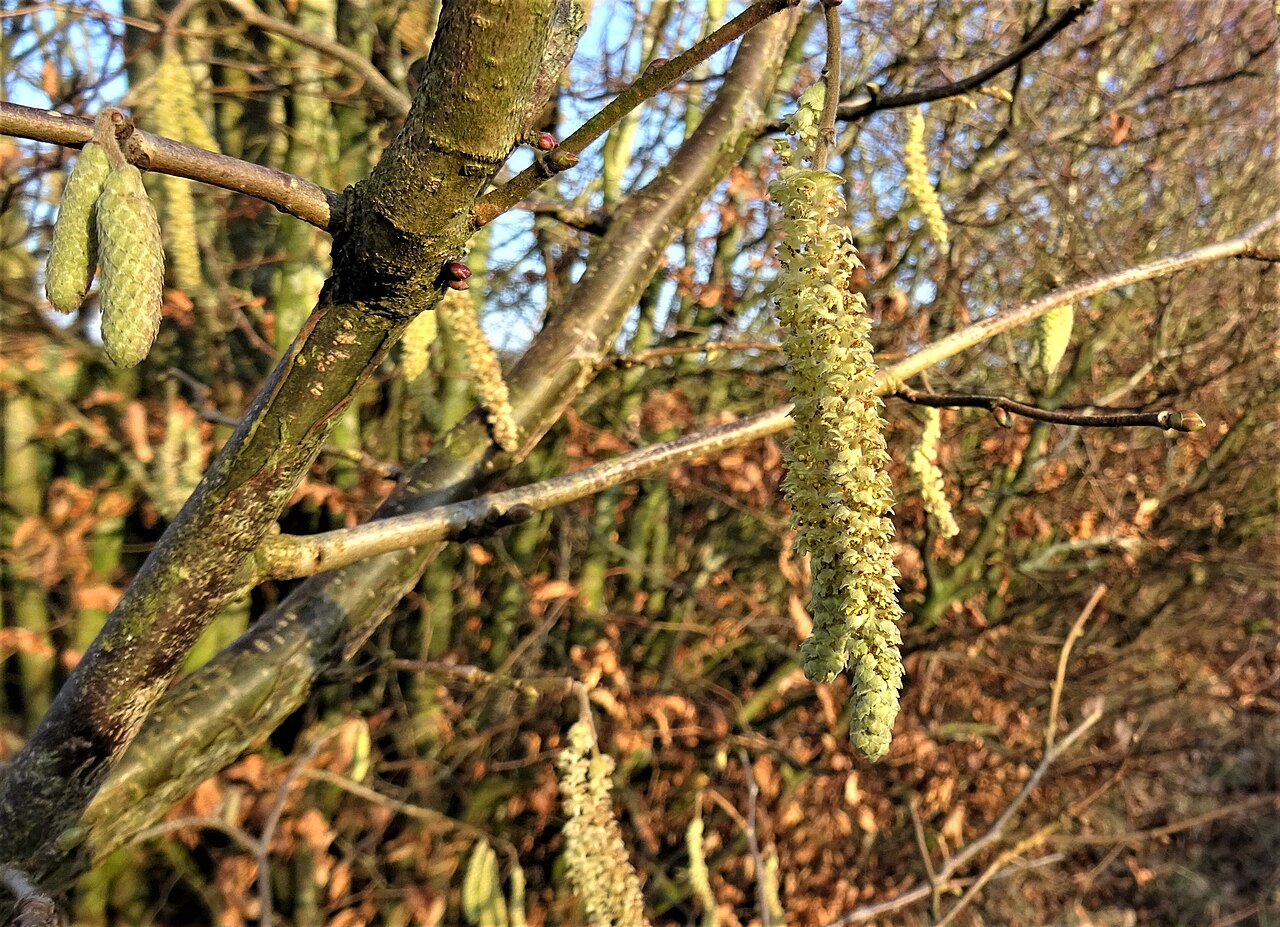
Hazelnut is a monoecious plant — both male and female flowers are found on the same tree — and typically dichogamous, meaning that the male and female flowering phases are often not simultaneous. Flowers develop very early, before leafing out.
- Male flowers are grouped into catkins (inflorescences) arranged on a rachis on branches from the previous vegetation. Catkins are usually grouped in 2–3 (in some species 8–10). They are pale yellow in color and can grow up to 20 cm in full bloom. A mature tree produces about 1 kg of catkins, and each catkin bears 130–260 flowers, depending on length.
- Female flowers are barely visible; only a tuft of red stigmas emerges from the bud. The flower is dark red.
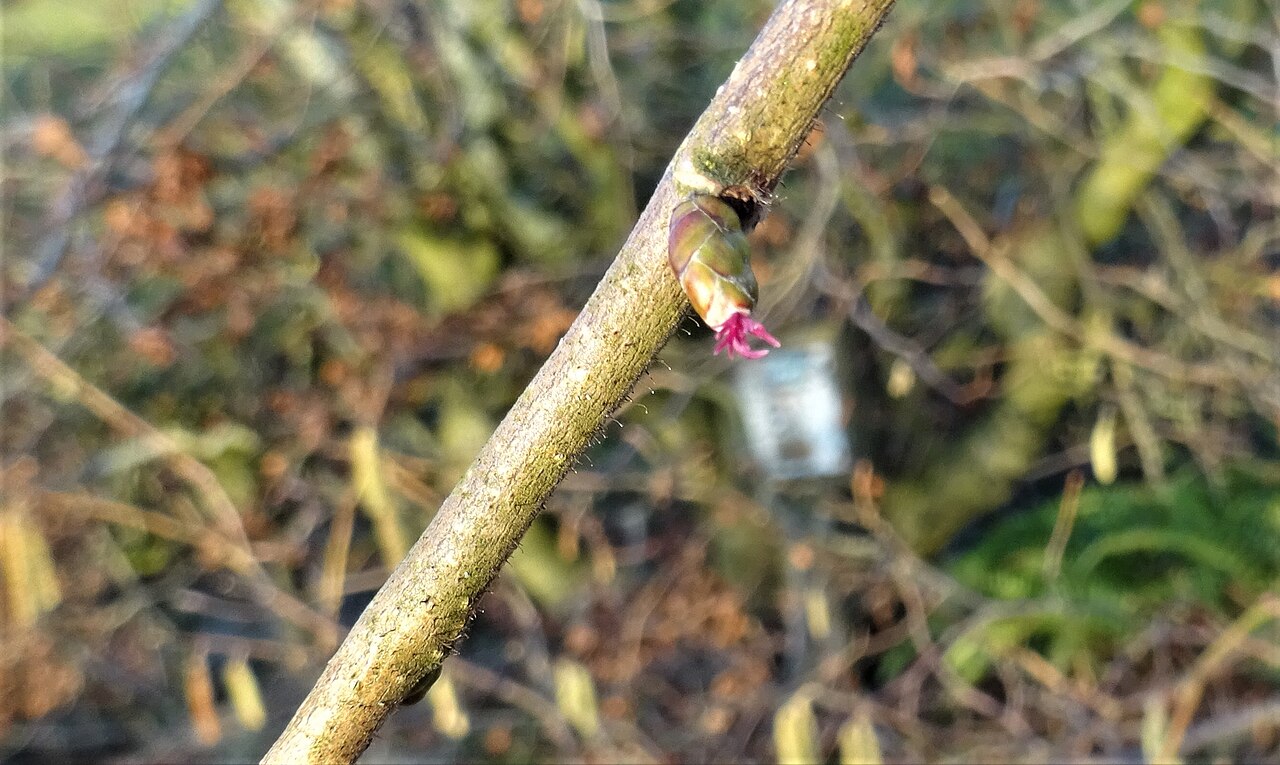
Depending on climatic conditions, hazelnut flowers from December to March. Pollen shedding lasts 2 to 25 days, while the entire flowering period can last up to 60 days. In warmer areas, protandry (male phase before female) is more common, while in cooler areas protogyny (female phase before male) occurs. Pollination is anemophilous (wind-driven), and fertilization occurs much later — from mid-May to early June. Due to the time gap between male and female phases, it is essential to plant compatible pollinizers whose flowering phases overlap with the main cultivar to ensure reliable cropping.
Sensitivity to frost by phase
Resistance to low temperatures drops dramatically with the development of flowers. Approximate values from literature (informative, highly variable by cultivar and tree condition):
| Organ / Phase | Approximate Critical Temperature |
|---|---|
| One-year-old shoots | approx. -30 °C |
| Vegetative buds | approx. -25 °C |
| Closed (unopened) male catkins | approx. -16 to -18 °C |
| Unopened female flowers | approx. -16 °C |
| Open male flowers (full bloom) | approx. -7 to -10 °C (even for a few hours) |
| Open female flowers | approx. -8 to -9 °C |
| Leaf buds / young shoots after leafing | approx. -3 to -6 °C |
Values differ in literature (e.g., flowers down to -14 °C, some cultivars down to -18 °C according to older sources), so they should be taken as a guide, not an absolute threshold.
Phase 1 and 3 — Leafing and shoot growth
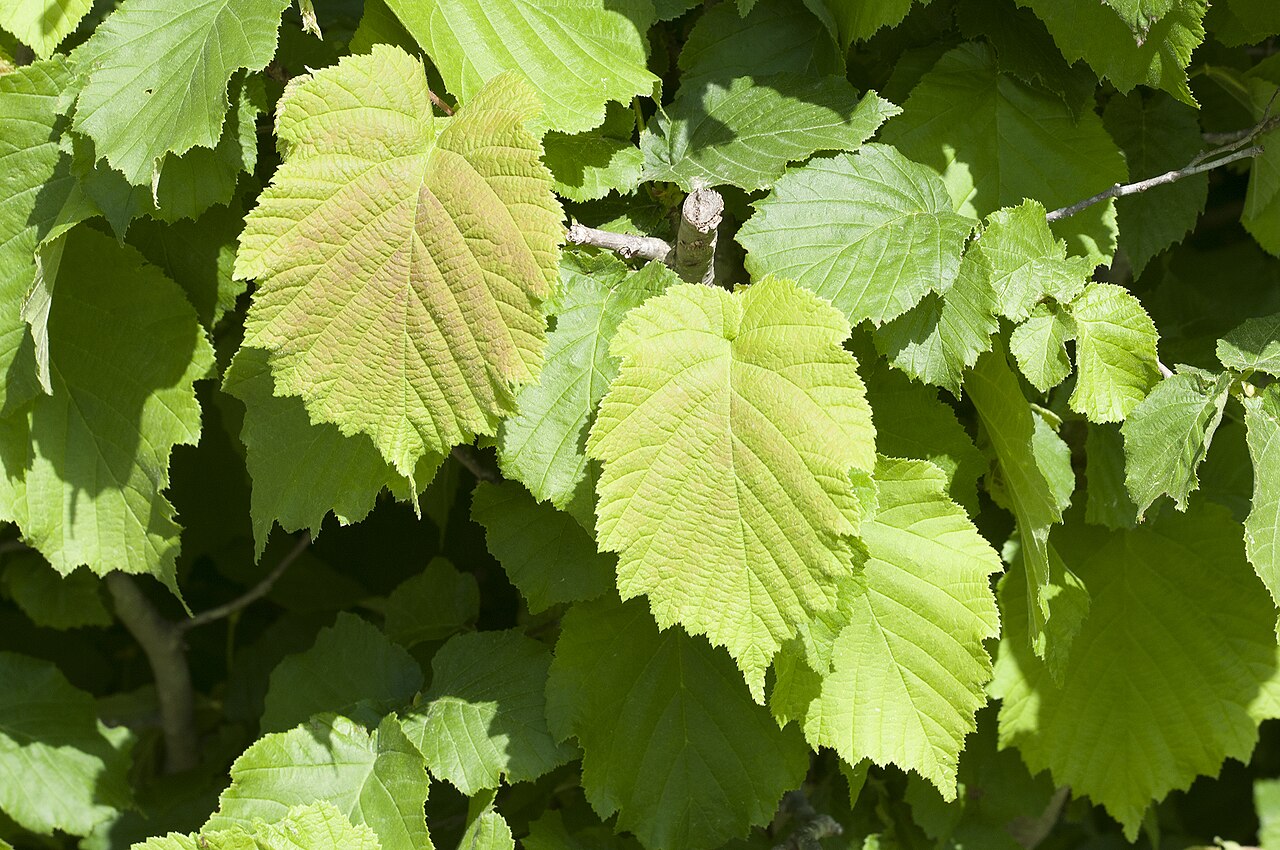
Only after flowering of male and female inflorescences do vegetative buds sprout, marking the true start of vegetation and leaf development. The leaf is the main vegetative organ — crucial for photosynthesis, transpiration, respiration, and hormone synthesis. The timing of bud sprouting depends on the genetic basis of the cultivar and climatic conditions. Concurrently with leafing, the elongation of shoots of the current vegetation occurs (shoot growth phase), on which new bearing buds will form in the following season.
Phase 7 — Fruit development and kernel filling
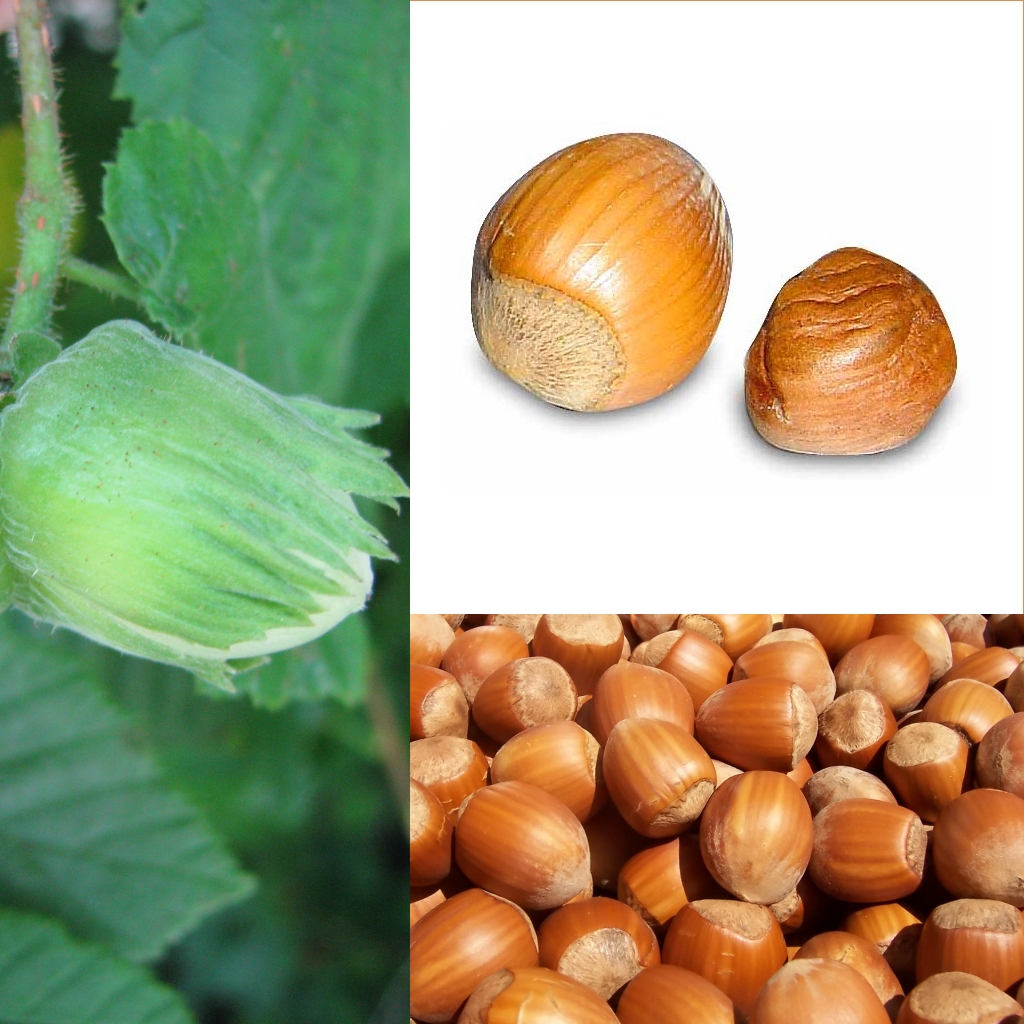
After winter pollination, fertilization occurs only in late spring. Egg-shaped fruits develop gradually and are surrounded by a leafy husk (involucre) with serrated edges, initially green. This is followed by the growth of the shell (pericarp), and then kernel filling:
- development of the husk and shell growth in spring and early summer;
- kernel filling — according to literature data, the kernel begins to fill the fruit around the third decade of June, and by the end of July the fruit is completely filled with a kernel that reaches maximum size.
Water is crucial in this phase. In years with extremely dry summers, the kernel remains small and underdeveloped, which directly reduces the kernel percentage (yield) and fruit quality. Therefore, the kernel filling period represents a critical period for irrigation.
Phase 8 — Fruit ripening
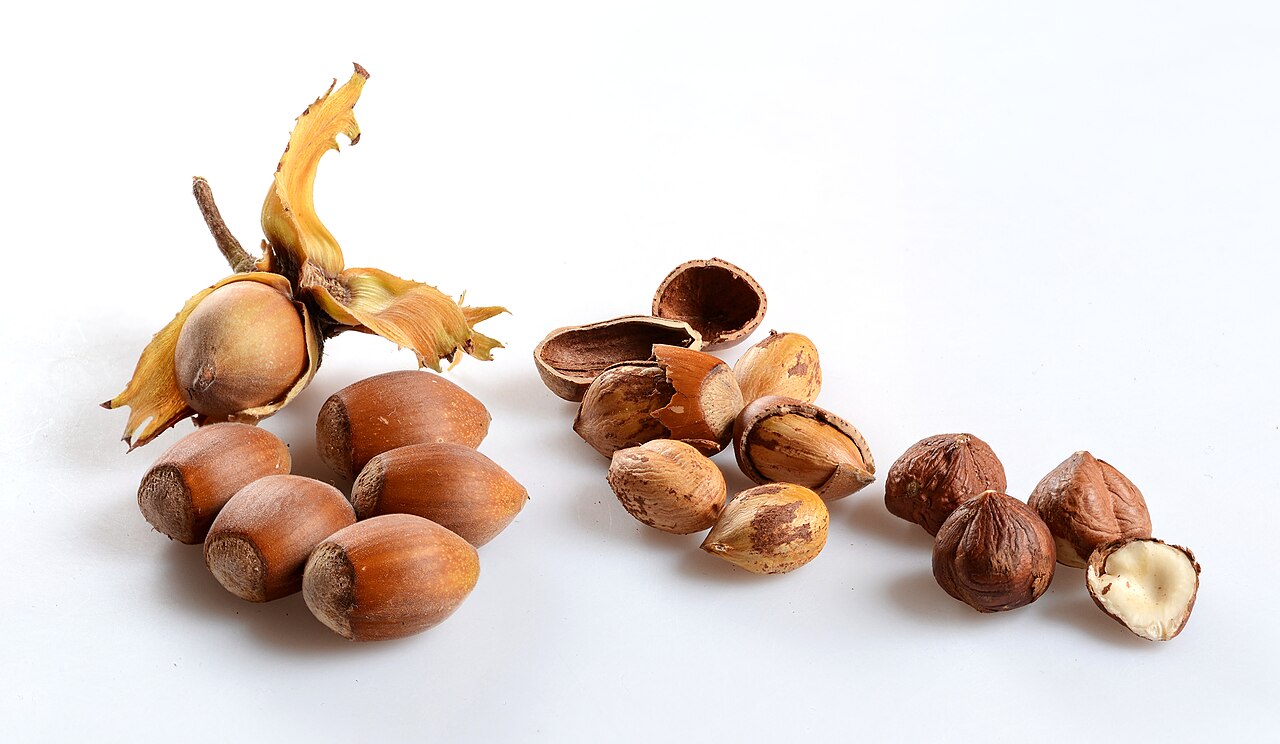
As the fruit ripens, the shell and husk gradually change color from green to brown. According to corpus data, fruits ripen in August and September; the reference cultivar 'Barcelona' ripens in late August and early September. Full maturity is reached when the fruit easily detaches from the husk and falls to the ground — which is the signal for harvest (manual, shaking, or mechanical collection of fallen fruits).
Phase 9 — Senescence and leaf drop
After harvest, in autumn, the leaves turn yellow and drop, closing the cycle. In protection practice, BBCH-95 phase (loss of about 80% of leaf mass) is important: advisory recommendations state that winter protection should be carried out before complete leaf drop (orientatively after at least 70% of leaf mass has dropped), because scars at the sites of fallen leaves represent entry points for fungal and bacterial pathogens. Winter protection should be carried out in calm weather, without wind and fog, at air temperatures above 5 °C and definitely before the start of flowering.
Approximate phenological calendar and timing of interventions
The following table links phenophases with typical months in continental Croatia and main agrotechnical interventions. Dates are indicative and vary significantly by cultivar, location, altitude, and year.
| Period | Phenophase (BBCH) | Typical interventions |
|---|---|---|
| November–December | Senescence/dormancy (9 → 0) | Winter protection before flowering (after ~70–80 % leaf fall), pruning |
| December–March | Flowering and pollen shedding (5–6) | Avoid interventions that damage flowers; monitor frost |
| March–April | Fertilization, bud swelling and opening, vegetation start, root growth (0 → 1) | Start of foliar fertilization — biostimulators, micronutrients (Zn, B, Fe, Mo); nitrogen fertilization |
| May–June | Fertilization, leafing, shoot growth, start of fruit development (1, 3, 7) | Disease and pest protection, irrigation, fertilization |
| June–July | Kernel filling (7) | Critical irrigation, pest protection for fruit |
| August–September | Ripening and fruit maturity (8) | Harvest (shaking/gathering), preparation for drying |
| October–November | Aging, leaf abscission (9) | Gathering remaining fruit, autumn fertilization, mulching |
For more advanced planning, the relationship between BBCH and GDD (growing degree days, sum of temperatures) is also used. Based on past and forecasted meteorological data, this allows for the advance estimation of the dates when specific phases occur. Such models are increasingly applied in precision agriculture and agrometeorology.
Practical recommendations and common mistakes
- Do not plan protection "by calendar," but by phase. Flowering shifts from year to year by several weeks; for example, in some years flowering started as early as the third decade of December. Monitor the actual state of the orchard.
- Perform winter protection before the start of flowering and before complete leaf fall, but at temperatures above 5 °C and in calm weather. Use larger volumes of water (approximately 1500–1800 l/ha or more) for even canopy coverage ("bathing" the tree).
- Ensure overlap of flowering between pollinizers and the main cultivar. Due to dichogamy and autosterility, pollination with pollen from the same cultivar often does not result in fertilization — compatible pollinizers are required.
- Do not underestimate irrigation during the kernel filling phase (June–July). Drought during this period permanently reduces kernel size and yield percentage, regardless of later irrigation.
- Watch for frost during sensitive phases. Open flowers are damaged at temperatures as low as -5 to -10 °C. Choose elevated, well-ventilated sites on gentle slopes where cold air does not stagnate.
- Link foliar fertilization to the phase, not the date. The start (bud swelling, vegetation start) requires biostimulators and micronutrients; always perform a compatibility test when mixing products.
Summary
The BBCH scale provides hazelnut with a unique, internationally comparable language for describing development through eight main phases — from bud dormancy (0), through winter flowering of catkins and female flowers (5–6), leafing and shoot growth (1, 3), to fruit development and kernel filling (7), ripening (8), and autumn senescence (9). Due to winter flowering and a cycle lasting at least 18 months, phases in hazelnut do not strictly follow numerical order, and systematic monitoring of phenophases is therefore the foundation for good timing of pruning, fertilization, protection, irrigation, and harvest.
Gallery
Sources
This text is an AI summary generated from a collection of hazelnut literature (internal RAG corpus) and publicly available sources. Main sources used:
- Taghavi T., Rahemi A., Suarez E. (2022). Development of a uniform phenology scale (BBCH) in hazelnuts. Scientia Horticulturae 296, 110837. — https://www.sciencedirect.com/science/article/pii/S0304423821009444
- Paradinas A., Ramade L., Mulot-Greffeuille C., Hamidi R., Thomas M., Toillon J. (2022). Phenological growth stages of 'Barcelona' hazelnut (Corylus avellana L.) described using an extended BBCH scale. Scientia Horticulturae 296, 110902. — https://www.sciencedirect.com/science/article/abs/pii/S0304423822000280
- New BBCH growth stage keys — EPPO Global Database / Reporting. — https://gd.eppo.int/reporting/article-7352
- An investigation of the relationship between reproductive growth and yield loss in hazelnut. ScienceDirect (38 phases, winter flowering, 18-month cycle). — https://www.sciencedirect.com/science/article/abs/pii/S030442380700091X
- Vujević P. et al. (2014). Flowering period of hazelnut cultivars and appearance of dichogamy under agroecological conditions of continental Croatia. (RAG corpus)
- Impact of low temperatures on hazelnut frost damage (RAG corpus, data on critical temperatures by phase, 2021.)
- Technological and economic characteristics of hazelnut cultivation (RAG corpus, 2018.). — https://doi.org/10.46584/lm.v36i2.1141
- Technological guide — Foliar fertilization of hazelnut (gnojidba.info, 2021.). — https://gnojidba.info/wp-content/uploads/2022/06/Vodic-za-folijarnu-gnojidbu-lijeske-2021.pdf
- Recommendations from the advisory service for owners of permanent hazelnut orchards (RAG corpus; BBCH-95 phenophase, winter protection)
- Smart Agriculture: Nuove Tecnologie Informatiche in Agrometeorologia e Agronomia (Parisi, 2024., BBCH–GDD link; RAG corpus)
- State and trends in hazelnut production and consumption and Economics and establishment of hazelnut orchards (RAG corpus; material on buds, catkins, and flowering)